THE SHORT ANSWER
Usually no. According to the FTC, no federal rule makes dealers allow three days to cancel, and its cooling-off rule leaves out cars sold by a dealer with a permanent location, whether on its lot or at an off-site event. A return is possible if the dealer promised one in writing, your state requires one (California does for dealer sales of $50,000 or less, since October 2026), or the contract made the deal depend on financing.
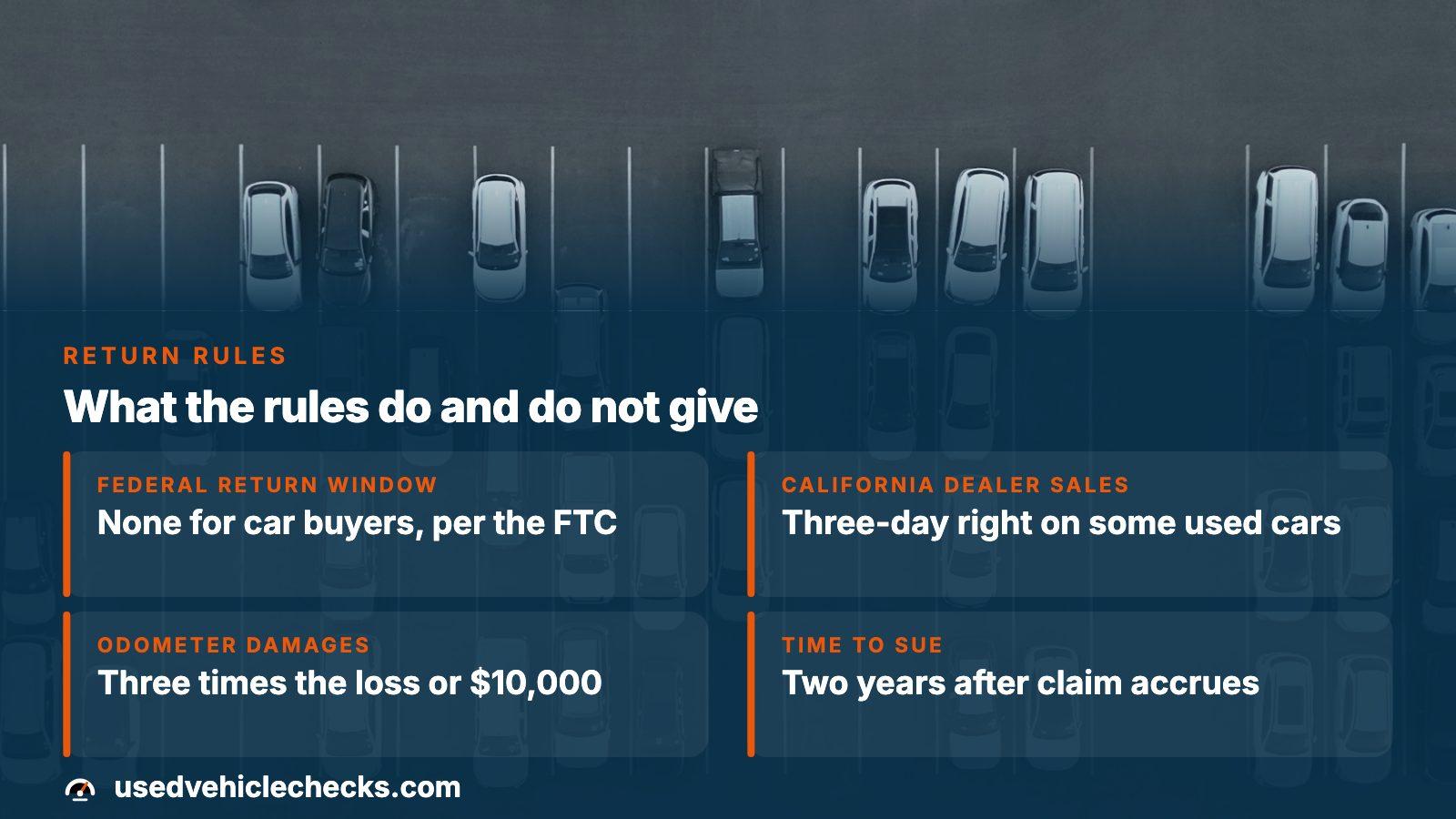
- Federal return window
- None for car buyers, per the FTC
- California dealer sales
- Three-day right on used cars of $50,000 or less since Oct 1, 2026
- Odometer damages
- Three times the loss or $10,000, whichever is greater
- Time to sue
- Two years after the claim accrues
Why the three-day myth does not cover cars
The myth borrows from the FTC's cooling-off rule, which is real. It gives you until midnight ending the third business day, Saturdays included, to cancel certain sales made at home, at work, in a dormitory, or at a seller's temporary spot such as a hotel room, fairground or restaurant.
Cars sit outside it twice over. Deals closed after negotiating at a seller's fixed business address are excluded. So are motor vehicles sold at a temporary location by a seller with a permanent business location elsewhere, and both facts must hold. A tent event run by a dealer with a permanent lot gets no cooling-off right either.
The FTC's page on buying from a dealer gives the plain version: federal law places no duty on dealers to offer three days to cancel.
Four places a way out can come from
With no federal clock running, any exit lives in the deal itself or in state law.
| Source | When it exists | What to confirm |
|---|---|---|
| Dealer's return policy | Only if the dealer offers one, often called money-back or no-questions-asked | Days, miles, fees, and a written copy |
| State law | Some states require dealers to allow cancellation; others do not | Your attorney general's current rules |
| Financing condition | The dealer can cancel if it cannot place your loan | Clauses headed conditional delivery or financing approval |
| Misstated mileage | Not a return right but a damages claim under federal odometer law | Title, odometer statement, dated readings |
A promise made across the desk is the weakest of these, since the FTC warns that spoken assurances are hard to enforce. The federal guidance covers dealers; in a private sale, start from what the seller signed then ask the state attorney general's office what else applies.
California's three-day right, in force since October 2026
California changed course on October 1, 2026. Under the Combating Auto Retail Scams Act, a licensed dealer's retail sale of a used vehicle priced at $50,000 or less carries an automatic three-day cooling-off right, replacing the earlier paid option that gave two days. It covers light-duty vehicles under 10,000 pounds; wholesale, fleet and auction sales are exempt. Older articles describing the two-day option are out of date for these sales.
Read two details. The DMV's dealer notice makes the right subject to mileage and condition requirements, so extra miles or damage may sink a return. And the agencies count differently: the DMV says business days, while the consumer agency's announcement says calendar days, and a refund reduced by a reasonable restocking charge. Ask the dealer to write the final day on your copy.
Why mileage works like a second clock
Days are half a return window. California's right turns on mileage and condition, and any written policy deserves the same questions: how many days, how many miles, what fee, what condition. Your baseline is the dash reading on delivery day, so photograph the display before you leave and save the listing's mileage claim that same day.
The other number is the VIN's history. UsedVehicleChecks offers a free preview of a VIN, and the full report, bought once, lists odometer readings by date, which shows whether the climb is steady or a lower figure follows a higher one. Check before paying, while walking away costs nothing.
When the mileage was wrong: a damages claim, not a return
Federal odometer law lets a private person sue over a violation committed with intent to defraud. Under 49 U.S.C. 32710 the buyer can recover triple the actual loss or $10,000, whichever is larger, and must sue within two years of the claim accruing. A winning buyer also has costs and attorney fees paid.
That is money, not a reversal, and intent must be proven. A lawyer will want the odometer statement, the title and dated readings.
From an NHTSA owner complaint
A buyer picked up a 2018 Chevrolet Equinox from a private seller with 75,000 miles showing. Registration later turned up a recorded 252,000. The complaint is labeled odometer fraud and does not say whether the seller took the car back.
The gap surfaced at the registration counter, after the money had moved. Compare the display, the title and recorded readings while the seller is still across the table.
As-is labels, implied warranties and the Buyers Guide
Every used car a dealer offers must carry a Buyers Guide, and you are handed a copy after the sale; motorcycles and most recreational vehicles are exempt. Warranty terms you negotiate have to be written onto it, and the Guide overrides the sales contract.
- As is: repair bills land on you, not the dealer.
- Warranty box checked: the Guide states the share of repair costs the dealer pays.
- No written warranty and not sold as is: implied warranties apply, and the FTC says they may run as long as four years, with the length varying by state.
A warranty settles who pays for repairs. Whether the sale can be reversed is a separate question.
When the dealer says the financing fell through
With spot delivery you drive home before the dealer has handed your loan to a lender, and the dealer can still back out within days if none will take it. If it wants the car back, the FTC says it generally owes you the down payment, trade-in and anything else you handed over.
The FTC has also alleged that some dealers called buyers, claimed the financing had collapsed, and pushed replacement paperwork with worse terms. In one consumer story on its site, a buyer refused the higher rate and said he would contact the attorney general; the dealer cancelled, and the new car went back while his old one came home.
Ask before signing whether the deal is final, and get the answer in writing.
A first-week routine if you already own the car
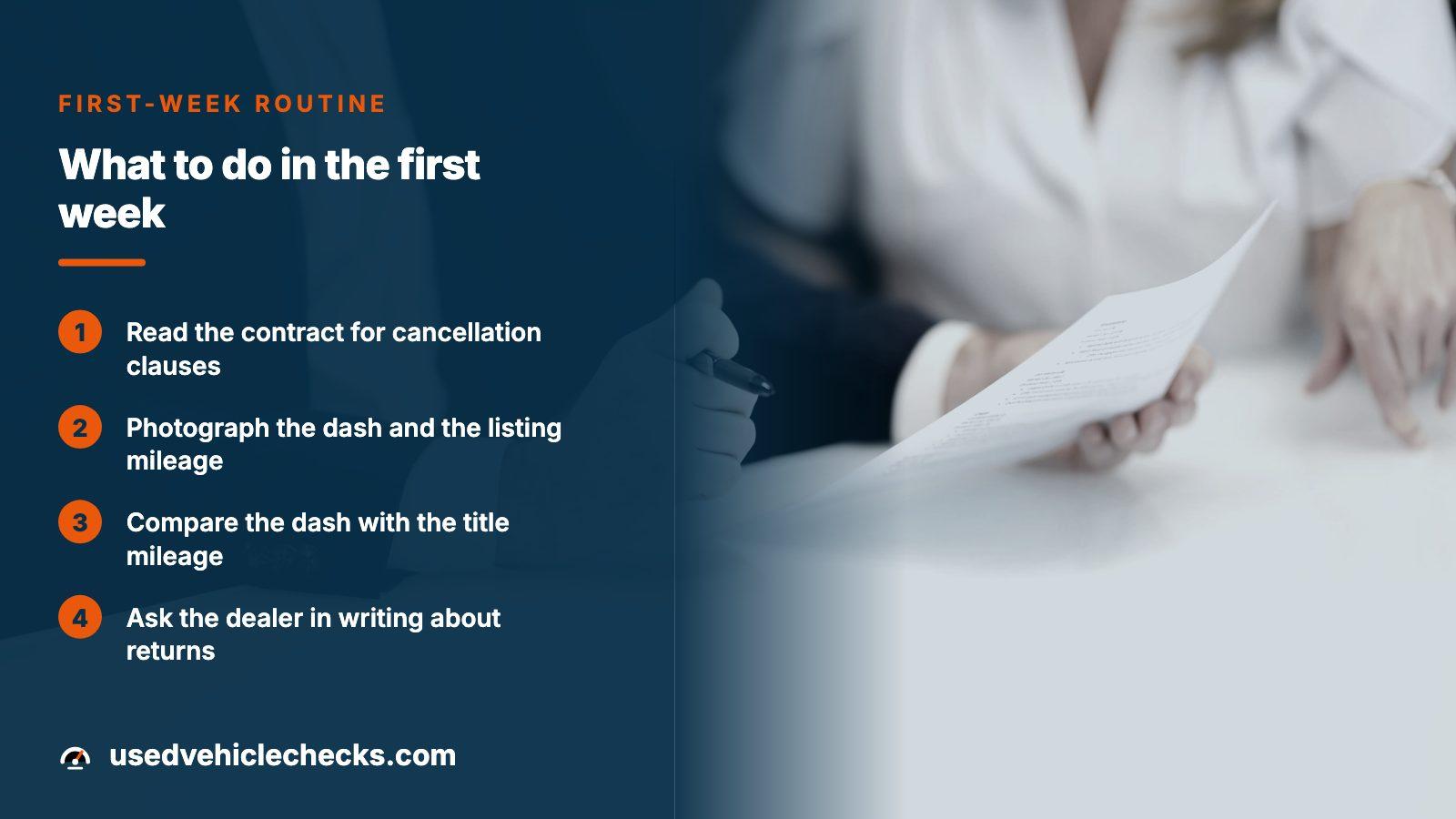
- Read the bill of sale and contract for any cancellation clause, return policy or financing condition, and photograph every page.
- Photograph the dash reading and keep the listing's mileage claim next to it.
- Compare the dash with the mileage printed on the title; the two should agree.
- Run the VIN for a free preview from UsedVehicleChecks, and buy the report if you need the dated odometer readings.
- Ask the dealer in writing whether any return right applies and what the last day is.
- Drive only what you must until you have an answer, since a mileage limit may apply.
If the readings disagree, keep every document and speak with a consumer attorney or your state attorney general's office before deciding anything.
Where this information comes from
- FTC: Buying a used car from a dealer — Backs the missing federal window, return policies, the Buyers Guide and implied warranties.
- FTC: Buyer's remorse and the Cooling-Off Rule — Backs the covered places, the vehicle exclusion and the business-day count.
- California DMV: OLIN 2026-10, CARS Act — Backs the three-day right, the price ceiling and the mileage and condition limits.
- California Business and Consumer Services Agency: CARS Act in effect — Backs the calendar-day wording and the restocking fee.
- GovInfo: 49 U.S.C. 32710, civil actions by private persons — Backs the intent requirement, the damages formula, the deadline and the attorney fees.
- FTC: Deal or no deal, yo-yo financing tactics — Backs spot delivery and what a dealer owes when it cancels.
- NHTSA owner complaint 11732694 — owner experience, paraphrased
Sources and photos: Facts checked against the sources above in November 2026. Photos by Derek Nelson, Carrie Allen www.carrieallen.com and Iain on Unsplash; diagrams by UsedVehicleChecks.
Keep reading
- Mileage Check by VIN: What the Recorded Odometer Readings ShowThe check that lists recorded odometer readings by VIN before you pay.
- Odometer Discrepancy Check: Find a Mileage Mismatch Before You PayHow to line up the dash, the title and the records when the numbers disagree.
- Financing fell throughWhat the contract paperwork carries when the lender says no.
- How to Buy a Used Car: Start With the Mileage, Then the RecordsThe checks that make a return unnecessary.
Frequently asked questions
Is there a three-day window to return a used car?
Not under federal law. The FTC says dealers have no duty to offer one, and the cooling-off rule excludes dealership purchases. Look at the dealer's written policy, your state's rules and any financing condition. California adds a three-day right on dealer sales of $50,000 or less.
Does the FTC cooling-off rule apply to car dealerships?
No. It excludes sales closed after negotiating at a seller's fixed premises, and motor vehicles sold at temporary locations by a seller with a permanent location. For such a dealer, the showroom, the hotel event and the tent sale are all outside it.
What if I bought the car as is and it breaks down?
As is leaves repair costs with you, so read the contract first. If the Buyers Guide shows no as-is mark and no written warranty, implied warranties apply, lasting as long as four years depending on the state. That is a repair matter, separate from returning the car.
Can a used car be returned if the odometer was rolled back?
Not automatically. A buyer can sue when a seller acted with intent to defraud and recover the larger of $10,000 or triple the loss, if filed within two years. Whether the sale itself is reversed depends on the contract, your state and the court, so see a consumer attorney.
Do I have to sign new terms if my financing was not approved?
The FTC has challenged pressure to sign a replacement contract as deceptive. If the dealer cancels and takes the car back, it generally must return your down payment and trade-in. Ask in writing whether the original deal is final, and read any new rate and payment before signing.
Now check the car itself
The guide explains what to look for. The report shows what this VIN has on record.