THE SHORT ANSWER
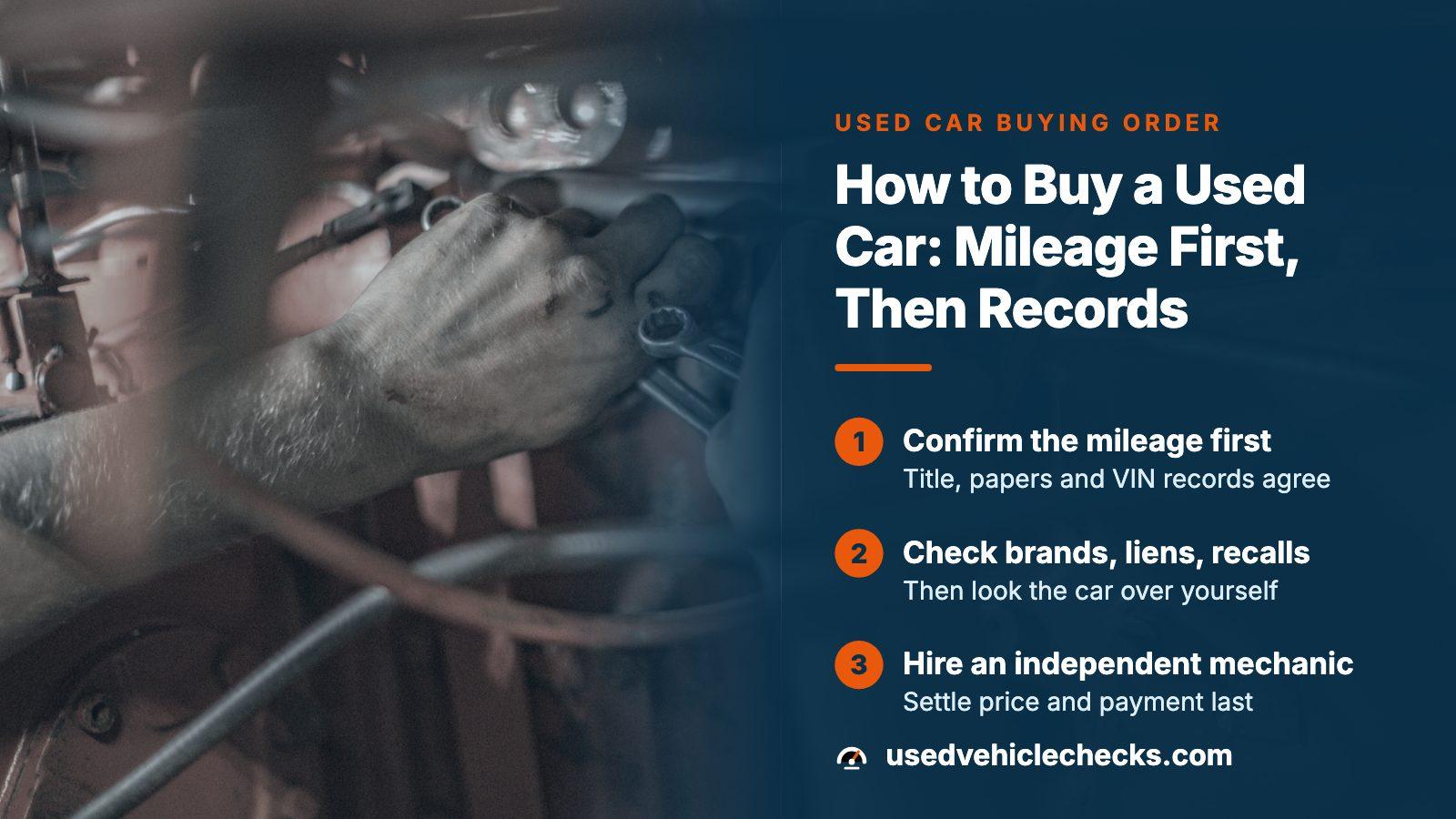
Buy a used car in this order: confirm the mileage against the title, the maintenance papers and the records tied to the VIN; check brands, liens and open recalls; look the car over yourself; have an independent mechanic inspect it; then settle price, payment and contract. Federal law does not hand you a cooling-off period on a dealer sale, so the signature is the one step you cannot count on undoing.
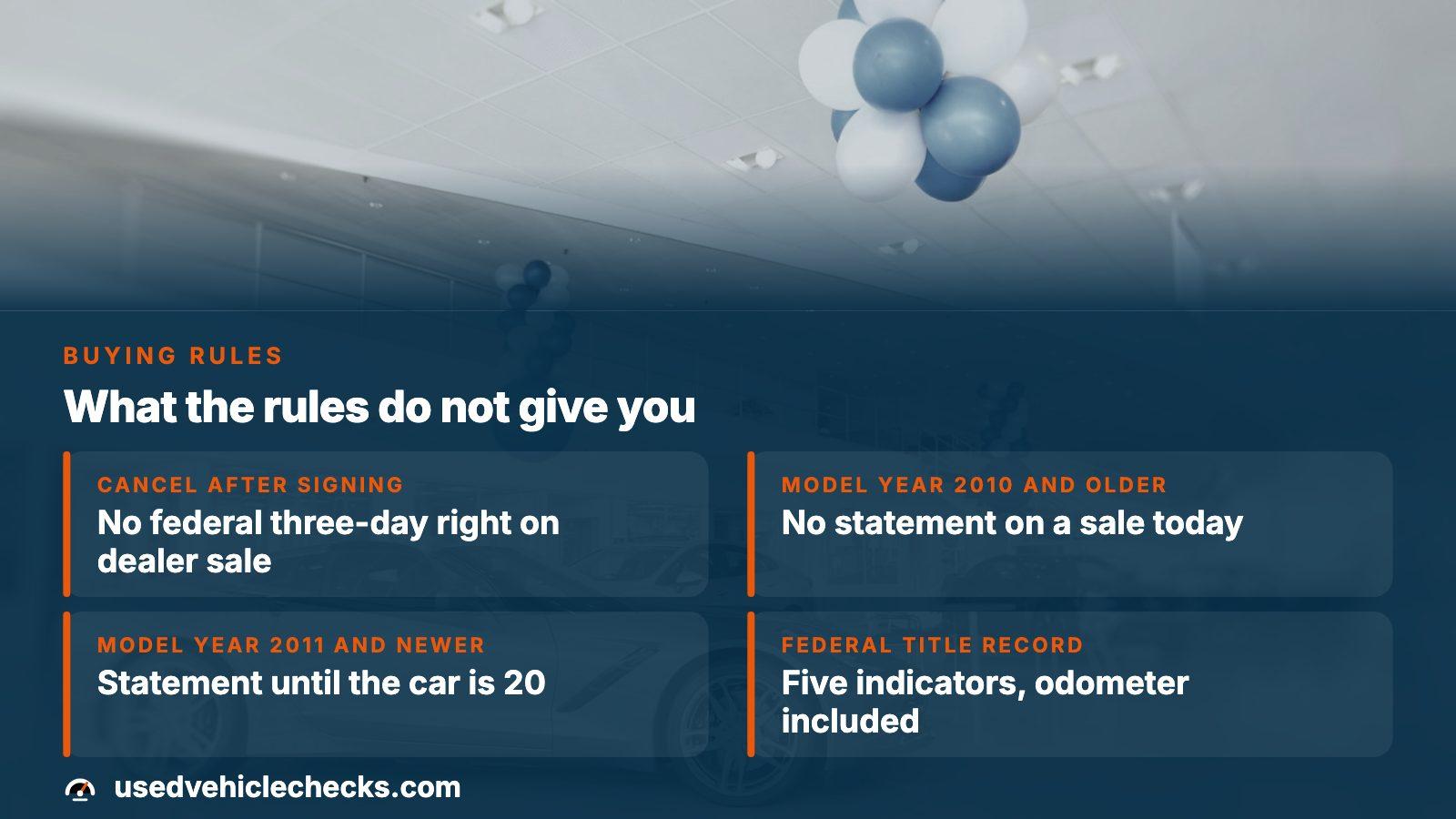
- Cancel after signing
- No federal three-day right on a dealer sale
- Model year 2010 and older
- No mileage statement needed on a sale today
- Model year 2011 and newer
- Statement needed until the car is 20 years old
- Federal title record
- Five indicators, odometer among them
Why the odometer reading goes first
UsedVehicleChecks starts every purchase with mileage because the reading drives the rest of the decision. It sets the asking price, tells you how much wear to expect on the pedals, seat and tires, and shows which services the car is due for. If the figure is wrong, each later judgment is wrong with it.
It is also the one number you cannot judge by looking at it. A modest dash reading proves nothing until a second source agrees.
Collect the paper before you travel
Ask for these before you agree to a visit. A seller who sends them quickly has saved you a trip; one who stalls has told you something.
- The VIN, typed out, so you can pull records and compare the listing's trim and engine with the factory build.
- Clear pictures of both sides of the title, with the mileage line legible.
- Maintenance receipts that show a date and an odometer figure on each one.
- The seller's name and address as they appear on the title.
Read the title line closely. Under the federal odometer rule, 49 CFR 580.5, the prior owner enters the mileage on the title at each transfer, signs it, prints a name and adds the date. One of three declarations goes with it: the reading is accurate, the dial has passed its mechanical limit, or the figure cannot be relied on. A blank, a smudge or the third choice is a question to settle before money moves.
Which cars come with a mileage statement at all
Not every sale includes one, and the cheaper cars are the likeliest to lack it. The age cutoffs in 49 CFR 580.17 work like this:
| Vehicle | Statement on a sale | What to lean on instead |
|---|---|---|
| Model year 2010 or older | None needed once the car has reached 10 years, counted from January 1 of its model year, which is every sale today | Dated records and a mechanic's read of the wear |
| Model year 2011 or newer | Needed until the car reaches 20 years, counted the same way | The completed statement, read field by field |
| Over 16,000 pounds GVWR | Exempt at any age | Service and registration history |
Dealers must keep each statement they issue or receive for five years.
Test the dash against a second source
Line up every dated reading you can find and look for a line that only rises. A reading that drops, or a leap too big for the time between two dates, is the warning. Sources include the title, service receipts and the federal title database, which carries the latest reported odometer reading beside brands, total-loss and salvage entries. It does not carry repairs, recalls or maintenance.
From an NHTSA owner complaint
An owner who bought a 2008 Honda Accord in a private sale found a receipt inside the car while cleaning it. The receipt put the mileage at 233,553, and the dash had shown 130,000 at purchase. A history report later gave 290,000, the seller blocked the owner's calls, and the police offered no help.
Paper that contradicted the dash was in the car all along, and nobody asked for it before the money changed hands. A UsedVehicleChecks report lists dated odometer readings for the VIN to set beside the dash. The preview costs nothing; the report is paid for once, with no subscription.
The other records that sit beside the mileage
Once the mileage story holds up, pull the records that answer different questions. No single lookup covers all of them, and any one can end a purchase.
| Record | Question it answers | Why it comes before payment |
|---|---|---|
| Title brands | Has a state labeled the car salvage, flood or junk? | The label follows the car into other states |
| Liens | Does someone else hold an interest in the car? | A lien outlives many other problems and is cheap to find early |
| Total loss and salvage | Did an insurer write the car off? | Value drops whatever the car looks like now |
| Open recalls | Does the maker owe a repair? | It is a price conversation, not a reason to walk |
| Factory build | Do trim, engine and body match the listing? | A mismatch costs nothing to find and ends the talk early |
Start with NHTSA's recall lookup, which costs nothing; NICB's database also takes a VIN and covers flood damage. A record shows what someone filed, not what happened: a crash with no insurance claim leaves no entry, and a flooded car with no insurer behind it may carry no brand.
What records cannot see: ten minutes at the car
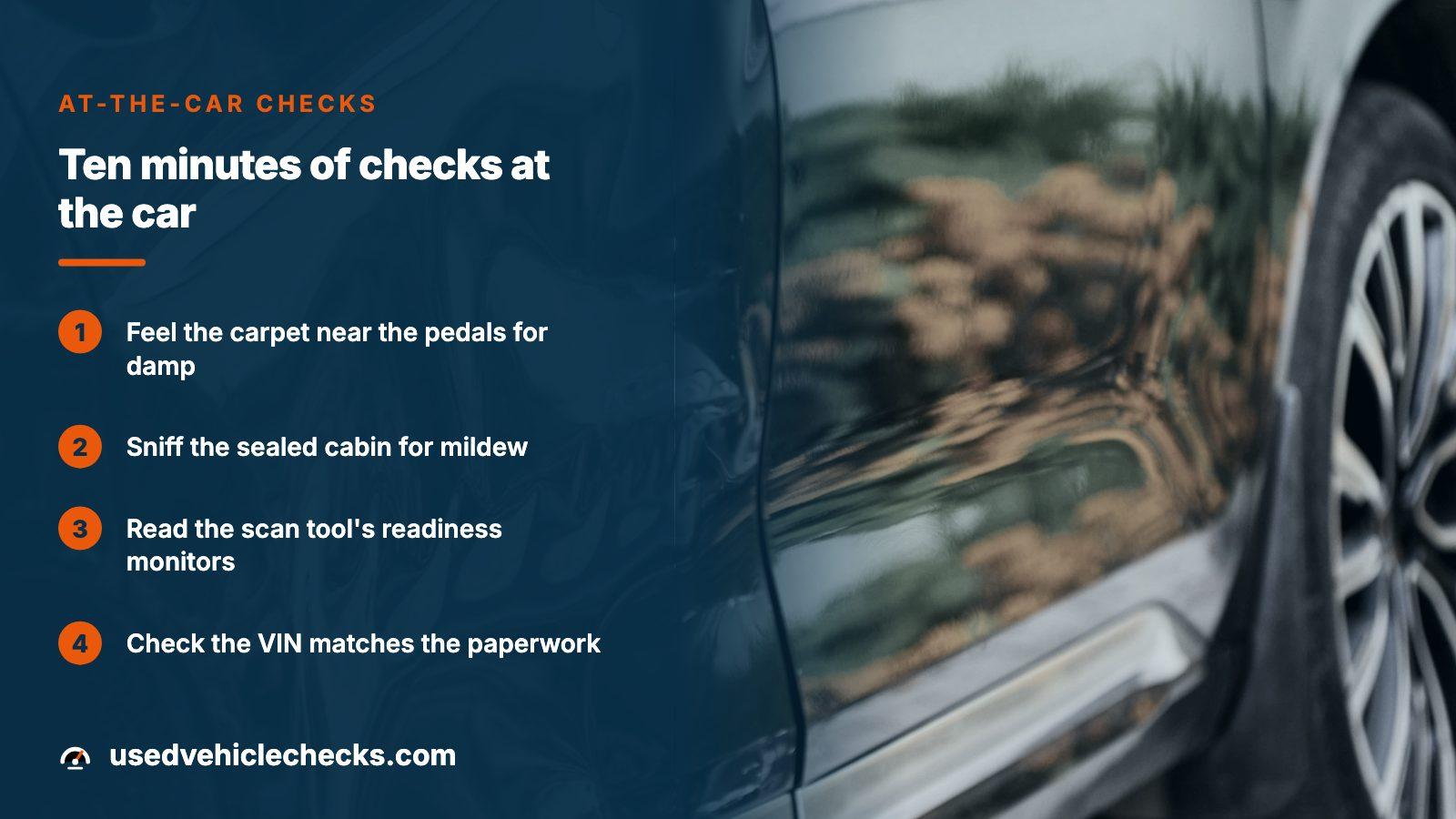
The undocumented half of a car's life shows up only in person. Bring a phone with the VIN records open, a flashlight and an inexpensive scan tool, then work through this list:
- Lift the carpet near the pedals and feel the padding for damp, silt or a tide line.
- Keep the cabin sealed for a spell, then put your nose near the driver's footwell as you open the door.
- Plug in the scan tool and read the readiness monitors, which show whether codes were cleared recently.
- Run every window, seat, wiper speed and light, and treat anything that cuts in and out as a real fault.
- Check that the VIN on the car itself agrees with the one on the title and in the records.
- Look at the pedals, seat edge and steering wheel and ask whether they fit the number on the dash.
Then drive it somewhere that tests it: a hill, a stretch of highway and some stop-and-go traffic.
Hire your own mechanic, not the seller's
The FTC advises against treating a history report as the inspection itself, even on a certified car. Ask the mechanic to put the VIN and a repair estimate on paper, then use that estimate in the price talk. If a dealer refuses every independent inspection, the FTC suggests shopping elsewhere.
From an NHTSA owner complaint
A buyer of a 2009 Honda Accord, bought in a private sale through Facebook Marketplace, took it to an independent mechanic afterward. The dash had shown about 147,000 miles. The mechanic found a large mileage discrepancy, and the owner's complaint puts the real figure at 252,000.
The inspection caught the problem, but only after the sale. Booked first, the same visit costs an inspection fee instead of the price of the car. Ask the seller to allow it before you drive over, and treat a refusal as an answer.
Price, payment and signature come last
These steps are hard to reverse. Federal law does not give you three days to cancel a dealer sale. Some states add a cancellation right and others offer one only if the dealer does, so get the return policy in writing and ask your state attorney general what applies.
- Get the out-the-door price written down, and decline add-ons such as gap insurance or VIN etching unless you want them. Extras like these can run to thousands of dollars.
- Read the Buyers Guide posted in the car. It says whether the sale is as is or under warranty, and any change you negotiate must be written onto it.
- Judge a loan by the down payment, term, APR and total cost, not the monthly figure.
- Size any deposit so that leaving remains easy.
A seller who insists you decide today has handed you a reason to stop.
Where this information comes from
- FTC: Buying a used car from a dealer — Buyers Guide, inspection advice, add-ons, financing and the lack of a federal cancellation right.
- FTC: What to know when buying a used car online — Where to start with free title and odometer information, and where to report a dishonest dealer.
- eCFR: 49 CFR part 580, odometer disclosure — What the title statement must show, the age exemptions and the five-year dealer record rule.
- NMVTIS: Used car buying tips — Test drive conditions, maintenance records and the independent inspection.
- NMVTIS: Understanding a vehicle history report — The five indicators in the federal title record and what it leaves out.
- NHTSA owner complaint 11756938 — owner experience, paraphrased
- NHTSA owner complaint 11729650 — owner experience, paraphrased
Sources and photos: Facts checked against the sources above in November 2026. Photos by Nina Mercado, Maxim Tolchinskiy and Richard R on Unsplash; diagrams by UsedVehicleChecks.
Keep reading
- Mileage Check by VIN: What the Recorded Odometer Readings ShowHow to test the dash against dated readings for one VIN.
- Odometer Rollback Check by VIN: Run the Mileage Test Before You PayWhat a rolled-back reading looks like in the records and on the car.
- Can I Return a Used Car? What the Rules Allow and Why Mileage MattersWhat the federal rules do and do not let you cancel.
- Lien Check Through the DMV: Seven Steps, Mileage Line IncludedWhy the lien check belongs before the money moves.
Frequently asked questions
What is the first thing to check when buying a used car?
The mileage. Compare the dash with the title, dated service receipts and any odometer entries tied to the VIN. If they disagree, ask the seller to explain in writing before you spend time on test drives or financing.
Is a vehicle history report enough on its own?
No. The federal title record covers five indicators and leaves out repairs, recalls and maintenance, and every record only reflects what someone filed. Use a report to screen cars, then let a mechanic test the one you want.
Can I return a used car after I buy it?
Not as a federal right. The FTC says some states require a cancellation right on dealer sales. Where none applies, you have the contract and the dealer's written return policy, so read both before signing.
Should I avoid a car with a high odometer reading?
Not automatically. A high figure that the title, receipts and records all support is a priced fact, and it should lower the offer. A low figure that nothing supports is the bigger risk.
What should I do if I think the odometer was rolled back?
Hold on to the signed title, bill of sale and every record that contradicts the dash, and ask a mechanic to document the wear. If a dealer was involved, the FTC says to report it through its fraud site and to your state attorney general.
Now check the car itself
The guide explains what to look for. The report shows what this VIN has on record.