THE SHORT ANSWER
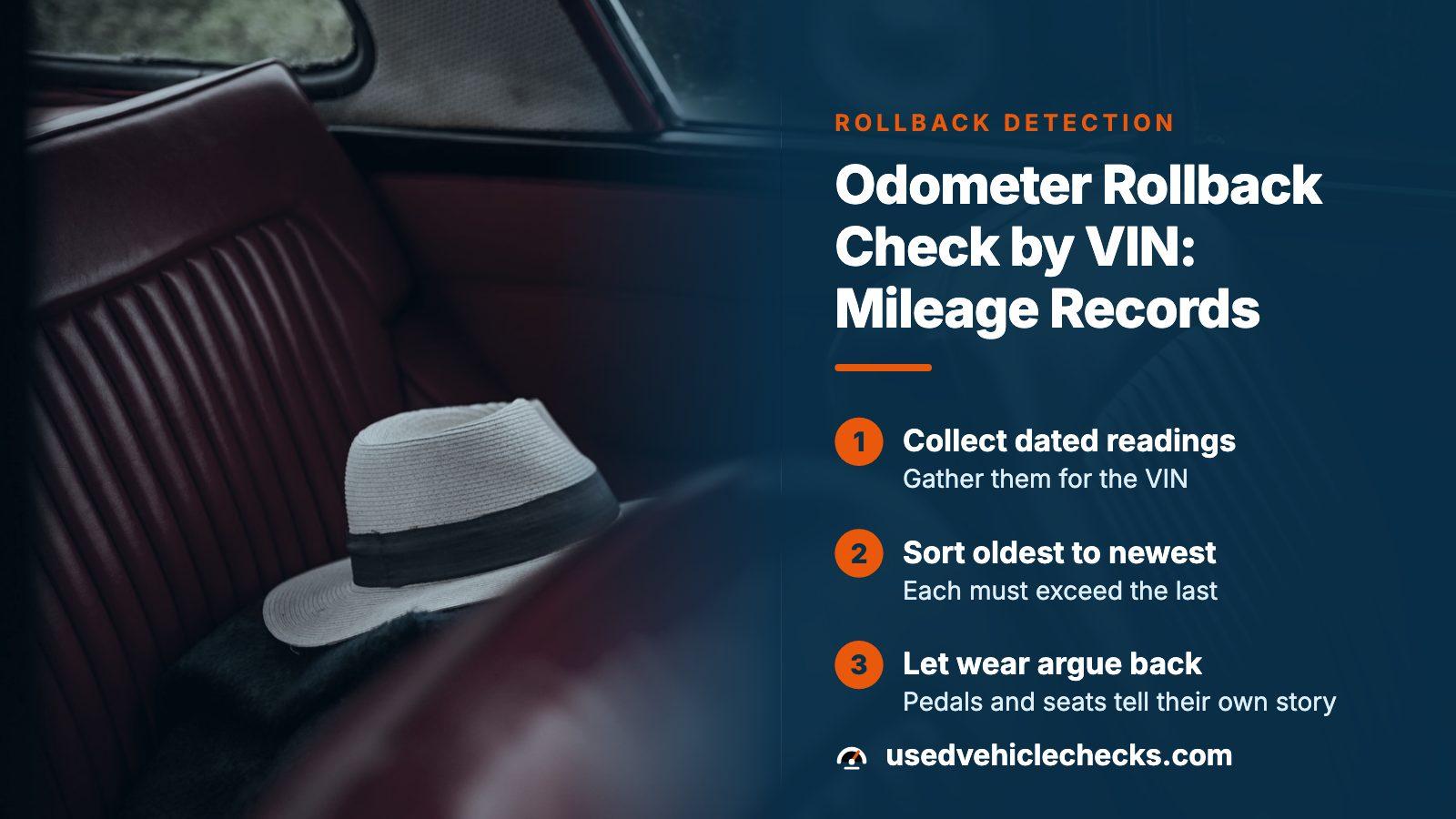
To check a car for odometer rollback, collect the dated mileage readings on record for its VIN, put them in order from oldest to newest, and confirm each one is higher than the last. A reading above today's display, or a jump no driver could have covered in the time, is documented evidence that the dash number was changed. The preview is free; the report is one payment.
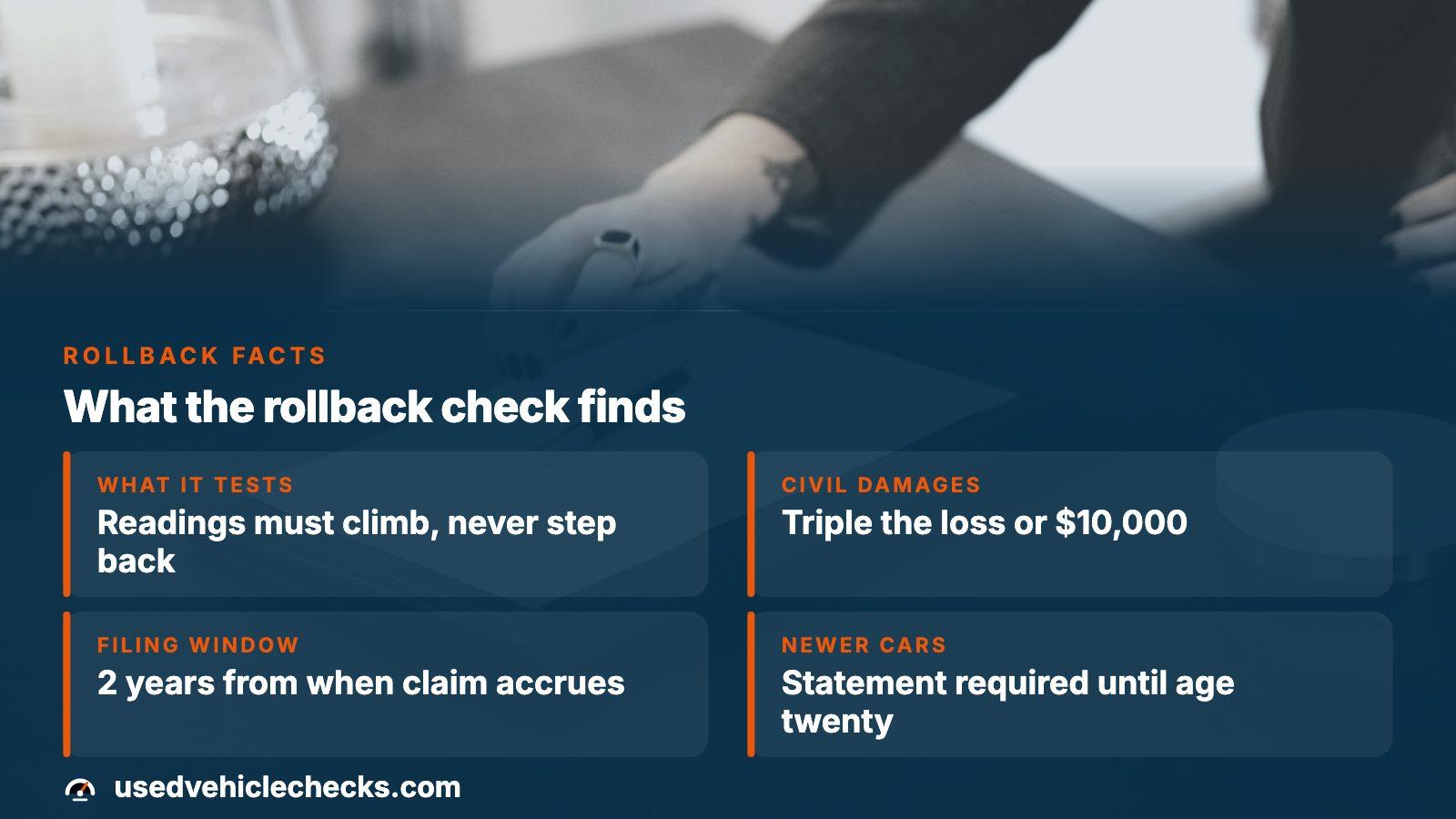
- What it tests
- Dated readings must climb, never step back
- Civil damages
- Three times actual loss or $10,000, if higher
- Filing window
- 2 years from when the claim accrues
- Newer cars
- Statement required until age twenty (model year 2011 and newer)
What the mileage check finds, and what it cannot
UsedVehicleChecks reads mileage before anything else on a used car, because price, wear and loan terms all rest on it. The check lists the odometer readings on record for the VIN with their dates, and an odometer rollback checker is that list in order. A rollback appears where the sequence stops climbing.
- Finds: an earlier reading higher than the number on the dash today.
- Finds: readings that stay flat across several events, which can mean a dead or disconnected odometer.
- Finds: a jump between two dates too large for the time between them.
- Cannot find: a rollback made before the first reading was recorded, or inside a long gap with no readings.
How to run it, starting at the VIN on the car
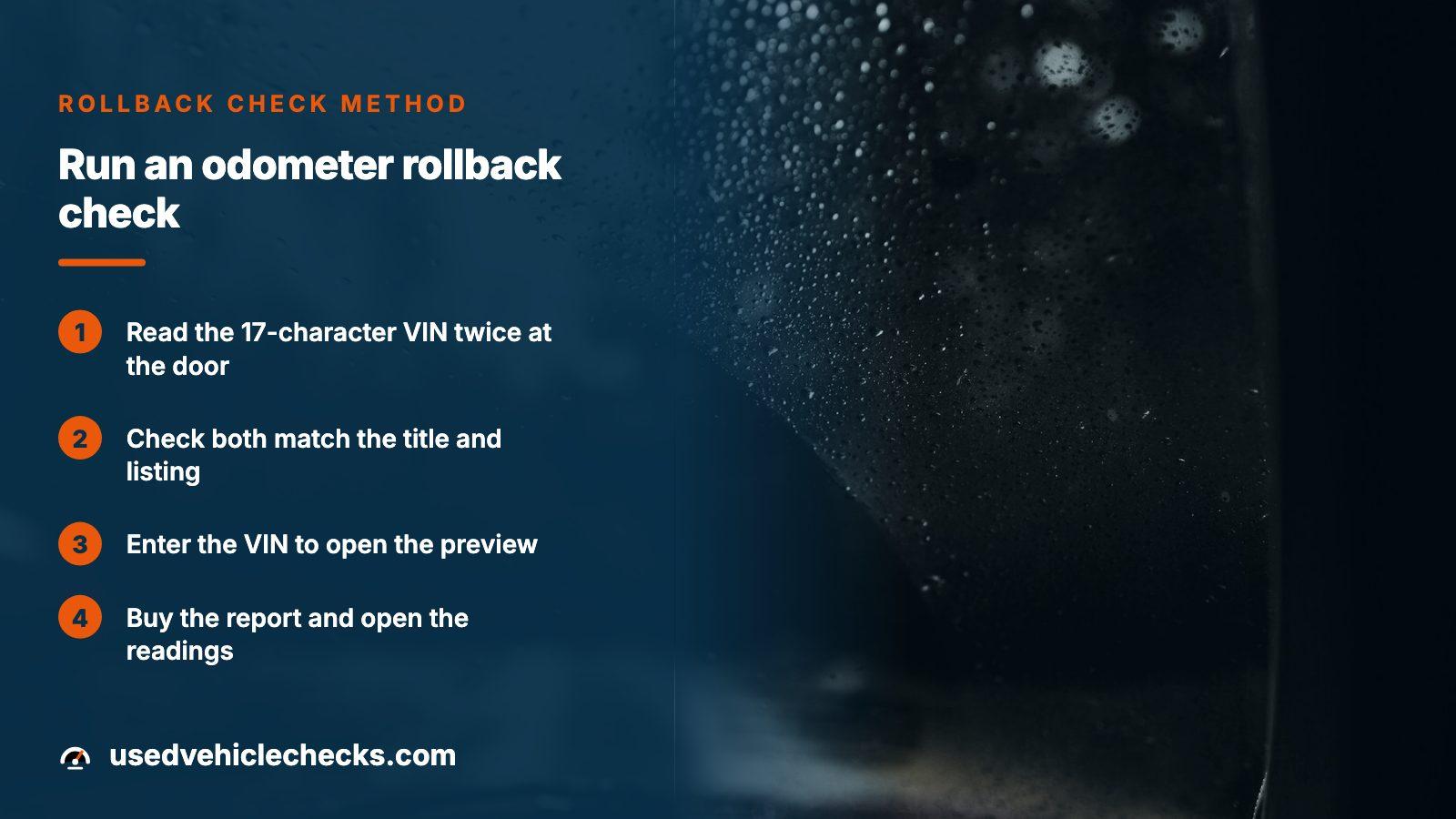
- Stand at the driver's door and read the 17-character VIN twice: once through the glass on the dash plate, once on the sticker in the door opening.
- Check that both match the VIN on the title and in the listing. A mismatch is a reason to stop before mileage even matters.
- Enter the VIN in the form on this page to open the free preview.
- If the car is still in the running, buy the report and open the odometer readings first, then read the title, accident and salvage records against them.
Do it before the test drive. Screenshot the mileage the seller advertised beside the readings, since listings get edited once a buyer starts asking questions.
Why some cars show only a few readings
A short list is not a clean bill. The national title record must show the mileage disclosed when a title was issued, while anything later depends on whether the state wrote it down. So one car carries a single dated reading per transfer and another, titled elsewhere, carries several. That difference comes from state record keeping, not from the cars. With fewer readings a rollback has more places to hide, so lean on the wear checks below.
Five patterns in the readings and what each one suggests
| Pattern in the readings | What it usually means | Your next move |
|---|---|---|
| Each reading a little above the last, at a believable pace | The display agrees with the record | Go on to wear and inspection |
| An earlier reading above today's display | Tampering, or a replaced cluster nobody disclosed | Ask for an explanation in writing; walk away unless an invoice records the mileage at the swap |
| A huge jump between two close dates | Heavy commercial use, or a mistyped entry | Check the use type and ask for service records |
| Readings that never change across several events | A stopped or disconnected odometer | Ask whether the title says True Mileage Unknown |
| A long gap with no readings | Stored, unregistered, or a state that wrote little down | Ask for service invoices that cover the gap |
Judge pace against use. A typical American driver covers about 12,000 miles a year, a fleet car can run at triple that, and a garage queen at a tenth. A big number is not a rollback; a number that contradicts the record is.
Let the rest of the report cross-examine the mileage
A mileage list is stronger when the other records back it or argue with it.
- Title brands: a salvage, rebuilt or similar brand on a car with surprisingly low miles deserves the hardest look at the readings.
- Accident and damage records: a repair dated near a mileage oddity may be the innocent explanation, so ask for the invoice.
- Salvage and auction history: each entry is a dated event, so any mileage noted with it joins your list. If a photo shows the instrument cluster, compare it.
- Ownership and use type: commercial driving explains a steep climb; private use with the same slope does not.
- Insurance, theft and market value: claims and thefts are dated moments that should fit the story, and a car priced for a low display is where a rollback pays.
Wear that argues with the display
The car itself catches contradictions in wear, and some parts are harder to fake than a number.
- Pedal and steering wheel rubber worn smooth on a car showing 45,000 miles.
- A sagging driver's seat bolster and carpet worn through at the heel.
- Four new matching tires on a car sold as low mileage; ask what became of the originals.
A dealer or specialist with a factory-level scan tool can also read mileage stored in other control modules, which on some cars disagrees with a dash that was changed alone. It costs a diagnostic hour and is worth ordering when the readings are thin.
What federal odometer law says, and the two-year window
Federal law makes anyone transferring a car give the buyer a written mileage statement, or a written note that the actual mileage is unknown when the seller knows the reading is wrong. That covers private sellers as well as dealers. Resetting or altering an odometer to change what it reads is banned, and so is advertising, selling or fitting a gadget whose purpose is to make one misreport.
A knowing and willful violation is a crime carrying up to 3 years in prison. A buyer who proves intent to defraud can sue for three times the actual loss, or $10,000 if that is higher, and a winning buyer also recovers court costs and attorney fees. The deadline to sue is 2 years from the point the claim accrues, so see a consumer attorney promptly.
Exempt cars, replaced clusters and the TMU label
| Situation | What the paperwork should show |
|---|---|
| Model year 2010 or older | Older rule: no statement once the car is ten years old, so a missing one is lawful, not a clue |
| Model year 2011 or newer | Statement required until the car is twenty years old, effective January 1, 2021 |
| Odometer repaired, mileage kept | Nothing unusual; the reading is the same before and after |
| Cluster replaced, mileage lost | Odometer set to zero and a written notice on the left door frame giving the old mileage and the date |
| Actual mileage unknown | Written disclosure at transfer; True Mileage Unknown on the title or listing |
A new cluster with no door-frame notice deserves questions, and removing or altering that notice with intent to defraud is itself banned. TMU lowers value but is honest; trouble starts when a car with a known odometer fault carries an unqualified number.
Cost, and what to do once you have the readings
The preview is free and commits you to nothing. After that the report is a one-time purchase, with 3, 5 or 10 available at once for buyers comparing several cars. There is no subscription, and the amounts are on the pricing page.
If the readings contradict the display
Before buying, walk away and keep a screenshot of the listing and the dated readings. After buying, keep the title, listing and readings together and contact a consumer attorney quickly because of the two-year window. NHTSA and your state attorney general both take odometer fraud complaints.
Where this information comes from
- NHTSA: changes to odometer disclosure requirements — Backs the move from a ten-year to a twenty-year exemption for model year 2011 and newer, effective January 1, 2021.
- NHTSA: odometer fraud — The federal program page and the route for sending a complaint.
- U.S. Code, Title 49, Chapter 327: Odometers — Statute text for the disclosure duty, the tampering ban, the penalties, the private damages claim and the door-frame notice.
- NMVTIS: national title record — The federal title record that carries the mileage disclosed at each title event.
Sources and photos: Facts checked against the sources above in November 2026. Photos by Nik, Justin Cron and Annika Wischnewsky on Unsplash; diagrams by UsedVehicleChecks.
Keep reading
- Odometer Reading: How to Read It, Write It Down and Test ItHow to read the odometer figure itself before you compare it with the records.
- How Many Miles Is Too Many on a Used Car? Age, Pace and ProofOnce the readings are honest, how to judge whether the total is too high for the price.
- Sample reportSee how a finished report lists odometer readings beside title and accident records.
- Can I Return a Used Car? What the Rules Allow and Why Mileage MattersWhat your options are if the numbers fail after the sale.
Frequently asked questions
What is the quickest way to run an odometer rollback check?
Enter the VIN for the free preview, buy the report if the car is still in the running, then list the odometer readings by date and confirm each one is higher than the last. Do it before the test drive and screenshot the readings next to the advertised mileage.
Can an odometer rollback checker tell me the true mileage?
No tool can read the true mileage of a car whose display was changed. A checker shows the readings that were recorded and whether they contradict each other or the dash. A contradiction is solid evidence; a clean list only means no recorded reading disagrees.
Are digital odometers harder to tamper with than the old dials?
Not in any way that helps a buyer. Tools sold for cluster repair can rewrite a modern display in minutes, which is why dated records carry more weight than the screen. A careless job can leave mileage stored in other modules disagreeing with the dash.
What does TMU mean on a title or listing?
TMU stands for True Mileage Unknown. A seller who knows the reading differs from the miles actually driven must say so in writing at transfer. The label lowers value but is not fraud. If a broken odometer or replaced cluster is the reason, ask for the invoice that records the mileage at that time.
Does a clean mileage history prove the odometer is accurate?
It proves less than people hope. A clean list means no recorded reading contradicts the dash. A rollback made before the first reading, or inside a long gap, leaves nothing to find. Add the wear check, ask for service records and, on a thin record, have a shop read other modules.
Now check the car itself
The guide explains what to look for. The report shows what this VIN has on record.