THE SHORT ANSWER
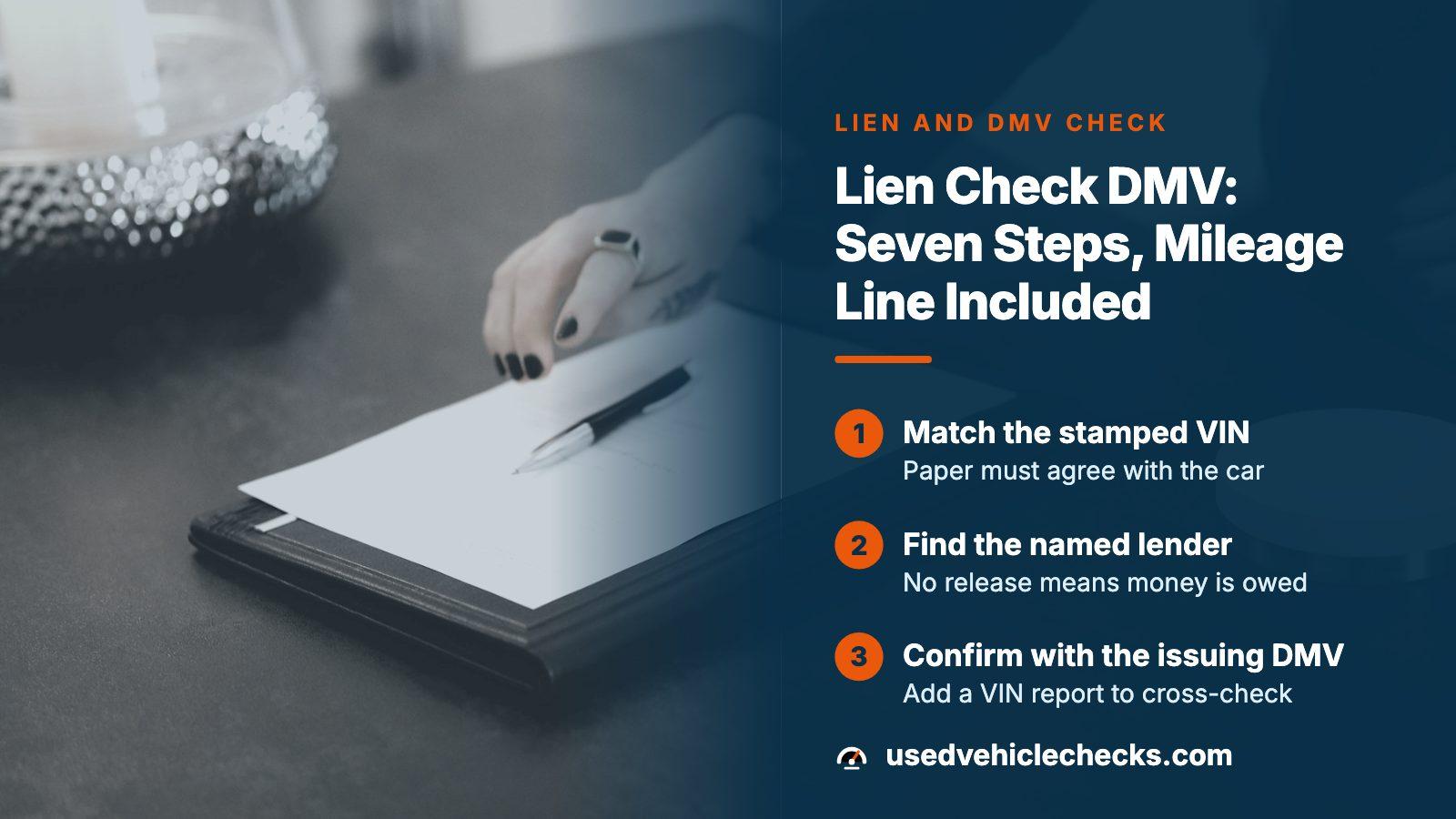
Start at the car: match its stamped VIN to the paper, then see the title and note any lender named on it. A named lender with no release means money is still owed. Confirm with the DMV of the state that issued the title, add a VIN report for lien and mileage entries, and pay nothing until the lender is paid or the title shows no lender.
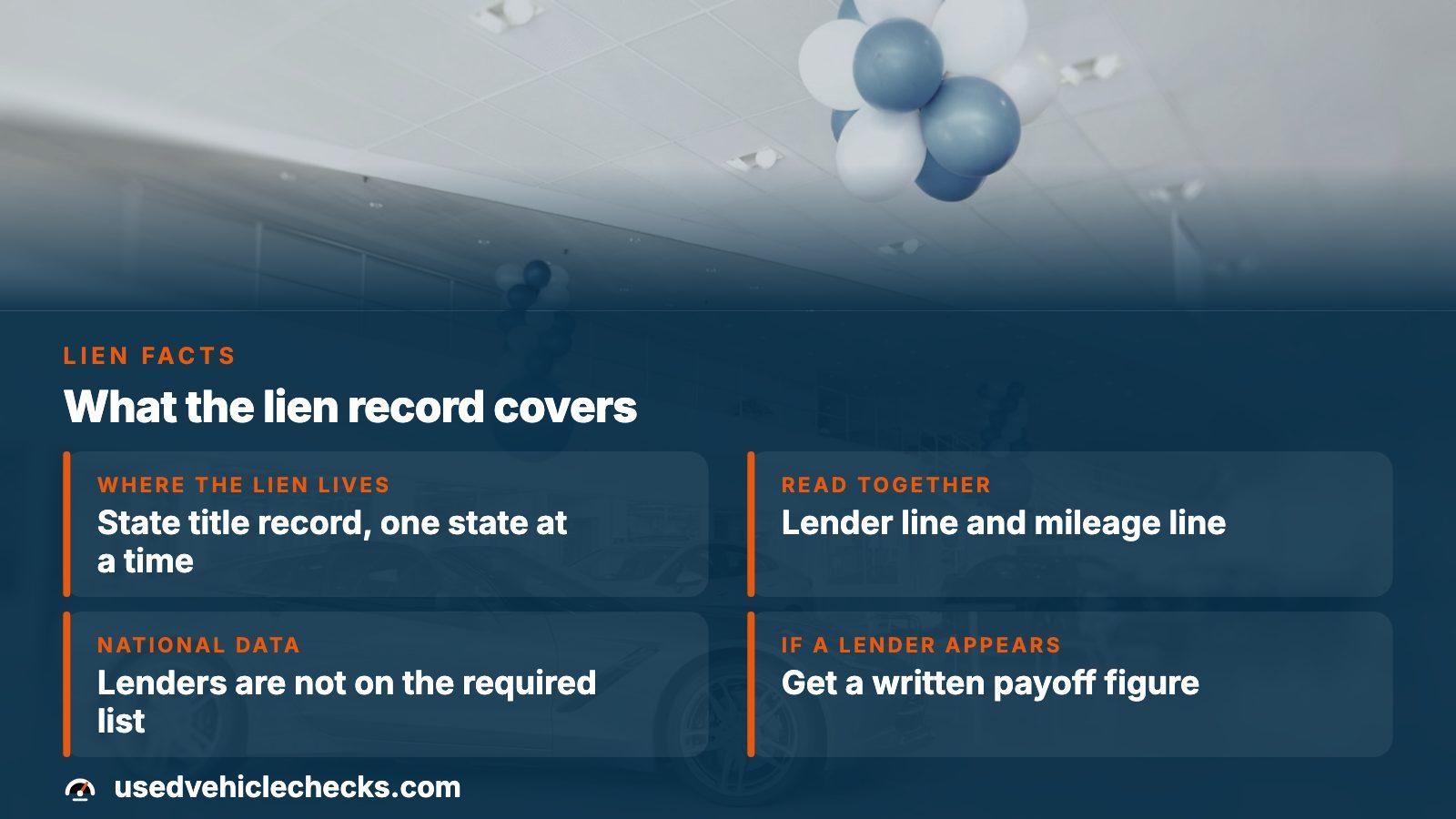
- Where the lien lives
- In the state's title record, one state at a time
- Read together
- The lender line and the mileage line on the same title
- National data
- A lender is not on the list every state must report
What the DMV holds, and what a national search leaves out
A lien is written into the title record of the state that titled the car. California's DMV describes a title that can carry the owner's name, the VIN, the odometer mileage, any brands and the lienholder's details, with a lender listed whenever money is owed. Every state keeps its own file, so no single DMV answers for the whole country.
The national title system is a thinner place to look. Every 24 hours, states must pass along five items: the VIN, brands and other title wording, the party named as titled owner, junk or salvage intake records where collected, and the odometer disclosure with later readings. A lender is not among them. Extra items travel only when the state and the system's operator agree, so a quiet national report proves little about a lien.
The check in seven steps
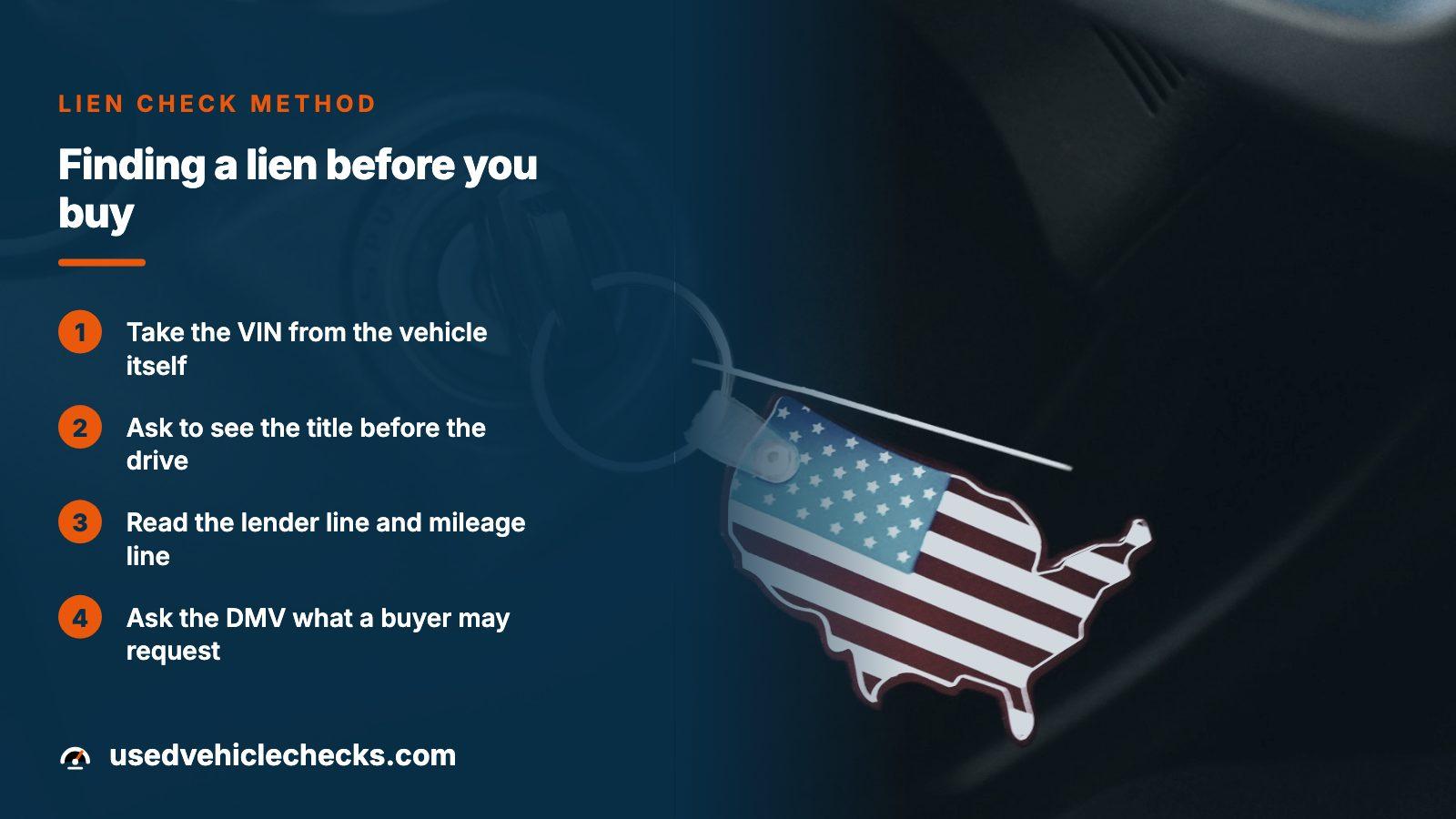
- Take the VIN from the vehicle itself rather than the ad, then hold it against the title and the listing.
- Ask to see the title before the test drive. If the seller's name is absent, stop and find out why.
- Locate the lender line and the mileage line, read them as a pair, and write both down.
- Run the preview on the VIN, buy the report for any car still in the running, and set its lien and odometer entries beside the paper.
- Ask the DMV in the issuing state what a buyer may request, since rules differ.
- Check the names: the title owner, the seller's ID, and the borrower the lender has on file.
- If a lender appears, get a written payoff figure, pay the lender rather than the seller, and wait for the release to reach the record.
Why the lender line and the mileage line travel together
Federal law expects the seller to state the odometer figure in writing at every sale. When a lender is holding the title, the seller has no title to sign, so the law allows a written power of attorney where state law permits. The state issues that form, the mileage goes on it, and the same number must be restated exactly on the new title.
For a buyer, a payoff and a mileage statement can arrive together from the lender's side. Ask to see the form and read its figure against the dash. A seller who knows the odometer is wrong has to say the true mileage is unknown, and that wording on any paper is a reason to cut the offer or walk.
Keep three numbers
Write down the mileage on the title, on the power of attorney if one was used, and on the dash. If they disagree, ask before paying, not after.
Which source answers which question
| Source | On the lender | On the mileage | Where it stops |
|---|---|---|---|
| Paper title in the seller's hand | Names the lender recorded at printing | Last signed statement | Can lag behind a payoff |
| State title record at the DMV | The legal answer on a recorded lender | What the state noted at title issue | What a buyer may see varies |
| National title report | Only where a state chose to add it | Title-issue disclosure and later readings | Silence is not a clean bill |
| The seller's lender | Balance and payoff, in writing | None | Speaks for its own loan only |
| UsedVehicleChecks report | Lien and impound entries | Odometer readings by date | Bought after the preview; no stand-in for the state record or an inspection |
Reading the result: patterns that should slow you down
- A lender is named and no release is attached: treat the car as unsold until that lender is paid.
- The seller says the loan is gone but the lender still prints on the title: ask for the lender's written release and the state's current record.
- The seller's name differs from the owner printed on the title.
- Another state titled the car recently: ask that state's DMV as well as the current one.
From an NHTSA owner complaint
A person selling a 2008 Hyundai Elantra that their mother had bought new told NHTSA that a lender's claim was recorded at the dealer's urging, although the whole price was paid by check and the dealer said it would vanish at once. It surfaced only when a duplicate title was ordered. Removing it ate more than a month and dozens of phone calls, with dealer and lender each denying they added it.
A lender entry nobody can explain is still an entry. Get it cleared and recorded before you pay.
Claims that come from a shop or a tow yard
Not every lien starts with a loan. California's DMV lets a shop that fixed a car, or a tow or storage operator, sell it for unpaid charges, provided the car is physically in its hands. The people on record as owners must be notified and have 10 days to object. Repair shops need a state registration for such a sale.
From an NHTSA owner complaint
An owner of a 2012 Chrysler 200 told NHTSA that a stalled car left beside the road overnight turned up wrecked the next day, in a tow yard. The insurer ruled it a total loss, and the owner had been told the yard was now a lienholder to be paid before any settlement.
These claims depend on the car's recent custody, not a loan record. Ask where it sat last, and for any shop or storage invoice.
When a loan is real: payoff, release and the clean title
A car with a loan can still be bought safely when the lender is paid first. Get the payoff figure in writing, send that amount to the lender, and let only the remainder go to the seller.
Texas sets the lender's release window at 10 days from payment. With a paper title, the owner files Form 130-U at the county tax office along with the title and whatever release the lender issued. With an electronic record, the lender and the state handle it, the owner files nothing, and a paper title is mailed once the release arrives. Other states keep their own timetables, so ask the DMV where the car was titled.
Either way, count the deal as unfinished until the state record, or a newly issued title, shows no lender. Keep the payoff letter and receipt together.
Preview, report and what to do next
Running the preview on a VIN commits you to nothing. A report is a one-off purchase with no renewal, and packs of 3, 5 or 10 reports are there for anyone weighing a short list. The pricing page carries current amounts. Inside the report, lien and impound entries and dated odometer readings give a second reading beside the paper title.
- Lender and mileage both check out: book a mechanic and settle the price.
- Either looks off: ask the issuing state's DMV for its record before the next talk about price.
- The seller resists showing the title: that is an answer too.
Where this information comes from
- 49 U.S.C. chapter 327: odometers — Source for the written mileage statement, the unknown-mileage wording and the power of attorney used when a lender holds the title.
- 28 CFR 25.54: what states report to NMVTIS — Lists the five items states send every 24 hours and shows a lender is not among them.
- California DMV: vehicle titles — Shows a title can carry lienholder details, odometer mileage and brands together.
- California DMV: lien sales for vehicles — Explains claims by repair, towing and storage businesses, notice and the 10-day window to oppose.
- TxDMV: remove a lien from a vehicle — Gives the lender's 10-day release period and the paper and electronic routes after a payoff.
- NHTSA owner complaint 11376182 — owner experience, paraphrased
- NHTSA owner complaint 11020702 — owner experience, paraphrased
Sources and photos: Facts checked against the sources above in November 2026. Photos by Annika Wischnewsky, Jake Kling and Richard R on Unsplash; diagrams by UsedVehicleChecks.
Keep reading
- Title Check by VIN: A Step-by-Step Check, Odometer Entries FirstBrands and dated mileage entries on the same title record.
- Mileage Check by VIN: What the Recorded Odometer Readings ShowA closer read of the odometer figures that sit beside the lender line.
- Buying a Car Out of State: Check the Mileage Before You TravelWhat changes when the lender and the title belong to another state.
- Curbstoning: Spotting an Unlicensed Dealer by the Odometer and TitleSellers whose name is not on the title, and why that matters.
Frequently asked questions
Can I run a lien check through the DMV with just a VIN?
It depends on the state. The state pages read for this guide describe owner-side steps, and none describes a lien search open to a stranger. Ask the issuing state's DMV what a buyer may request, and rely on the paper title and a VIN report meanwhile.
Does a clean national title report prove there is no lien?
No. The federal rule names five items every state must send, and a lender is not one; more goes in only by agreement between the state and the operator. A quiet report means keep checking, against the state record and the title itself.
A seller claims the loan is cleared. How do I verify that?
Ask for the lender's written release and look for the lender's name on the title or in the state record. Texas allows a lender 10 days from receiving payment, so a title printed just after payoff may still show it. If the loan is open, pay the lender directly.
Why does a lien check involve the odometer?
The title that names the lender also carries the mileage statement, and when a lender holds the title the seller may give the figure by power of attorney instead. Reading both lines together means a gap in either gets noticed before you pay.
Can a repair shop or tow yard put a lien on a car?
Yes. California's DMV says a repair, towing or storage business may sell a car it holds for unpaid charges, after notice to the owners on record. A California car held in another state falls under that state's law, so ask the DMV where it was titled.
Now check the car itself
The guide explains what to look for. The report shows what this VIN has on record.