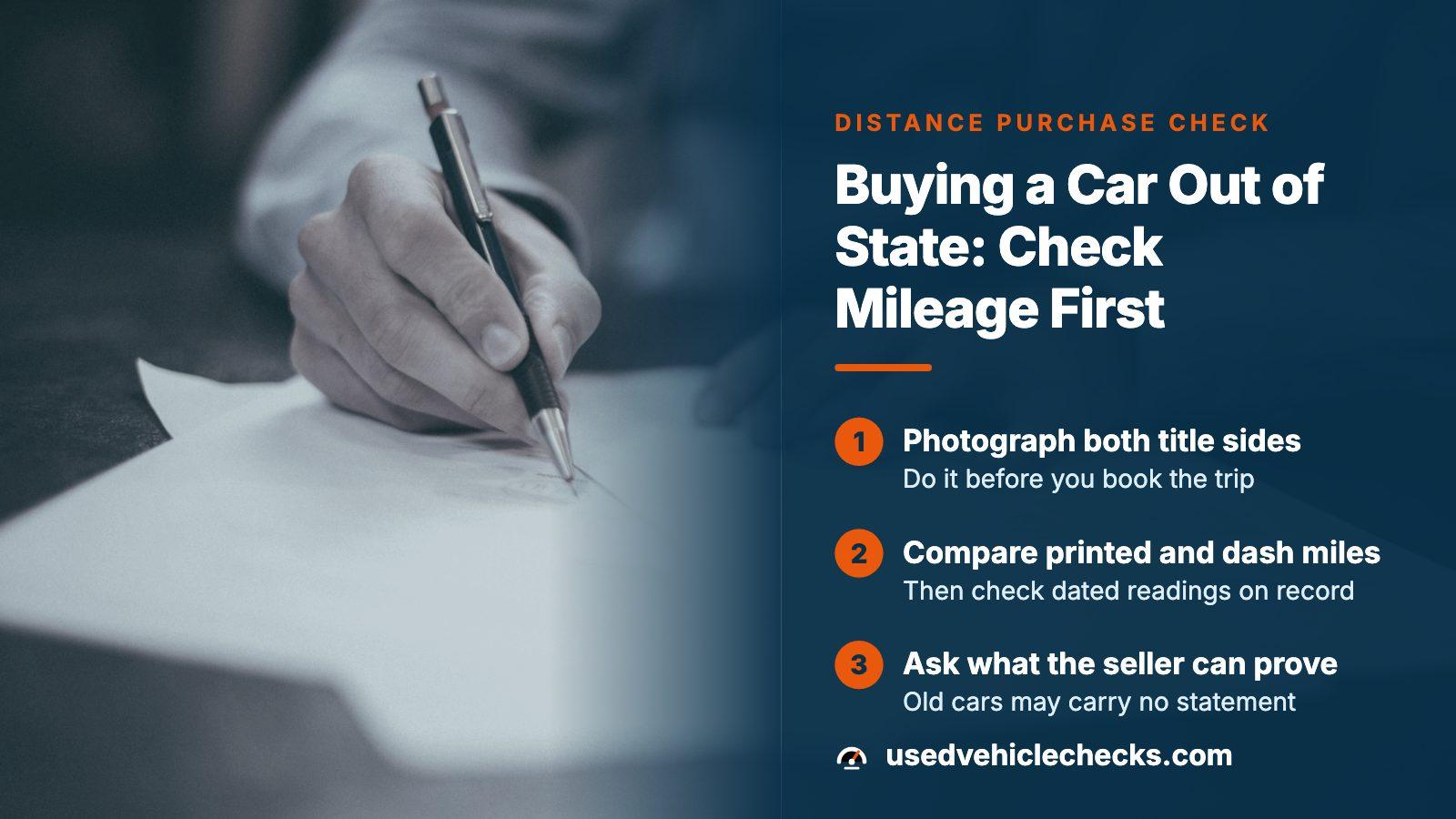
THE SHORT ANSWER
To buy a car out of state safely, test the mileage before the trip. Get the VIN and sharp photos of both sides of the title, then compare the printed mileage with the dash and with dated readings on record for that VIN. Cars built in or before the 2010 model year no longer need a federal mileage statement, so they deserve extra scrutiny. Add a brand and recall check, then pay for an inspection near the car.
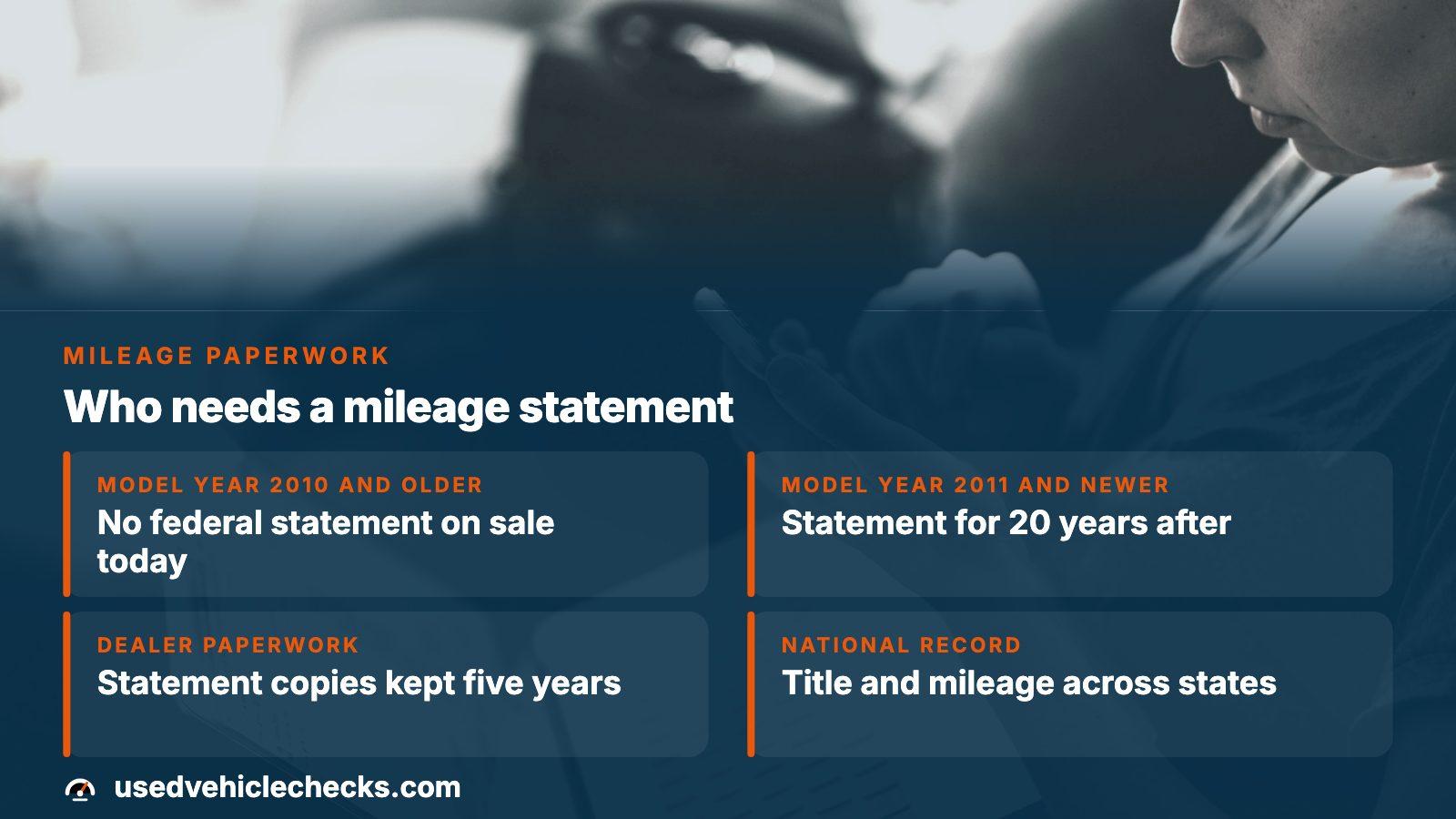
- Model year 2010 and older
- No federal mileage statement on a sale today
- Model year 2011 and newer
- Statement required until 20 years after the model year starts
- Dealer paperwork
- Copies of mileage statements kept for five years
Distance turns the mileage figure into a promise you cannot test
Close to home, a mileage figure that looks wrong costs you an afternoon. Several states away, the same doubt costs a flight, a motel night and a long drive home in a car you no longer trust. The dash number sets the asking price, and it is the one you can least test from your kitchen.
The paperwork adds a second problem: the title you are shown came from one state, and the car may have lived in several. So the mileage check comes first, before travel is booked. Photos, records and documents can all be gathered from a desk, and the trip should only confirm them.
What the title should say about mileage
Federal rules tie mileage to every change of ownership. The seller writes the reading directly on the title, then signs and adds a printed name, so the title that reaches you carries the previous owner's figure. When the seller is not the titled owner, a separate reassignment form carries that entry. Ask for sharp photos of both sides before you talk price, and read these points:
- The reading and the transfer date, with no tenths of a mile.
- Printed names and addresses for the seller and the buyer.
- Make, model, year, body type and VIN, matched against the listing.
- The statement chosen: the display is accurate, the dial rolled past its highest number, or the display does not show the true mileage.
- A signature with a printed name beside it.
The form's printed notice says a missing or false entry can be punished with fines, imprisonment or both. On a car young enough to need a statement, a blank where the reading belongs is a question for the seller, asked in writing.
Older cars may have no mileage statement to read
The statement does not last forever. Federal rules retire it by model year, and the cutoff lands on many of the cheaper cars that people end up buying at a distance.
| Vehicle | Mileage statement | Example in the rule |
|---|---|---|
| Model year 2010 or older | Exempt when the sale falls at least 10 years after that model year's January 1 | For sales in 2020 or later, per the rule's own example |
| Model year 2011 or newer | Exempt only after 20 years from the same starting date | A 2011 car turns exempt for sales in 2031 |
| Over 16,000 pounds GVWR | Never needed, whatever the model year | Heavy-duty trucks |
| Not self-propelled | Never needed | A towed trailer |
Exempt does not mean the mileage cannot be false. It means the signed statement, one cross-check, may be missing, so the claim leans on dated readings, service paper and the car itself. State law may still ask for more.
What the federal title database adds, and where it goes quiet
The national title database, NMVTIS, runs under the Justice Department, and approved providers sell its reports to the public. Its report is narrow: where the car is titled, the date of the last title, brands, an odometer reading, and total-loss and salvage entries. Brand history spans every state that applied one, so a brand from one state can surface even when the next state's title looks clean.
Mileage is where it thins out. The rules call for the reading disclosed on the day a state issued the title, but later readings appear only when the state noted them. Two cars with the same real past can show different trails, depending on how closely each state tracked them. A sparse list describes the state's habits more than the car, so look for dated readings elsewhere. The Justice Department also calls the report short on purpose: an empty one is a good sign, not proof of a trouble-free car.
When the car arrives and the paperwork does not
Mileage and title travel together. The signed reading lives on the title, so a car delivered without one comes with no statement to read, and the figure on the dash has no paper behind it.
From an NHTSA owner complaint
A buyer of a 2010 Jeep Wrangler wrote that the deal rested on a video and a phone call, and that a transport company then hauled the Jeep to New Hampshire. It showed up with a bill of sale and one key but no title. The seller said it was coming, yet on April 20 it had not arrived. A mechanic near home soon listed repairs and an engine so oily it was a fire risk, none of it mentioned on the call.
Distance turned a missing title into a waiting game. Ask for photos of the title, front and back, and agree in writing how and when it will reach you before money moves.
What to ask the seller while the car is still far away
Most useful answers arrive by message and photo. Ask for these, and notice how willingly they come:
- A photo of the dash with the ignition on, taken today, kept beside a screenshot of the mileage in the listing.
- Service invoices showing dates and readings.
- From a dealer, a copy of the mileage statement it received when it bought the car. Dealers must keep copies for five years.
- Where the car was bought. Auction companies also keep the reading from the day they took the car in, for five years.
- Proof that the person selling is the person named on the title.
A seller who stalls has shown you something before you have spent a cent on the trip.
A sequence that keeps the early steps cheap
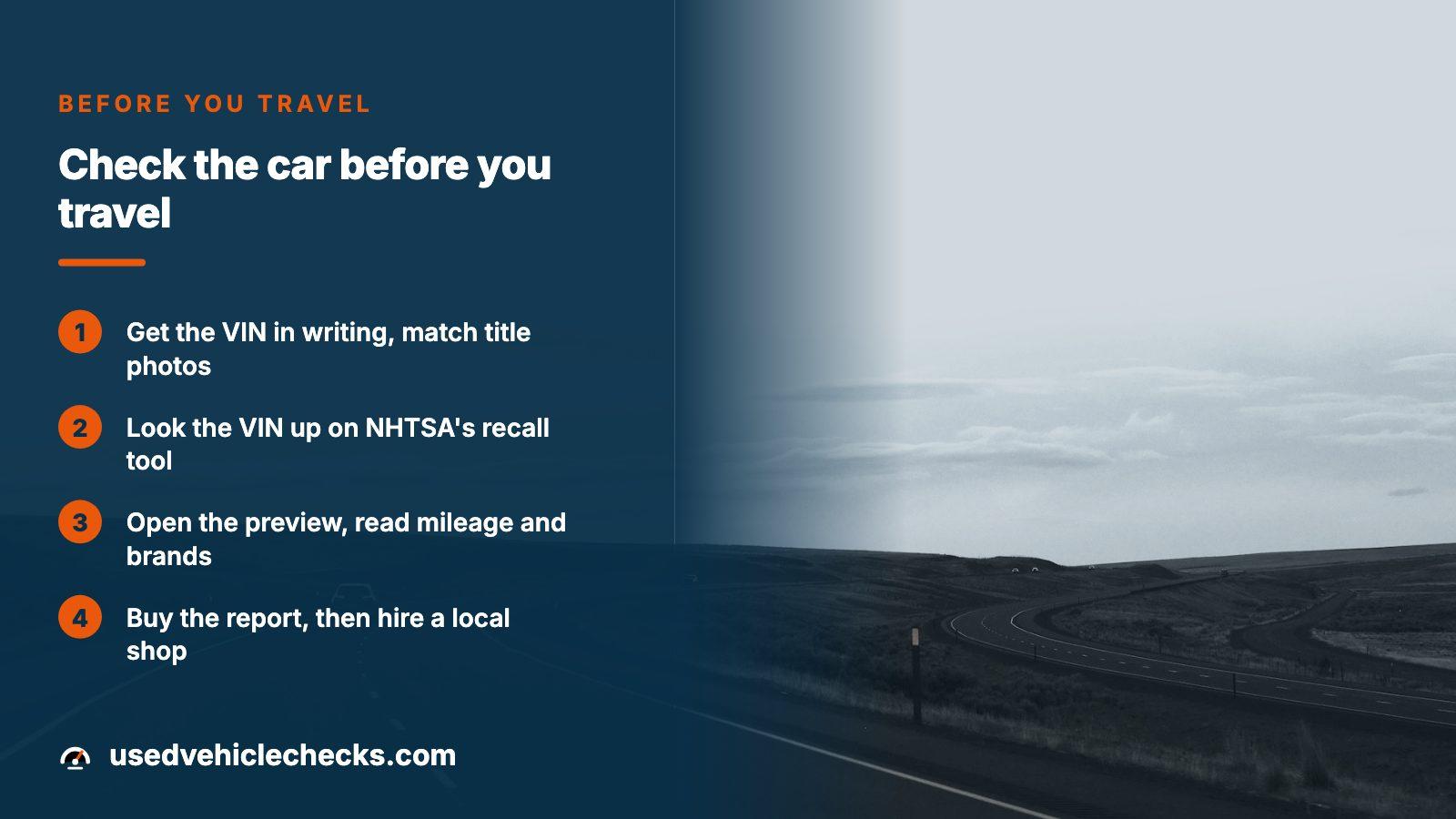
- Get the VIN in writing and match it against the title photos.
- Look the VIN up with NHTSA's recall tool, which charges nothing and shows any recall campaign still open on that car.
- Open the preview here and read the mileage and title-brand entries.
- If the car survives, buy the report and read the dated odometer readings from oldest to newest.
- Hire an independent shop near the car, chosen by you, and ask it to weigh wear against the displayed mileage.
- Ask the motor vehicle agency in your state, and the one in the seller's, about tax, registration and temporary tags before money moves.
This page gives no tax advice, since the answer depends on two states and can change. An inspection or emissions pass from the selling state may also fall short in yours.
Where the preview and the report fit
UsedVehicleChecks starts from mileage. Type the VIN into the form on this page and the preview opens at no cost. If the car stays on your shortlist, the report sets dated odometer readings beside title brands, and where salvage or auction records exist it shows their photos. Each report is bought once, with no subscription; see the pricing page for amounts.
If the readings and the paper disagree
Pause the purchase, keep screenshots of the listing and the report, and ask the seller for the cause in writing. A reading on file above the dash needs a document behind it, such as a service invoice, before you travel.
Where this information comes from
- NMVTIS: understanding an NMVTIS vehicle history report — The items in a report, brand history from any state, and why a short report is not proof of a trouble-free car.
- eCFR: 49 CFR Part 580, odometer disclosure — What the title must show, the three seller statements, record retention for dealers and auctions, and the age exemptions.
- eCFR: 28 CFR Part 25, NMVTIS — The odometer data the system carries and the limit on later readings.
- NMVTIS: approved providers — Where the public can buy an NMVTIS report.
- NHTSA: recalls — The recall lookup by VIN.
- NHTSA owner complaint 11461449 — owner experience, paraphrased
Sources and photos: Facts checked against the sources above in November 2026. Photos by Scott Graham, John Kakuk and Michal Biernat on Unsplash; diagrams by UsedVehicleChecks.
Keep reading
- Mileage Check by VIN: What the Recorded Odometer Readings ShowThe full mileage check, with every recorded reading in date order.
- Title Check by VIN: A Step-by-Step Check, Odometer Entries FirstRead the brands and title history that sit behind the paper you were shown.
- Odometer Rollback Check by VIN: Run the Mileage Test Before You PayHow to test readings for a backward step and what wear can confirm.
- Buying a Car Online: Check the Mileage Before the Truck ArrivesMore on buying a car you have only seen in photos.
Frequently asked questions
Can I trust the mileage on an out-of-state title?
Treat it as the previous owner's signed claim, not a test result. Line it up with the dash, the dated readings on record for the VIN and the service invoices. If they disagree, ask the seller for the cause in writing before you travel.
Do I need a mileage statement when I buy an older car?
Federal rules no longer require one for cars built in or before the 2010 model year. A 2011 or newer car stays covered until 20 years after its model year starts. When a seller offers none, ask for the mileage in the bill of sale so a figure exists on paper.
Can a clean title from another state hide a salvage brand?
It can happen. State agencies apply brands, and a car retitled elsewhere may carry paper with no trace of one. The federal database keeps brands from any state, and insurers and yards report salvage and total loss to it, so a VIN check can show what the paper omits.
Do I need an inspection if the car is a long drive away?
Yes, and more than usual. The Justice Department recommends an independent inspection in addition to any report, and a long trip makes a late walk-away expensive. Choose a shop near the car yourself and book it once the records look clean.
Who decides what sales tax and registration I owe?
Your own state's motor vehicle agency decides, and it helps to ask the seller's agency too. Rules vary and change, and this site gives no tax advice. Get the figures and the temporary tag requirements from the agencies before you send money.
Now check the car itself
The guide explains what to look for. The report shows what this VIN has on record.