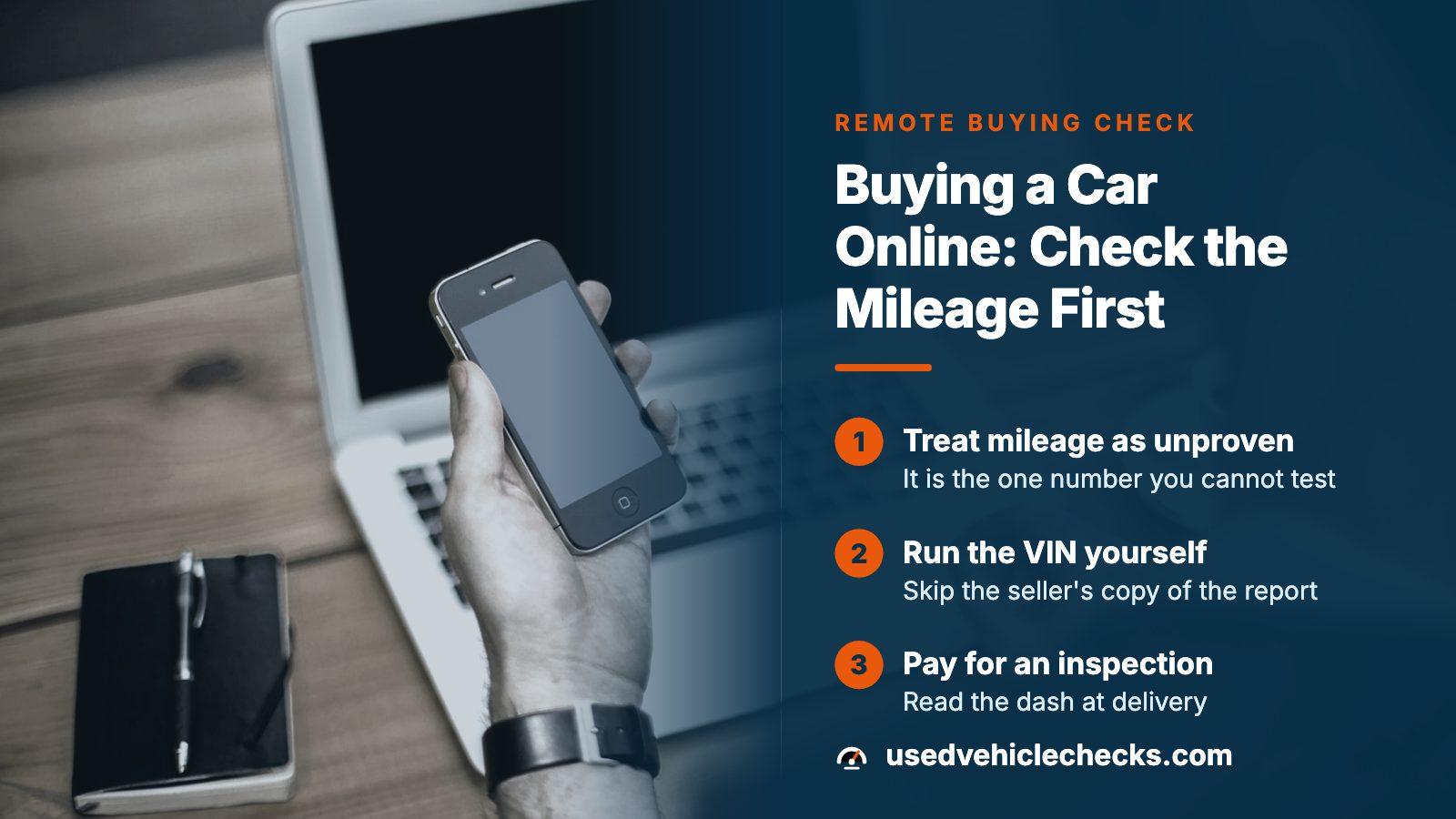
THE SHORT ANSWER
Buying a car online works when you treat the listed mileage as unproven. Get the VIN, run it yourself instead of trusting the seller's report, and read the dated odometer readings against the listing. Pay for an independent inspection, keep the signed mileage statement, and photograph the dash on delivery. Federal law sets a delivery deadline and a refund path, but gives no three-day right to return the car.
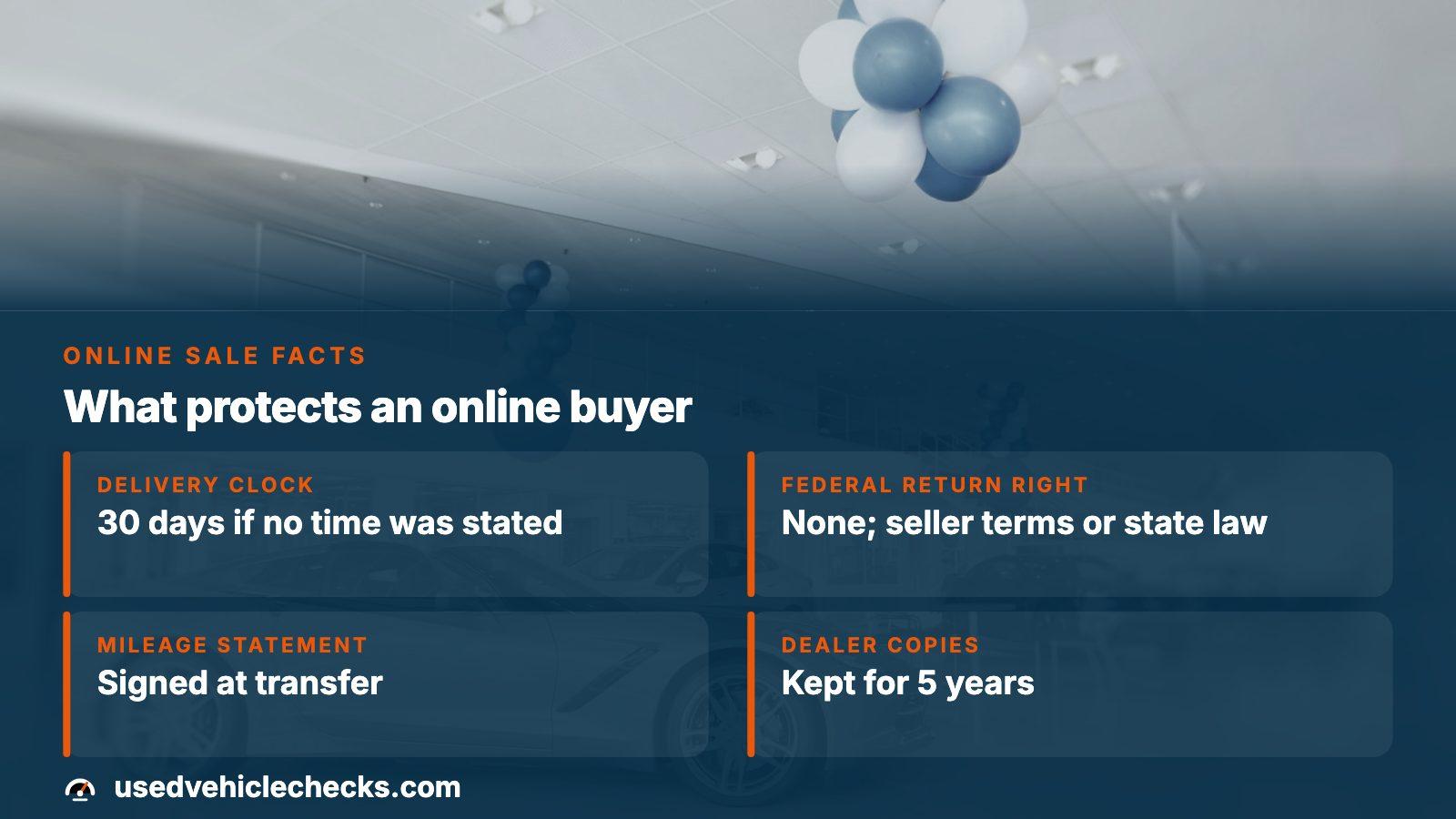
- Delivery clock
- 30 days if no time was stated, 50 if you applied for credit
- Federal return right
- None; the seller's terms or state law decide
- Mileage statement
- Signed at transfer; dealers keep copies for 5 years
- Refund speed
- Within 7 working days on most payment types
The one number in the listing you cannot test
UsedVehicleChecks starts every car with the odometer, and an online purchase makes that habit matter more. In a driveway you can sit in the seat, check the pedal rubber and read the dash. Online you get photos, a figure typed by the seller and a delivery date. The price, and often the loan, rests on that figure.
The federal title system behind vehiclehistory.gov rests on five items, and the latest reported odometer reading is one of them. It makes a useful first screen, though coverage is incomplete: the program counts about 87 percent of US vehicles, and an empty search can be a false negative. A full report lines up readings by date, which one latest figure cannot.
Four places a mileage figure shows up, and what each proves
| Where the figure appears | What it shows | When you see it |
|---|---|---|
| The listing | What the seller claims today | Before you commit |
| Dated readings on a record | What others reported over the car's life | After you run the VIN |
| The signed mileage statement | What the seller certifies at transfer | With the sale papers |
| The dash on delivery | What the car itself reads now | In your driveway |
Only the middle two can referee between the first and the last. A record reading above the listing figure is grounds to stop. One below it is ordinary, since records trail the car. A long stretch with no entries proves nothing, so ask for service invoices that note the mileage.
Run the VIN yourself, never the seller's copy
A seller can attach a report with a straight face and still be showing you another car's story. Ask for the full 17-character VIN in text, compare it with any plate photos in the listing, and run that exact string.
From an NHTSA owner complaint
A buyer of a 2015 Mazda3 found it on an online marketplace and agreed to buy after seeing a history report for the car. The next day, back home, the buyer noticed the report's VIN was not the car's VIN. A lookup on the car's own VIN turned up what the buyer describes as a rollback by the seller.
The lesson is the order of operations. Run the check before money moves, on a VIN you typed yourself, and a mismatch surfaces when walking away still costs nothing.
The mileage statement still applies when you sign on a screen
Mileage has to be stated in writing when ownership changes hands, and none of the federal exemptions turns on whether the sale happened online. The form lists the reading, the date, the names and addresses of both parties, and a car description down to the VIN. The seller then signs one of three declarations: the figure is accurate, the gauge has rolled past its design limit, or the figure is false and must not be relied on.
- In an electronic deal, the warning that a false or missing entry can bring fines or prison has to appear before anyone signs.
- An electronic signature must identify a person and use secure authentication, or be completed in front of a state employee or bonded agent.
- Where a lender holds the title and state law allows it, a power of attorney can carry the disclosure on the state's form.
- Dealers keep the statements they issue and receive for 5 years.
Read it before signing and keep your copy. A recent car will not be exempt: model year 2011 and newer cars qualify only after 20 years.
What the federal delivery rule covers, and where it stops
The FTC's mail, internet and telephone order rule reaches a car ordered online. Its text never mentions motor vehicles, and its four exclusions, which include seeds and C.O.D. orders, leave them in. The FTC's alert to shoppers adds that dealers must let online buyers cancel for a prompt refund if a car ships late.
- A delivery time the seller promised is the one that governs.
- No time promised: shipment is expected within 30 days of a completed order.
- You applied for the seller's own credit when ordering: the allowance becomes 50 days.
- A slipped date means a new date or a refund, and refunds on most payment types are due within 7 working days of cancelling.
None of that speaks to the car's condition, and none of it is a cooling-off period. The FTC says no federal rule grants a three-day window to bring a car back, so any window comes from state law or the seller's own terms. Read them before ordering and look for a cap on miles driven.
Delivery day: read the dash before the driver leaves
Photograph the odometer, the instrument cluster and the VIN plate while the transporter is still there, and set the figure beside a screenshot of the listing from order day. Do it before the first drive, since each added mile muddies a later dispute.
From an NHTSA owner complaint
A buyer who ordered a 2016 Jetta from an online retailer says it arrived with several faults, including bad brakes and a navigation unit that did not work. While arranging a swap, the owner read 83XXX miles on the dash against 80XXX in the listing, a gap the owner puts near 3,000 miles, and says video and several people back up that the car could not have covered that distance. An earlier car from the same seller, the owner adds, also had a screen reading that disagreed with the posting.
The lesson is timing. A dash reading is evidence only if you recorded it on day one. Send the photos to the seller in writing that day, and ask how the return terms treat mileage.
Inspection and paperwork to settle before you pay
A history report can show accident and flood entries but typically not mechanical faults, and the FTC adds that it is no stand-in for an independent mechanic, even when the seller calls the car certified. You pay the mechanic. If the seller refuses an outside look, the FTC suggests trying another seller.
- Ask for the Buyers Guide up front. Online buyers are entitled to one, and it says whether a warranty comes with the car or it is sold as is.
- Have the total you will pay, the out-the-door price, confirmed in writing, along with proof the car is in stock.
- Search the seller's name with words like scam or complaint.
- Have the inspection report name the make, model and VIN and list repair estimates, which also help you negotiate.
Where a full report fits in the sequence
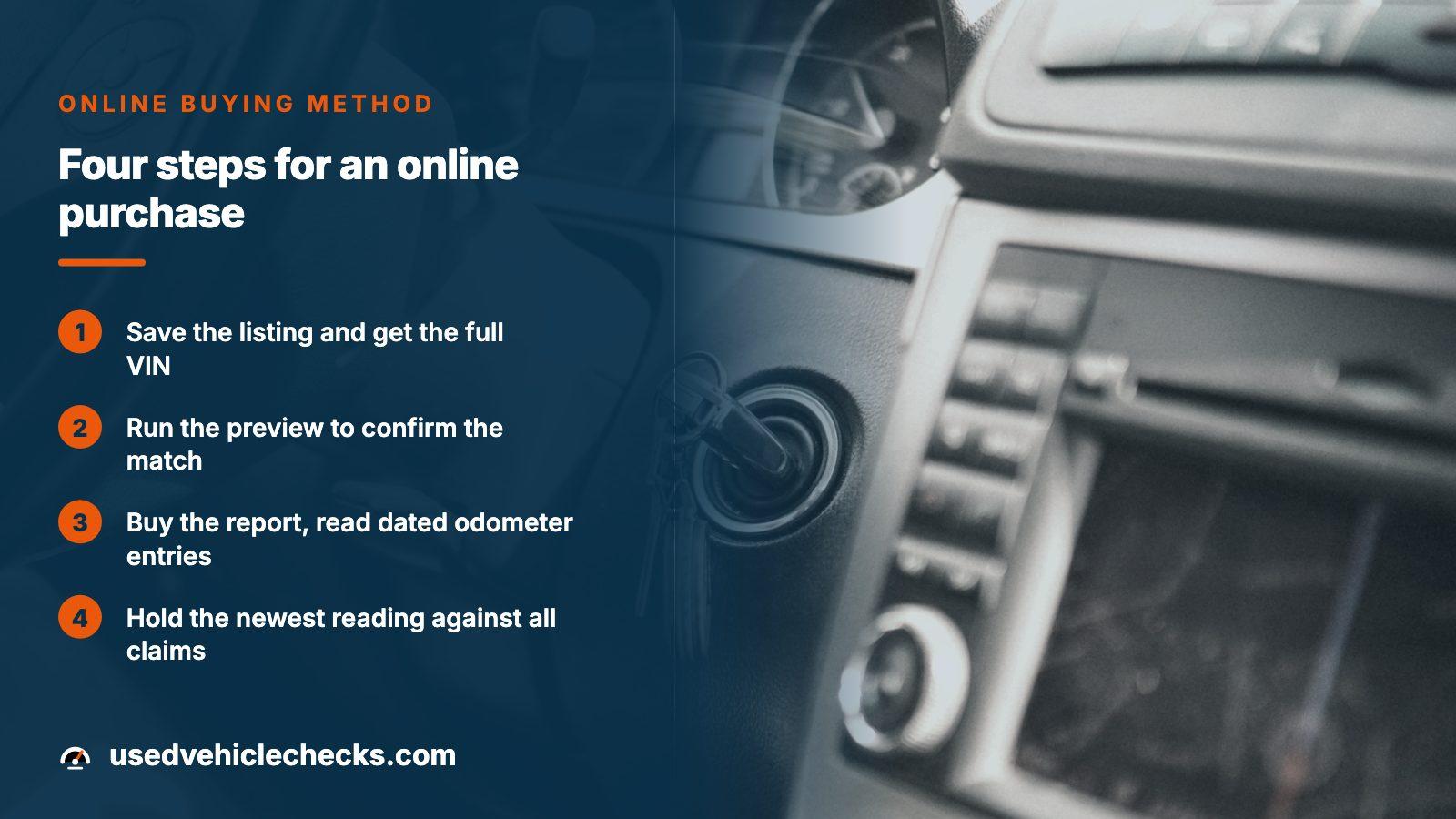
- Save the listing, mileage included, and get the full VIN in writing.
- Run the preview, which costs nothing, to confirm the car matches the listing.
- Still interested? Buy the report and read the dated odometer readings first, then brands, accident and salvage entries and ownership.
- Hold the newest reading against the listing, the signed statement and, on delivery, the dash.
One payment buys one report, with no subscription. Packs covering 3, 5 or 10 cars are offered to shoppers still comparing. Prices sit on the pricing page.
Where this information comes from
- 16 CFR part 435: mail, internet, or telephone order merchandise — The covered sale, the four exclusions, the 30-day and 50-day shipping limits and the refund timing.
- FTC: what to know when buying a used car online — Buyers Guide duty, the cancel-and-refund duty for late online shipments, and the advice to start at vehiclehistory.gov.
- FTC: buying a used car from a dealer — Buyers Guide for online sales, the three-day myth, independent inspection and what a history report leaves out.
- NMVTIS: information for consumers — The five indicators in the federal title record, its coverage and why a search can come back falsely clean.
- 49 CFR part 580: odometer disclosure requirements — What the mileage statement lists, electronic signing rules, record keeping and the age exemptions.
- NHTSA owner complaint 11706401 — owner experience, paraphrased
- NHTSA owner complaint 11524557 — owner experience, paraphrased
Sources and photos: Facts checked against the sources above in November 2026. Photos by Alejandro Escamilla, tim and Richard R on Unsplash; diagrams by UsedVehicleChecks.
Keep reading
- Mileage Check by VIN: What the Recorded Odometer Readings ShowHow to pull the dated readings and set them beside the listing.
- Can I Return a Used Car? What the Rules Allow and Why Mileage MattersWhat a return window can and cannot cover once the car is yours.
- Buying a Car Out of State: Check the Mileage Before You TravelTitle and paperwork questions when the car comes from another state.
- Odometer Discrepancy Check: Find a Mileage Mismatch Before You PayWhat to do when the records and the dash disagree.
Frequently asked questions
Is it safe to buy a car online without seeing it?
It can be, when the checks do the work your eyes cannot: run the VIN yourself, compare dated odometer readings with the listing, pay for an independent inspection and read the return terms first. Buyers get hurt by skipping those steps, not by ordering from a screen.
How do I check the mileage on a car I found online?
Get the full VIN from the seller, run it, and read the latest reading along with earlier ones. The federal vehiclehistory.gov site gives the most recent reading it holds at no charge. On delivery, photograph the dash beside a listing screenshot.
Can I return a car I bought online within three days?
Not by federal right. In some states the law gives a right to cancel, and in others a return window exists only when the seller offers one, sometimes as a money-back guarantee. Get the terms in writing, including any limit on miles driven.
What delivery deadline applies to a car bought online?
A time the seller promised is the standard. With none stated, the federal order rule allows 30 days from a completed order, or 50 if you applied for the seller's credit. A late seller must offer a new date or a refund, and refunds on most payment types are due within 7 working days.
What if the dash shows more miles than the listing said?
Document it before you drive: dated photos of the odometer and VIN plate beside the listing screenshot. Tell the seller in writing that day and ask what the return terms say about mileage. Then compare both figures with the dated readings on the record to see which one the history supports.
Now check the car itself
The guide explains what to look for. The report shows what this VIN has on record.