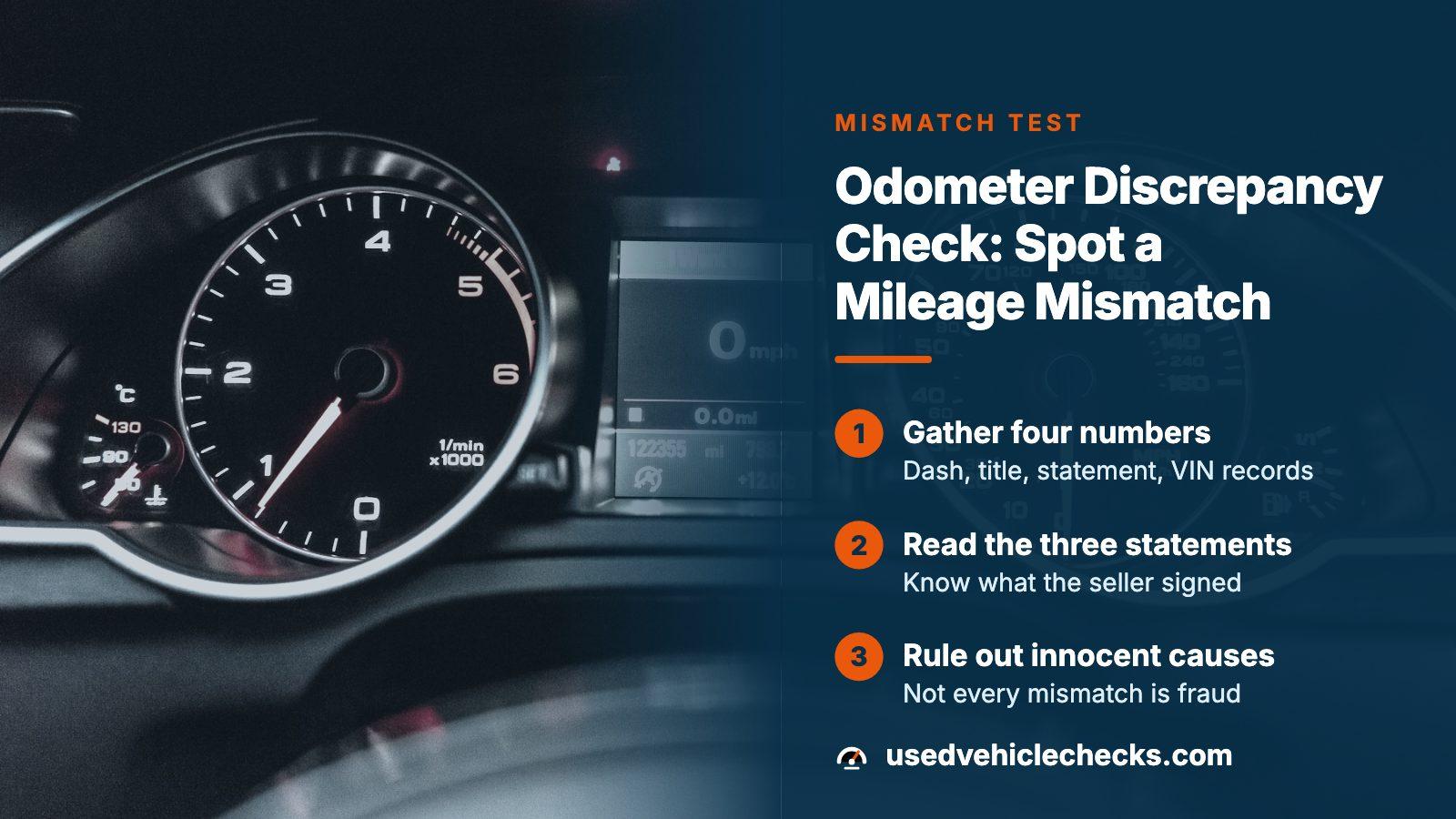
THE SHORT ANSWER
To run an odometer discrepancy check, gather four numbers for one car: the dash reading, the mileage printed on the title, the figure in the seller's signed statement, and the dated readings on record for the VIN. They should agree or climb in date order. A title brand, a warning box ticked on the statement, or a recorded reading above the dash all count as a discrepancy.
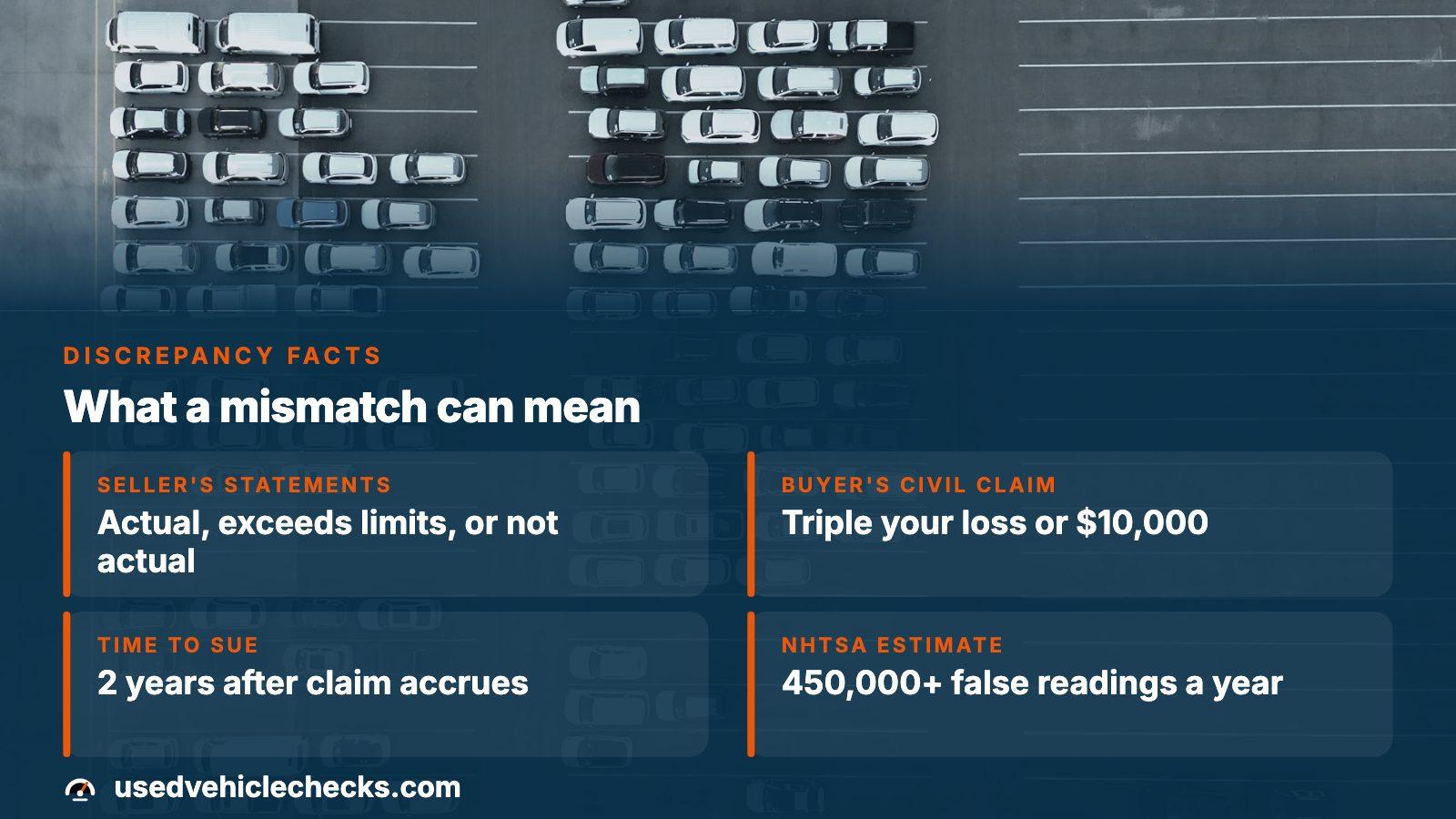
- Seller's statements
- Actual mileage, exceeds mechanical limits, or not actual with a warning
- Buyer's civil claim
- Three times your loss, or $10,000 if that is higher
- Time to sue
- 2 years after the claim accrues
- NHTSA estimate
- More than 450,000 vehicles a year sold with false readings
Three things people mean by an odometer discrepancy
The phrase turns up in three places, and each one calls for a different reaction. On the federal mileage form it is a printed warning: a seller who knows the display is wrong ticks the box that says so. On a title it can be a brand, applied by a state agency when earlier recorded readings contradict a newer one. In ordinary conversation it is the gap a buyer finds between the dash and the paperwork.
The first is the seller admitting a problem, the second an agency voicing suspicion, the third your own evidence. Collect all three kinds of signal and never lean on the display alone.
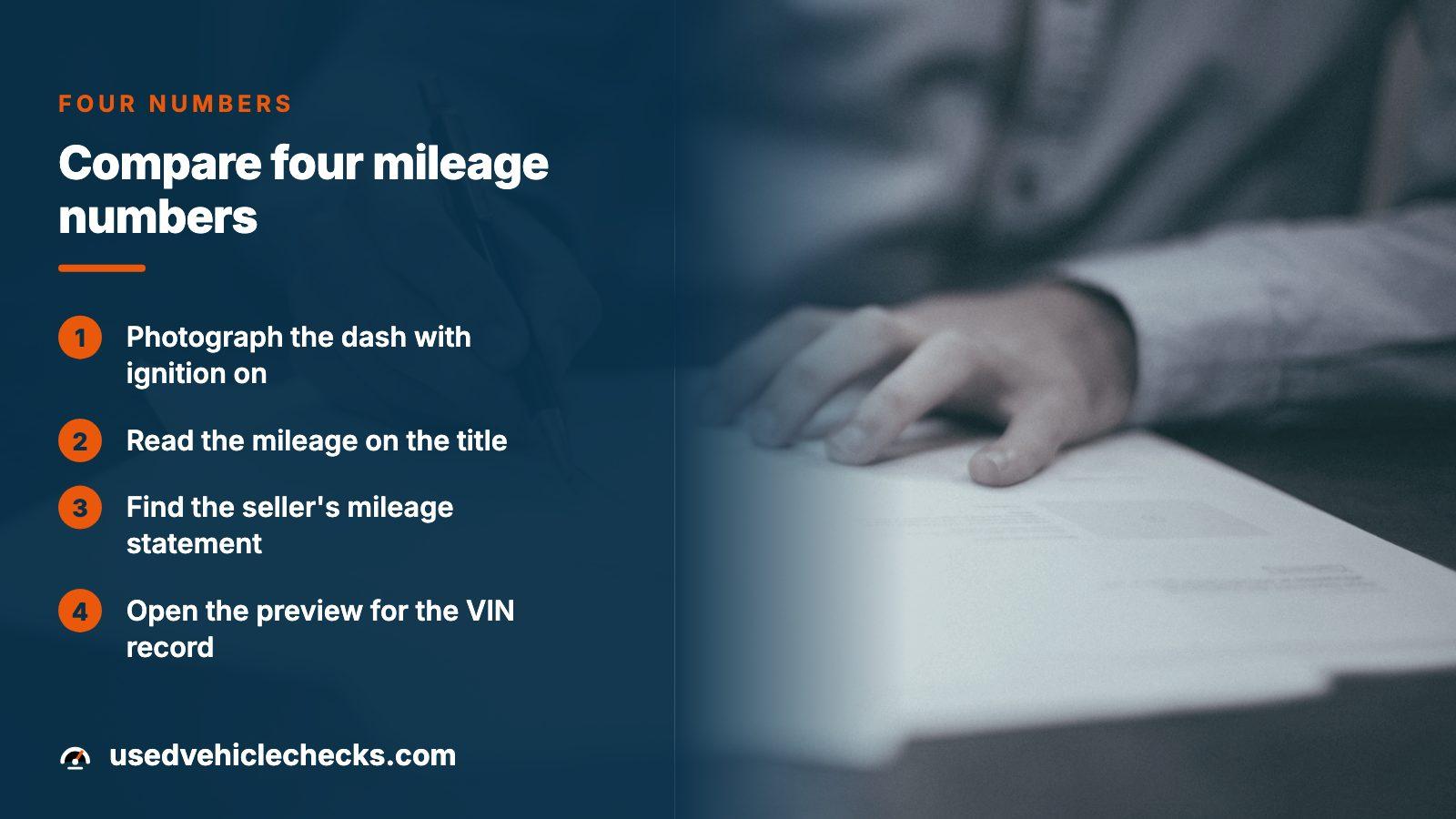
Four numbers to line up before the test drive
- The dash: photograph the display with the ignition on, and screenshot the mileage in the listing the same day, since ads get edited.
- The title: read the mileage the last seller disclosed, plus any brand or code printed near it.
- The seller's statement: find which mileage declaration was selected and confirm it is signed, dated and carries the right VIN.
- The record: open the free preview for the VIN, then read the dated odometer readings oldest to newest if you buy the report.
A title must carry the mileage disclosed at the last change of ownership, which makes it the sturdiest printed anchor you can hold. A seller who cannot show the title, or explain who holds it, has a problem before mileage even comes up.
From an NHTSA owner complaint
A buyer of a 2017 Chevrolet Equinox from a private seller paid when the car stood at 98,000 miles. Afterward, papers left in the glove compartment showed the title carried 156,300. A history report backed up the higher number, and the owner filed a police report.
The answer was already inside the car. Ask to see the title and compare its figure with the dash before the money moves.
Reading the three statements a seller can sign
Federal rules give the seller three statements to choose from, and the one selected tells you what the seller claims to know.
| Statement on the form | What the seller is saying | What you do |
|---|---|---|
| Reading reflects the actual mileage | As far as the seller knows, the dash is right | Hold it against the title and the recorded readings |
| Exceeds mechanical limits | The display rolled past its highest number, so true miles are higher | Ask how far past the limit the car has gone and price on that total |
| Not the actual mileage, with the discrepancy warning | The seller knows the display is wrong by more than calibration error | Treat the mileage as unknown and get the reason in writing |
The third box is an honest disclosure. Trouble begins when a seller who knows better selects the first one. An older car may need no statement at all: model year 2010 or older after ten years, model year 2011 or newer after twenty. Silence on a car that old is not a flag.
Odometer brands on a title, in plain terms
States word these differently, so read the brand itself. The Texas motor vehicle agency publishes the national odometer brands and how its own titles print each one.
| Brand | What the agency means | Your move |
|---|---|---|
| Odometer Discrepancy | A reading recorded earlier conflicts with the current one | Ask which readings clash and request the documents |
| Odometer May Be Altered | The agency suspects alteration but has not confirmed it | Order an independent inspection before any offer |
| Not Actual - Odometer Tampering Verified | Tampering is confirmed | Do not buy on the displayed mileage |
| Odometer Replaced | The unit in the car is not the one fitted at the factory | Ask for the invoice that records the mileage at the swap |
Five of the nine national brands print as Not Actual Mileage on a Texas title, so one phrase can cover very different stories. California uses single-letter codes, where N means the odometer is broken, replaced, or the owner is unsure of the true mileage. Ask which brand name the record carries; the national names are more specific than the printed phrase.
When a mismatch is not fraud
A gap proves nothing about intent until you know the cause. Four ordinary explanations exist, and each leaves paper behind.
- A replaced instrument cluster: when the old mileage cannot carry over, the new unit starts at zero and a notice on the left door frame gives the earlier reading and the date.
- An odometer that rolled past its limit: the title should then say the mileage exceeds mechanical limits.
- A keying slip at a title office or service desk: the readings on either side should not share the error.
- Calibration tolerance: the form's warning applies only above calibration error, so a few miles apart is not a discrepancy.
Ask for the invoice behind whichever story you hear. An honest cause is documented, and a seller with no paper has told you something too.
Why dated readings settle what the display cannot
NHTSA says a tampered digital odometer is harder to spot than a mechanical one, since nothing visibly moves. A reading with a date on it is different: it was recorded before this sale, apart from anything done to the dash.
From an NHTSA owner complaint
A dealer sold a 2018 Chevrolet Equinox showing 60,248 miles. Later, applying for an extended warranty, the owner heard that the last reported odometer was 155,000. A history report listed 144,738 for September 2024. The dealer was informed of the gap.
A reading dated before the sale is hard to explain away. Pull the dated readings before you sign, not after a warranty company does it for you.
What the law gives you when the number was false
- Private claim: a seller who acted with intent to defraud owes triple your actual damages or $10,000, whichever is larger, and a winning buyer also recovers costs and a reasonable attorney's fee.
- Deadline: a lawsuit must start within 2 years of when the claim accrues.
- Crime: knowing and willful violations carry a fine, up to 3 years in prison, or both.
- Reporting: large schemes go to NHTSA's Vehicle Safety Hotline at 888-327-4236, and a single car goes to your state enforcement agency.
NHTSA cannot pursue claims for individual buyers and advises speaking with a private attorney. The civil claim turns on intent to defraud, so documents carry more weight than suspicion.
Where the preview and the report fit
UsedVehicleChecks starts from mileage. Enter the VIN in the form on this page and the preview opens at no cost. If the car stays on your shortlist, the report lists the dated odometer readings next to title brands, and its salvage and auction entries carry photos, where a visible dash is one more reading to compare. Payment is once per report, never a subscription; amounts sit on the pricing page.
If the numbers disagree
Before paying, stop, keep screenshots and ask for the cause in writing. After paying, keep every document together, contact your state enforcement agency and speak to a consumer attorney inside the two-year window.
Where this information comes from
- NHTSA: odometer fraud — Backs the 450,000 estimate, the buyer tips, the hotline and the point about digital odometers.
- eCFR: 49 CFR Part 580, odometer disclosure — The three seller statements, the signing steps, the model form with its warning and the age exemptions.
- U.S. Code, 49 U.S.C. 32710: civil actions by private persons — Treble damages or $10,000, the two-year limit and the fee award.
- TxDMV: odometer brands — The national odometer brand list and how a Texas title prints each one.
- NMVTIS: information for consumers — What the federal title database holds and where its reports fall short.
- NHTSA owner complaint 11721826 — owner experience, paraphrased
- NHTSA owner complaint 11730173 — owner experience, paraphrased
Sources and photos: Facts checked against the sources above in November 2026. Photos by Ambitious Studio* | Rick Barrett, Scott Graham and Iain on Unsplash; diagrams by UsedVehicleChecks.
Keep reading
- Mileage Check by VIN: What the Recorded Odometer Readings ShowThe full mileage check, with every recorded reading in date order.
- Odometer Rollback Check by VIN: Run the Mileage Test Before You PayHow to test the readings for a backward step and what wear can confirm.
- Title Check by VIN: A Step-by-Step Check, Odometer Entries FirstRead the brands and history on the title that sits beside the mileage.
- Can I Return a Used Car? What the Rules Allow and Why Mileage MattersYour options once a mileage problem turns up after the sale.
Frequently asked questions
What does odometer discrepancy mean on a vehicle history report?
It flags a conflict between mileage readings, usually an earlier recorded figure above a later one, or an agency brand saying the reading cannot be trusted. It is not proof of tampering, since a replaced cluster or a keying slip can cause the same flag. Ask for the paperwork behind it.
Can I legally buy a car with an odometer discrepancy brand?
Federal rules require disclosure, not a ban on sale. The risk is practical: the mileage is unverified. Get the cause in writing, have a shop inspect the car, and price it as if the true mileage were unknown. An explanation with no documents is a reason to walk.
How big a difference counts as a discrepancy?
No single figure is set. The federal warning applies when the display is off by more than calibration error, so a few miles of drift does not qualify. A recorded reading above today's dash, or a title far from the display, does.
Does a clean odometer check mean the mileage is accurate?
Not by itself. The federal title database calls its reports intentionally concise and warns that gaps in reporting can look like a clean record. A clean result means no recorded reading disagrees. Back it up with pedal and tire wear, service stickers, maintenance records and an inspection.
Do private sellers and gifts fall under the mileage rules too?
Yes. The federal rules cover anyone who transfers ownership, and the statute counts a gift as a transfer, along with a sale or any other means. A private seller owes the same signed statement a dealer does, unless the age exemption covers the car.
Now check the car itself
The guide explains what to look for. The report shows what this VIN has on record.