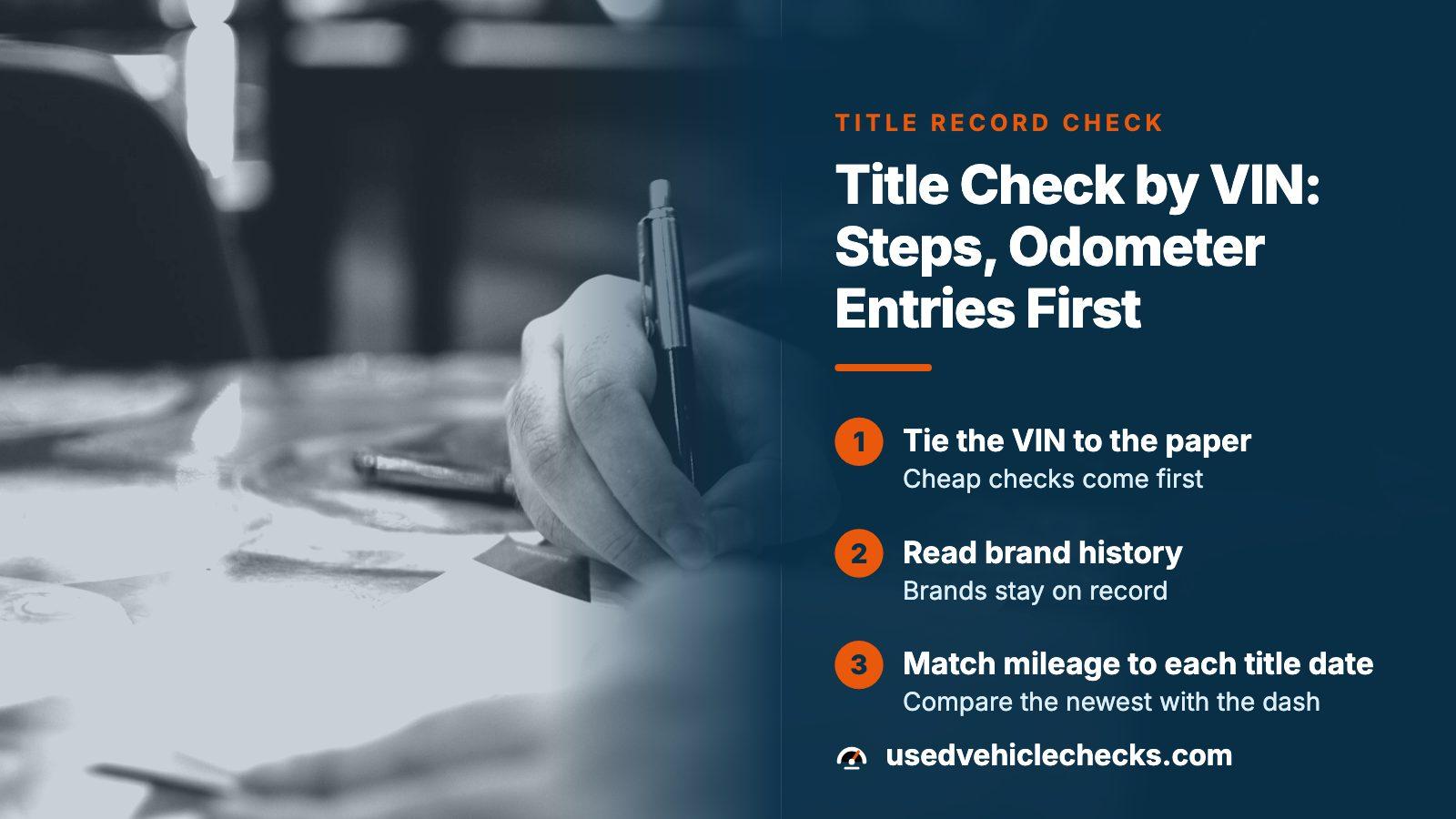
THE SHORT ANSWER
To check a title by VIN, put the car's 17-character number through the preview, then buy the report for any car still in the running. Read the brand history first, then the mileage entry beside each title date, and compare the newest with the dash. A brand, a missing state or a mileage figure that drops means you stop and ask the seller for paperwork before money moves.
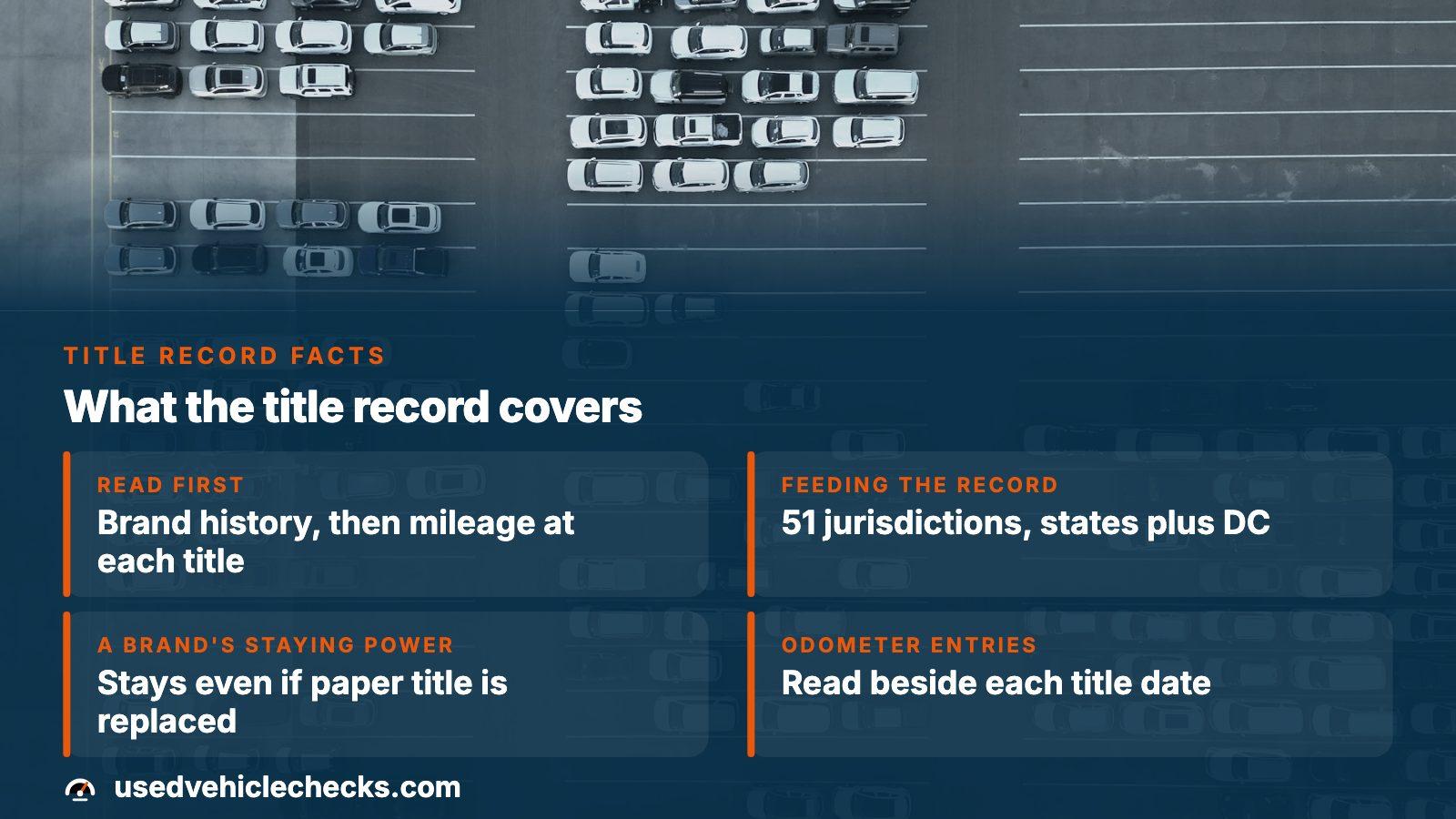
- Read first
- Brand history, then the mileage entry at each title
- States feeding the national record
- 51 jurisdictions, the 50 states plus D.C.
- A brand's staying power
- It remains on record even if a paper title is reissued elsewhere
What a title check by VIN covers, and where it stops
A title is a state's written record of who owns a car and what has been noted against it. A VIN search reads that record across states: where the car was titled and when, any brand attached, a theft entry if one exists, any total-loss or salvage entry, and the latest odometer data. State titling offices, insurers and salvage or junk businesses all feed it.
- It is not a repair log, and it does not list mechanical problems.
- It does not hand a buyer the owner's name; personal details stay with law enforcement and state agencies.
- An empty result means participating states reported nothing, which is not the same as a sound car.
Seven steps, ordered so the cheap checks come first
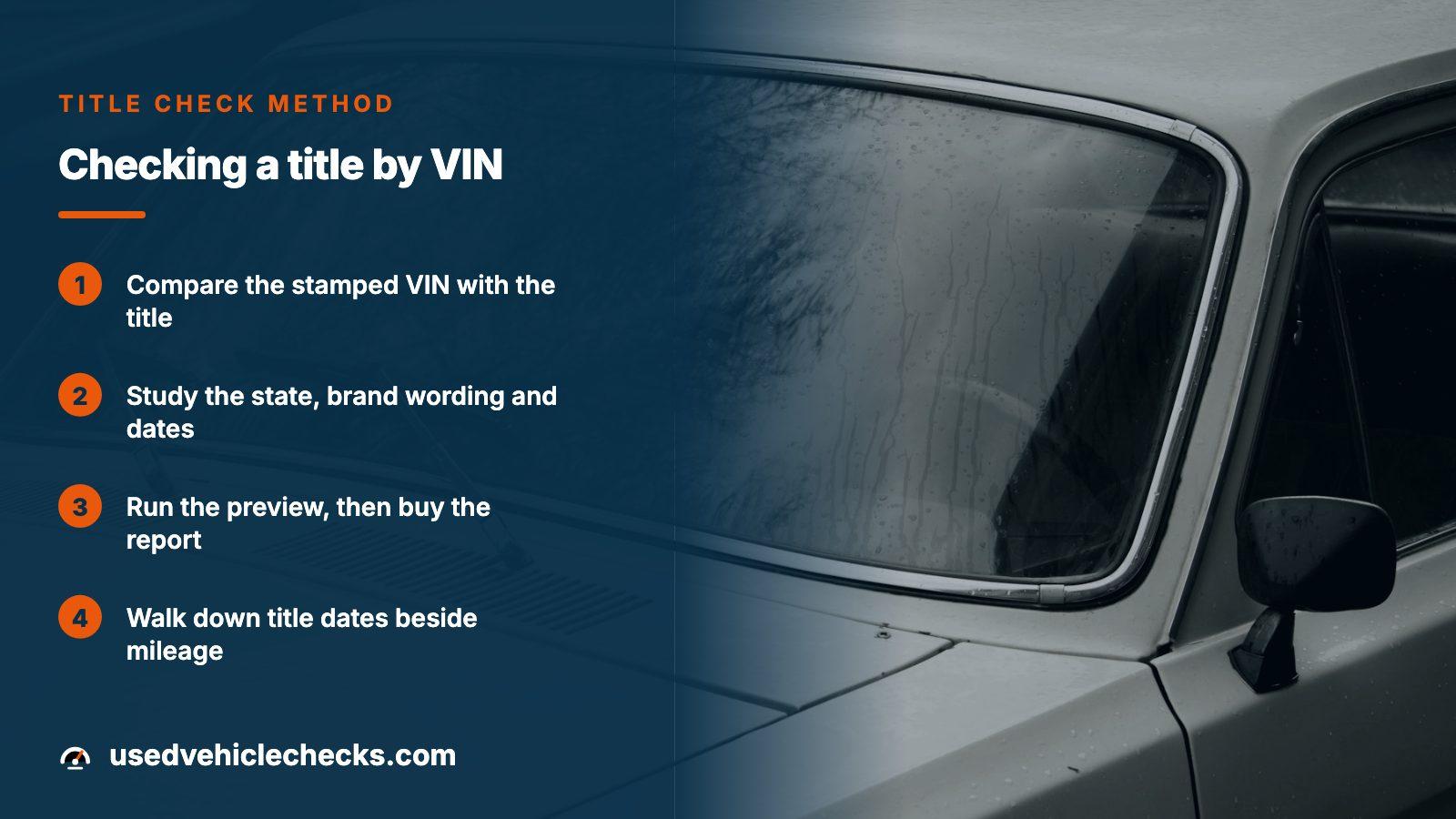
- Stand at the car and compare the VIN stamped on it with the one on the title, the listing and any dealer window sheet. Any difference ends the search.
- Study the paper title: the issuing state, the brand wording, the lienholder line and the mileage the last seller signed.
- Run the VIN through the preview to confirm the car decodes as the year and model advertised.
- Buy the report for a car still in the running and read the brand history before anything else.
- Walk down the title dates and note the mileage written beside each one.
- Run the outside lookups for flood, unrecovered theft and salvage declarations, and request the record the state itself holds if the file looks thin.
- Pay a mechanic for an inspection, then settle the price using what the records showed.
Steps one and two: tie the number to the paper
Federal law puts a mileage statement on the title itself. Each seller gives one in writing, and when the seller knows the display is wrong, the title must say the true figure is unknown. Anyone buying to resell may not take a statement left incomplete.
At a dealer, the window sheet repeats the VIN, but its vehicle section has no field for title or history. The FTC leaves the job of getting a history report to the buyer.
From an NHTSA owner complaint
A buyer of a 2014 Ford Escape, bought in a private sale through an online marketplace, told NHTSA the odometer read 96,105 at purchase. At registration, the owner's husband found a mileage discrepancy on the title; the registration figure was about 138,000. The owner went to the police.
That buyer met the gap at the registration counter. Reading the signed mileage line before paying puts the same question to the seller instead.
Step four: reading the brand history
A brand is a label a state gives a title to mark a condition, with junk, salvage and flood the usual examples. Each state sets its own under its own law, so one may call a car salvage where another would not, and a few skip a flood brand entirely. The national record keeps every brand any state reports, and a state titling a car from elsewhere consults it first.
| What you see | What it tells you | Your move |
|---|---|---|
| A brand with a state and a date | A state wrote the car's condition into the record that day | Ask for repair invoices; price it as branded |
| Clean paper title, brand in the search | The paper was likely reissued where the brand did not follow | Believe the record over the paper, and press the seller for an explanation |
| Total loss, no brand | An insurer declared a loss; a stolen car unrecovered for 30 days can get the same label | Find out which it was, then inspect hard |
| A transfer to a salvage or junk yard | A dismantler or auction pool once held the car | Request the repair history |
| Nothing at all | A clean car, or a reporting gap | Lean on the inspection |
Step five: the mileage written beside each title date
This is where UsedVehicleChecks looks first. Every title issue is a dated moment when someone put a number on paper, so the entries form a rough line, and the report lists the odometer readings on record by date. Put dates and miles in two columns, then check three things: the line climbs, the pace suits the work the car did, and the newest entry sits at or below the dash.
- An entry lower than an earlier one is the plainest warning.
- A statement that the true mileage is unknown is what the law requires of a seller who knows the display is wrong. It should lower your offer, since nobody can vouch for the figure.
- A brand followed by a mileage entry that barely moves deserves a question about where the repair was done.
Step six: what each source adds, side by side
| Source | What it answers | Where it stops |
|---|---|---|
| Paper title | Issuing state, brand wording, lienholder, last signed mileage | Earlier states, and any brand the paper dropped |
| NICB lookup, free by VIN | Flood, unrecovered theft and salvage declarations | A lookup of declarations, not a title record |
| Titling state's own record | Detail the national record may not hold | Access and wording differ from state to state |
| Federal title database report from an approved provider | Title, brands, latest odometer data, total loss and salvage entries | Built to be brief; no repairs, no recalls |
| UsedVehicleChecks report | Dated odometer readings and title brands, plus lien entries and photos from salvage auctions | Bought after the preview; never a stand-in for an inspection |
When the check turns something up: reprice, verify or walk
- Reprice when a brand is real and the seller can document the repair.
- Verify when the file looks odd: ask the titling state what it holds and reread the signed mileage line against the dated entries.
- Walk when the seller cannot show the title, the VINs differ, or a lienholder is named and no release appears.
From an NHTSA owner complaint
An owner who bought a 2017 Kia Sportage with a salvage title at auction told NHTSA the engine had 57,463 miles when error code P1326 put it into limp mode. By the owner's account, the 60,000-mile warranty limit covers only cars without a salvage title, and dealers would not repair it.
That buyer took the brand knowingly. For you, the point is that a brand can shape warranty talks years later, so see it in the record before the price is agreed.
If a mileage statement proves false and was meant to deceive, a buyer can claim the larger of $10,000 or 3 times the actual loss, plus costs and attorney fees, but must sue within 2 years.
Preview, report and cost
The preview takes the VIN and commits you to nothing. The report is a one-time purchase with nothing to renew. Packs hold 3, 5 or 10 reports, handy when you are lining up several cars. The pricing page lists current amounts.
Keep the paperwork together
Save the VIN photo, a scan of the title, the listing and the readings in one folder. If the mileage turns out to be false, a consumer attorney will want those documents.
Where this information comes from
- NMVTIS: information for consumers — Defines brands, says brands persist in the national record, explains total-loss labels and gives the limits of a concise report.
- NMVTIS: states and title verification — Source for the 51 participating jurisdictions and the checks a state runs before titling an out-of-state car.
- NMVTIS: used car buying tips — Points buyers to the free NICB lookup and to a mechanic's inspection.
- 49 U.S.C. chapter 327: odometers — Statute for the mileage statement on a title, the unknown-mileage wording and the buyer's damages claim.
- FTC: dealer's guide to the Used Car Rule — Shows the window sheet carries the VIN but has no title or history field.
- NHTSA owner complaint 11759525 — owner experience, paraphrased
- NHTSA owner complaint 11639799 — owner experience, paraphrased
Sources and photos: Facts checked against the sources above in November 2026. Photos by Owen Michael Grech, Tigran Shishmanyan and Iain on Unsplash; diagrams by UsedVehicleChecks.
Keep reading
- Odometer Discrepancy Check: Find a Mileage Mismatch Before You PayWhat to do when the dated entries and the dash disagree.
- Mileage Check by VIN: What the Recorded Odometer Readings ShowA closer read of the odometer readings the title record carries.
- Lien Check Through the DMV: Seven Steps, Mileage Line IncludedThe lienholder line on a title and how to confirm it is released.
- Buying a Car Out of State: Check the Mileage Before You TravelHow a car's title travels when you buy across a state line.
Frequently asked questions
Can I run a title check by VIN for free?
Part of it, yes. The NICB lookup is free and searches by VIN for flood and salvage declarations. The UsedVehicleChecks preview costs nothing too, so start there. The full record of brands and dated mileage entries comes with the report, bought once.
Does a clean paper title mean the car has no brand?
No. The paper shows what one state wrote down. A brand applied in another state stays in the national record even when a later title is issued clean, so the search runs on the VIN, not the seller's document.
What does the mileage on a title tell me?
It is the figure the seller declared at that transfer, or a note that the true mileage is unknown. Compare it with the dash and with the dated readings in the report. A newer title showing fewer miles than an older one is the pattern to question.
Will a title check show who owns the car?
Not by name. Individual consumers receive no personal identifying information from the national system, which shares owner names with police and state motor vehicle offices alone. You do see brands, dates, mileage entries and lienholders, which is what matters before you pay.
How current is the title data?
The national program says new and updated title information must reach it at least once every 24 hours, and some states send it in real time. Its FAQ adds that timing varies by state, so ask the seller when the title was last issued.
Now check the car itself
The guide explains what to look for. The report shows what this VIN has on record.