
THE SHORT ANSWER
Curbstoning means selling cars as a business while presenting as a private owner. Under the FTC's Used Car Rule, a seller becomes a dealer on the sixth used vehicle sold or offered within twelve months. Test the seller with paper: the name on the title should match a photo ID, the VIN plate should match the title, and the mileage should agree with dated records. Any mismatch is grounds to leave.
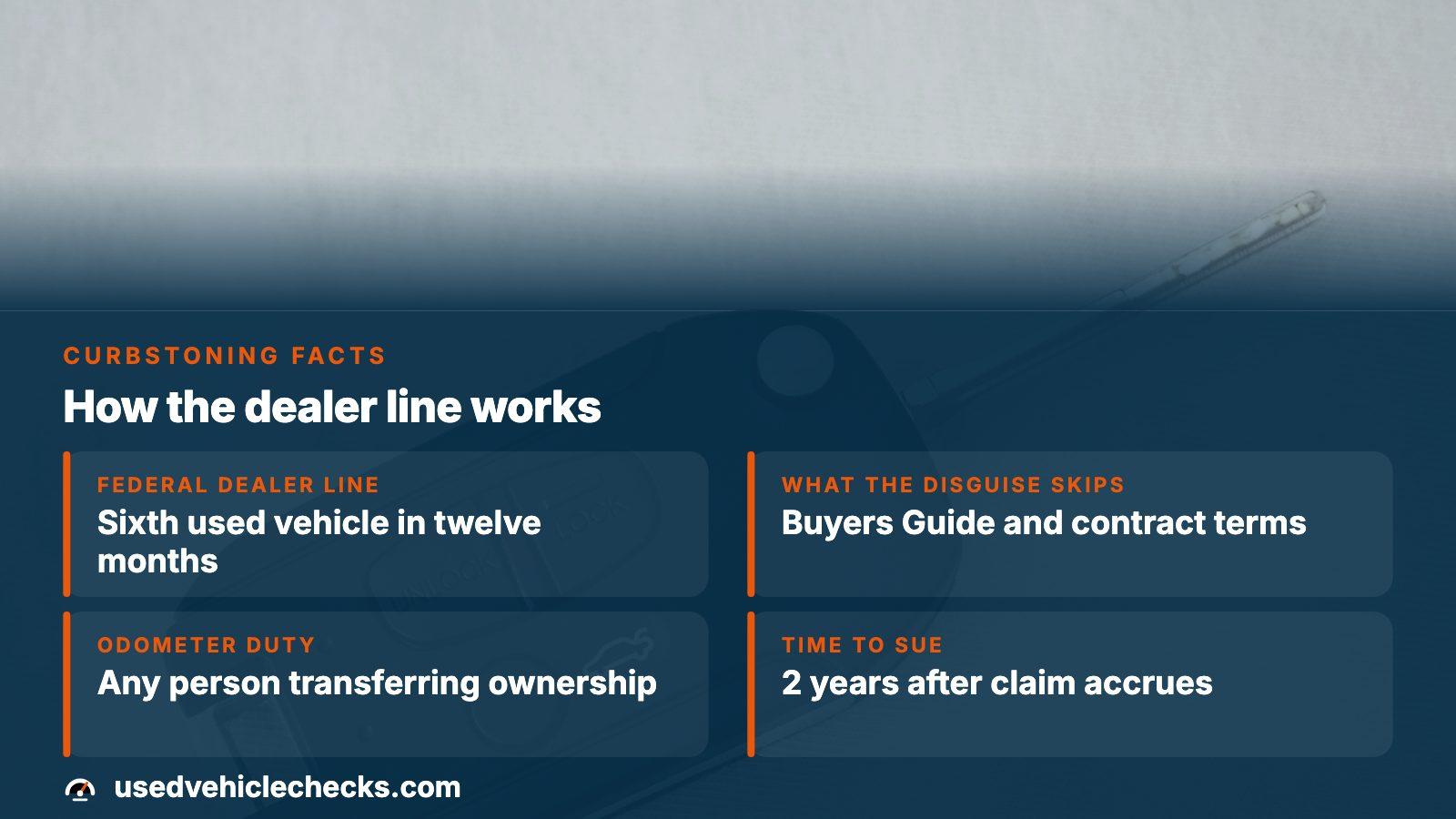
- Federal dealer line
- The sixth used vehicle sold or offered in twelve months
- What the disguise skips
- The Buyers Guide and the contract terms it overrides
- Odometer duty
- Falls on any person transferring ownership, not only dealers
- Time to sue over fraud
- 2 years after the claim accrues
What curbstoning hides, and why mileage is the first test
A curbstoner buys used cars to resell and lists each one as a personal vehicle. The ad reads like a private sale and the handover happens in a parking lot. UsedVehicleChecks starts every car with its mileage, and here the number deserves extra doubt: a reading is only as good as the person who signed for it, and a hidden dealer puts distance between that signature and you. The federal pages reviewed do not say curbstoned cars carry wrong readings as a rule. The point here is narrower: the paper trail is thinner, so the reading needs a second source.
How the Used Car Rule counts a seller's cars
Under 16 CFR 455.1, you tally a seller's used cars over the last twelve months, whether they sold or were only advertised. Once the tally reaches five, the next sale or listing makes that seller a dealer. That car is the sixth, and a listing that never sold still counts.
| Cars sold or offered before this one | Seller's status under the rule |
|---|---|
| Zero to four in twelve months | Private seller; no window form owed |
| Five or more in twelve months | Dealer, with or without a lot or a license |
| A bank, or a business selling to its own employee | Left out of the definition |
States license dealers on their own terms, so the federal count tells you what the seller owes you, not whether the state would call them licensed.
What the disguise takes away
- The Buyers Guide, a window form shown on the car before it is offered.
- A clear word, ahead of the sale, when the car carries no warranty at all.
- A contract that yields to the form: the final window form joins the sale contract and wins over a conflicting clause.
- A ban on side promises that contradict the form.
New York's DMV warned in 2024 that a private sale may cost less, but the buyer gives up dealer protections, a warranty is unlikely, and disputes go to the seller or a court. A curbstoned sale looks private, so that is where you stand.
The odometer statement: whose signature are you relying on?
Federal odometer rules speak of any person who transfers ownership, by sale, gift or otherwise, so a private seller owes you a signed mileage statement just as a dealer does. Under 49 CFR 580.5 the statement names both parties, gives the reading and the date, and identifies the car down to its VIN.
The order of signing matters. A titled owner writes the reading on the title itself. A separate reassignment form enters only after that owner has signed the title over, and, apart from narrow power-of-attorney cases, nobody may sign as both seller and buyer in one deal.
Dealers also keep a copy of each statement for five years. A seller passing as private probably keeps none, so your copy may be the only one.
A title marked mileage exempt
That mark is lawful on an older car. Vehicles of model year 2010 or earlier are exempt from mileage statements once a decade has passed since the start of that model year; for 2011 and later the wait is 20 years. With no signed statement, the ad is all the seller offers.
From an NHTSA owner complaint
A buyer of a 2002 Hyundai Sonata told NHTSA the private seller was told the car had roughly 40,000 to 45,000 miles, yet a parts-store scan read 278,000 and the maker's system showed more than 302,000. The title bore a "mileage exempt" mark, and the seller was not the titled person, which the buyer read as title jumping. The buyer had kept screenshots of the ad.
The complaint does not call the seller a curbstoner or say other cars were sold. It shows a pattern: an unprovable mileage claim, an exempt title and a name mismatch together. Save the ad, and run the VIN first: an exempt title cannot supply dated readings.
Records that do not depend on the seller
A seller's story cannot be audited, but a title record can. A federal NMVTIS report covers five things: the title's state and latest date, brand labels, mileage, total-loss records and salvage records. The Justice Department's page says the odometer entry exposes discrepancies in a car's past, and treats a clean result as good news.
| Record | What it can settle on a curbstoned car |
|---|---|
| Dated odometer readings | Whether the ad and dash sit at or above the last recorded figure |
| Brands, total loss, salvage | Whether a damaged car is sold in silence |
| Ownership and use type | Whether a fleet past was skipped |
A UsedVehicleChecks report sets dated readings beside those entries. Begin with the preview, which costs nothing, then buy the report for a car you still want; amounts are on the pricing page. No record names the seller, so that comparison stays with the title and a photo ID.
Signals to test before you drive out
- Photo ID and title show one name; New York's DMV says the title should sit in the seller's name.
- The VIN plate on the car matches the title.
- Any lender named on the title has released its lien.
- The dash is not lower than any earlier recorded reading.
- One search of the phone number finds no run of other listings.
- A friend's name on the title is the stated reason; ask to meet that friend.
- A seller who claims a dealer license but has no business address gets a license lookup.
None proves curbstoning alone, and each has an innocent version. The name mismatch is the exception, since it is a fact on paper rather than a feeling.
At the meeting: a short routine
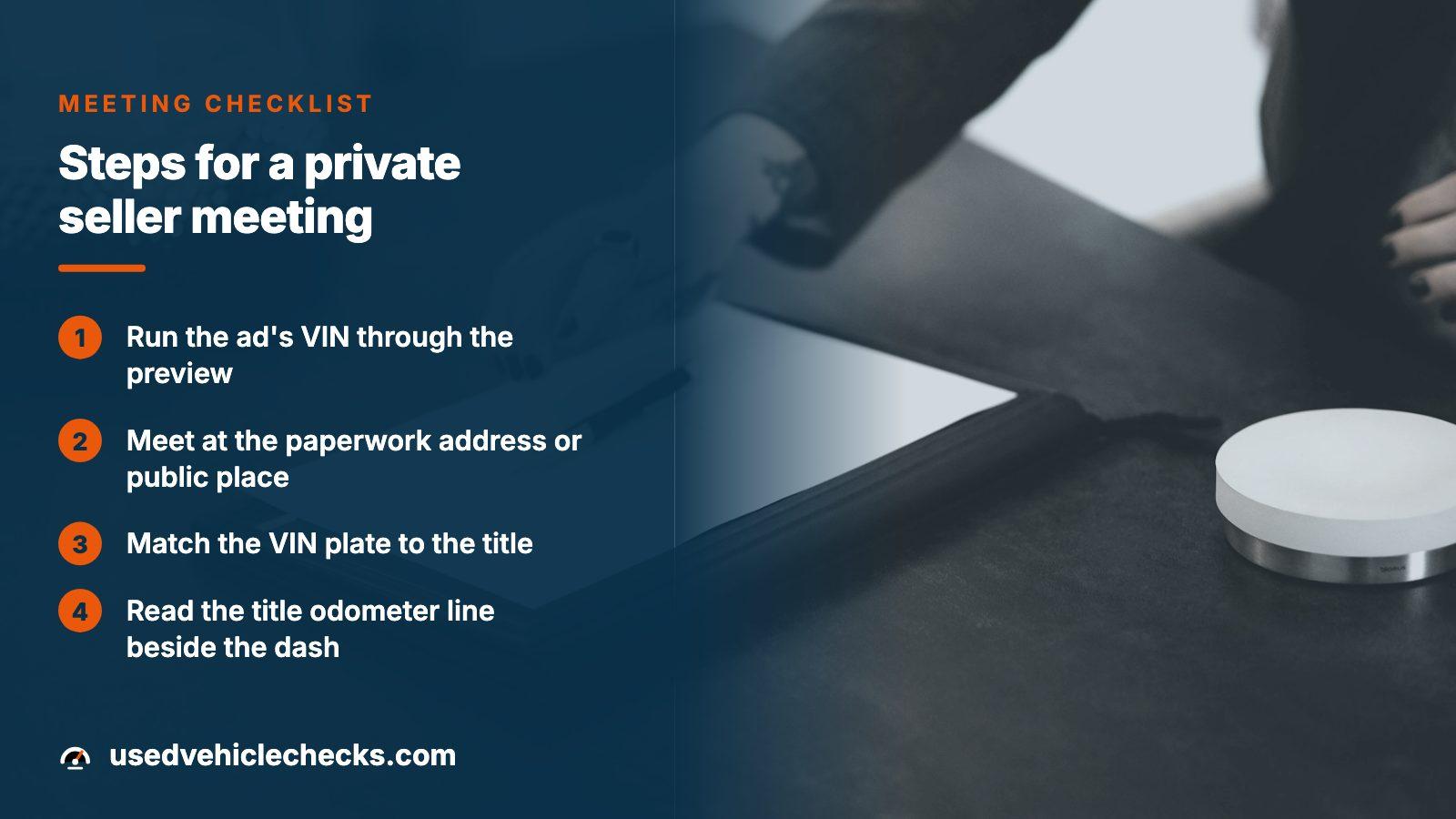
- Run the ad's VIN through the preview first, and note the mileage in the ad.
- Meet at the address on the paperwork, or a public place with cameras.
- Match the VIN plate to the title, then the ID to the printed name.
- Read the title's odometer line beside the dash, and photograph both.
- Hire your own mechanic; the NMVTIS page urges an inspection alongside a report.
- Pay by cashier's check to the seller, as New York's DMV suggests, and leave with a signed bill of sale and mileage statement.
If you already bought one
Keep the listing, the messages and photos of the title, and bring the paperwork to your titling office early. If the mileage proves false, 49 U.S.C. 32710 lets a buyer sue someone who broke the odometer chapter with intent to defraud: the larger of $10,000 or triple the proven loss, plus costs and attorney's fees on a win. The deadline is two years from when the claim accrues.
Reports go to the state motor vehicle agency. California's DMV, for one, lists unlicensed dealers it calls curbstoners and odometer rollbacks among the complaints its investigators take, but only for violations inside California. A seller in another state means a complaint in that state.
Where this information comes from
- 16 CFR part 455: Used Motor Vehicle Trade Regulation Rule — The sixth-car dealer definition, its exclusions, the window form and the contract override.
- 49 CFR part 580: odometer disclosure requirements — Who must disclose, what the statement lists, the signing order, dealer copies and the age exemptions.
- 49 U.S.C. 32710: civil actions by private persons — The damages formula, the fee award and the two-year deadline for an odometer fraud suit.
- NMVTIS: understanding a vehicle history report — The five federal title indicators, the odometer entry and the advice to add an inspection.
- New York DMV: consumer warning on car sales scams — Title-name and VIN checks, the lost protections of a private sale and the cashier's check advice.
- California DMV: filing a complaint for unlawful activities — Unlicensed dealers called curbstoners, odometer fraud complaints and the in-state limit.
- NHTSA owner complaint 11686374 — owner experience, paraphrased
Sources and photos: Facts checked against the sources above in November 2026. Photos by Nikolai Kolosov, Annika Wischnewsky and Shadow Photography on Unsplash; diagrams by UsedVehicleChecks.
Keep reading
- Mileage Check by VIN: What the Recorded Odometer Readings ShowHow to pull dated readings and hold them against the dash.
- Title Check by VIN: A Step-by-Step Check, Odometer Entries FirstWhat the title record shows when the seller's name is not on it.
- Odometer Discrepancy Check: Find a Mileage Mismatch Before You PayWhat to do when the records and the dash disagree.
- How to Buy a Used Car: Start With the Mileage, Then the RecordsThe wider steps that sit around a private sale.
Frequently asked questions
What is curbstoning?
Selling cars again and again as a business while passing as a private owner, so the sale escapes dealer duties. The name is usually traced to cars parked at the curb instead of on a lot. One person selling a personal car is not curbstoning; repetition is the giveaway, and unsold listings count toward it.
Is curbstoning illegal?
Licensing is state law, and a state agency decides whether an unlicensed seller broke it. California's DMV calls it unlawful to provide vehicle-related services, dealing included, without its business license, and names curbstoners among those it pursues. Federally, dealer duties attach by count, so a seller who skips them is out of line either way.
At what point does a seller turn into a dealer under federal law?
At the sixth used vehicle. Once a seller has sold or advertised five in the past twelve months, dealer duties cover the next one, per 16 CFR 455.1. Banks and a few other sellers are excluded. States license on their own terms, so ask your DMV before listing several cars.
Will a VIN report show whether the seller is a dealer?
No. A VIN report describes the car, not the seller. It can show dated odometer readings, brands, salvage and ownership entries, which help you test a mileage claim. Who is selling is settled by the title and a photo ID. New York, for one, offers a search for DMV-regulated businesses.
Is a curbstoned car more likely to have a rolled-back odometer?
No federal source reviewed gives a rate, so none is quoted here. What the rules show is that the reading rests on the signature of whoever transferred the car, and a seller hiding behind another person's title has stretched that chain. Treat the number as unproven until dated records agree with the dash.
Now check the car itself
The guide explains what to look for. The report shows what this VIN has on record.