THE SHORT ANSWER
The Cruze years to avoid are 2012, 2011, 2014 and 2013, which draw between 2.33 and 3.44 times the model's median year of 251 complaints. The years 2018 and 2019 have the lightest records, and engine is the area owners report most. A flagged year means inspecting more closely and reading the mileage history with care. It does not condemn a car whose own record turns out clean.
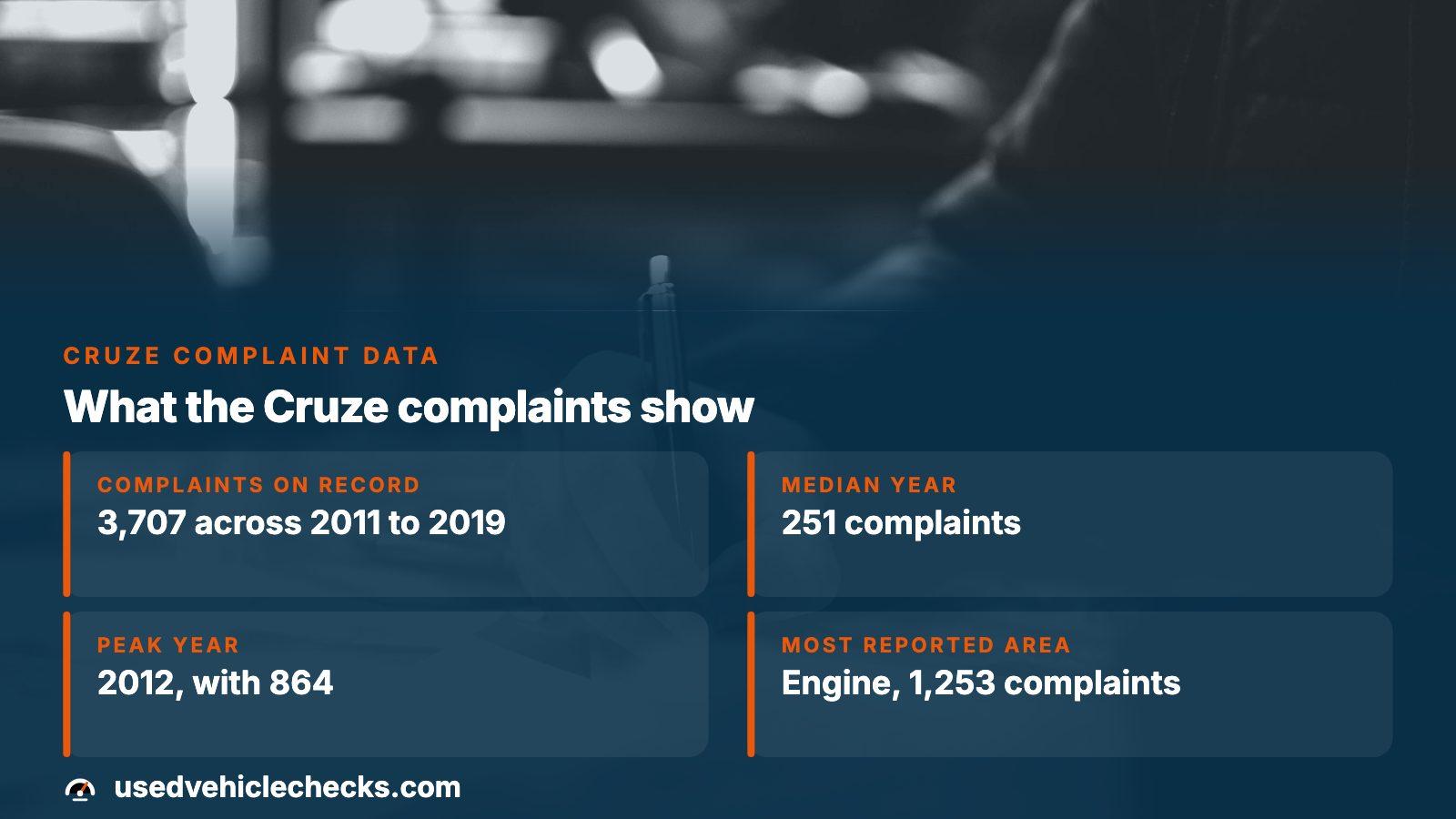
- Complaints on record
- 3,707 across 2011 to 2019
- Median year
- 251 complaints
- Peak year
- 2012, with 864
- Most reported area
- Engine, 1,253 complaints
The four Cruze years that run well above the median
NHTSA holds 3,707 owner complaints for the Cruze across model years 2011 to 2019, and they are lopsided. The middle year draws 251, so each year is judged against the Cruze's own median instead of against other compacts. Four years sit at more than twice that line, and the leading complaint area for every one of them is the engine.
| Model year | Complaints | Times the median | Recalls on file |
|---|---|---|---|
| 2012 | 864 | 3.44× | 7 |
| 2011 | 731 | 2.91× | 7 |
| 2014 | 699 | 2.78× | 10 |
| 2013 | 585 | 2.33× | 5 |
The 2014 year has the longest recall list yet ranks third on complaints. A long list can mean faults were caught and repaired, which beats silence, but every campaign is one more item to confirm on the particular car.
The later years, and why a thin file proves little
From 2015 the counts settle at the median or below: 251 complaints for 2015, 247 for 2016, 201 for 2017, 109 for 2018 and just 20 for 2019. Recalls thin out as well, from four in 2015 and 2016 to two in 2017, three in 2018 and two in 2019.
Take the 2019 figure with salt. Owners of a young car have had little time to write to anyone, so the newest years always flatter themselves. That is why 2018 and 2019 are the cleanest files but not guaranteed winners. A 2016 Cruze still carries four recalls, and campaigns reach ranges of build dates that only the VIN can place.
What Cruze owners say goes wrong
- Engine: 1,253 complaints, the biggest group by a wide margin
- Electrical system: 755
- Power train: 673
- Unknown or other: 382
- Service brakes: 263
- Steering: 167
In the 2011 to 2014 engine complaints, owners keep describing coolant loss, overheating, oil leaks, failed water pumps and turbocharger faults. The engine heading lumps many different faults together, so 1,253 is a ceiling for any single problem and never a count of broken water pumps.
On a test drive, watch the temperature gauge, look for damp residue around the engine bay, and ask the seller whether the car has ever lost coolant or oil between services.
Why the odometer outweighs the year on a Cruze
A flagged year is a label for a whole batch of cars. The one you are buying has either had an easy life or a hard one, and its dated odometer readings show which. The longer a Cruze has run, the longer it has been exposed to the cooling and oil faults owners describe, so the reading is a rough measure of how much of the risk is still ahead of you.
From an NHTSA owner complaint
A 2013 Cruze owner wrote to NHTSA about a car with about 125,000 miles on it, bought a month earlier, that was now leaving oil in the driveway. The mechanic blamed the oil pump cooler. The part was backordered across the country, the shop had to track one down far away, and a second Cruze in the shop had the same leak.
A buyer can take two things from that story. Treat a six-figure reading as a cue for a repair budget and a mechanic's look under the car, and do not take the listing's mileage on trust.
How to read the readings on a flagged Cruze
- Begin with the oldest dated reading and move forward. A healthy history climbs steadily, with gaps that fit how people really drive.
- Hold the newest reading against the dash. A display lower than the last recorded figure must be explained before anyone mentions price.
- Look for plateaus and cliffs: the same figure on different dates, or a long silence followed by a big jump.
- Check the use type. A rental or fleet Cruze may have covered its miles fast, and fast miles load the engine and cooling system harder.
- Set service invoices beside the readings. Mileage on a repair order should sit between two recorded figures.
The report lays out those dated readings next to accident and damage entries, title brands, salvage and auction photos and liens, so each can be weighed against the miles. One mismatch is a question for the seller. Several are a reason to walk.
Recalls follow build dates, not model years
A recall tally by year cannot say which campaign reaches which car. GM's campaign 12V288000 covered 2011 and 2012 Cruzes built between October 2009 and May 2012, because dripping oil could collect on the engine shield near hot parts and catch fire. The remedy was a dealer modification of the shield at no charge. A 2012 Cruze built after that window closed is outside it.
From an NHTSA owner complaint
A 2012 Cruze owner reported that the car restarted on its own at highway speed with the check engine light on. A dealer found a coolant leak, and when it returned, the dealer linked it to that same campaign yet said the VIN was not included. The manufacturer agreed and offered no further help. The car showed 117,969 miles. The complaint does not explain why the dealer made the link.
A recall only costs nothing when it covers your VIN. Run the VIN through NHTSA's recall tool, at no cost, before you read anything into a year's recall count.
A repair on paper is not proof of a fix
From an NHTSA owner complaint
A 2013 Cruze owner described smoke from under the hood and a coolant overheating message while driving. A mechanic who met the owner at the roadside found fractured coolant hoses, and they were replaced. The leak came back about three months later, with roughly 105,000 miles on the car.
A new hose or pump on an invoice shows what somebody paid for, not whether the root fault was found. If the seller says the cooling system was just done, ask which parts, at what mileage, by whom, and whether the same repair shows up twice in the paperwork.
Checking one Cruze before you make an offer
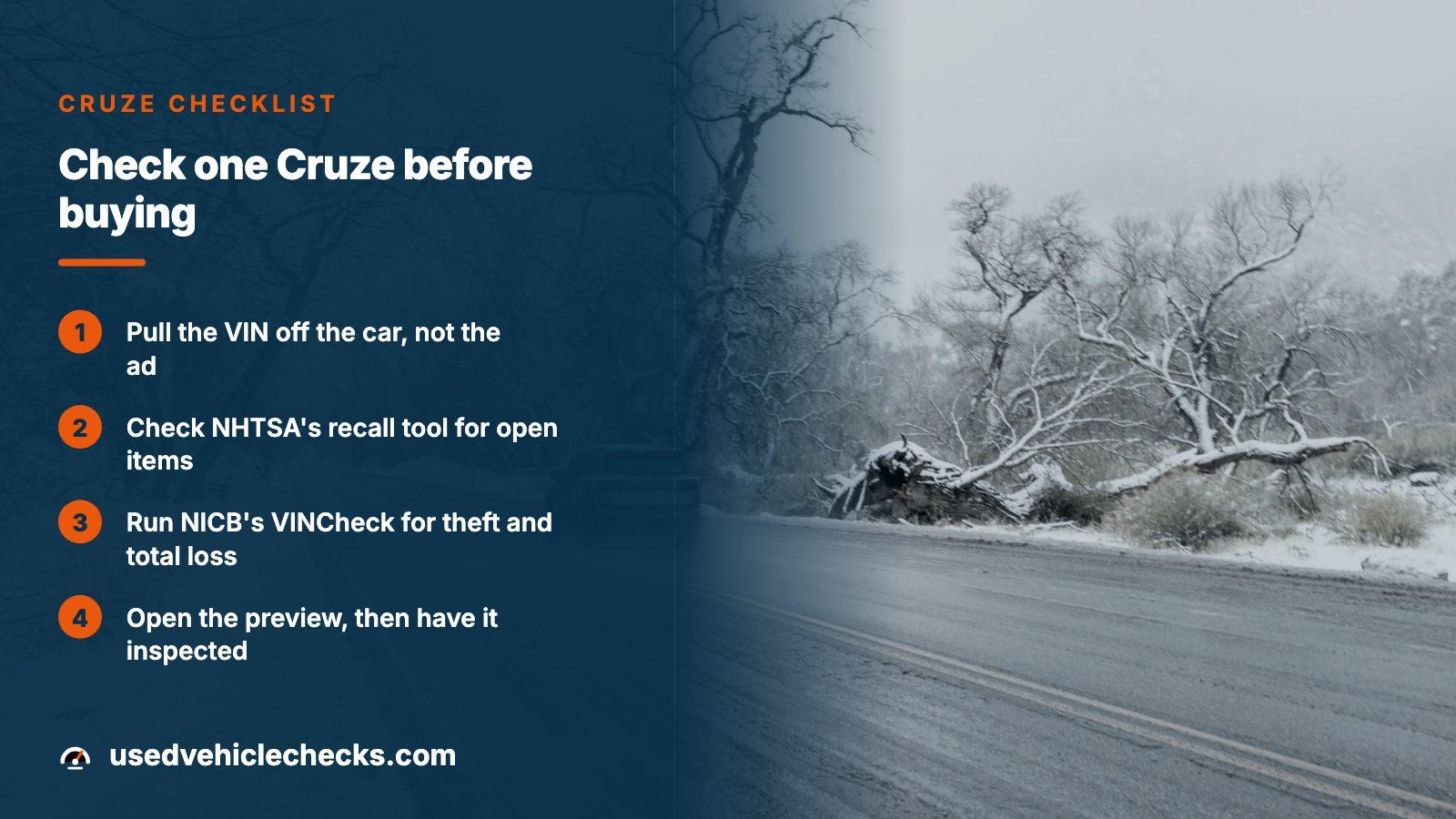
- Pull the VIN off the vehicle rather than trusting the ad, and check that its tenth character matches the model year claimed.
- Look the VIN up in NHTSA's recall tool and note every open campaign.
- Run NICB's VINCheck for a no-cost theft and total-loss screen.
- Open the preview on this site. Once the Cruze makes your final two or three, buy the report and start with the odometer readings, then the damage, title, lien and auction entries.
- Ask a mechanic to pressure-test the cooling system and look over the engine for oil and coolant residue, then use what turns up when you negotiate.
Payment is a single charge with nothing recurring. Take a single report, or choose a pack when you are weighing several Cruzes against each other. The pricing page lists the options.
Where this information comes from
- NHTSA: vehicle safety and owner complaints — The federal agency that receives the owner complaints behind each model-year count.
- NHTSA: recalls by VIN — A no-charge lookup for open recall campaigns on one specific car.
- NHTSA recall campaign 12V288000 — The record for the 2011 and 2012 Cruze engine shield campaign and its build-date window.
- NICB: VINCheck — A quick theft and total-loss screen for one VIN.
- NHTSA owner complaint 11165288 — owner experience, paraphrased
- NHTSA owner complaint 11536269 — owner experience, paraphrased
- NHTSA owner complaint 11492810 — owner experience, paraphrased
Sources and photos: Facts checked against the sources above in November 2026. Photos by Willian Cittadin, Zoshua Colah and Owen Michael Grech on Unsplash; diagrams by UsedVehicleChecks.
Keep reading
- How Many Miles Is Too Many on a Used Car? Age, Pace and ProofDecide what a six-figure reading on a compact means before you shortlist one.
- Odometer Rollback Check by VIN: Run the Mileage Test Before You PayHow to line readings up by date and spot a step backward.
- Toyota Corolla Years to Avoid, and Why the Odometer Matters MoreA rival compact ranked against its own median for a like-for-like comparison.
- Honda Civic Years to Avoid: Complaints, Recalls and MileageAnother compact where the model year matters less than the mileage history.
Frequently asked questions
Which Chevrolet Cruze years should I avoid?
Start with 2012, 2011 and 2014, which hold 864, 731 and 699 filings, while 2013 follows at 585. Avoiding them really means inspecting harder and offering less, since every one of those years also produced sound cars. A steady odometer history and finished recalls count for more than the year alone.
Is the 2012 Chevrolet Cruze a bad car?
It is the year to scrutinize most, with 864 complaints, 3.44 times the median, and 7 recalls on file. That describes the whole year, not one car. A 2012 with every recall done, dated odometer readings that climb in order and a clean mechanic's report is a different proposition from one with gaps in its record.
Which Cruze years are the most reliable?
Complaint counts measure filings, not reliability. The lightest records belong to 2018 and 2019, with 109 and 20 complaints, but young cars look clean partly because owners have had less time to report. Whatever the year, look up open recalls by VIN and have the engine and cooling system inspected.
What do Chevrolet Cruze owners complain about most?
Engine draws the most complaints, 1,253 across 2011 to 2019, then the electrical system at 755 and the power train at 673. Because the engine heading lumps many faults together, read those totals as a hint about where the mechanic's attention belongs, not a tally of one failing part. Leaks of coolant and oil recur in the owner narratives.
How do I check the mileage on a specific Cruze?
Use the VIN. Open the preview on this site, then buy the report if the car is still in the running and read its dated odometer readings from oldest to newest. Compare the latest with the dash and with the mileage on service invoices, and treat any earlier, higher figure as a warning.
Now check the car itself
The guide explains what to look for. The report shows what this VIN has on record.