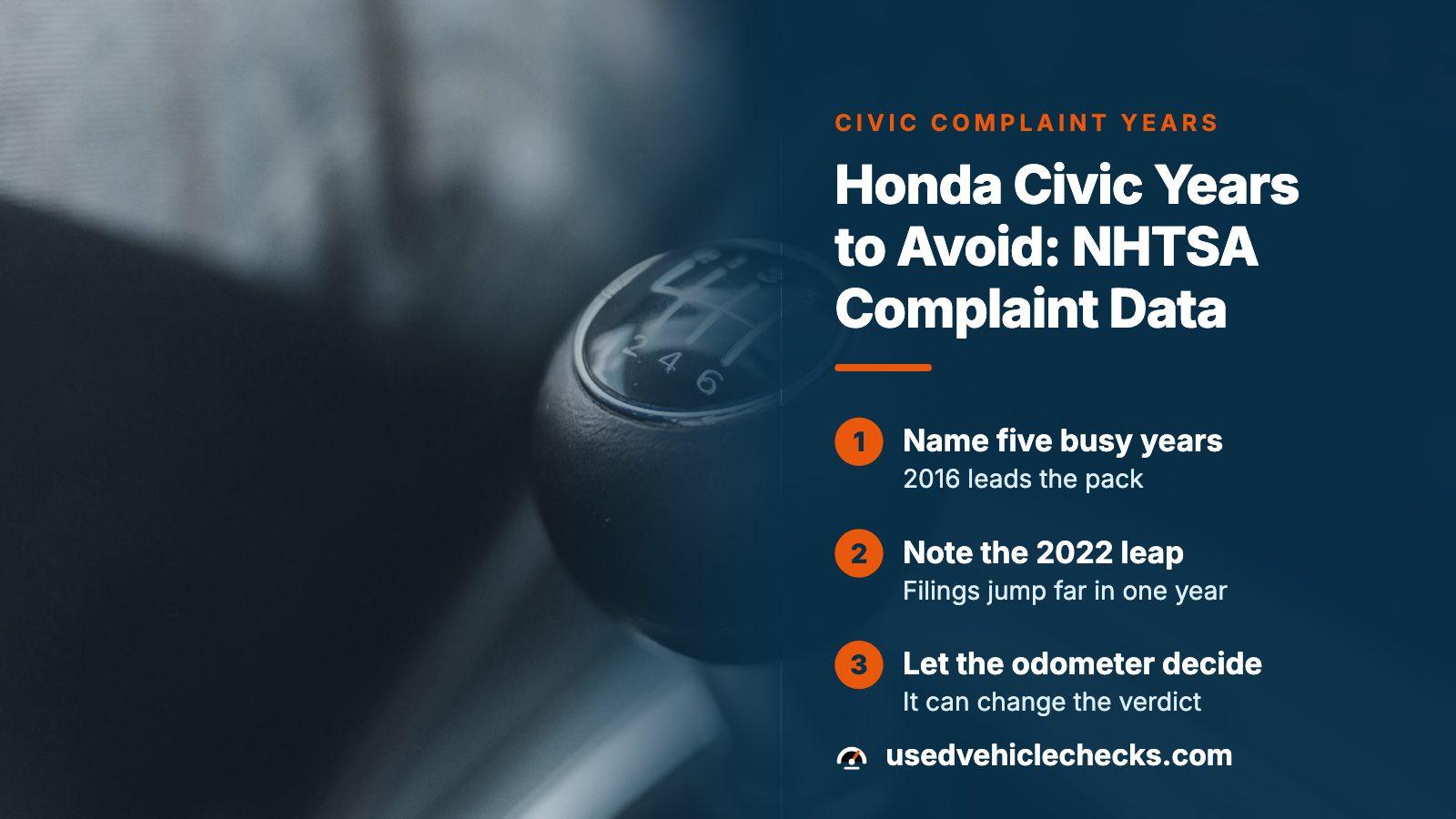
THE SHORT ANSWER
Across 2008 to 2022, the Civic years that deserve the hardest look are 2016, 2008, 2022, 2018 and 2017, each at least 1.37 times the median year of 425 complaints. The lightest settled records belong to 2021 and 2011. Steering is the most reported area overall, at 1,937 complaints. A flagged year is a reason for a longer test drive and a mileage check, not a reason to walk away.
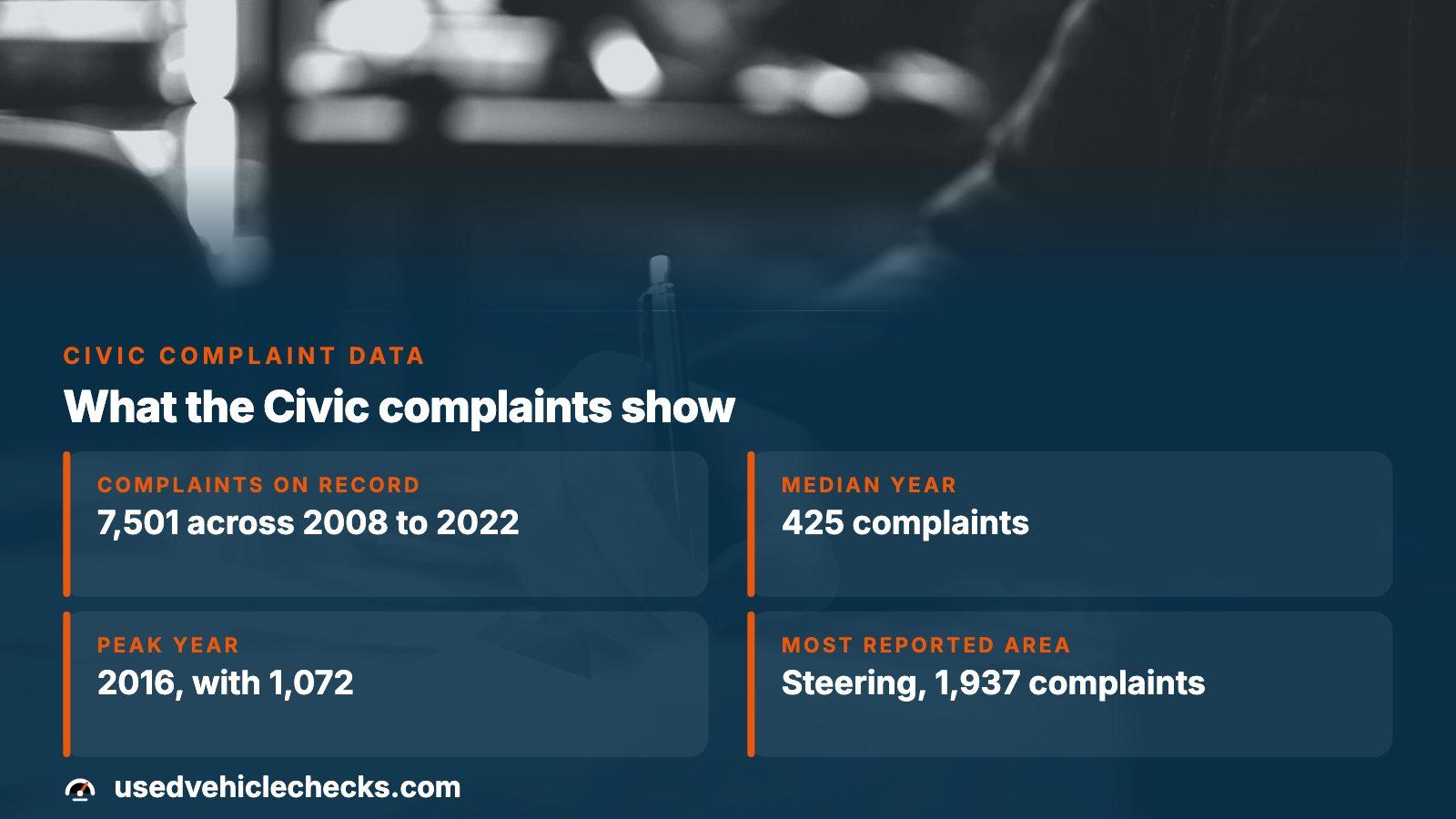
- Complaints on record
- 7,501 across 2008 to 2022
- Median year
- 425 complaints
- Peak year
- 2016, with 1,072
- Most reported area
- Steering, 1,937 complaints
The five Civic years that sit above the pack
As of mid-August, NHTSA held 7,501 owner complaints on the Civic for model years 2008 through 2022. The middle year logs 425, so each year is weighed against that figure instead of against other compact cars. Five years land well above it.
| Year | Owner filings | Versus median | Recalls | Main trouble spot |
|---|---|---|---|---|
| 2016 | 1,072 | 2.52× | 5 | Steering |
| 2008 | 987 | 2.32× | 7 | Air bags |
| 2022 | 954 | 2.24× | 4 | Steering |
| 2018 | 603 | 1.42× | 6 | Steering |
| 2017 | 583 | 1.37× | 6 | Steering |
The first three sit far ahead of the other two, and each has its own story below. Every count is an unverified owner account, so the table shows where to press, not which cars are bad.
2016: steering that sticks at highway speed
About two in five of the 2016 filings are about steering, and most describe one fault: the wheel turns notchy or sticks during small corrections, then lets go. The year's recalls cover an engine part, a marker light, the parking brake, a fuel pump and a seat sensor, none of them steering, so a clean recall lookup does not clear a 2016.
From an NHTSA owner complaint
A 2016 owner who filed in March 2023 said the steering went notchy under about 45 mph and drifted at highway speed, sticking and releasing as often as three times a minute. A Honda dealer blamed the rack itself and quoted roughly $4,800 for a new one, an alignment and labor. The car had about 73,000 miles on it.
Ask a 2016 seller whether the rack has ever been replaced, and ask for the invoice with its mileage. Then drive the car on the highway for a good while before you talk price, since the fault tends to show only after the car has been driven a while.
2022: the leap from 152 to 954
The 2021 year logs 152 complaints and 2022 logs 954, the sharpest step in the table. Roughly five in six of the 2022 filings concern steering, the same sticking, over-correcting wheel. Two NHTSA recalls touch the steering: 23V704 covers replacement racks assembled wrongly, and 24V744 covers a gearbox made incorrectly, adding friction inside so the car takes more effort to turn.
From an NHTSA owner complaint
A buyer who took home a one-owner 2022 Civic Sport with about 34,000 miles filed in March 2023. The wheel stuck and over-corrected on the test drive, and it got much worse on the interstate ride home. Switching off every lane-assist setting changed nothing. The dealership could not reproduce the fault and said parts would take months, so the car went back unrepaired.
A fault that needs miles to show can slip past a ten-minute loop around the block. Look up recalls 23V704 and 24V744 by VIN, and ask whether the steering gearbox has ever been swapped.
2008: air bag recalls and a cracked engine block
Air bags top the 2008 filings, and the recall record agrees: of seven campaigns, six are about the inflator in the passenger-side front air bag, either a rupture risk or a replacement fitted wrongly. The seventh covers a fuel hose bracket. A car this old has usually changed hands, and a notice sent to a former owner can miss the person driving it now.
From an NHTSA owner complaint
The second owner of a 2008 Civic with about 137,500 miles filed in August 2020 after the engine overheated. A Honda shop ran a pressure test on the coolant system and found a crack in the block. The owner said the dealer described a ten-year warranty extension, already expired, that Honda declined goodwill help, and that the repair would top $5,000.
That is one owner's account, but it shows what an aging, high-mileage Civic can cost. Check the VIN for open recalls, then read the odometer record: a 2008 showing far fewer miles than eighteen years of driving would add up to is a flag of its own.
Where the odometer changes the verdict
A year sorts Civics into complaint groups, but only the odometer history shows how hard one car has worked. NMVTIS, the federal title database, includes the odometer reading among five items in its report, to help spot discrepancies.
| What the mileage record shows | What it suggests | What to do |
|---|---|---|
| An even climb with evenly spaced dates | Ordinary use for the car's age | Treat the flagged year as a cue for a longer highway test drive |
| Few miles for a 2008 or a 2016 | Light use, or a figure that needs proof | Ask for service invoices and compare each dated reading with the dash |
| A past reading above today's display | A rollback, or an instrument cluster swap nobody recorded | Ask for the replacement invoice; without one, believe the higher number |
| Miles close to where owners report failures, such as the 73,000 above | A trouble window the car may be entering | Ask whether the rack, gearbox or block has been replaced, and at what mileage |
The cleanest years, and the catch behind them
Two settled years sit well under the median: 2021 with 152 complaints and 2011 with 171, at 0.36 and 0.4 times a typical year. The 2011 year also carries 9 recalls, more than any other, so a thick recall file may only mean faults were found and fixed at the maker's expense.
The newest years look tidy for a simple reason: few owners have had time to file anything. A young Civic can still have lived hard, since rental and ride-share duty adds miles quickly, so a thin complaint file never stands in for the odometer record.
What the complaint numbers cannot tell you
- Popularity: a bestseller attracts more filings than a rare car of equal quality.
- Age: an older year has simply had more time to pile up reports, so the youngest look cleaner than they are.
- The account itself: each filing is one owner's version of events, and nobody has verified it.
- Reach: a year describes thousands of cars, whereas title, damage and mileage records belong to one VIN.
Recalls are a different animal: the maker has admitted the fault and pays for the fix, but only until a car reaches 15 years since first sale.
Checking one Civic before you pay
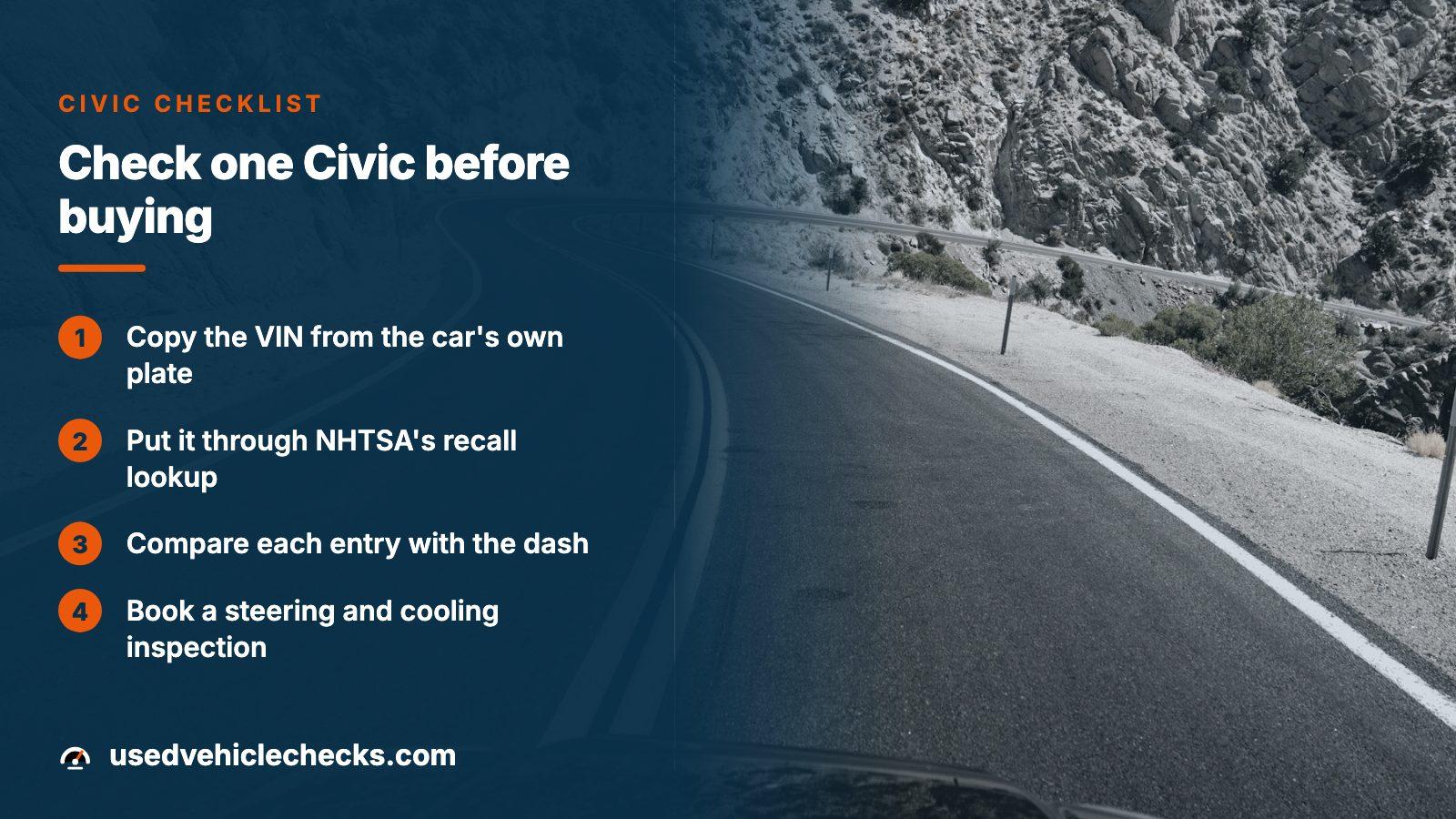
- Copy the VIN from the car's own plate, not the listing, and check that its tenth character matches the year in the advert.
- Put it through NHTSA's recall lookup, a no-charge tool, and write down any open campaign. Steering matters on a 2022, air bag inflators on a 2008.
- Start the free preview on this site. If the Civic is still a contender, buy the report and read its odometer entries first, oldest to newest.
- Compare each entry with the dash and with any mileage printed on service invoices.
- Weigh title brands, salvage or auction photos and accident entries against that mileage story.
- Try NICB's VINCheck, a no-cost theft and total-loss screen.
- Book a mechanic to inspect the steering, cooling system and air bag light, and drive at highway speed for as long as the seller allows.
Payment is once per report, with no subscription; the pricing page shows the single report and the packs for a longer shortlist.
Where this information comes from
- NHTSA: recalls by VIN — A no-charge lookup for open recall campaigns on one specific car.
- NMVTIS: understanding a vehicle history report — What the federal title database's report covers, odometer reading included.
- NMVTIS: used car buying tips — Federal advice on test drives, mechanic inspections and service records.
- NICB: VINCheck — A quick theft and total-loss screen for one VIN.
- NHTSA owner complaint 11514272 — owner experience, paraphrased
- NHTSA owner complaint 11513788 — owner experience, paraphrased
- NHTSA owner complaint 11349887 — owner experience, paraphrased
Sources and photos: Facts checked against the sources above in November 2026. Photos by Erik Mclean, Will Truettner and Owen Michael Grech on Unsplash; diagrams by UsedVehicleChecks.
Keep reading
- Odometer Rollback Check by VIN: Run the Mileage Test Before You PayHow to line readings up by date and catch a step backward.
- Mileage Check by VIN: What the Recorded Odometer Readings ShowWhat a dated list of readings shows for one VIN before money changes hands.
- Toyota Corolla Years to Avoid, and Why the Odometer Matters MoreA compact rival ranked against its own median, for a like-for-like comparison.
- How Many Miles Is Too Many on a Used Car? Age, Pace and ProofWork out whether a high reading on the dash rules a Civic out.
Frequently asked questions
Which Honda Civic years should I avoid?
Start with 2016, 2008 and 2022, which drew 1,072, 987 and 954 complaints against a median year of 425. Every one of those years still has sound cars, so use the flag to justify a longer test drive, a mechanic's inspection and a look at the mileage record.
Is the 2016 Honda Civic a bad car?
Not automatically, but it is the year to inspect hardest. It tops the table with 1,072 filings, 2.52 times the median, mostly about steering. Ask whether the rack was ever replaced, drive at highway speed for a good while, and read the odometer history before making an offer.
Which Civic years are the most reliable?
Filings measure complaints, not reliability, but 2021 and 2011 carry the lightest settled records, at 152 and 171. Newer cars look clean mostly because few owners have filed yet, so check open recalls by VIN, and read the odometer record, whatever the year.
Which part of a Civic gives owners the most trouble?
Steering, with 1,937 complaints across 2008 to 2022, ahead of the 888 filed as unknown or other and the 858 about air bags. A long highway drive is the quickest test for a sticking wheel, and a mechanic should look over the rack and gearbox.
How do I check the mileage on a specific Civic?
Use the VIN. Open the free preview on this site, buy the report if the car stays in the running, and read the dated odometer readings from oldest to newest. A figure above today's dash is a warning to settle before any money moves.
Now check the car itself
The guide explains what to look for. The report shows what this VIN has on record.