
THE SHORT ANSWER
Avoid 2012 unless the transmission recall is documented as done and the mileage history is clean. The 2013 and 2014 years are the next worst, with electrical and coolant complaints. The Sonic's worst years are the oldest ones. The 2016 through 2020 cars have thin files, with 48 complaints or fewer per year.
- Complaints, 2012 to 2020
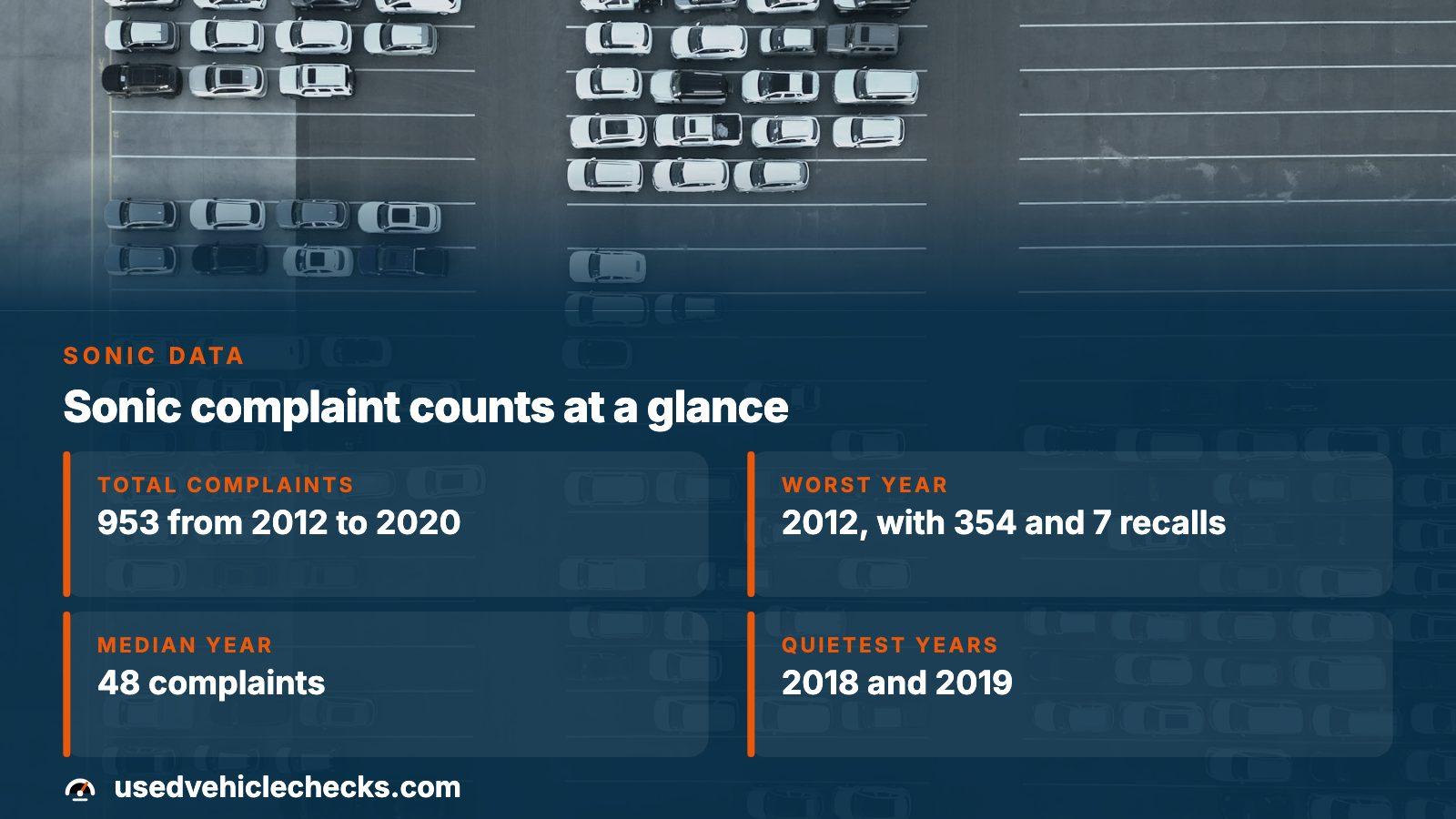
- 953 in total
- Worst year
- 2012, with 354 complaints and 7 recalls
- Median year
- 48 complaints
- Quietest years
- 2018 and 2019, with 15 and 8
Every Sonic year ranked against the model's own median
The Sonic sold for nine model years in the data, and owners filed 953 complaints across them. The spread is steep. The middle year, 2016, has 48, so the table below measures each year against that line instead of against other small cars. Four years clear it by a wide margin.
| Model year | Complaints | Times the median | Recalls |
|---|---|---|---|
| 2012 | 354 | 7.4 | 7 |
| 2013 | 217 | 4.5 | 6 |
| 2014 | 150 | 3.1 | 4 |
| 2015 | 114 | 2.4 | 3 |
| 2016 | 48 | at median | 2 |
| 2017 | 37 | below | 0 |
| 2018 | 15 | below | 1 |
| 2019 | 8 | below | 0 |
| 2020 | 10 | below | 0 |
Crash scores are not the issue. NHTSA gives the 2012, 2013, 2015, 2017 and 2019 four-door Sonic five stars overall, so the question is reliability and repair cost.
Why 2012 sits at the top
Of the 354 complaints on the 2012 car, 154 sit under power train, more than any other area on any Sonic year. Owners describe a car that stops upshifting, stalls, or loses power on the highway and refuses to leave first gear.
GM's campaign 14V315000 is the backdrop. It reaches 2012 Sonics assembled between March 1 and June 29 that pair the 1.8L four-cylinder with the six-speed automatic, where the turbine shaft inside the gearbox can fracture. A car that fails this way will not shift out of first or second, so speed is capped. The dealer remedy is a new turbine shaft at no charge, and the campaign began in August 2014.
The 2012 year also carries three separate driver air bag recalls for one shorting-bar fault, plus a missing brake pad campaign, a washer hose campaign and a block heater cord campaign. Seven recalls is the longest list of any Sonic year.
2013 and 2014: fewer gearbox stories, more electrical and coolant trouble
Power train drops out of the lead after 2012. In 2013 the top areas are electrical system with 56 complaints and engine with 55, and in 2014 electrical leads again with 49. Coolant shows up in summaries 11 times for 2013 and 12 times for 2014, with owners describing lost coolant, overheating and, on one 2013 car, a blown head gasket.
- 2013: a turn signal fault the body control module did not flag (12V454000), flashing brake lamps (13V220000) and weak welds on a fuel tank strap bracket (13V464000).
- 2013 and 2014 share the fuel tank bracket campaign, limited to cars built in a narrow stretch of August 2013.
- 2013 also picked up an air bag inflator recall in July 2023 (23V516000), which can seriously injure occupants if the inflator ruptures.
- 2014: a steering column connection fault that could limit the driver air bag to its first stage (14V543000), for cars built in a few days around late July and early August 2014.
The later years, and what a short file does not prove
Counts fall from 114 for 2015 to 48 for 2016 and 37 for 2017, then to 15, 8 and 10 for the last three years. Recalls fall too: nothing for 2017, 2019 or 2020, and one for 2018, a driver seat-back frame weld (18V342000).
Be careful with that quiet end. A newer car has had fewer owners with the time to write in, so 2018 to 2020 will always look better than 2012. They are the best bet in the range, not a guarantee. In 2017 engine was still the biggest heading, with 19 of 37 complaints, so the quiet years are not fault free.
What a failed Sonic transmission looked like to its owners
From an NHTSA owner complaint
An owner who bought a 2012 Sonic with 33,688 miles wrote that it had several recalls, including the transmission one GM listed as resolved. Three weeks later the car hesitated, lurched and bucked when slowing, and a $3,200 transmission rebuild had to be booked.
The lesson is that a closed recall on paper did not guarantee a healthy gearbox, and low miles did not either. Ask the seller for the work order, not just a verbal assurance.
From an NHTSA owner complaint
Another 2012 owner lost power on a highway at night and could only coast to the shoulder. The car would run in first gear only, and it was towed 35 miles. A garage called the transmission finished at about 90,000 miles, with a rebuild near $3800.
Put the two together and you get a rough repair figure for a 2012 and a mileage range where it can arrive. Price a possible rebuild into the offer on any car that has not had one.
Recalls follow build dates, not model years
A recall count by year cannot say whether the Sonic in the driveway is in scope. The transmission campaign, for example, reaches only 2012 cars built in a four-month window with one engine and one gearbox. A 2012 built outside it may never have been in the campaign, and a 2013 or 2014 can be caught by a different one.
That is why the 17-character VIN matters more than the year. Run it through NHTSA's free recall lookup to see open campaigns, then read the service records for the ones already completed.
Why the odometer history can outweigh the model year
A flagged year is a label on a whole batch of cars. This one Sonic has had either a gentle life or a hard one, and the dated odometer readings show which. A 2012 with a long, steady record of readings and a documented transmission repair is a better buy than a 2015 whose mileage jumps backward or goes missing for years.
The report from UsedVehicleChecks sets those readings in date order beside any title brands, crash and damage entries and salvage records. A step down in miles, or a gap that matches a damage entry, is a question for the seller. The title records in such a report come from a federal database aimed at fraud and stolen cars.
Checking one Sonic before you make an offer
- Find the VIN stamped on the Sonic and see whether it matches the one printed on the title paperwork.
- Put that VIN into the free NHTSA recall lookup and list every open campaign, the gearbox and air bag ones above all.
- Try NICB's free tool for a quick theft and total-loss screen.
- Open the free preview here, then, if the car stays on your list, buy the report and go through the mileage entries in date order.
- Request invoices for gearbox, cooling or air bag work, then have an independent mechanic road-test it.
Seeing the preview costs nothing. The complete report is paid once, with nothing recurring, and buyers comparing a few Sonics can look at multi-report packs. Details are on the pricing page.

Where this information comes from
- NHTSA complaints API: 2012 Chevrolet Sonic — The federal record behind the yearly complaint counts and the power train split.
- NHTSA recalls API: 2012 Chevrolet Sonic — Campaign numbers, build windows and remedies used in the recall sections.
- NMVTIS: VehicleHistory.gov — The federal title information system and why it exists.
- NICB: VINCheck — A free theft and total-loss screen for a single VIN.
- NHTSA owner complaint 11503393 — owner experience, paraphrased
- NHTSA owner complaint 11575685 — owner experience, paraphrased
Sources and photos: Facts checked against the sources above in November 2026. Photos by Erik Mclean, Mustafa Sheikhmouss and Iain on Unsplash; diagrams by UsedVehicleChecks.
Keep reading
- Chevrolet Cruze Years to Avoid: Complaints and Odometer ChecksThe Sonic's larger sibling, ranked the same way against its own median.
- Chevy Trax Years to Avoid, Ranked by NHTSA Complaint and Recall CountsAnother small Chevrolet with recalls that overlap the Sonic's radio campaigns.
- How Many Miles Is Too Many on a Used Car? Age, Pace and ProofDecide what a high reading means before you shortlist a small car.
- Odometer Rollback Check by VIN: Run the Mileage Test Before You PayHow to line up readings by date and catch a step backward.
Frequently asked questions
What is the worst year for the Chevy Sonic?
The 2012 model, with 354 NHTSA complaints and 7 recalls, the highest of any year. Most trouble sits in the transmission, with 154 power train complaints. The 2013 and 2014 years follow. A 2012 with documented transmission work and a steady mileage record is a much safer purchase.
Are any Chevrolet Sonic years reliable?
The 2017 through 2020 cars have the lightest files, between 8 and 37 complaints a year. That is encouraging, but the newest cars have had little time to pile up reports. Even 2017 still lists engine as its biggest area, so inspect the car regardless.
How much does it cost to rebuild a Sonic transmission?
Two owners told NHTSA of quotes of $3,200 and about $3800 for 2012 cars. Those are individual quotes, not a national price, and shops vary. Treat them as a rough planning figure when a car has not had the repair.
Does a closed recall mean the Sonic is fixed?
Not always. A recall covers one specific fault on cars built in a set window. One owner reported a gearbox failure after the transmission recall was listed as resolved. Ask for the dealer paperwork and check the VIN on NHTSA's lookup.
Can a VIN check tell me which Sonic to buy?
It cannot judge mechanical condition, but it lists dated odometer readings, title brands, crash and damage entries and salvage history for that car. That helps separate a gently used Sonic from a risky one before a mechanic looks at it.
Now check the car itself
The guide explains what to look for. The report shows what this VIN has on record.