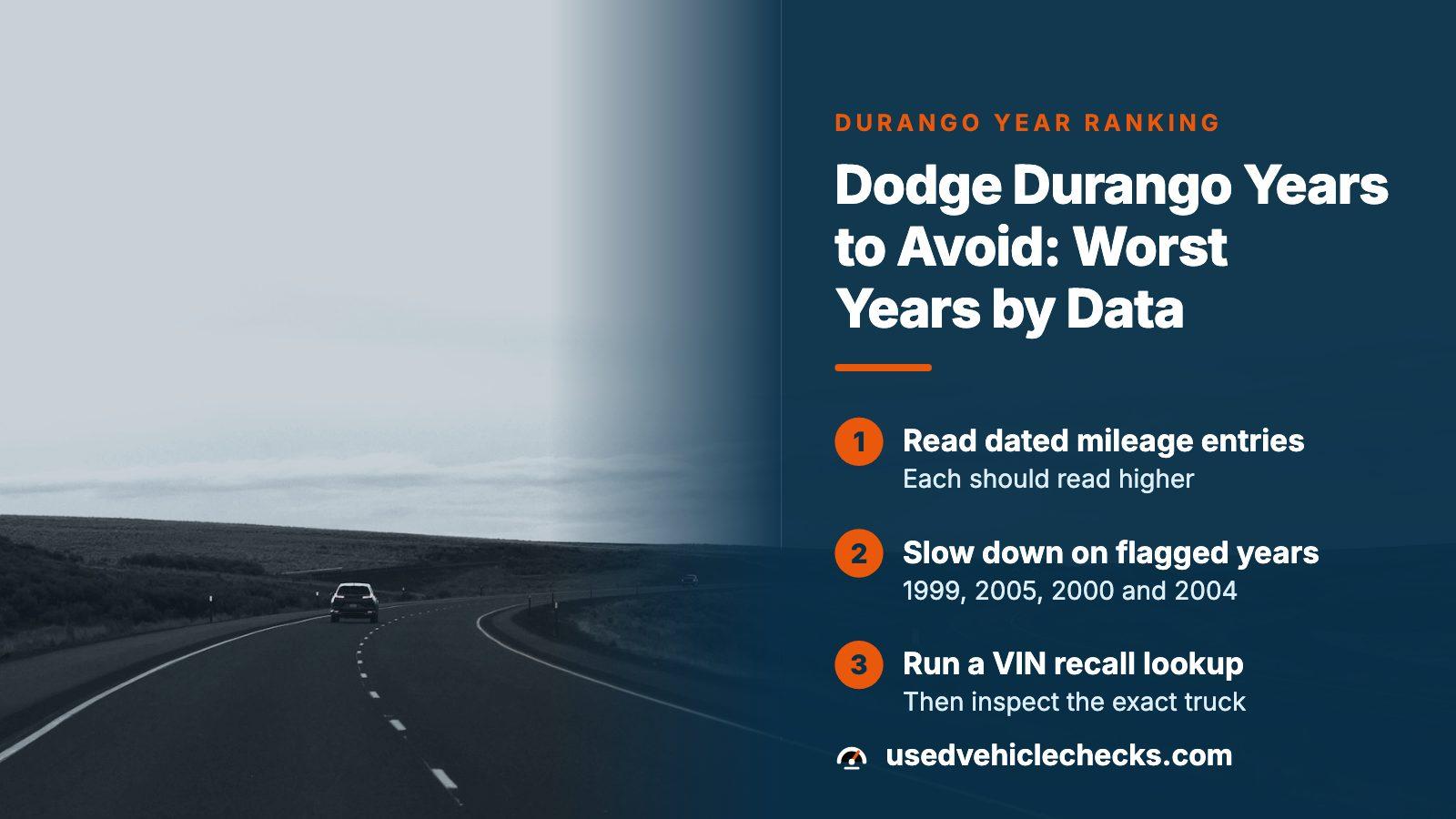
THE SHORT ANSWER
Of 26 model years with data, the heaviest complaint loads belong to 1999, 2005, 2000 and 2004, plus 2011 for the newer body style. The median year has about 388 complaints. The cleanest records are 2016 to 2024, though young years always look light. A flagged year means a slower inspection, a VIN-based recall lookup and close reading of the dated mileage entries.
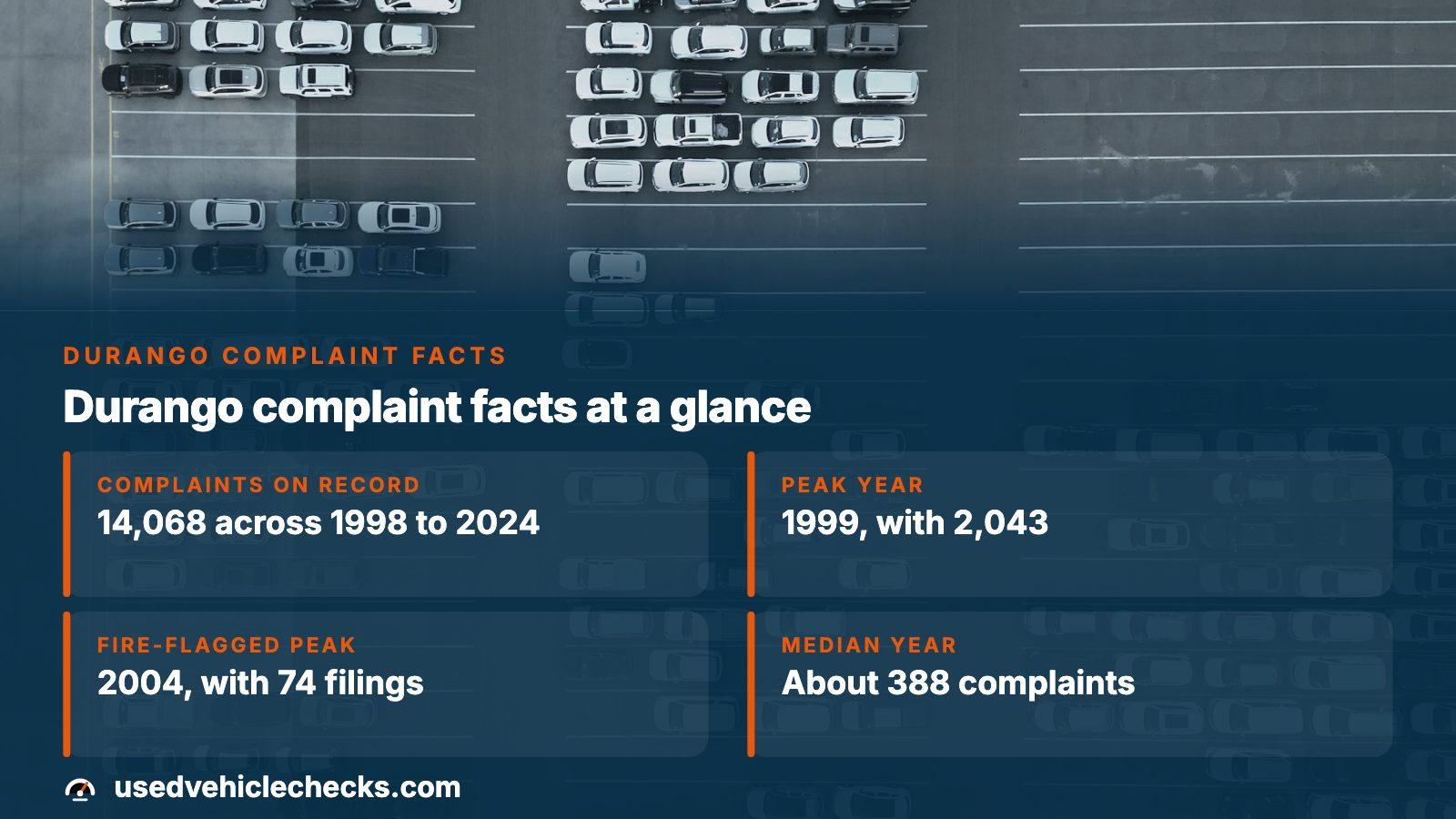
- Complaints on record
- 14,068 across 1998 to 2024
- Peak year
- 1999, with 2,043
- Fire-flagged peak
- 2004, with 74 filings
- Median year
- About 388 complaints
Five years that tower over the median
I pulled every Durango complaint and recall from NHTSA's public interfaces on 2026-11-07, covering model years 1998 to 2024. That is 14,068 owner complaints, and they are lumpy. With a median of about 388 per year, five years stand clear of the rest.
| Year | Complaints | Fire-flagged | Recalls | Most-named area |
|---|---|---|---|---|
| 1999 | 2,043 | 24 | 5 | Suspension |
| 2005 | 1,567 | 21 | 9 | Fuel system |
| 2000 | 1,116 | 33 | 4 | Suspension |
| 2004 | 1,115 | 74 | 9 | Engine |
| 2011 | 800 | 57 | 8 | Electrical |
Complaints are unchecked owner reports. A recall is a formal campaign the maker has filed. The columns therefore measure different things. Older years also had longer to collect filings, which inflates their totals a little.
1998 to 2003: suspension trouble and a long tail
The earliest years add up to 5,641 complaints. Suspension drives the worst of them: 1,128 of the 2,043 filings for 1999 and 514 of the 1,116 for 2000. Crash flags peak here too, at 111 in 1999 and 118 in 2000, with 172 injuries recorded for 1999.
By 2003 the count drops to 339, so the early years are not uniformly bad. They are old, though. Any Durango from this stretch has had decades to wear out bushings, ball joints and wheel bearings, and a low odometer reading on one of them deserves suspicion rather than applause.
2004 to 2009: the fire flags and the filler-neck recall
This band logs 3,925 complaints. The 2004 year carries 74 fire-flagged filings, the highest of any Durango year, with engine, electrical and air bag complaints leading. The 2005 year draws fuel system complaints, 553 of its 1,567.
A real campaign sits behind part of that. In 2009 the maker recalled 18,951 model year 2005 Durangos because the filler tube's check valve might not seal after refueling, letting gasoline escape and creating a fire risk. Dealers were to inspect the valve and replace the tank assembly at no charge. Years 2008 and 2009 fall to 97 and 19 complaints, though the 2009 year still shows 4 recalls.
From an NHTSA owner complaint
A 2005 owner wrote in 2024 that gasoline was spilling from the filler neck during fill-ups, even though the SUV had gone through the 2009 recall repair. The failure came back at roughly 180,000 miles, and no mechanic or dealer had looked at it yet.
For a buyer, a recall marked complete is no guarantee that the repair held. Ask for the repair paperwork, and smell around the filler door.
2011 to 2014: an electrical story with a stall recall
The API returns nothing for 2010, then 2011 arrives with 800 complaints, 514 of them naming the electrical system, and 57 flagged for fire. The next two years log 640 each, with electrical still on top. Recall counts climb to 10 for 2012 and 11 for both 2013 and 2014.
The best-known campaign concerns the fuel pump relay in the power module. It can fail and stall the engine with no warning. The first remedy moved the relay outside the module. A later campaign in November 2019 covered 2011 to 2013 vehicles fitted with the larger V6 and V8 options (3.6, 5.7 and 6.4 liter), replacing the relay and part of the wiring harness. Owners received interim notices from December 2019, and letters for the final remedy went out in December 2020.
From an NHTSA owner complaint
A 2011 owner reported in 2026 that the SUV stalled while being started, at about 182,000 miles. In the owner's account, the 2019 recall list left out this VIN even though the failure matched. The owner had not yet taken it to a dealer.
So the year alone settles nothing. Recall coverage follows VIN ranges, so two Durangos built the same year may land on different sides of a cutoff.
2014 and later: lighting complaints replace engine ones
The 2014 year logs 786 complaints, but the mix changes: exterior lighting leads with 260, seats follow with 165, and electrical takes 150. It also records 60 injuries and 11 recalls, the heaviest recall load of the later years.
- 2015: 505 complaints, 4 recalls, lighting first with 197
- 2016: 161 complaints, 3 recalls
- 2017: 214 complaints, 2 recalls
- 2018: 233 complaints, 5 recalls, electrical first with 87
- 2021: 208 complaints, 8 recalls, lighting first with 94
Counts for 2022 to 2024 are 61, 39 and 14, but those vehicles have had little time to collect complaints, so a light record is partly just youth.
Why the odometer history beats the model year
Both owner stories above involve readings near 180,000 miles, and both describe repairs that did not stick. A Durango that has covered that distance is expected to wear. What you cannot afford is a reading that was never real.
A rolled-back or swapped cluster can make a worn 2005 look like a gentle one, and it would hide exactly the suspension, fuel and electrical wear this page describes. Dated readings from titles, inspections and service stops, laid side by side, expose a step backward.
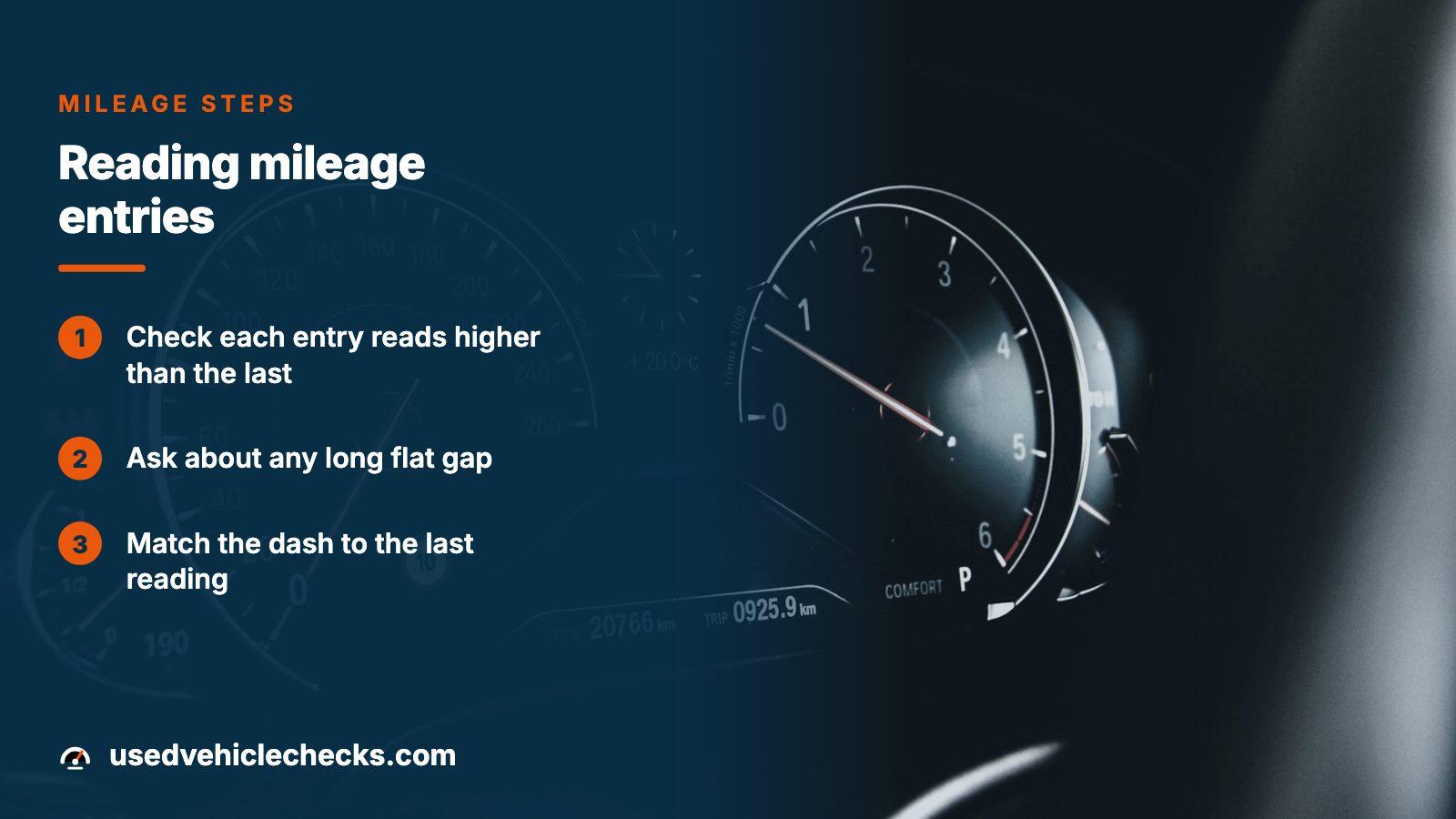
- Every entry should be dated later and read higher than the entry before.
- A long flat gap between readings deserves a question to the seller.
- The dash figure should land close to the last recorded reading plus normal use.
What to run on the exact Durango before paying
Start with the VIN printed on the dash plate and the driver's door jamb, then compare it with the title. A free preview on this site's VIN page shows whether records exist, and the paid report lays out the dated odometer readings, title brands, and any accident or salvage entries. See the pricing page for how a single report or a pack works.
Then run the federal recall lookup on the same VIN, because campaign coverage follows VIN ranges. Open items on a 2011 to 2013 Durango, such as the stall recall, are worth settling before money changes hands.
The Justice Department's vehicle history site describes NMVTIS as a federal title database meant to shield buyers from fraud and dangerous cars, and to stop thieves reselling stolen ones. A title record cannot tell you how a transmission was treated, so pair it with a pre-purchase inspection.
Turning the ranking into an offer
Treat 1999, 2000, 2004, 2005 and 2011 as years that need more proof, not automatic rejections. A flagged year with steady odometer readings, a clean title and receipts for the known repairs can still be a fair purchase. A clean year with a mileage gap and no paperwork is the riskier car.
If a seller dismisses the questions or refuses a VIN check, that tells you more than any complaint table.
Where this information comes from
- NHTSA complaints API: Dodge Durango by model year — The federal feed behind every yearly complaint, crash, fire and injury count.
- NHTSA recalls API: Dodge Durango by model year — Campaign numbers, dates, and remedies for the stall and filler-neck recalls.
- VehicleHistory.gov: NMVTIS — The Justice Department page describing the national title record program.
- NHTSA owner complaint 11592499 — owner experience, paraphrased
- NHTSA owner complaint 11744294 — owner experience, paraphrased
Sources and photos: Facts checked against the sources above in November 2026. Photos by John Kakuk, Viktor Theo and Iain on Unsplash; diagrams by UsedVehicleChecks.
Keep reading
- Jeep Grand Cherokee Years to Avoid: Complaints and MileageA close mechanical relative that shared the relay recall, ranked against its own median.
- Mileage Check by VIN: What the Recorded Odometer Readings ShowHow to pull the dated mileage history for one specific vehicle.
- Odometer Rollback Check by VIN: Run the Mileage Test Before You PayWhat a step backward in the readings looks like.
- How Many Miles Is Too Many on a Used Car? Age, Pace and ProofDecide what a high reading means before a Durango makes your shortlist.
Frequently asked questions
What is the worst year for the Dodge Durango?
By raw complaints it is 1999, with 2,043 filings, followed by 2005 with 1,567. For fire-flagged filings the peak is 2004, with 74. Counts depend partly on age, so treat the worst year as a prompt for a deeper inspection of that vehicle, not a verdict.
Are newer Durangos safer bets than old ones?
Complaint counts are much lower from 2016 on, ranging from 161 down to 14. Part of that is simply less time on the road. A newer SUV can still carry open recalls, so a VIN-level recall lookup applies to every year.
Does a 2011 to 2013 Durango have a stall recall?
NHTSA lists a fuel pump relay campaign for those years, and the 2019 version names three engine sizes. Coverage depends on the VIN, so check the exact vehicle. One 2011 owner said the VIN was missing from the list despite an identical symptom.
How do I know a high-mileage Durango's odometer is honest?
Collect dated readings from the title, inspections and service visits, then confirm each is later and higher than the last. A drop, a long flat gap or a dash reading far below the record means you should walk away or demand proof.
Do complaints prove a model year is defective?
No. NHTSA complaints are unverified owner reports and can overlap with recalls or duplicate each other. They show where owners report trouble. Recalls and inspection findings on the specific vehicle carry more weight than the complaint total.
Now check the car itself
The guide explains what to look for. The report shows what this VIN has on record.