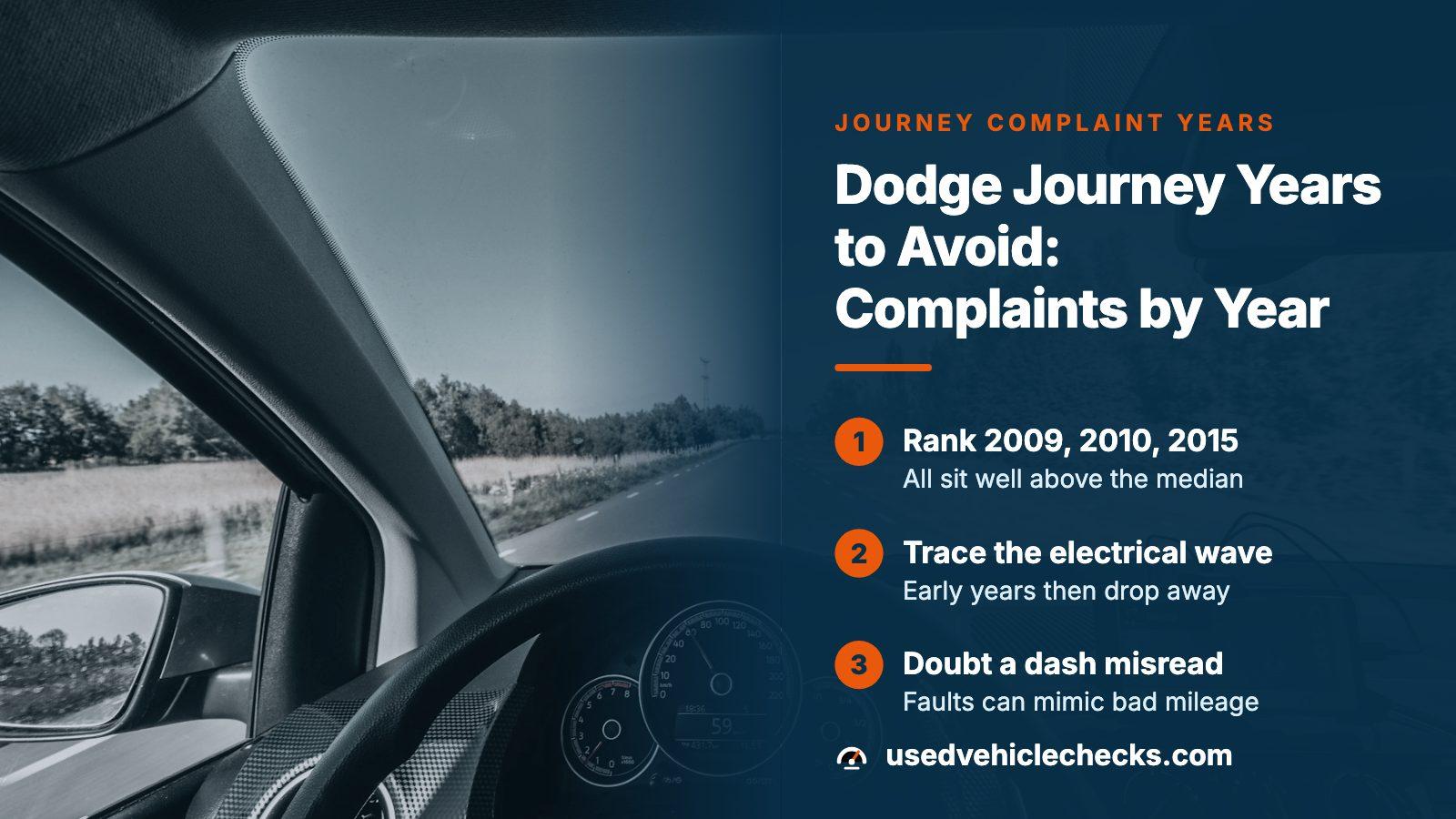
THE SHORT ANSWER
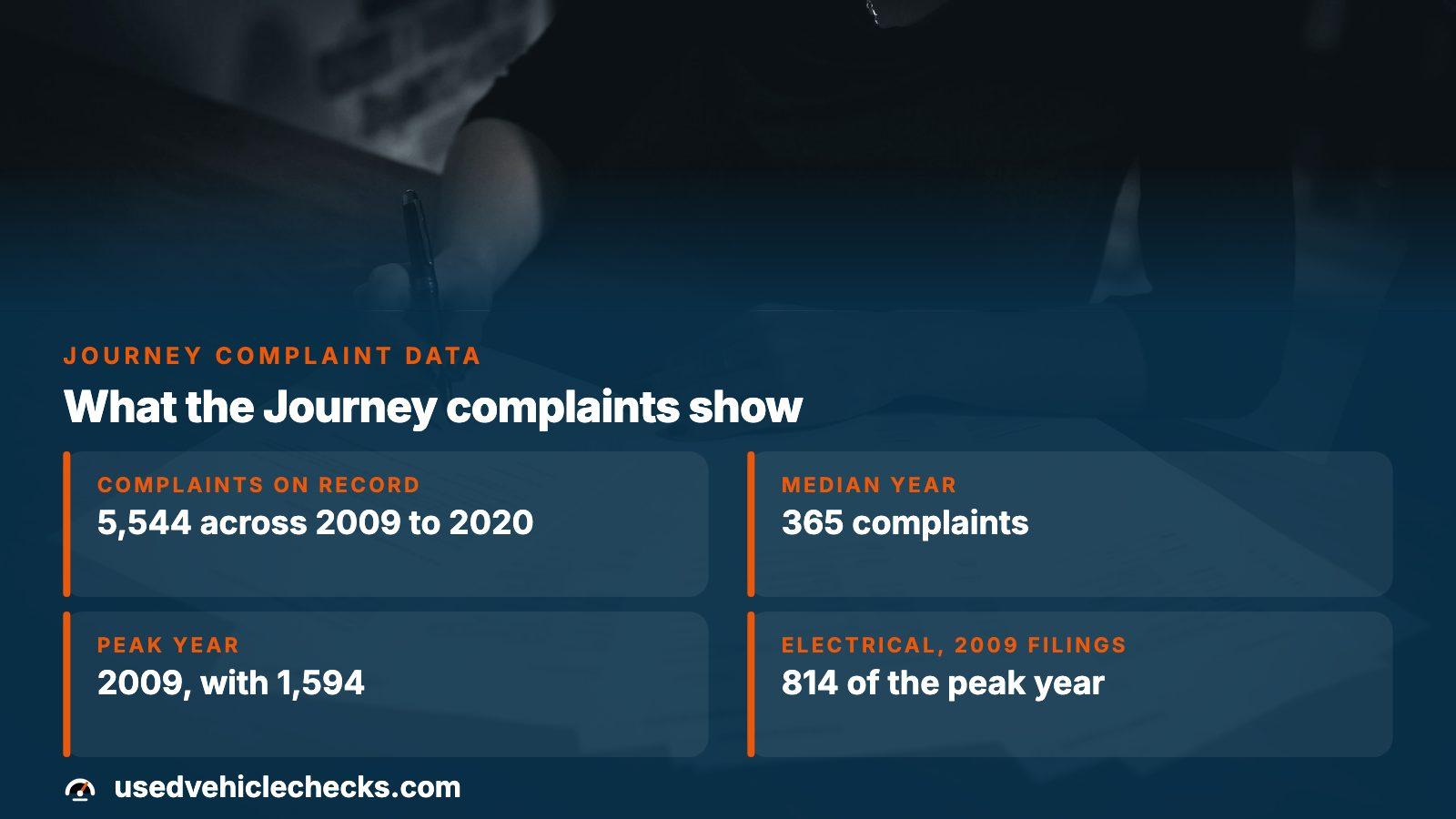
Across model years 2009 to 2020, three Journey years deserve the closest look: 2009, 2010 and 2015, each well above the median of 365 complaints. The lightest records belong to 2020, 2019 and 2011, though the youngest years always look clean. Electrical filings lead in 2009 and 2010, engine filings in 2015. A year on the flagged list means a longer walk-around and a hard look at the mileage history, never a blanket rejection.
- Complaints on record
- 5,544 across 2009 to 2020
- Median year
- 365 complaints
- Peak year
- 2009, with 1,594
- Most reported area
- Electrical system, 814 of the 2009 filings
The three Journey years that run above the median
Reading NHTSA's database in November 2026 turns up 5,544 owner complaints against the Journey, spread over model years 2009 to 2020. They do not fall evenly. The middle year draws 365, so that is the yardstick, and three years sit above it.
| Year | Filings | Multiple of median | Recalls | Biggest area |
|---|---|---|---|---|
| 2009 | 1,594 | 4.37× | 8 | Electrical system |
| 2010 | 1,085 | 2.97× | 3 | Electrical system |
| 2015 | 554 | 1.52× | 6 | Engine |
Let the table steer your inspection and your first offer. A recall is the maker admitting a fault, while a complaint is one owner's unchecked account, so the two columns measure different things. Good Journeys and troublesome ones came out of all three years.
The electrical wave of 2009 and 2010, then the drop
Electrical filings carry both worst years: 814 of the 1,594 for 2009 and 653 of the 1,085 for 2010. For 2011 the electrical count falls to 43, out of 169 filings in all, and brakes lead that year with 55.
A recall limited to 2009 and 2010 builds shows what sits behind part of it. The ignition switch can drift out of run after a jolt, killing the engine and, with it, the air bags, steering assist and brake assist. Dealers fit a new switch and new key fobs at no charge. A 2011 sidesteps that campaign, but a short file can also mean fewer sold, so it guarantees nothing.
Why 2015 stands apart from the years beside it
The 2015 year files 554 complaints, 1.52 times the median, with engine at 135 and electrical at 118. Some of that is paperwork rather than breakdowns: 25 filings cite the engine-cover recall and describe waiting on a repair part that had not arrived. Another 33 cite the recall for water reaching the ABS wiring.
From an NHTSA owner complaint
One owner wrote in 2015 that a Journey showing only 2,108 miles died while slowing for a turn near home. Power steering and brakes went with the engine, and no warning lamp came on. It restarted from park, yet the dealer kept it for days, found no codes and planned to add miles trying to repeat the stall.
A low reading shielded nothing there. On any 2015, ask whether the engine-cover recall was done and whether the car has ever cut out on the road.
Brakes: where a low reading can mislead
Service brakes draw 374 filings on the 2009 year, and the 228 that name the hydraulic area all name service brakes as well. Among 2009 filings that state a mileage, the middle figure for brake complaints sits far below the engine and electrical ones.
| Area (2009 filings) | Filings naming a mileage | Middle mileage |
|---|---|---|
| Service brakes | 64 | 24,250 |
| Engine | 58 | 82,500 |
| Electrical system | 251 | 83,000 |
From an NHTSA owner complaint
A 2009 R/T AWD owner wrote in 2010 that pads and rotors had worn through to bare metal at just over 21,000 miles. Brake cover under the warranty lasted only 12 months or 12,000 miles, the owner added, and called it a design problem.
So a low odometer proves neither gentle use nor fresh brakes. Hold the wear you can see against the reading, and ask for the invoices.
What owners say the odometer read when trouble began
| Model year | Filings naming a mileage | Middle mileage |
|---|---|---|
| 2009 | 428 | 75,000 |
| 2010 | 255 | 74,000 |
| 2015 | 92 | 60,000 |
Only a minority of filings state a figure of 1,000 miles or more: 428 of 1,594 for 2009, 255 of 1,085 for 2010 and 92 of 554 for 2015. Each is an unverified note of when trouble began, which is a different thing from a failure rate. A 2009 model is 17 years old this year, so a Journey from the flagged years may already be past those readings. What counts then is whether invoices dated near those miles show the work was done.
When the dash misreads: an electrical fault or a rollback
Electrical trouble on these SUVs reaches the instrument cluster. Owner filings describe gauges failing, a dark dash and a speed readout that jumps.
From an NHTSA owner complaint
A 2009 owner reported in 2014 that the odometer itself, not just the trip meter, had dropped on its own to a mileage far below the real one. As the filing tells it, the dealer blamed an electrical fault and replaced the instrument cluster. The owner's larger worry was stalling without warning, which came back that December.
That account is why a Journey's displayed mileage cannot stand alone. A fault, a cluster swap and a rollback can all leave a dash below the miles the car has covered. A genuine swap comes with a repair invoice that explains the drop. A rollback comes with silence and an older, higher figure in the records. Open the free preview before paying anything; the full report then sets out dated readings from oldest to newest.
The lighter years, and a recall that spans the middle
Three years have the lightest files: 2020 with 66 complaints, 2019 with 102 and 2011 with 169, or 0.18, 0.28 and 0.46 times the median. The first two are also the youngest, so owners have had little time to report anything. Each carries one recall, a rearview camera fault, while 2011 carries 4, including the air bag wiring and engine-cover campaigns.
Years 2012 to 2014 and 2016 sit close to the median, between 353 and 416 filings, and 2017 and 2018 run lower at 202 and 237. One steering recall cuts across several of them: after a cold snap, the return line for the power steering can burst on start-up and leave the driver without assist. It spans builds from 2009 to 2016, and only the VIN says whether it applies to a given car.
Checking one Journey before you pay
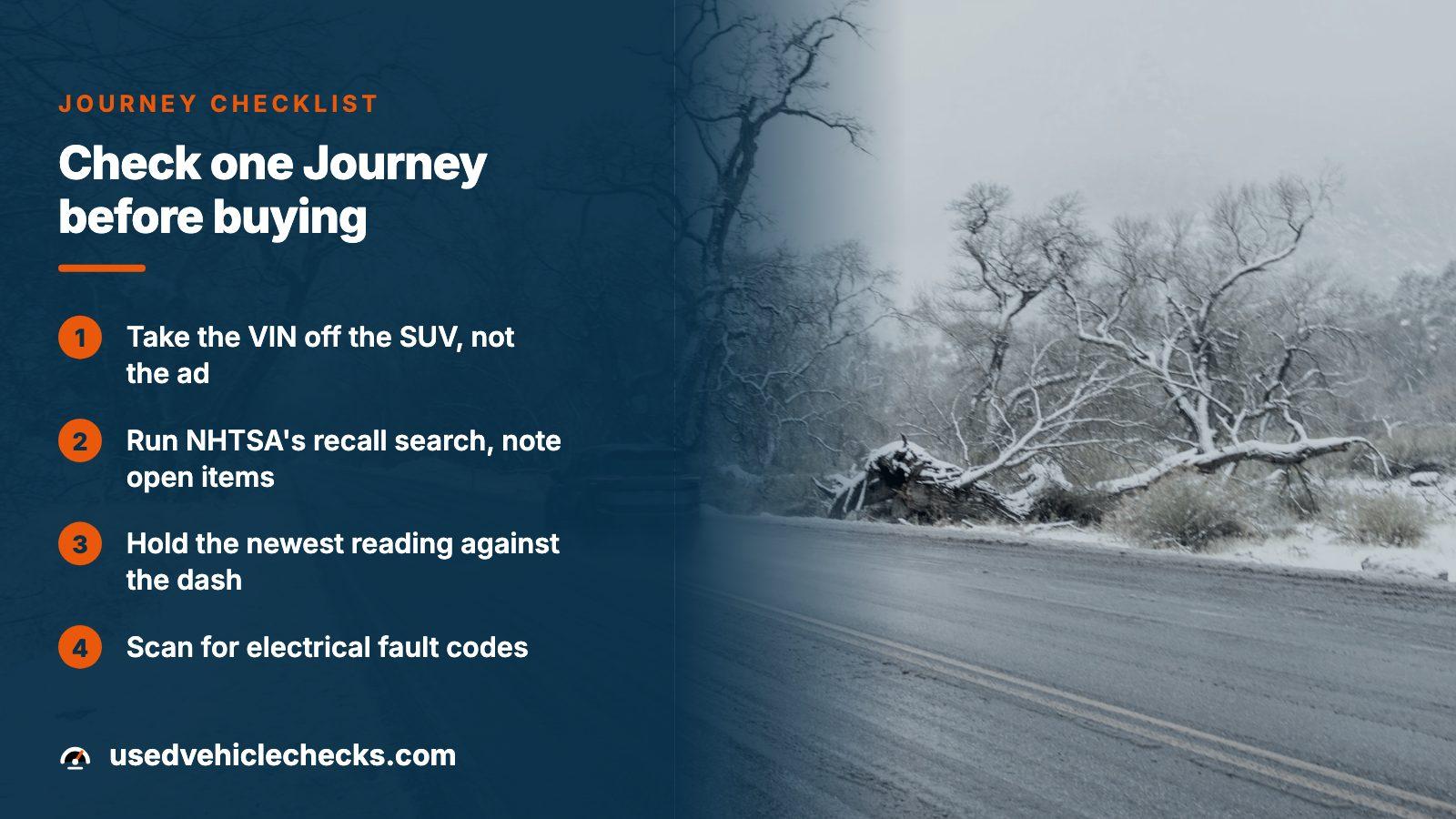
- Take the VIN off the SUV itself instead of the advert, and check that its tenth character fits the year being claimed.
- Run it through NHTSA's recall search, a no-cost tool, and note every campaign still open on that exact car.
- Open the free preview. If the Journey stays on your shortlist, buy the report and start with the odometer readings.
- Hold the newest reading against the dash and against mileage written on repair invoices. A figure below an earlier one needs an explanation on paper.
- Read the title brands, damage entries and use type against those miles, then run NICB's VINCheck for a no-cost theft and total-loss screen.
- Have a mechanic scan for electrical fault codes, work every switch and gauge, and compare brake wear with the reading.
Paying once covers a report, with nothing recurring afterward, and a pack of reports suits a shortlist of several SUVs. The pricing page has the options.
Where this information comes from
- NHTSA: vehicle safety and owner complaints — The federal agency whose complaint database supplies every yearly count here.
- NHTSA: recalls by VIN — A no-cost lookup showing which recall campaigns are open on one specific vehicle.
- NMVTIS: national title record — The federal title-record program, which covers the single car that a year table cannot.
- NICB: VINCheck — A quick theft and total-loss screen for one VIN.
- NHTSA owner complaint 10669173 — owner experience, paraphrased
- NHTSA owner complaint 10326926 — owner experience, paraphrased
- NHTSA owner complaint 10730254 — owner experience, paraphrased
Sources and photos: Facts checked against the sources above in November 2026. Photos by Sander Jeurissen, Zoshua Colah and Dimitri Karastelev on Unsplash; diagrams by UsedVehicleChecks.
Keep reading
- Dodge Grand Caravan Years to Avoid: Complaints and MileageA second Dodge nameplate sharing the 2009 and 2010 ignition recall, ranked against its own median.
- Odometer Rollback Check by VIN: Run the Mileage Test Before You PaySee what a step backward looks like once the readings are laid out by date.
- Mileage Check by VIN: What the Recorded Odometer Readings ShowHow to pull the dated mileage history for one specific vehicle.
- How Many Miles Is Too Many on a Used Car? Age, Pace and ProofDecide what a high reading means before a Journey makes your shortlist.
Frequently asked questions
Which Dodge Journey years should I avoid?
Start your caution with 2009, 2010 and 2015, which carry 1,594, 1,085 and 554 complaints against a median year of 365. Caution means a harder inspection and a lower offer. A flagged Journey with steady odometer readings and service invoices can still be a fair purchase.
Is the 2009 Dodge Journey a bad buy?
It needs the most scrutiny: 1,594 complaints, 4.37 times the median, and 8 recalls on file, led by electrical and brake reports. A 2009 with recalls done, brake work on paper and mileage that climbs in order is a different vehicle from one with gaps in its records.
Which Journey years have the lightest complaint records?
By count, 2020, 2019 and 2011 are lightest, at 66, 102 and 169 filings. Complaint counts measure filings, not reliability, and the newest years look tidy mainly because their owners have had little time to report.
What goes wrong most often on a Dodge Journey?
Across the twelve model years, owners name the electrical system 2,182 times, ahead of service brakes at 1,067 and engine at 981. A pre-purchase inspection should begin with a fault-code scan and a test of every switch, then move to the brakes.
How do I check the mileage on a specific Journey?
Use the VIN. Open the preview on this site, and if the vehicle is still in the running, read the dated odometer readings in the report from oldest to newest. Compare the latest with the dash and with repair invoices, and treat any earlier, higher figure as a warning.
Now check the car itself
The guide explains what to look for. The report shows what this VIN has on record.