
THE SHORT ANSWER
Skip 2013 unless every recall is closed and the price reflects the risk. Treat 2011 and 2014 with caution, mainly for steering and fuel system trouble. The 2012 and 2017 models carry the thinnest complaint files. Counts are owner reports, not proven defects, so run the VIN for open recalls and check the odometer history before paying.
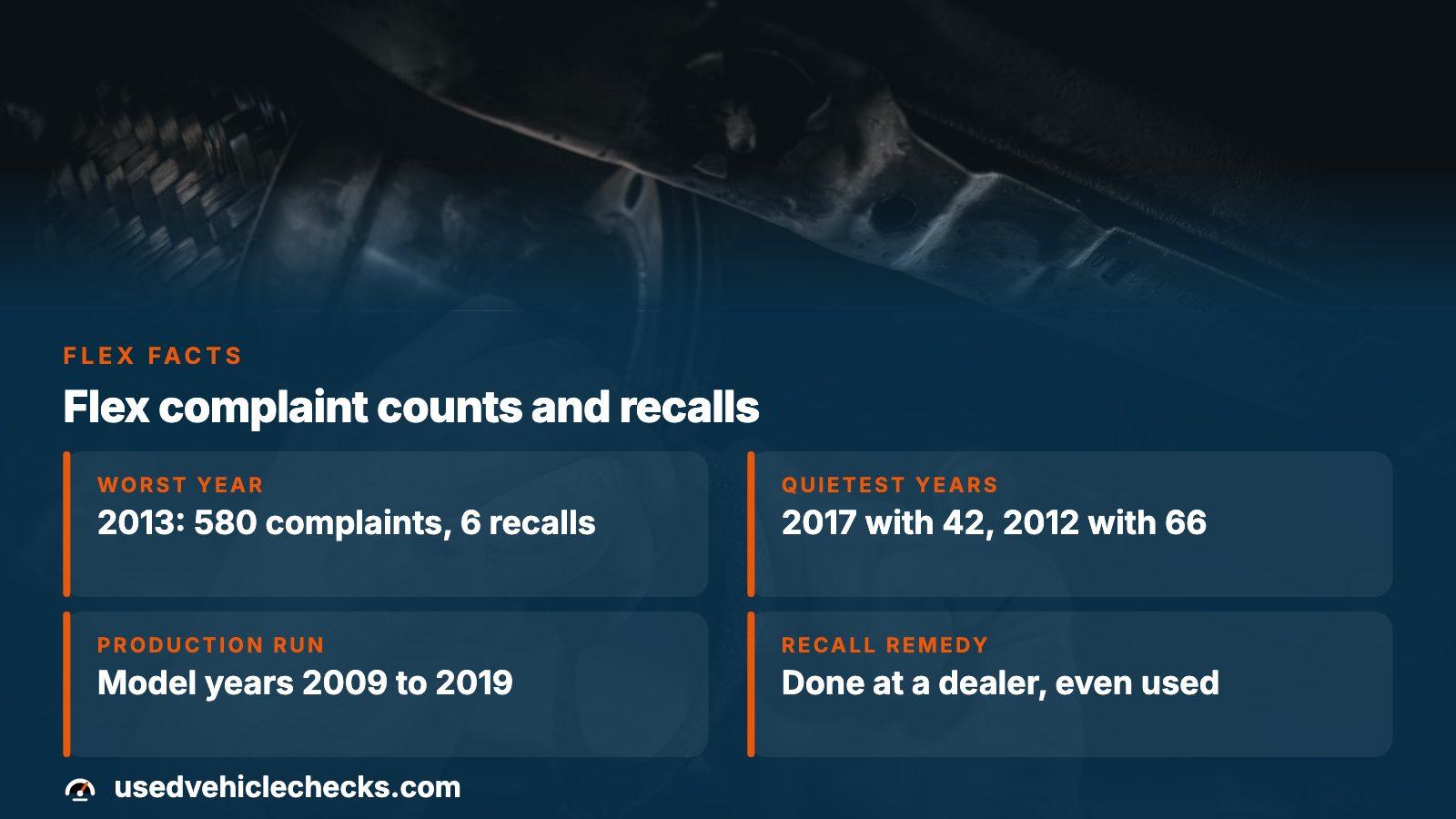
- Worst year
- 2013: 580 complaints, 6 recall campaigns
- Quietest years
- 2017 with 42 complaints, 2012 with 66
- Production run
- Model years 2009 to 2019
- Recall remedy
- Free at a dealer, even on a used Flex
The verdict, year by year
Every figure here comes from NHTSA's own complaint and recall records for the Flex, pulled for each model year from 2009 through 2019. NHTSA lists no 2008 or 2020 Flex, so that is the full set. Across those eleven years owners filed 1,952 complaints, and 2013 accounts for roughly three in ten of them.
| Model year | Owner complaints | Recall campaigns | Injuries reported |
|---|---|---|---|
| 2009 | 181 | 1 | 6 |
| 2010 | 139 | 1 | 4 |
| 2011 | 144 | 2 | 9 |
| 2012 | 66 | 2 | 4 |
| 2013 | 580 | 6 | 13 |
| 2014 | 249 | 4 | 10 |
| 2015 | 117 | 4 | 1 |
| 2016 | 103 | 3 | 3 |
| 2017 | 42 | 4 | 2 |
| 2018 | 69 | 3 | 1 |
| 2019 | 262 | 4 | 3 |
Read the table as a ranking of paperwork, not of reliability, since a year with few complaints may simply have fewer owners filing.
2013: the year with the longest file
No other Flex year comes close. Of the 580 complaints, 201 name the electrical system, 149 the steering, 69 the body structure and 59 the fuel or propulsion system. Thirteen injuries were reported, the highest of any year.
The recall list matches the complaints. Two separate campaigns cover a fuel delivery module that can crack and leak fuel, with a fire risk. Another covers a halfshaft that can come apart so the engine's power no longer reaches the wheels. A fuel pump module that can overheat and stall the engine, the steering assist recall, and a rear toe link recall make up the rest.
- Six campaigns means six VIN lookups you must see closed, not one.
- Some are tied to build dates, so a neighbor's 2013 Flex can differ from yours.
- The toe link recall covers only Police Interceptor or SHO Performance Pack builds, so check whether your trim is one of those.
If a 2013 is the only one in your budget, buy it only after every campaign shows as repaired.
2011 and 2012: the power steering problem
Steering draws 57 of the 144 complaints on the 2011 Flex and 25 of the 66 on the 2012. The related recall covers loss of power steering assist on 2011 and 2012 Flex models with the 3.5L GTDI engine, and on the 2013. Without assist, the wheel needs far more effort at low speed. The fix starts with a dealer reading the steering control module for stored faults, and only a car showing assist-loss codes gets a new steering gear.
From an NHTSA owner complaint
An owner of a 2011 Flex told NHTSA in 2025 that the power steering warning light kept coming on at startup and the wheel went stiff. A dealer blamed a linkage in the electronic power steering module, and the car went unrepaired. The failure mileage was given as about 170,000.
Take from it that the steering fault does not stay in the past, and that it shows up at high mileage. On any 2011 or 2012, ask whether the recall work was done and whether the steering light ever came on. The 2012 is the better pick of the pair on complaint count alone.
2009 and 2010: air bag recall, engine and brake complaints
The first two years drew 181 and 139 complaints. The 2009 file leans toward engine complaints at 36, electrical at 32 and brakes at 32. The 2010 file is led by steering with 32 and engine with 30.
Both years sit under one campaign for the driver's frontal air bag, which can inflate improperly in the second stage during a high-speed crash. The dealer remedy is a new driver air bag module where one is needed. A car this old has had years to be repaired, so the question is whether it was.
These are the oldest Flex models, so the mileage history matters more here than for any later year. A very low reading on a car this age deserves a second look.
2014 to 2016: fuel pump, seat sensor and turbo oil leaks
The 2014 Flex logged 249 complaints, 10 injuries and four recalls. Steering again leads with 66, then electrical with 57 and the fuel or propulsion system with 46. One campaign covers a seat frame fitted with too little clearance on Flex models built between March 1 and May 31, 2014, which can make the passenger air bag switch off when it should stay on.
The fuel pump electronic module recall reaches 2013 to 2015 Flex models with the EcoBoost engine, and a turbocharger oil tube recall covers 2016 and 2017 models with the same engine. In both cases the engine type decides whether you are affected, so match the engine to the campaign.
- 2015: 117 complaints, one of them a parking brake campaign for cars built in a three-week window in May.
- 2016: 103 complaints, a fire risk from the turbo oil supply tubes on EcoBoost cars.
- 2014: the heaviest of the three, and the one to check hardest.
2019: a camera complaint pile-up
The last model year shows 262 complaints, which looks bad until you see that 148 of them concern the rearview camera. A further 60 name the body structure. Next to 2013 these are lighter faults, though a blank camera screen is a real gap when backing up.
Two camera campaigns now cover 2019 Flex models, and the 2015 to 2019 range sits under a newer one that has a phased remedy by model year. A B-pillar trim campaign covers 2017 to 2019, and the records give March 2027 as the expected remedy date for that one and for one camera campaign. A 2019 Flex bought today may therefore carry an open recall that the dealer cannot yet fix. A starter and alternator cable campaign from 2018 is also on the 2019 record.
Ask the seller whether the camera has acted up, and price in the wait for the remedy.
The years that look best on paper
The 2017 Flex has the thinnest complaint file at 42, with two crashes flagged and two injuries. The 2012 Flex follows at 66, and the 2018 at 69.
Neither pick is clean. The 2017 and 2018 models still carry camera and trim campaigns, and the 2012 carries the steering and air bag ones. What these years lack is the cluster of fuel, drivetrain and electrical campaigns that sits on 2013. A low complaint count is a reason to shortlist a car, not a reason to skip checks.
Where the mileage check earns its price
Most Flex faults above are age and mileage faults: steering modules, light circuits, cameras. That makes the odometer the number you most need to trust. A low reading on a car with a failing steering module and a worn driver's seat is telling two different stories.
Run the VIN through a UsedVehicleChecks preview, then buy the report for any Flex still on your list. Read the dated odometer entries in order, note any drop or long stall, and check the open recall section against the campaigns in this guide. Title and accident records sit in the same report.
- Match the VIN on the car to the listing and the title.
- Run the preview, then buy the report for a Flex you would actually own.
- Check mileage readings for steady growth, with no drop between entries.
- Confirm each recall for that year shows as completed.
- Have a mechanic test the steering assist and the camera before you pay.

Where this information comes from
- NHTSA recalls API: Ford Flex by model year — campaign numbers, components and remedies behind the recall counts
- NHTSA complaints API: Ford Flex by model year — owner complaint counts and components for each year
- NHTSA owner complaint 11681381 — owner experience, paraphrased
- VehicleHistory.gov (US Department of Justice) — the federal title information system's consumer site
Sources and photos: Facts checked against the sources above in November 2026. Photos by Nik, Anastasiia Nelen and Martin Fennema on Unsplash; diagrams by UsedVehicleChecks.
Keep reading
- Ford Taurus Years to Avoid: What NHTSA Complaints and Recalls ShowThe Taurus shares the Flex platform and several of its recalls.
- Ford Explorer Years to Avoid: What the Complaints and the Odometer SayAnother Ford crossover with its own complaint pattern by year.
- How Many Miles Is Too Many on a Used Car? Age, Pace and ProofHelps judge a high-mileage Flex against its age.
- Mileage Check by VIN: What the Recorded Odometer Readings ShowHow to read dated odometer entries before you pay.
Frequently asked questions
What is the worst year for the Ford Flex?
On NHTSA's numbers it is 2013, with 580 owner complaints, 13 reported injuries and six recall campaigns. Electrical and steering complaints lead. The year is not unbuyable, but you should see every campaign closed first and expect the price to reflect that history.
Which Ford Flex year is the most reliable?
The 2017 model has the fewest complaints at 42, and the 2012 and 2018 models follow. NHTSA records measure owner reports and recalls, not repair bills, so no year is guaranteed. Pair a low count with a clean recall check and a mechanic's inspection.
Are there open recalls on used Flex models?
Yes, some. Records from 2024 and 2025 cover rearview cameras and door trim on late models, with final remedies expected in March 2027 for two campaigns. Run the VIN, because recall status depends on the car, not the year.
Is a high-mileage Ford Flex worth buying?
It can be, if the odometer history is steady and the recalls are done. Steering and electrical faults tend to appear with age, as one 2011 owner reported at about 170,000 miles. Budget for repairs and verify the mileage before you commit.
Does the Flex have a transmission problem?
NHTSA's records show no transmission recall for the Flex. Power train appears among the top components on the 2009 and 2011 files, with 23 and 19 complaints, but nothing there singles out the transmission. A mechanic's drive test is the way to settle it on a specific car.
Now check the car itself
The guide explains what to look for. The report shows what this VIN has on record.