THE SHORT ANSWER
On NHTSA complaint counts, approach the 2016, 2013, 2015, 2017 and 2014 Ford Explorer with extra care: each runs at roughly two to three times the nameplate's median of 830 complaints a year. The lightest settled files are 2009, 2010 and 2008, though those SUVs are old. Read a flagged year as a reason to inspect closely and haggle, not as a ruling. Before you pay, read that VIN's dated odometer readings, open recalls and title record.
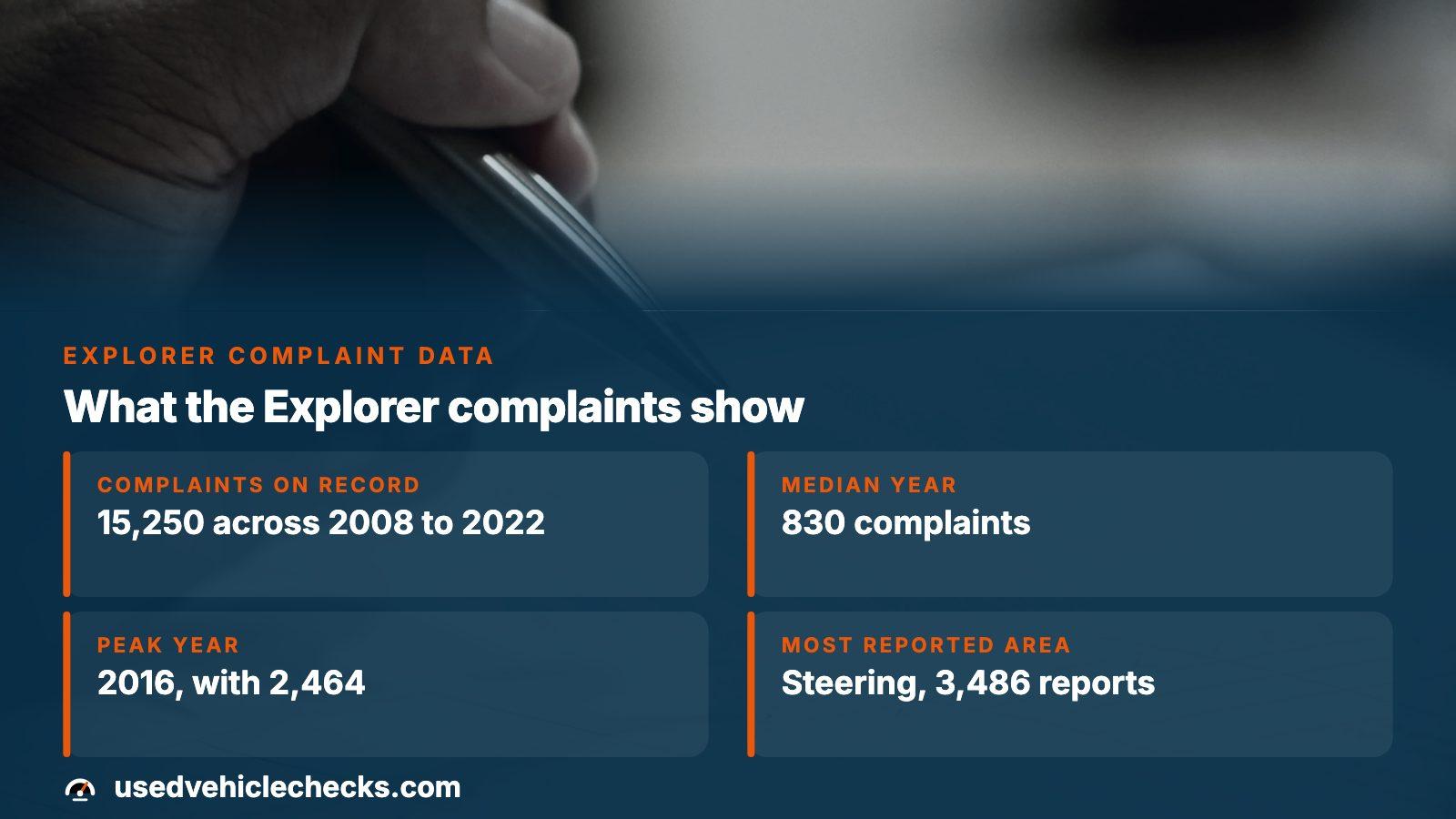
- Complaints on record
- 15,250 across 2008 to 2022
- Median year
- 830 complaints
- Peak year
- 2016, with 2,464
- Most reported area
- Steering, 3,486 reports
The Explorer years that draw the most owner complaints
Owners have sent NHTSA 15,250 complaints about 2008 to 2022 Explorers, and the years carry very different loads. The middle year of the 15 sits at 830, so each row is judged against that mark, not against other SUVs.
| Model year | Complaints | Times the median | Most reported area | Recalls on file |
|---|---|---|---|---|
| 2016 | 2,464 | 2.97× | Structure | 15 |
| 2013 | 2,237 | 2.7× | Steering | 12 |
| 2015 | 1,816 | 2.19× | Structure | 9 |
| 2017 | 1,713 | 2.06× | Structure | 14 |
| 2014 | 1,684 | 2.03× | Steering | 7 |
| 2020 | 1,250 | 1.51× | Power train | 33 |
| 2011 | 1,197 | 1.44× | Steering | 8 |
Five consecutive years, 2013 through 2017, run at about double the median or more. The 2020 and 2011 years sit above the line without reaching double. A high count means look harder and negotiate. It settles nothing about the Explorer you are standing beside.
When the dash and the record disagree on an Explorer
This is where Explorer purchases go wrong, whatever the year. Twelve complaints about 2010 through 2017 Explorers, lodged from May 2025 to May 2026, come from buyers who found out after the sale that the recorded mileage sat far above the dash figure. Some gaps ran past a hundred thousand miles.
From an NHTSA owner complaint
The buyers of a 2015 Explorer filed within a day of the sale. Their history report gave a last reading of 218,737 miles, yet the dash showed 160,000. They wrote that they were "figuring this out afterwards" and had never faced anything like it.
A dated reading above today's display is the whole signal, and a VIN check puts it in front of you before money changes hands.
From an NHTSA owner complaint
A 2017 Explorer buyer reported a dealer sale in late November 2025 that came with a history report showing about 103,000 miles, matching the dash. An emissions test needed for registration then flagged a mismatch, with the recorded mileage at 243,402.
A sheet handed over by a seller is not a check you ran yourself. Pull the VIN's readings on your own and read them oldest first.
What owners report shifts from one stretch of years to the next
Pooled across all 15 years, steering leads with 3,486 reports and structure follows at 3,160. Grouped by production stretch, the pattern moves.
| Model years | Complaints | Leading area | Reports in that area |
|---|---|---|---|
| 2008 to 2010 | 296 | Power train | 67 |
| 2011 to 2014 | 5,948 | Steering | 2,439 |
| 2015 to 2019 | 7,029 | Structure | 2,105 |
| 2020 to 2022 | 1,977 | Power train | 694 |
In the 2015 to 2019 years, a large share of the structure filings describe trim and pillar pieces coming loose, which several recall campaigns also cover. For 2020, the power train filings center on transmission shifting. Recalls on the rear suspension toe links, which can fracture, reach across 2011 to 2019 models. A mechanic can test most of this quickly, so the inspection should open with the stretch your Explorer belongs to.
The 2011 to 2013 steering fix and the paperwork around it
Complaints climb from 115 for 2010 to 1,197 for 2011, led by steering with 743 of the 2011 filings. NHTSA recall 14V286 applies to 2011 to 2013 Explorers with production dates from mid-May 2010 to the end of February 2012. In those SUVs a flaky connection in the electric steering gear can drop a sensor signal and kill power assist, so low-speed turns take real muscle. Ford's remedy is a software update, plus a new steering rack if the car has shown the fault, free of charge.
From an NHTSA owner complaint
A 2012 Explorer owner wrote that power steering assist quit on a mountain road near Aspen in July 2022. The family was told the fault fell under a customer satisfaction program that paid for repairs for ten years only. The car was about eight months past that, so the bill would run to thousands. A dealership had sold them the SUV under two years earlier, and the program entry on its history report had not read as a warning.
Treat any campaign entry on a report as a question: was the work done, and is the free window still open? Steering that was fixed, with paperwork, is a different purchase from steering that was not.
The quiet years are mostly old Explorers
By count, 2009 has 33 complaints, 2010 has 115 and 2008 has 148, all far below the median. The 2022 and 2019 years come next. The 2022 file is short largely because that SUV is young and has barely begun to collect reports, so recent years stay off any cleanest list.
| Model year | Complaints | Times the median | Recalls on file |
|---|---|---|---|
| 2009 | 33 | 0.04× | 1 |
| 2010 | 115 | 0.14× | 2 |
| 2008 | 148 | 0.18× | 3 |
| 2022 | 272 | 0.33× | 24 |
| 2019 | 303 | 0.37× | 6 |
A quiet file does not mean a quiet odometer. Two of the 115 filings for 2010 are among the mileage-mismatch complaints above, and an Explorer that old has had many years to build up readings that need lining up. Read the title brands and accident entries around those readings too.
How to read these counts without fooling yourself
- Sales: a best seller piles up more filings than a niche model of the same build quality, so every year is held to the Explorer's own median.
- Age: an older year has had more months to gather reports, and the newest years look spotless only because nobody has filed yet.
- Origin: every complaint is one owner's account of what happened, and nobody has verified it. In bulk it points somewhere; alone it proves little.
- Recalls: a different signal. The maker admits a defect and fixes it at no cost, but the duty ends once an SUV passes 15 years from its first sale, which can put the oldest Explorers outside it.
No count here describes the particular SUV on the lot. Only its own VIN answers that.
Before you pay for one specific Explorer
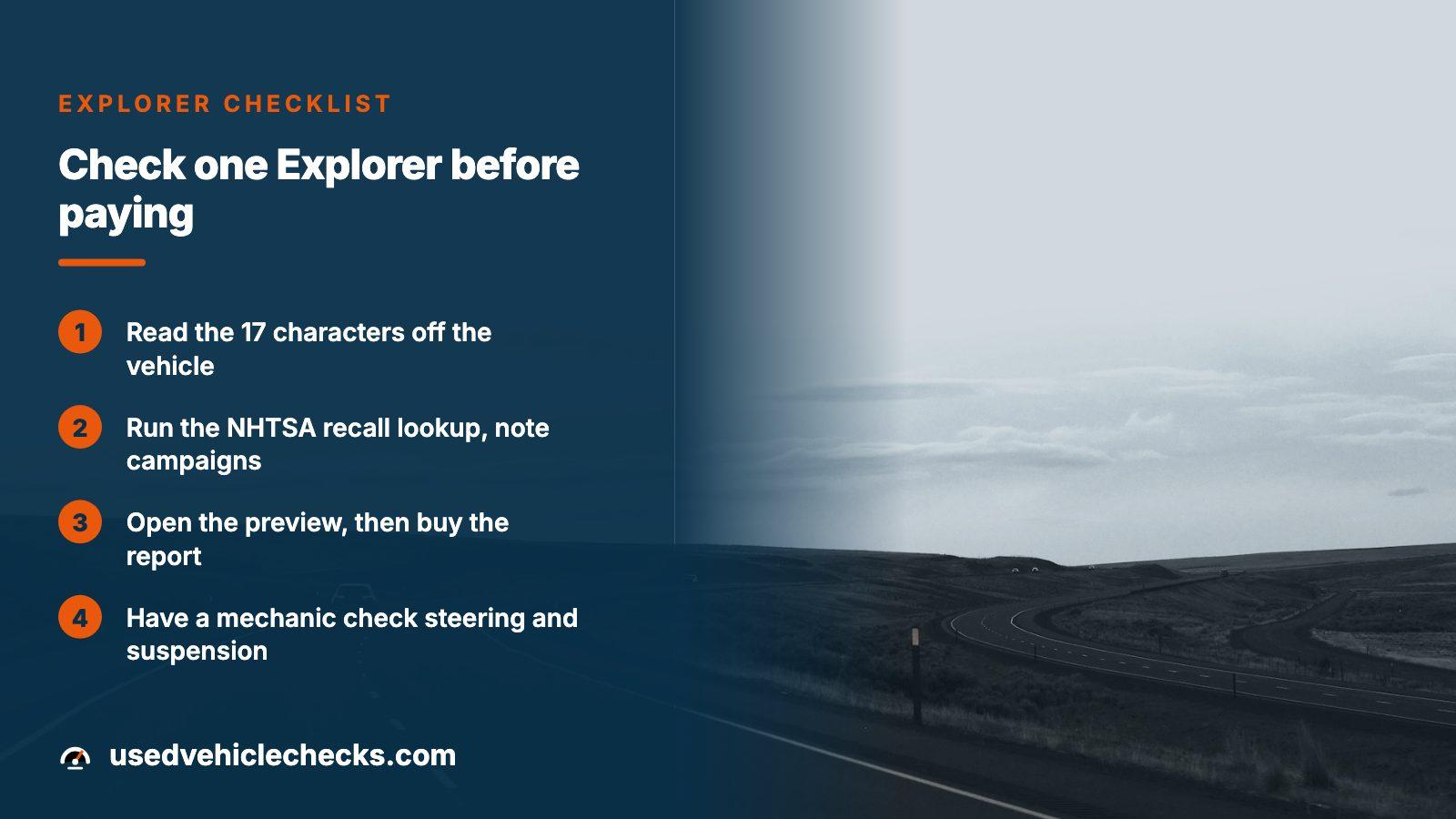
- Read the 17 characters off the vehicle, not the listing: they are stamped where the dash meets the glass by the driver, and printed again on the label on the driver's door pillar.
- Run the free NHTSA recall lookup and note open campaigns, such as the steering, toe link and trim recalls above.
- Open the preview, which is the part that costs nothing.
- Should the Explorer survive your cut, buy the report. Start with the odometer readings in date order, then the title brands, accident entries, ownership count and use type.
- Have a mechanic look at the steering, rear suspension and trim before you sign.
Paying is one charge with no renewal, and the pricing page shows the single report and the packs for anyone comparing several SUVs.
Where this information comes from
- NHTSA: vehicle safety and owner complaints — The federal home of the owner complaint filings behind each model year's count.
- NHTSA: recalls by vehicle — A no-cost lookup for open campaigns on one VIN, including the steering and trim recalls named here.
- NMVTIS: national title record — Federal title history for a single vehicle, which a yearly table cannot supply.
- NICB: VINCheck — A no-cost screen of one VIN for theft and total-loss records.
- NHTSA owner complaint 11696980 — owner experience, paraphrased
- NHTSA owner complaint 11704205 — owner experience, paraphrased
- NHTSA owner complaint 11477143 — owner experience, paraphrased
Sources and photos: Facts checked against the sources above in November 2026. Photos by Sean Foster, John Kakuk and Masjid MABA on Unsplash; diagrams by UsedVehicleChecks.
Keep reading
- Mileage Check by VIN: What the Recorded Odometer Readings ShowRead a VIN's dated odometer readings before an Explorer makes your shortlist.
- Odometer Rollback Check by VIN: Run the Mileage Test Before You PayHow to spot a reading that steps backward, as in the complaints above.
- How Many Miles Is Too Many on a Used Car? Age, Pace and ProofDecide what a high number on the dash means for an SUV of this age.
- Toyota 4Runner Years to Avoid: Read the Year, Then the MileageThe same complaint-by-year read for another SUV on the shortlist.
Frequently asked questions
Which Ford Explorer years should I avoid?
Start your caution with 2016, 2013, 2015, 2017 and 2014. The 2016 year leads with 2,464 NHTSA complaints, against a yearly median of 830. A flagged year is a prompt for a tougher inspection and a firmer price, since well-kept Explorers turn up in every one of them.
Which Ford Explorer years carry the thinnest complaint records?
Model years 2009, 2010 and 2008 come out lightest, with 33, 115 and 148 filings. They are also the oldest Explorers in this range, so ownership count, wear and mileage records matter more than the tally. The 2019 year is low too, at 303.
Is a high-mileage Explorer a bad buy?
Not on the number alone. What counts is whether the readings agree: dated entries that only climb, a pace that fits the use type, and wear that matches the dash. A high figure with a clean trail can beat a low one nobody can document.
What do Explorer owners complain about most?
Steering, with 3,486 reports over 2008 to 2022, then structure at 3,160. Steering leads for 2011 through 2014, structure for 2015 through 2019, and power train for 2020 through 2022. Use your SUV's stretch as the inspection list, and check open recalls on its exact VIN.
How do I check one Explorer before I buy it?
Use its VIN. Look up open recalls with NHTSA's lookup, open the preview here, and buy the report only if the SUV is still in the running, so you can read its odometer readings, title brands and accident records. A model year describes a whole run of Explorers; the VIN describes the one you would own.
Now check the car itself
The guide explains what to look for. The report shows what this VIN has on record.