THE SHORT ANSWER
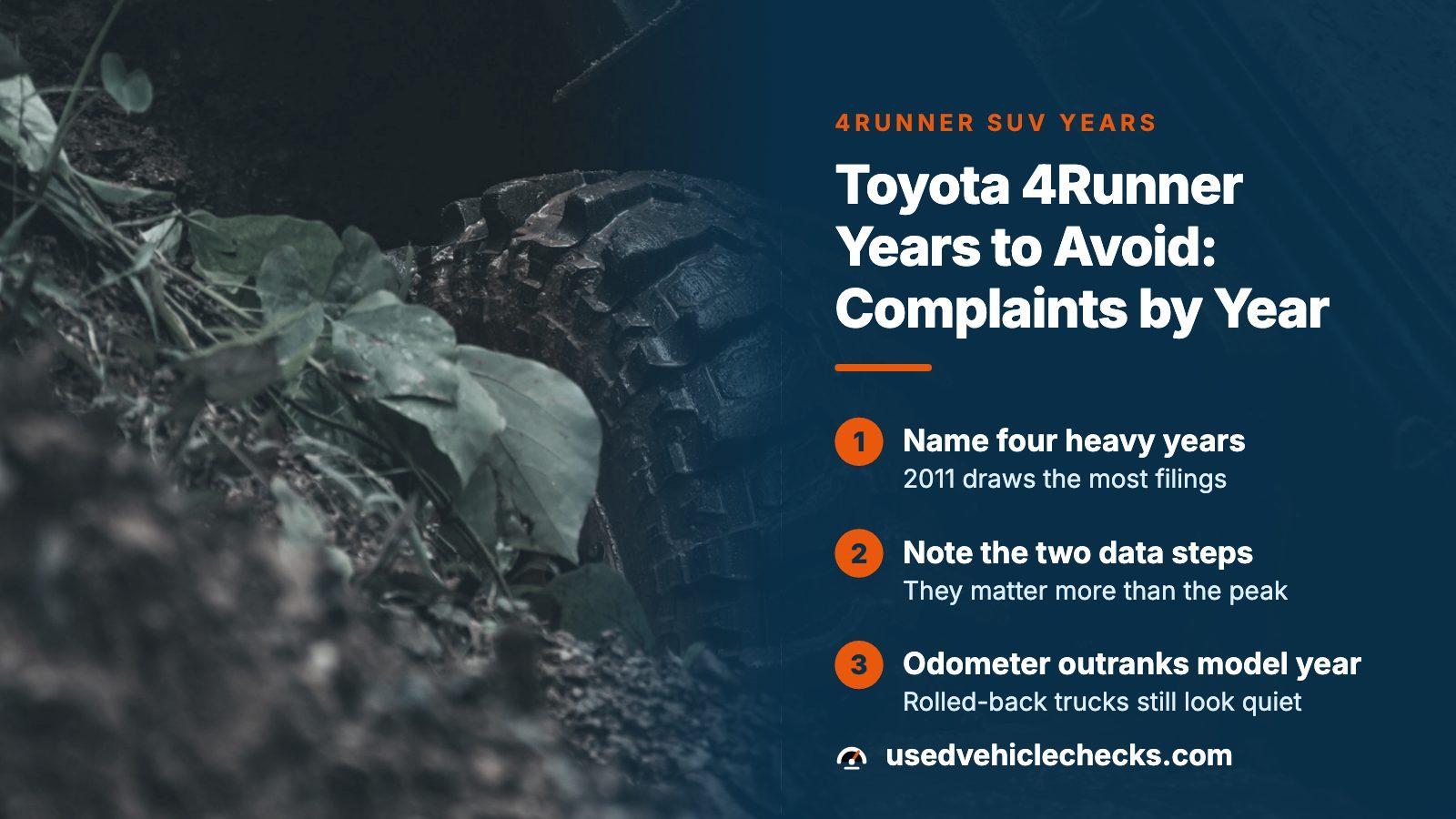
On NHTSA complaint counts, approach the 2011, 2010, 2008 and 2012 Toyota 4Runner with extra care. They run at 2.55, 2.27, 1.5 and 1.5 times the nameplate's median of 64 complaints a year. The lightest settled records are 2009 and 2020, and air bags draw more reports than any other area. A flagged year justifies a closer inspection and a lower offer. Before you pay, read that VIN's odometer readings, open recalls and title record.
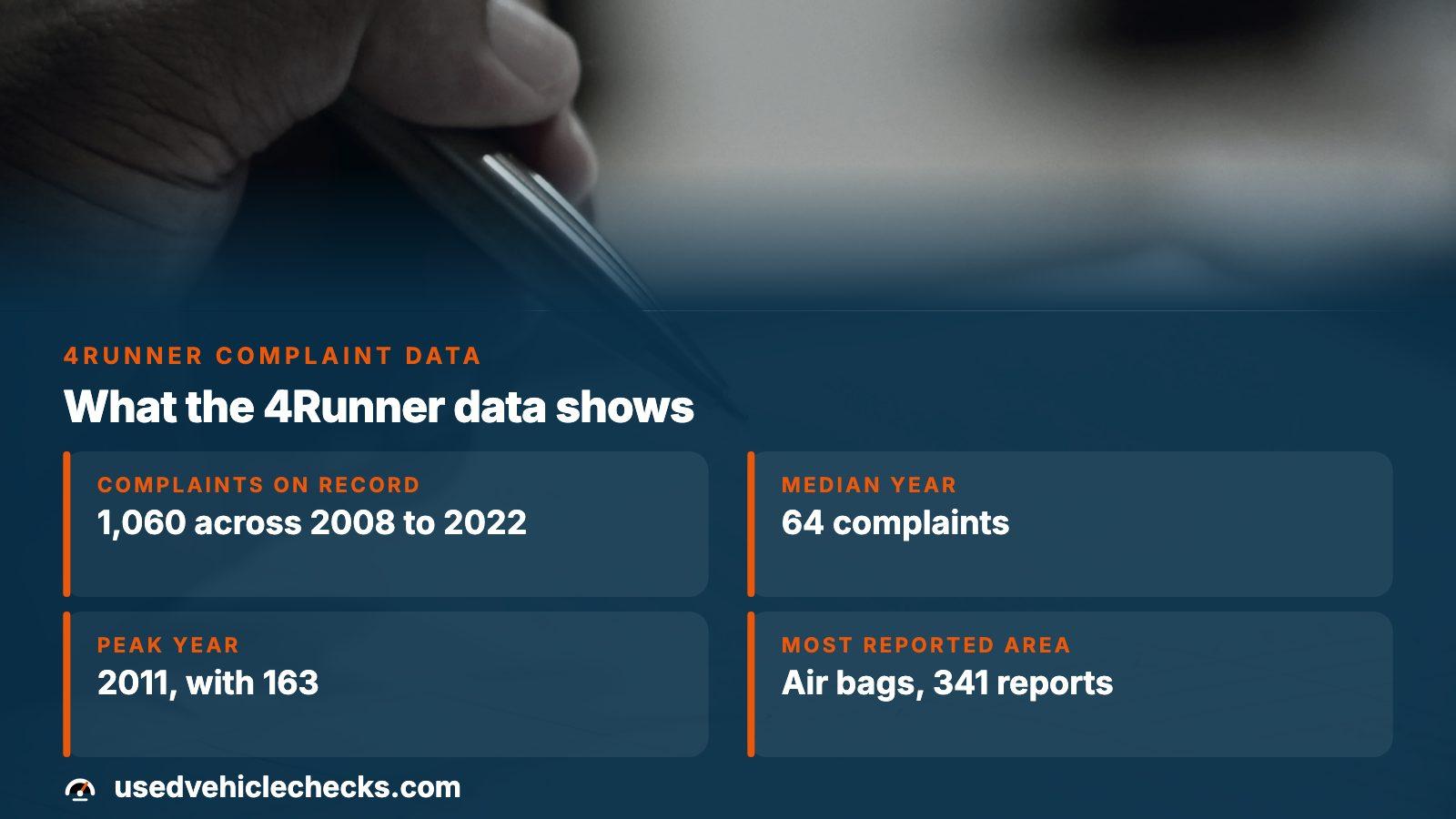
- Complaints on record
- 1,060 across 2008 to 2022
- Median year
- 64 complaints
- Peak year
- 2011, with 163
- Most reported area
- Air bags, 341 reports
The four years that sit above the 4Runner's median
NHTSA holds 1,060 owner complaints for the 4Runner across model years 2008 to 2022, and they cluster unevenly. The middle year of the 15 sits at 64, so each year is read against that figure rather than against other vehicles.
| Model year | Complaints | Times the median | Most reported area | Recalls on file |
|---|---|---|---|---|
| 2011 | 163 | 2.55× | Air bags | 10 |
| 2010 | 145 | 2.27× | Air bags | 12 |
| 2008 | 96 | 1.5× | Power train | 5 |
| 2012 | 96 | 1.5× | Air bags | 8 |
That puts 2011 and 2010 well ahead of the pack, with 2008 and 2012 a step behind. None of it condemns one particular SUV. Sound examples exist in every year on the list, and the flag mostly earns you bargaining room.
The quietest 4Runner files, and the footnote that goes with them
Among settled model years, 2009 shows 22 complaints and 2020 shows 31, at 0.34 and 0.48 times the median. The 2013 and 2017 years follow at 36 each. Read 2009 with some care. It has the thinnest complaint file and also 6 recalls, against 1 for 2020. That can mean defects were caught early, and it certainly means more campaigns to look up by VIN.
The youngest years stay off any cleanest list: a 2021 shows 34 complaints and a 2022 shows 39, but owners have had little time to report anything.
Two steps in the data that matter more than the ranking
Complaints rise from 22 for the 2009 model year to 145 for 2010, then drop from 96 for 2012 to 36 for 2013. A step that steep can reflect a change in how the SUV was built, or in how many owners filed, so a 2009 and a 2010 may not be the same population, and neither may a 2012 and a 2013.
For a buyer, the year in a listing says less than which side of a break the SUV sits on. When a seller calls something basically a 2010, ask for the VIN. Its tenth character is the model year code, and the decoded record shows how that SUV was built.
Why the odometer outranks the model year on a 4Runner
Two 4Runners from one model year can be different machines: one commuted, another towed or ran fleet duty. The complaint table cannot tell them apart. Dated mileage readings can, provided they hold together.
| Pattern in the readings | What it can mean |
|---|---|
| Each reading higher than the last, at a steady pace | Ordinary use for the SUV's age |
| The same figure at several dates | A stopped odometer or a reporting gap |
| A newer entry below an older one | Rollback or an undisclosed instrument swap |
| A steep climb over a short stretch | Heavy use such as fleet duty |
From an NHTSA owner complaint
A 2011 4Runner owner told NHTSA a dealer sold the SUV with 84,000 miles on the dash around March 2018. Within two weeks it shook and would not turn properly, and neither round of tire, alignment and brake work cured it. A Toyota visit for an air bag recall then produced a history report whose last reading, from 2017, was 194,000 miles. The seller, the owner said, claimed to know nothing about it.
An 84,000 dash figure and a 194,000 record cannot both be true. Dated entries read before payment show that gap at once, not months into ownership.
What owners report most, in every year
Across the whole run, air bags lead by a wide margin.
| Problem area | Reports, 2008 to 2022 |
|---|---|
| Air bags | 341 |
| Unknown or other | 130 |
| Electrical system | 88 |
| Service brakes | 77 |
| Structure | 55 |
| Steering | 49 |
Air bags top 2010, 2011 and 2012 too, and 112 of the 163 filings for 2011 name them. A recall campaign covers a span of production, not a whole model year, so look up open campaigns on the exact VIN and ask for proof of any air bag repair.
From an NHTSA owner complaint
A 2011 4Runner owner wrote that the family had bought the SUV about a year earlier. It then sat at the dealer for over two months waiting on a back-ordered air bag recall part, with December the earliest estimate. The loaner was not comparable, trips were cancelled, and the dealer would not take it back in trade.
An open air bag recall can park the SUV for months. Find out on the VIN whether the repair was done, and price the risk if it was not.
Reading the counts without being misled
- Volume: a bestseller collects more reports than a scarce model that is just as good, so each year is held against the 4Runner's own median.
- Age: an old year has had longer to collect reports, which leaves the youngest years looking clean for the wrong reason.
- Source: each complaint is one owner's account, and nobody has checked it.
- Recalls: a different signal. The maker has conceded the defect and must repair it without billing the owner, though the obligation expires 15 years after the SUV first sold, which can leave the oldest ones outside it.
None of these figures describes the SUV in front of you. Its own history sits behind the VIN.
How the year and the mileage read together
- A flagged year at a price that already reflects it, with service invoices and a clean mileage sequence, can still be a fair buy.
- A quiet year whose readings step backward is a pass, whatever the table says.
From an NHTSA owner complaint
A 2018 4Runner buyer told NHTSA the SUV carried 65,862 miles when bought from a dealer. A later history report listed 61,000 miles in April 2022, then 90,000 in February 2023, then 54,000 near the end of that same month. The SUV now shows about 86,000, and the owner filed it as odometer fraud.
At 58 complaints, a 2018 sits just under the median of 64, so the table gave this buyer no warning. The dated readings carried it. Service invoices fill in the other half, and on an SUV of this vintage they count for more than any year-level statistic.
Before you pay for one specific 4Runner
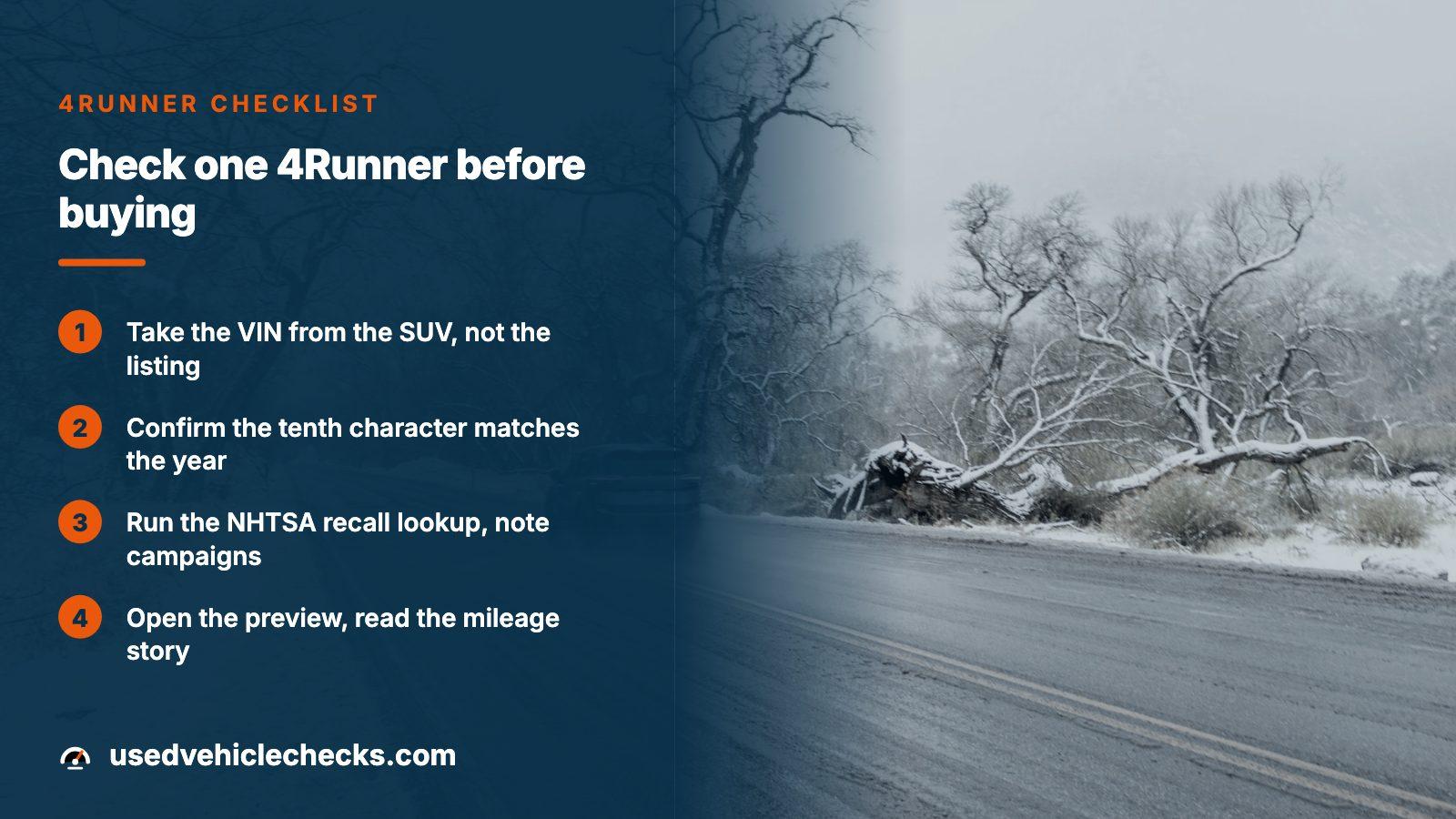
- Take the VIN from the SUV rather than the listing: a metal tag on the dash corner nearest the driver, readable through the glass, or the label on the driver's doorpost.
- Confirm that the tenth character matches the model year the seller claims.
- Run the VIN through the free NHTSA recall lookup and note any open campaigns.
- Open the preview here. Should the 4Runner make your final cut, buy the report and start with the odometer readings, oldest first.
- Set that mileage story against the title brands, accident entries and use type, then send a mechanic to the air bags, electrical system and brakes.
Opening the preview costs nothing. The report is one payment with nothing to cancel afterward. The pricing page shows the single report and the packs for anyone weighing several SUVs.
Where this information comes from
- NHTSA: vehicle safety and owner complaints — The federal source of the owner complaint filings behind each model year's count.
- NHTSA: recalls by vehicle — A no-cost way to look up open recall campaigns for one VIN.
- NMVTIS: national title record — Federal title history for a single vehicle, which a year-by-year table cannot supply.
- NICB: VINCheck — A no-cost screen of one VIN for theft and total-loss records.
- NHTSA owner complaint 11206849 — owner experience, paraphrased
- NHTSA owner complaint 10915118 — owner experience, paraphrased
- NHTSA owner complaint 11750896 — owner experience, paraphrased
Sources and photos: Facts checked against the sources above in November 2026. Photos by Johann Noby, Zoshua Colah and Masjid MABA on Unsplash; diagrams by UsedVehicleChecks.
Keep reading
- Odometer Rollback Check by VIN: Run the Mileage Test Before You PayHow to line up a vehicle's mileage readings and spot a step backward.
- How Many Miles Is Too Many on a Used Car? Age, Pace and ProofDecide what a high number on the dash means before you shortlist an SUV.
- Odometer Reading: How to Read It, Write It Down and Test ItWhat the dash figure and the recorded readings each tell you.
- Toyota Tacoma Years to Avoid: Judge the Odometer Before the Model YearThe same year-by-year read for the Toyota pickup many 4Runner shoppers also weigh.
Frequently asked questions
Which Toyota 4Runner years should I avoid?
Start your caution with 2011, 2010, 2008 and 2012. The 2011 model year leads with 163 NHTSA complaints, where the median year has 64. Flagged years deserve a tougher inspection and a firmer price, but well-kept examples with steady mileage records are still fair purchases.
Which 4Runner years show the thinnest complaint files?
Among settled years, 2009 has 22 complaints and 2020 has 31, with 2013 and 2017 next at 36 each. The newest years are unproven, since owners have had little time to report problems. The 2009 also carries 6 recalls, so look up its VIN before you settle on a price.
Is a high-mileage 4Runner a bad buy?
Not on the number alone. What matters is whether the record holds together: dated readings that only rise, a use type that explains the pace, and wear that matches the figure. A high reading with that proof can beat a low one nobody can document.
What do 4Runner owners complain about most?
Air bags, with 341 reports over the 2008 to 2022 span, far ahead of the 130 filed as unknown or other. Electrical system follows with 88. Use that order as an inspection list on any year, and check open recalls on the exact VIN, since campaigns cover production ranges.
How can I vet a single 4Runner before I buy it?
Use the VIN. Run the free NHTSA recall lookup, open the preview here, and if the SUV stays on your shortlist, buy the report for its odometer readings, title brands and accident records. The model year speaks for a whole population of SUVs. The VIN speaks for the one you are about to buy.
Now check the car itself
The guide explains what to look for. The report shows what this VIN has on record.