THE SHORT ANSWER
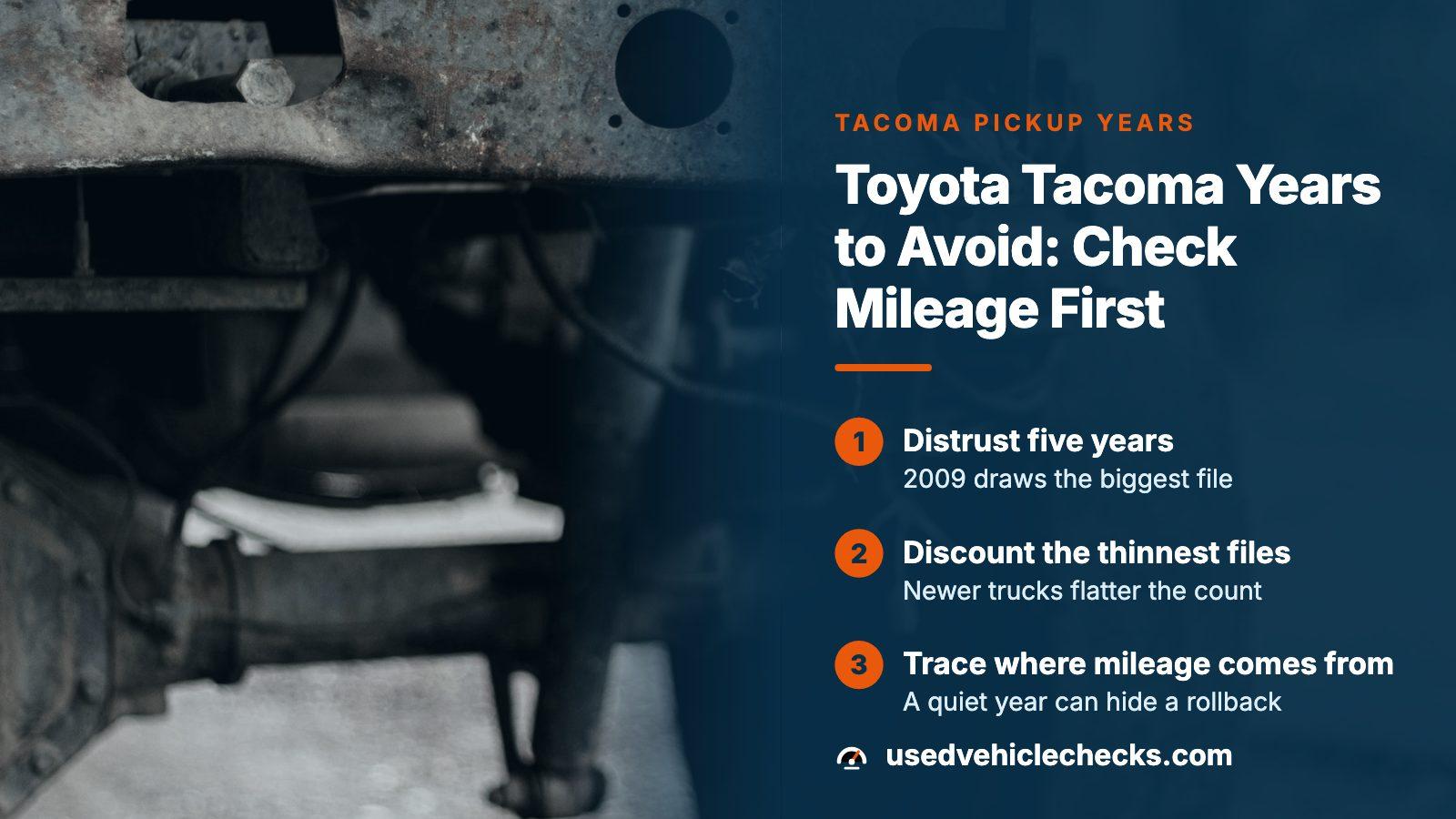
Treat the 2009, 2008, 2016, 2012 and 2010 Toyota Tacoma with extra suspicion. Each sits between 1.44 and 2.56 times the nameplate's median of 202 complaints a year. Trucks from 2022, 2021 and 2020 show the thinnest files, yet they are young, which makes 2014 and 2015 the fairer low-complaint picks. Expect to inspect closely and bargain on a flagged year. Neither a flag nor a clean year replaces reading one truck's mileage history.
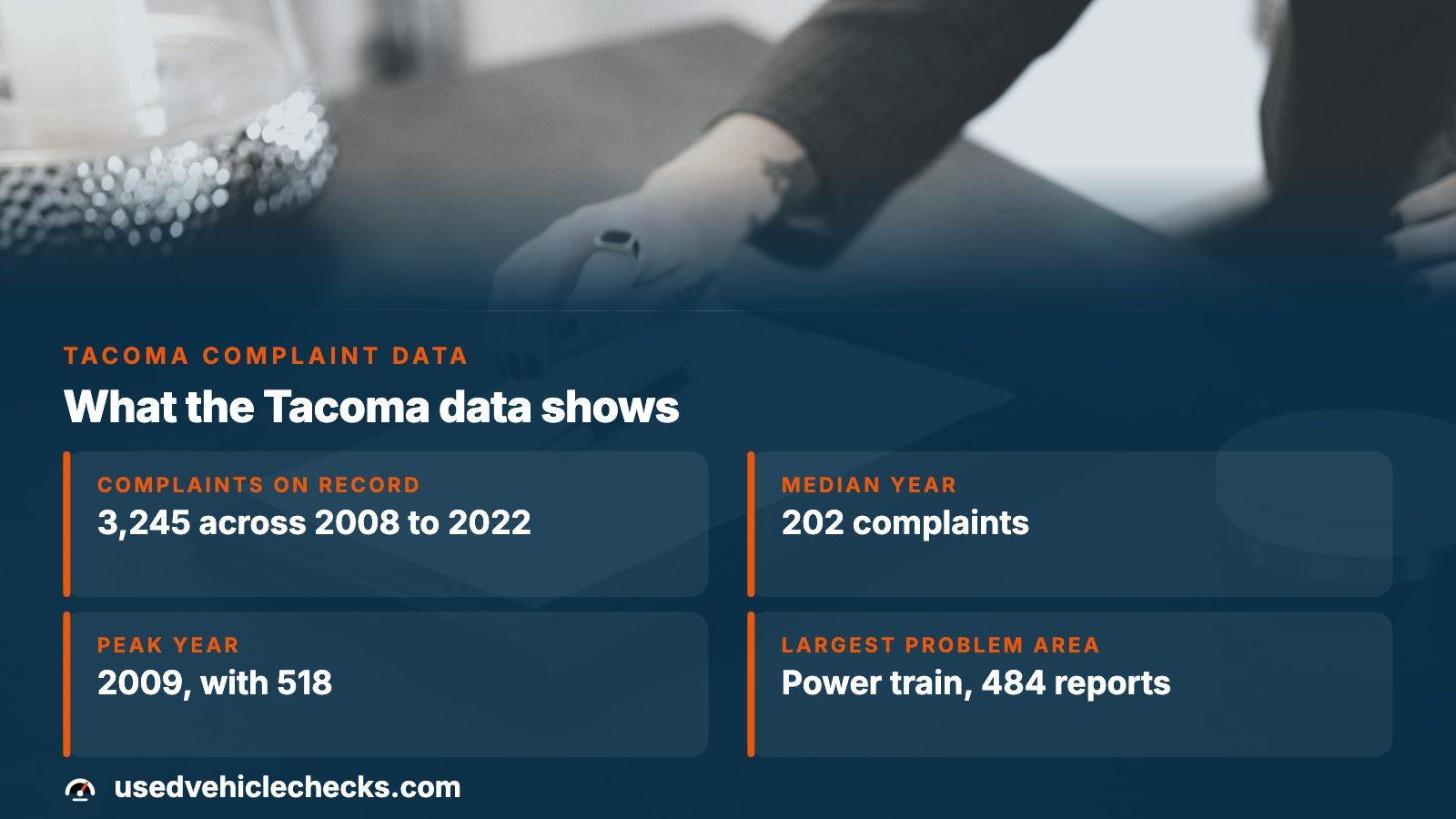
- Complaints on record
- 3,245 across 2008 to 2022
- Median year
- 202 complaints
- Peak year
- 2009, with 518
- Largest problem area
- Power train, 484 reports
The five Tacoma years that sit above the median
NHTSA's file on the Tacoma holds 3,245 owner complaints for model years 2008 to 2022. The middle year holds 202, so each year is read against that figure and not against other pickups.
| Model year | Complaints | Times the median | Most reported area |
|---|---|---|---|
| 2008 | 445 | 2.2× | Suspension |
| 2009 | 518 | 2.56× | Suspension |
| 2010 | 291 | 1.44× | Suspension |
| 2012 | 294 | 1.46× | Engine |
| 2016 | 323 | 1.6× | Power train |
Look at the step from 100 filings on the 2015 trucks to 323 on the 2016s. That kind of rise may point to a redesign, a mechanical change or a surge in filings, so the two years may be different trucks. Sound examples exist in every flagged year. The flag buys bargaining room and tells a mechanic where to look first.
The lightest files, and why they flatter the young trucks
The lowest totals are 57 for 2022, 78 for 2021 and 86 for 2020. Owners of those trucks have had little time to write anything down, so the numbers say more about age than quality. Better evidence comes from 2014 at 93 and 2015 at 100, trucks that have been on the road long enough for faults to surface. Both carry 4 recalls, against none for 2021, which makes a VIN lookup matter more on them than the low count suggests.
- Volume: popular trucks collect more filings than rare ones of the same quality.
- Age: a truck from an early year has simply had more time to collect reports.
- Source: every complaint is a single owner's unverified version of events.
- Recalls: a different measure, since the maker has acknowledged the defect and owes a repair without charge.
What the worst years actually describe
Many filings on 2008 and 2009 trucks describe a rusted frame or a broken rear leaf spring. Toyota recalled certain Pre-Runner and 4x4 trucks built from September 14, 2009, to October 11, 2010, because a leaf spring could fracture, shift out of place and possibly puncture the fuel tank, which carries a fire risk. The 2009 file also holds a run of lighting reports about headlight lenses that melted from bulb heat.
For 2016, power train leads, and the recalls on file cover rear differential seepage and a crank position sensor on six-cylinder trucks. For 2012, the engine filings mostly describe a secondary air injection fault that lights the dash and leaves the truck crawling at low speed.
Why a model year cannot tell you what a Tacoma has done
A year in an ad names a production run. It says nothing about whether the truck towed a camper, idled on a work site or sat in a driveway. The dash reading is supposed to answer that, and in a private sale it is often the only evidence offered. Every one of the seven Tacoma rollback filings pulled for this page, spread over model years 2008 to 2018, describes a private sale.
From an NHTSA owner complaint
A shopper eyeing a 2008 Tacoma told NHTSA the private seller's truck showed 114,000 miles. A check with the local DMV before any money changed hands showed 196,000, so the shopper walked away without buying.
That is the best result a mileage check can deliver: a bad deal that never happens. The 2008 year is already second on the flagged list, and a rolled-back one stacks the odds further.
A quiet year can still hide a rolled-back truck
The 2018 model year logs 202 complaints, exactly the median, so a year-level table would wave it through. Mileage fraud ignores that table.
From an NHTSA owner complaint
A buyer of a 2018 Tacoma described a private sale at 32,000 miles. After paying, the buyer pulled a history report that put the real figure above 200,000, and learned the seller was not the title holder.
Two warnings sat in that one story: a dash figure far below the truck's true total, and a seller whose name was missing from the title. Either is enough to stop and ask for paperwork before cash changes hands.
Where a Tacoma's mileage figures come from
| Source | What it gives you | Its limit |
|---|---|---|
| The dash | Today's number on the cluster | One figure with no dates, and one that can be altered |
| State title or registration record | What the state wrote down at a past transfer | Only as recent as that transfer |
| National title record | The latest reported reading, plus title brands and salvage entries | A single reading, and not every state or business reports |
| History report with dated readings | A sequence you can check for steps backward | Gaps between entries stay hidden |
| Service invoices | Dated mileage from independent shops | Only what the seller kept |
Line the figures up oldest first. They should only climb, at a pace that fits how the truck was used.
From an NHTSA owner complaint
A 2012 Tacoma buyer bought privately at 51,350 miles. The gap surfaced only at registration, where the recorded figure was 212,400. The buyer learned this after paying.
Dated readings checked before payment would have shown that gap at once. The dash alone could not.
Holding the wear up against the odometer
Once the readings hold together, the truck still has to look like its number. The FTC advises paying an independent mechanic for an inspection and asking for a written report with an estimate and the VIN on it, which doubles as a bargaining tool. Point the mechanic at the weak spots of the year in question.
- 2008 to 2010: rear leaf springs, frame and subframe rust, and on 2010 the propeller shaft.
- 2012: stored engine codes, especially from the secondary air system.
- 2016: the rear differential for seepage, plus proof that the differential and crank sensor recalls were completed where they apply.
- Any year: open recall campaigns on the VIN, and wear on pedals, seat and steering wheel that fits the figure.
Before you pay for one specific Tacoma
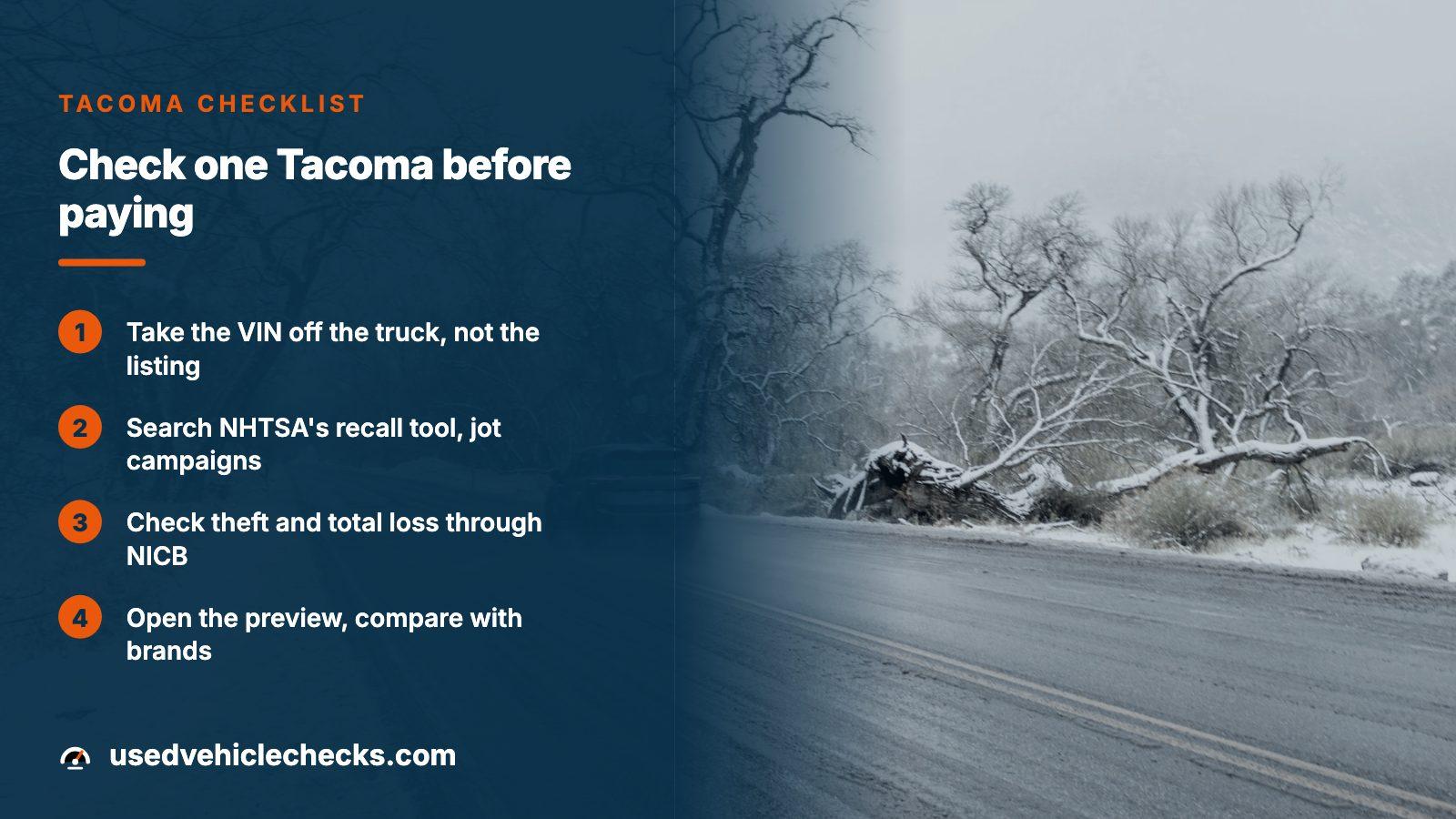
- Take the VIN off the truck rather than the listing. Its model year character sits in tenth position, so compare it with the year the seller claims.
- Enter the VIN in NHTSA's no-cost recall search and jot down any open campaigns.
- Check theft and total-loss records through the NICB VINCheck tool.
- Open the preview on this site. Should the Tacoma survive your shortlist, buy the report and start with the odometer entries, oldest first.
- Set that against title brands, accident and salvage entries, then book the mechanic.
Opening the preview costs you nothing. The report itself is paid for once, and no plan is left running afterward. Pricing details, including the packs for comparing several trucks, sit on the pricing page.
Where this information comes from
- NHTSA: recalls by vehicle — A no-cost lookup for open recall campaigns on one VIN, and the record behind the recalls named here.
- NMVTIS: information for consumers — What the national title record shows, including the latest odometer reading, and why a clean result is no guarantee.
- FTC: buying a used car — Why a history report does not replace an independent mechanic's inspection.
- NICB: VINCheck — A no-cost screen of one VIN for theft and total-loss records.
- NHTSA owner complaint 11734605 — owner experience, paraphrased
- NHTSA owner complaint 11692398 — owner experience, paraphrased
- NHTSA owner complaint 11712767 — owner experience, paraphrased
Sources and photos: Facts checked against the sources above in November 2026. Photos by Zoshua Colah and Annika Wischnewsky on Unsplash; diagrams by UsedVehicleChecks.
Keep reading
- Odometer Rollback Check by VIN: Run the Mileage Test Before You PayHow to line up a truck's readings and catch one that steps backward.
- How Many Miles Is Too Many on a Used Car? Age, Pace and ProofDecide what a high reading should mean for your shortlist.
- Mileage Check by VIN: What the Recorded Odometer Readings ShowWhat a mileage check by VIN returns and where its readings come from.
- Toyota 4Runner Years to Avoid: Read the Year, Then the MileageThe same year-by-year read for the SUV that many Tacoma shoppers also weigh.
Frequently asked questions
Which Toyota Tacoma years should I avoid?
Start your caution with 2009, 2008, 2016, 2012 and 2010. The 2009 model year leads with 518 NHTSA complaints against a median of 202. A flagged year means look harder and offer less, yet it proves nothing about one particular truck, and the reverse holds too: a quiet year can still hide a bad history.
Which Tacoma years have the lightest complaint records?
The 2022 model year has 57 complaints, 2021 has 78 and 2020 has 86, but those trucks are young and owners have had little time to file. Among older ones, 2014 has 93 and 2015 has 100. Both of those carry 4 recalls, so open campaigns on the VIN still deserve a look.
Is a high-mileage Tacoma a bad buy?
Mileage alone settles very little. A truck with a long, documented record and matching wear can be a safer purchase than one with a low reading that no paperwork backs up. Dated readings that only rise, a use type that explains the pace and an underside that fits the figure are the tests.
How can I tell if a Tacoma's odometer was rolled back?
Compare the dash with the state title record and with dated readings in a history report. A newer reading below an older one, or a dash figure far under what the record shows, is the warning. Ask the seller for service invoices, and be wary of anyone whose name is not on the title.
Can I read a Tacoma's model year from its VIN?
Yes. In a 17-character VIN, position ten is the model year code and the first three positions identify the maker. Compare that character on the truck with the year in the ad before going further. If they disagree, the listing or the paperwork needs an explanation before you spend more time on that truck.
Now check the car itself
The guide explains what to look for. The report shows what this VIN has on record.