THE SHORT ANSWER
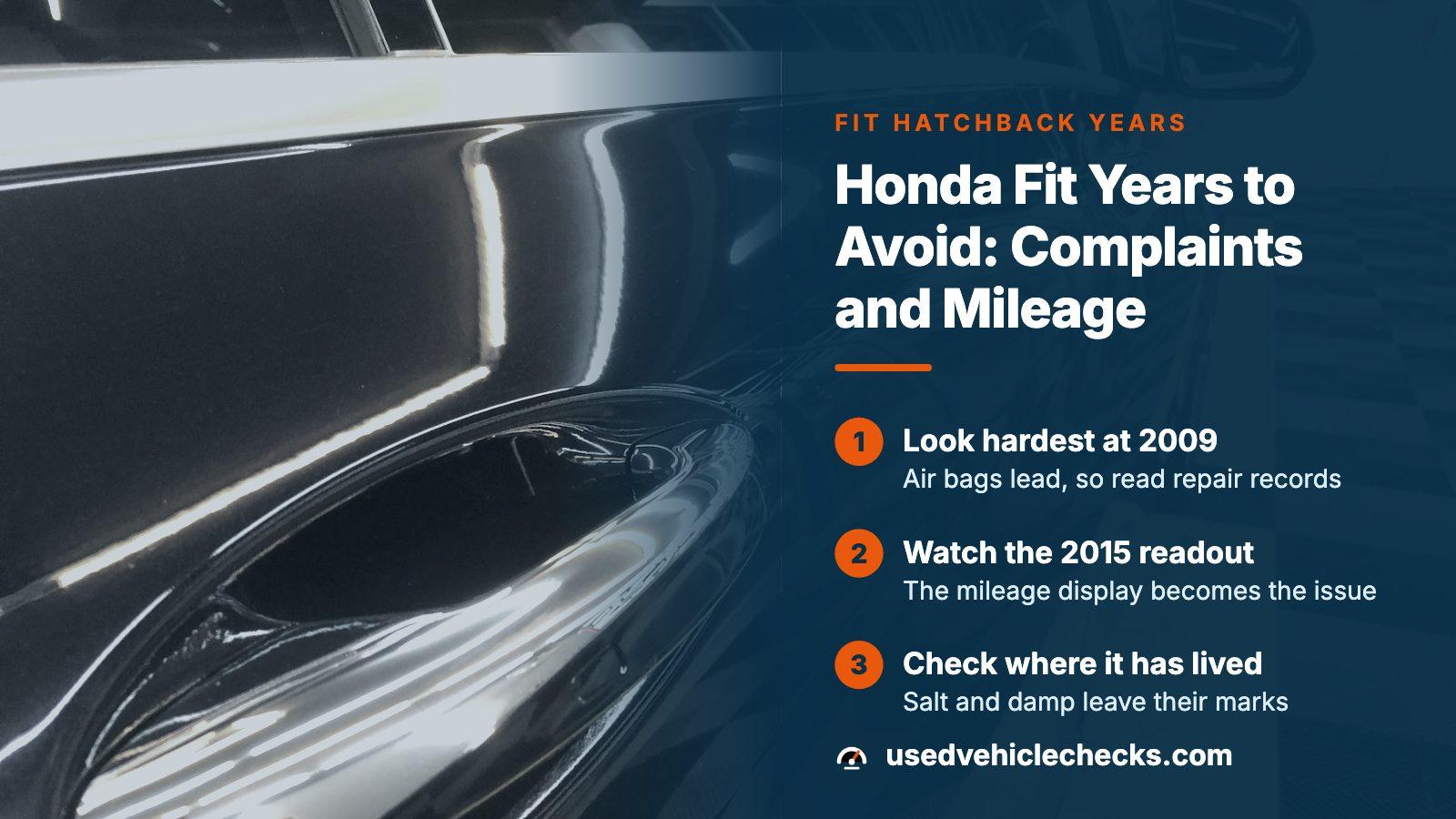
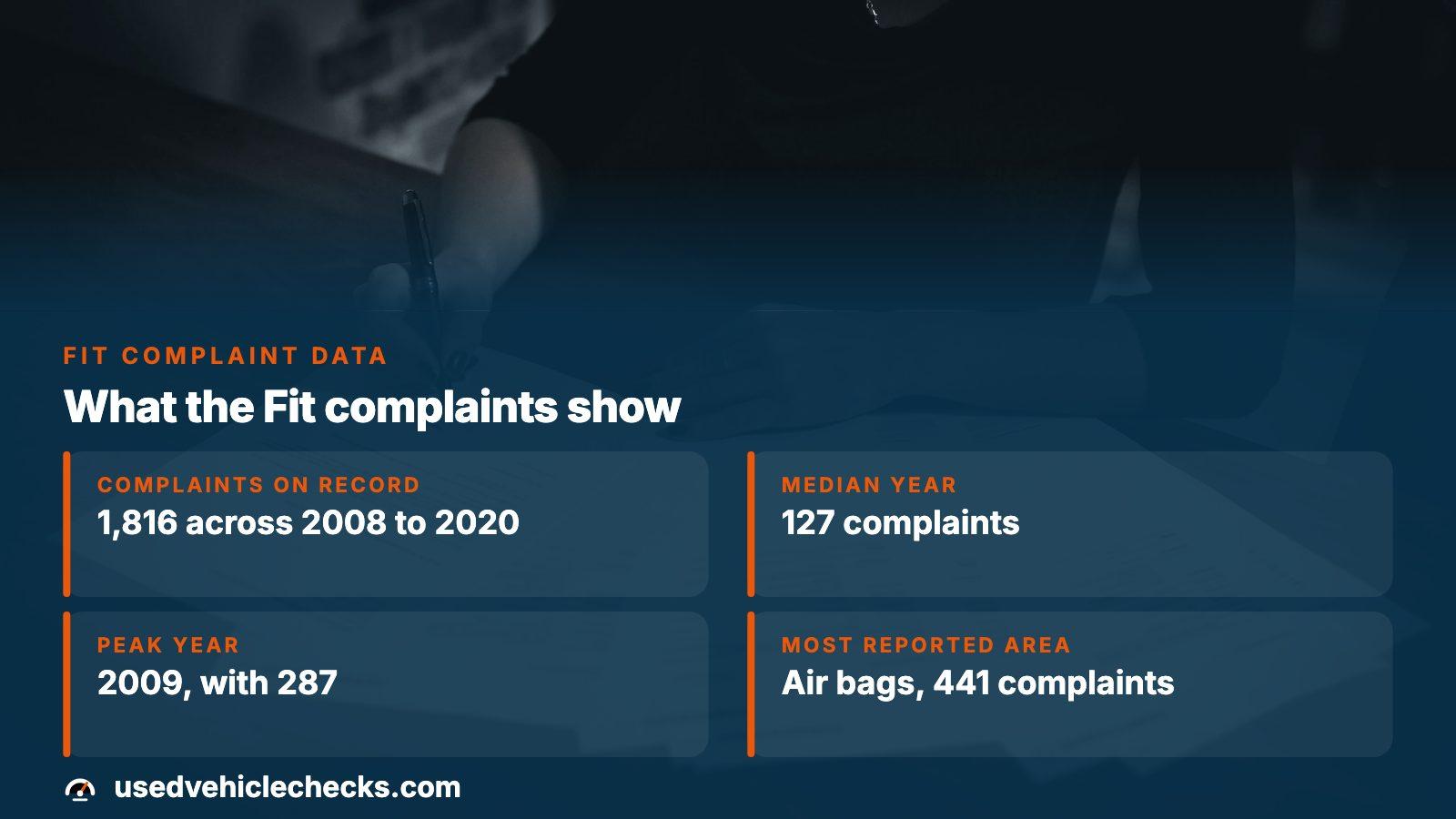
Across 2008 to 2020, the Fit years that need the hardest look are 2009, 2015, 2008, 2010 and 2013, each at least 1.39 times the median year of 127 complaints. The quietest settled records belong to 2020 and 2017. Air bags lead the overall tally, and from 2015 on the mileage readout is itself a repeat complaint. Use a flag to plan a cold start, a recall lookup and a mileage check.
- Complaints on record
- 1,816 across 2008 to 2020
- Median year
- 127 complaints
- Peak year
- 2009, with 287
- Most reported area
- Air bags, 441 complaints
The five Fit years that sit above the median
As of mid-August, NHTSA held 1,816 owner complaints on the Fit for model years 2008 through 2020. The middle year logs 127, so each year is weighed against that figure instead of against other small cars. Five years land above it.
| Year | Owner filings | Versus median | Recalls | Main trouble spot |
|---|---|---|---|---|
| 2009 | 287 | 2.26× | 11 | Air bags |
| 2015 | 282 | 2.22× | 4 | Electrical system |
| 2008 | 217 | 1.71× | 8 | Air bags |
| 2010 | 183 | 1.44× | 12 | Air bags |
| 2013 | 176 | 1.39× | 10 | Air bags |
NHTSA has no 2014 row for the Fit, so the climb runs from 176 in 2013 to 282 in 2015, and the trouble shifts from air bags to electrical faults. Each count is an unverified owner account, so the table shows where to press, not which cars are bad.
2009: air bags first, and a repair record to read
More than a third of the 2009 filings in a November pull of NHTSA's data list air bags, and nine of the 11 campaigns recorded for a 2009 Fit involve inflators. Two concern replacement work gone wrong: 17V545, where one dealership may have fitted passenger inflators incorrectly, and 18V268, covering passenger bags installed badly during a swap. A third, 16V061, covers a driver's inflator that moisture can wear down until it ruptures.
From an NHTSA owner complaint
A parent filed in August 2017 about a 2009 Fit their daughter bought that April. A Honda dealer had replaced the passenger air bag in September 2016 and the driver's in March 2017, shortly before the sale. After a serious crash, the investigating officer said the driver's bag should have fired, and an inspector was being sent to check the installation.
A swapped bag does not close the question. Ask for the work order showing when each one was replaced, look the VIN up for open campaigns, and have a mechanic check the warning light.
2015: when the mileage readout becomes the problem
Electrical trouble tops the 2015 filings, and the largest strand is the digital panel showing mileage, fuel level and trip data. In the November pull, about a quarter of the 2015 filings describe it blanking, flickering or printing gibberish, often in the cold, and several owners blame cracked solder joints. Filings for 2016, 2018 and 2019 describe the same fault, so any Fit from 2015 on can have it.
None of the four 2015 recalls touches the display: they cover ignition coil wiring that can stall the engine (15V559), transmission software that can damage a pulley shaft (15V574), grab handle brackets and a pillar trim cover. A clean recall result says nothing about this fault.
From an NHTSA owner complaint
A 2015 owner who filed in March 2023 said the gauge screen shows scrambled data or nothing in cold weather. As that screen is the only place the car shows its odometer, the mileage cannot be read in those conditions. The owner blamed cracking solder points on a logic board.
A blank display proves nothing about fraud, but it removes your easiest check. If a cluster has been replaced, ask for the repair order recording the reading at the swap.
When the mileage on a Fit does not add up
NHTSA moved the federal exemption from mileage statements at sale from ten years to twenty, effective January 1, 2021, but only for model year 2011 and newer. A 2008, 2009 or 2010 Fit can therefore be sold with no federal statement, which is lawful, so dated odometer entries in the title record carry more weight.
From an NHTSA owner complaint
A buyer of a 2009 Fit from a dealer reported odometer fraud to NHTSA in July 2026. The car showed 54,247 miles at the sale. The buyer noted an abnormal clicking sound, and a scanner app used by the buyer's uncle reported 172,429 miles, while the dash read 90,000 when the complaint was filed.
Investigators settle whether that happened. Either way, a low dash figure on an old Fit needs dated readings behind it.
| What the record shows | What it suggests | What to do |
|---|---|---|
| Entries rise at an even pace | Ordinary use for the age | Go on to the inspection |
| An earlier reading above today's dash | Tampering, or an unrecorded cluster swap | Ask for the repair order; without one, believe the higher number |
| Very few miles on a 2008 to 2010 car | Light use, or a figure with no proof | Ask for service invoices showing dates and mileage |
| Dash blank on a cold start | A display fault, not proof of fraud | Recheck once warm against the dated record |
Salt, damp carpets and where the car has lived
Most of the 2008 body complaints concern water: in the November pull, 35 of the 43 filed under structure describe leaks at the doors, windows or spare tire well. A musty Fit may simply leak, but flood damage is the other explanation, and the brand history in a federal title record is where a flood label would appear.
Salt matters too. Recall 20V770 covers 2009 to 2013 Fits originally sold or ever registered in 22 states and Washington, DC, because the drive shaft coating may not have been applied properly, leaving it open to road salt damage, a break and sudden loss of drive power. Put the question to the seller, then test the answer against the report's title and ownership entries.
What the complaint counts cannot tell you
- Sales volume: the more of a model sold, the more complaints it draws, even when each car is equally sound.
- Time on the road: a 2009 has had many more years of owners to complain than a 2020.
- Verification: each filing is one owner's story, and no one has checked it.
- Scope: a model year describes thousands of cars, while title, damage and mileage entries belong to one VIN.
Even the quiet years are not spotless: 2020 and 2017 log 35 and 42 filings, yet a handful in each mention the dash display. Recalls differ in kind, since Honda admits the fault and pays, but federal law ties that duty to 15 years from first sale, so on the oldest Fits get any free-repair promise in writing.
Checking one Fit before you pay
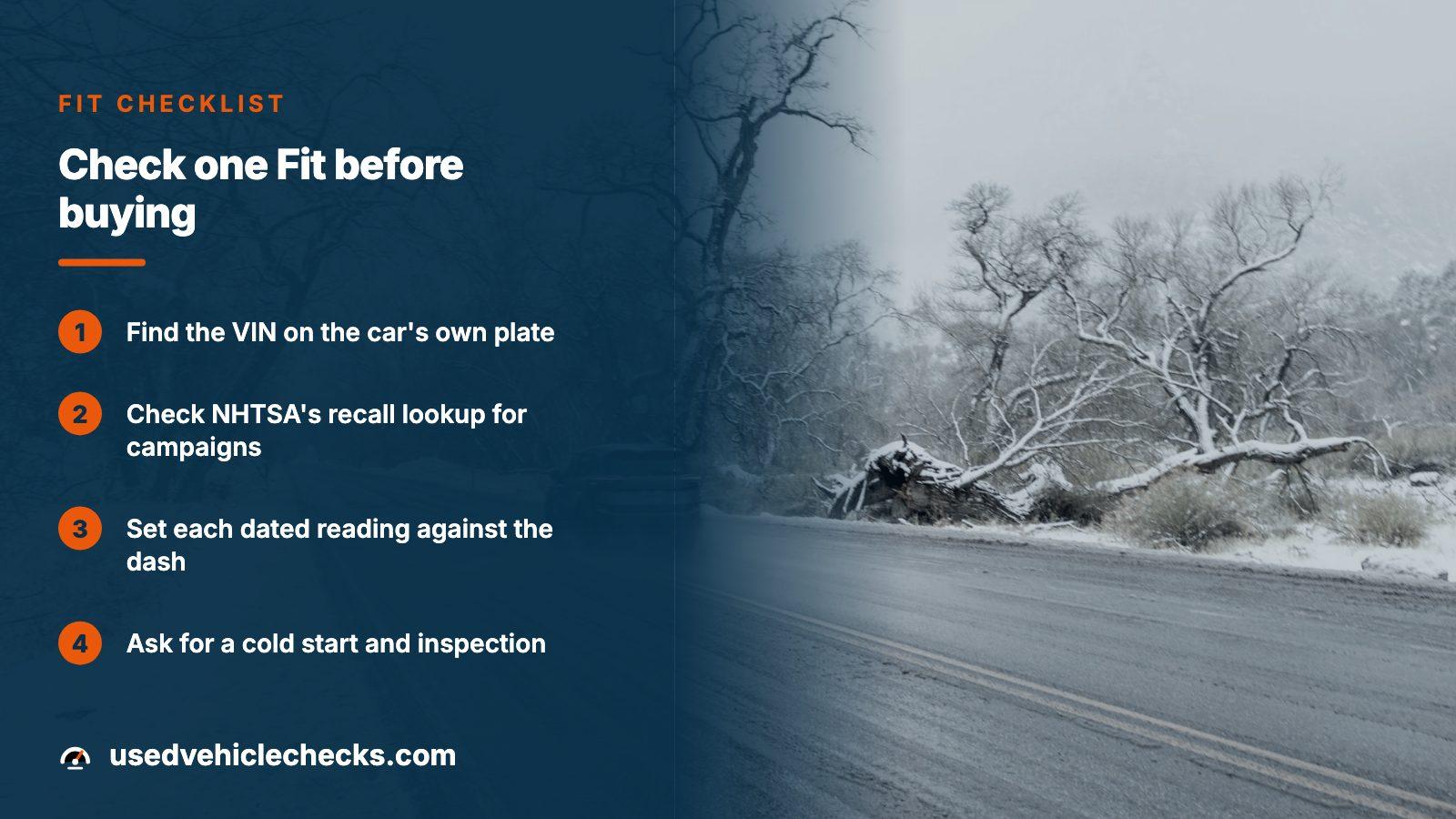
- Locate the VIN on the car's own plate; its tenth character should match the model year in the advert.
- Check NHTSA's recall lookup for open campaigns: inflator entries on a 2009, coil or transmission software on a 2015.
- Open the free preview on this site. If the Fit stays in contention, buy the report and start with the odometer entries, oldest first.
- Set each dated reading against the dash and any mileage on service invoices; a figure above today's display needs a written explanation.
- Read title brands, salvage and accident entries and ownership history next, thinking of water and salt.
- Add NICB's VINCheck, a no-charge lookup for theft and total loss.
- Ask to start the car after a cold night, and have a mechanic test it on a long hill, at highway pace and in slow commuter traffic.
You pay once for a report; no plan renews behind it. Prices, including the packs for a longer shortlist, sit on the pricing page.
Where this information comes from
- NHTSA: recalls by VIN — A no-charge lookup for open recall campaigns on one specific car.
- Federal Register: odometer disclosure requirements — The rule that moved the mileage-statement exemption from ten to twenty years for model year 2011 and newer.
- NMVTIS: understanding a vehicle history report — What the federal title database's report covers, odometer reading and brand history included.
- NICB: VINCheck — A quick theft and total-loss screen for one VIN.
- NHTSA owner complaint 11753282 — owner experience, paraphrased
- NHTSA owner complaint 11512627 — owner experience, paraphrased
- NHTSA owner complaint 11012352 — owner experience, paraphrased
Sources and photos: Facts checked against the sources above in November 2026. Photos by Clarence Tioh, Zoshua Colah and Dimitri Karastelev on Unsplash; diagrams by UsedVehicleChecks.
Keep reading
- Odometer Rollback Check by VIN: Run the Mileage Test Before You PayHow lining up dated readings exposes a step backward.
- Mileage Check by VIN: What the Recorded Odometer Readings ShowWhat a dated list of readings shows for one VIN before money changes hands.
- Title Check by VIN: A Step-by-Step Check, Odometer Entries FirstWhere a flood or salvage brand would appear on a damp-smelling Fit.
- Nissan Versa Years to Avoid, and What the Odometer AddsA small-car rival ranked against its own median, for a like-for-like comparison.
Frequently asked questions
Which Honda Fit years should I avoid?
Start with 2009, 2015 and 2008, which drew 287, 282 and 217 complaints against a median year of 127. Each still has sound cars, so use the flag to justify a cold start, a recall lookup, a mechanic's inspection and a look at the mileage record.
Is the 2015 Honda Fit a bad car?
Not automatically, but test it hardest. It logged 282 filings, 2.22 times the median, led by electrical faults and many about a dash display that blanks. Start it on a cold morning and ask whether the cluster was ever replaced.
Which Fit years are the most reliable?
Complaints measure trouble reported, not reliability, but 2020 and 2017 carry the lightest settled records at 35 and 42. Newer cars look tidy partly because few owners have filed yet, so check recalls by VIN and read the odometer record.
Which part of a Honda Fit gives owners the most trouble?
Air bags lead with 441 complaints across 2008 to 2020, then the electrical system with 351. Air bag filings cluster in the older years, while electrical ones, such as the blanking mileage display, lead from 2015. Have a mechanic look at both.
How do I check the mileage on a specific Fit?
Use the VIN. Open the free preview on this site, buy the report if the car stays in contention, and read the dated odometer entries oldest to newest. Compare each with the dash, and settle any past reading above today's display before money moves.
Now check the car itself
The guide explains what to look for. The report shows what this VIN has on record.