THE SHORT ANSWER
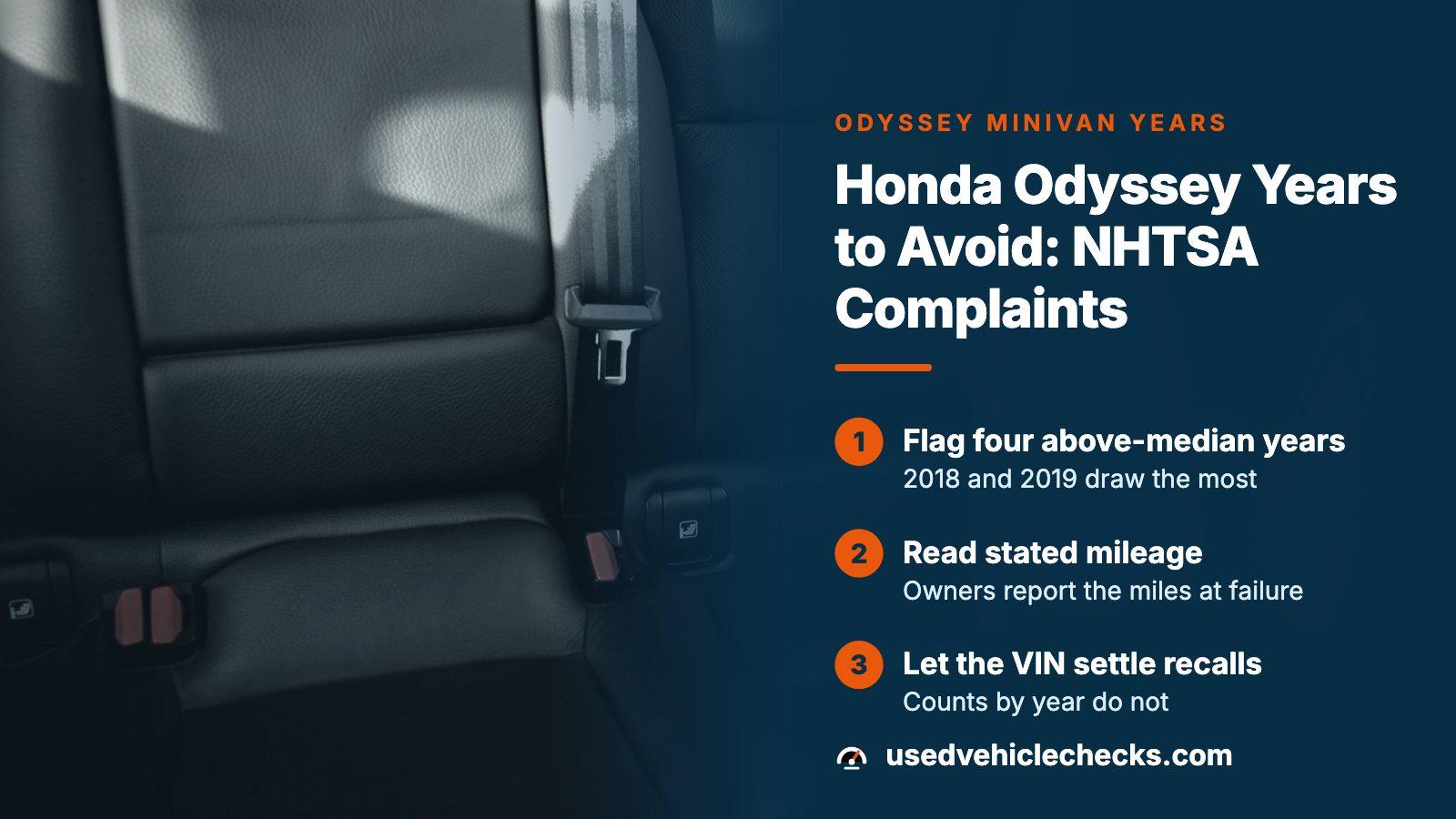
Across 2008 to 2022, the Odyssey years that earn the hardest look are 2018, 2019, 2008 and 2020, with 957, 921, 499 and 445 complaints against a median year of 242. The quietest settled year is 2017, at 39. Electrical trouble leads the whole run. Use a flagged year to sharpen the inspection, the VIN check and the mileage review, never as grounds for dismissing a van you have not seen.
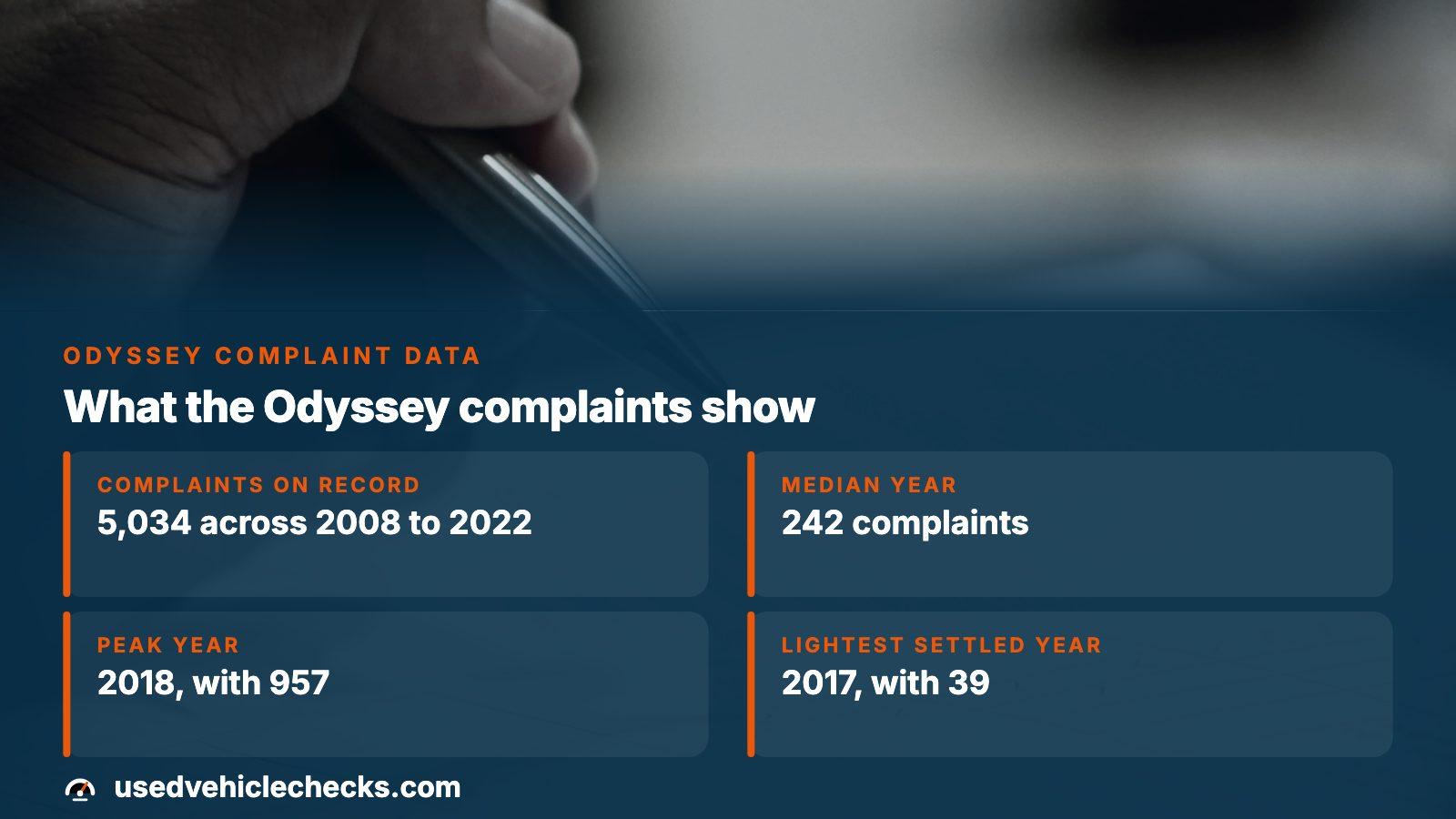
- Complaints on record
- 5,034 across 2008 to 2022
- Median year
- 242 complaints
- Peak year
- 2018, with 957
- Lightest settled year
- 2017, with 39
The four Odyssey years that sit above the median
NHTSA holds 5,034 owner complaints on the Odyssey across model years 2008 to 2022, and they pile up unevenly. The middle year draws 242, so that is the yardstick. Four years clear it by a wide margin, and the first two clear it by close to four times.
| Model year | Complaints | Recalls on file | Times the median | Most reported area |
|---|---|---|---|---|
| 2018 | 957 | 16 | 3.95× | Electrical system |
| 2019 | 921 | 20 | 3.81× | Electrical system |
| 2008 | 499 | 5 | 2.06× | Service brakes |
| 2020 | 445 | 14 | 1.84× | Forward collision avoidance |
Those counts come from an August 2026 pull. NHTSA keeps taking filings, and its live database on 5 November showed 1,014 for 2018, 998 for 2019 and 492 for 2020. The order has not changed, but the top years are still growing.
The step from 2017 to 2018, and the years in between
The step matters more than the peak. The 2017 model year logs only 39 complaints, the lightest file of any settled year, and the 2018 model year arrives with 957. A gap like this is the kind that tends to follow a design overhaul, so if a listing straddles the line, find out which side the van is on.
Between 2009 and 2016 the yearly counts stay close to the median, running from 198 up to 307 in 2014. The newest years, 2021 and 2022, show 132 and 128, but a young year always looks quiet, since few owners have yet had a reason to file. Call them unproven, not clean. Even the 39 for 2017 is a light record, not a promise about any one van.
What owners report, and at what mileage
Across all 15 model years, filings gather in a few areas.
- Electrical system, 937 filings
- Engine, 880 filings
- Forward collision avoidance, 613 filings
- Unknown or other, 507 filings
- Service brakes, 453 filings
- Power train, 436 filings
The driver-assistance group shows the clearest pattern. In the 2018 to 2020 filings read for this page, owners describe a windshield camera that quits and drags adaptive cruise control, lane keeping and collision braking down with it. The mileages they give stretch from 28,170 to 123,952. One owner paid $1,335.88 for a replacement, and quotes elsewhere reach $2,400.
From an NHTSA owner complaint
The owner of a 2019 Odyssey wrote that six alerts began beeping at once while driving, and that Honda traced them to the forward-facing camera. The van had only 55,000 miles and had left warranty a few months earlier. The owner called it a bigger safety concern than the rear-camera recalls.
A low reading did not protect that van. On any 2018 to 2020 Odyssey, start the engine cold, watch the dash for safety-system warnings and ask whether the camera has ever been replaced.
Odometer complaints filed on Odysseys
NHTSA's file is not only about parts. In a pull of its Odyssey complaints for 2008 to 2022 on 5 November 2026, 17 opened with the words Odometer Fraud. Each is one buyer's unproven account. In the two below, the mismatch surfaced only after the sale.
From an NHTSA owner complaint
A buyer paid a private seller for a 2008 Odyssey in April 2024 with the odometer recorded at 129,000 miles. When the buyer tried to trade the van in, the dealer said a history report's latest reading was 230,000 miles, dated one week before the sale. The buyer filed it as odometer fraud.
A dated record from before the purchase contradicted the paperwork, and it surfaced only at the trade-in counter.
From an NHTSA owner complaint
A buyer at a dealership bought a 2018 Odyssey recorded at 66,700 miles. At registration, the mileage on file turned out to be 178,000. The short complaint does not explain how the gap arose, only that the buyer discovered it after paying.
Neither buyer learned the true figure while shopping. One dated reading pulled before the deal would have exposed the gap while leaving cost nothing. The federal title program lists the odometer reading among the few indicators a history report should cover, and says checking it helps a buyer spot discrepancies.
Recall counts by year, and why the VIN decides
Recalls differ from complaints: each one is a defect the maker has admitted and must repair without charge. A federal statute, 49 U.S.C. §30120(g), sets a 15-year limit on the free repair, counted from first sale. The flagged years carry plenty: 16 campaigns on file for 2018, 20 for 2019 and 14 for 2020, against 5 for 2008. Heavy recalls and heavy complaints sit in the same years here.
Campaigns follow build ranges, not model years. Take NHTSA campaign 23V751000: a manufacturing error can make an engine's connecting rod bearing wear and seize, and Honda's notice names certain 2018 and 2019 Odysseys, with a dealer inspection and repair or engine replacement as the remedy. A 2020 van sits outside it by year, and a 2019 van is inside only if its VIN falls in the range. NHTSA's recall lookup by VIN costs nothing, so run it on the van.
Checking one Odyssey before you pay
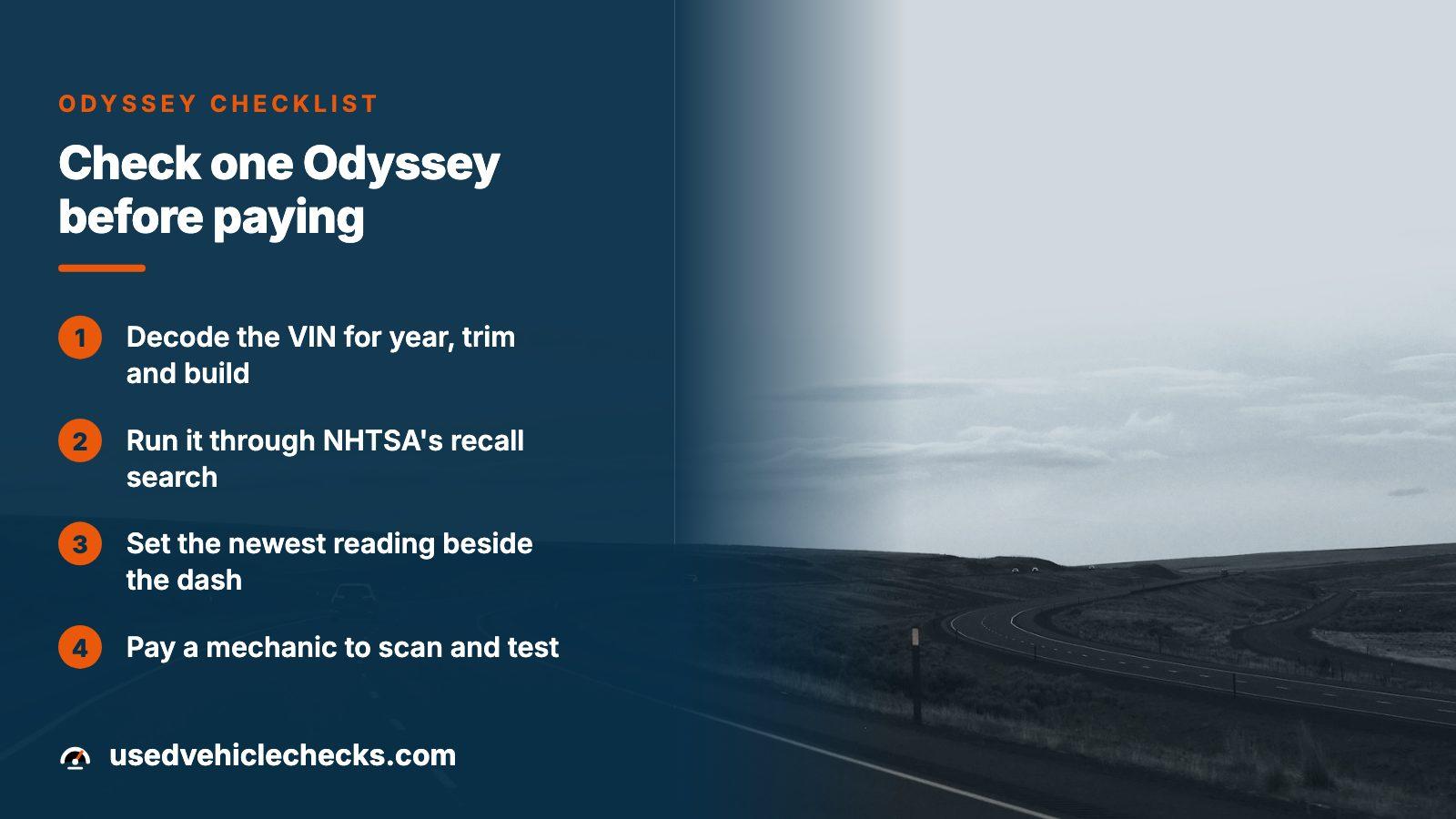
- Start by decoding the VIN to see whether the year, trim and engine agree with the listing.
- Run the VIN through NHTSA's recall search and note each open campaign, mainly any that touch sliding doors, cameras or the engine.
- Open the free preview on this site. If the van stays on your shortlist, buy the report and read its odometer readings first, oldest to newest, with their dates.
- Set the newest reading beside the dash and beside any mileage written on service invoices. A figure that falls, repeats oddly or sits above the dash is the red flag.
- Read the title brands, plus any damage or salvage entries and the use type, against those miles. A van with a rebuilt past and low miles is a different bet.
- Run NICB's VINCheck, a free theft and total-loss screen.
- Pay a mechanic to scan the driver-assistance system, work both sliding doors and the power tailgate, and listen to the engine.
You pay once for a report, and no plan continues afterward. Shoppers weighing several vans can compare pack options on the pricing page.
What the counts can and cannot say
Sales volume pads the totals: a minivan that sells in large numbers draws more filings than a niche model built to the same standard. Age inflates them as well: the models on the road longest have had the most chances to draw complaints. Each filing records only what one owner believed had happened, so pooled together they show a pattern and read singly they prove little. Title, damage and mileage records belong to a single VIN.
How to use a flagged year
Let a flagged year raise the standard of your inspection and sharpen your offer. Then let the VIN's own records decide, because every year on this page produced well-kept vans and neglected ones.
Where this information comes from
- NHTSA: vehicle safety and owner complaints — The federal agency that receives the owner complaints behind each model-year count.
- NHTSA: recalls by VIN — A no-charge lookup for open recall campaigns on one specific van.
- NMVTIS: what a vehicle history report includes — The federal title program's own explanation of why odometer readings are on a history report.
- NICB: VINCheck — A quick theft and total-loss screen for one VIN.
- NHTSA owner complaint 11771436 — owner experience, paraphrased
- NHTSA owner complaint 11738110 — owner experience, paraphrased
- NHTSA owner complaint 11734277 — owner experience, paraphrased
Sources and photos: Facts checked against the sources above in November 2026. Photos by Maxim Hopman, John Kakuk and Masjid MABA on Unsplash; diagrams by UsedVehicleChecks.
Keep reading
- Odometer Rollback Check by VIN: Run the Mileage Test Before You PaySee how a list of dated readings exposes a step backward.
- Mileage Check by VIN: What the Recorded Odometer Readings ShowRun the mileage check on the Odyssey you are actually considering.
- How Many Miles Is Too Many on a Used Car? Age, Pace and ProofDecide what a high reading means on a family minivan.
- Dodge Grand Caravan Years to Avoid: Complaints and MileageA rival minivan ranked against its own median, for a like-for-like comparison.
Frequently asked questions
Which Honda Odyssey years should I avoid?
Start your caution with 2018, 2019 and 2008, which carry 957, 921 and 499 complaints against a median year of 242, then add 2020 at 445. Caution means a harder inspection, a closer look at the mileage record and a lower opening offer. Sound Odysseys came out of every flagged year, so judge the van by its VIN.
Is the 2018 Honda Odyssey a bad van?
Not automatically, but it is the year to scrutinize most: 957 complaints, 3.95 times the median, and 16 recalls on file, led by electrical filings. A 2018 with its recalls completed, readings that climb in date order and no camera warnings is a different van from one with gaps.
Which Odyssey year has the lightest record?
Complaint counts measure filings, not reliability, but 2017 has the lightest settled file at 39. The years from 2009 to 2016 sit near the median. The newest years, 2021 and 2022, read as quiet simply from youth. A low count never replaces the VIN check on the van itself.
What goes wrong most often on an Odyssey?
Electrical complaints lead with 937 filings across 2008 to 2022, ahead of the engine at 880 and forward collision avoidance at 613. On 2018 to 2020 vans, a failing front camera that switches off the driver-assistance systems is the fault to test for on the first drive.
How do I check the mileage on a specific Odyssey?
Line up the dated odometer readings for the VIN. They should only climb. The free preview on this site is the first step, and the report adds the full reading history. Then compare the newest figure with the dash and with service invoices. A reading above today's dash needs an explanation before you pay.
Now check the car itself
The guide explains what to look for. The report shows what this VIN has on record.