THE SHORT ANSWER
For a car bought and financed during service, the 36 percent Military Lending Act cap generally does not reach the purchase loan, and the 6 percent rate limit is meant for debts taken on before service. Repossession needs a court order only where you paid a deposit or installment before service. A car lease can end on qualifying orders. No rule vets the odometer or the title, so check both before you sign.
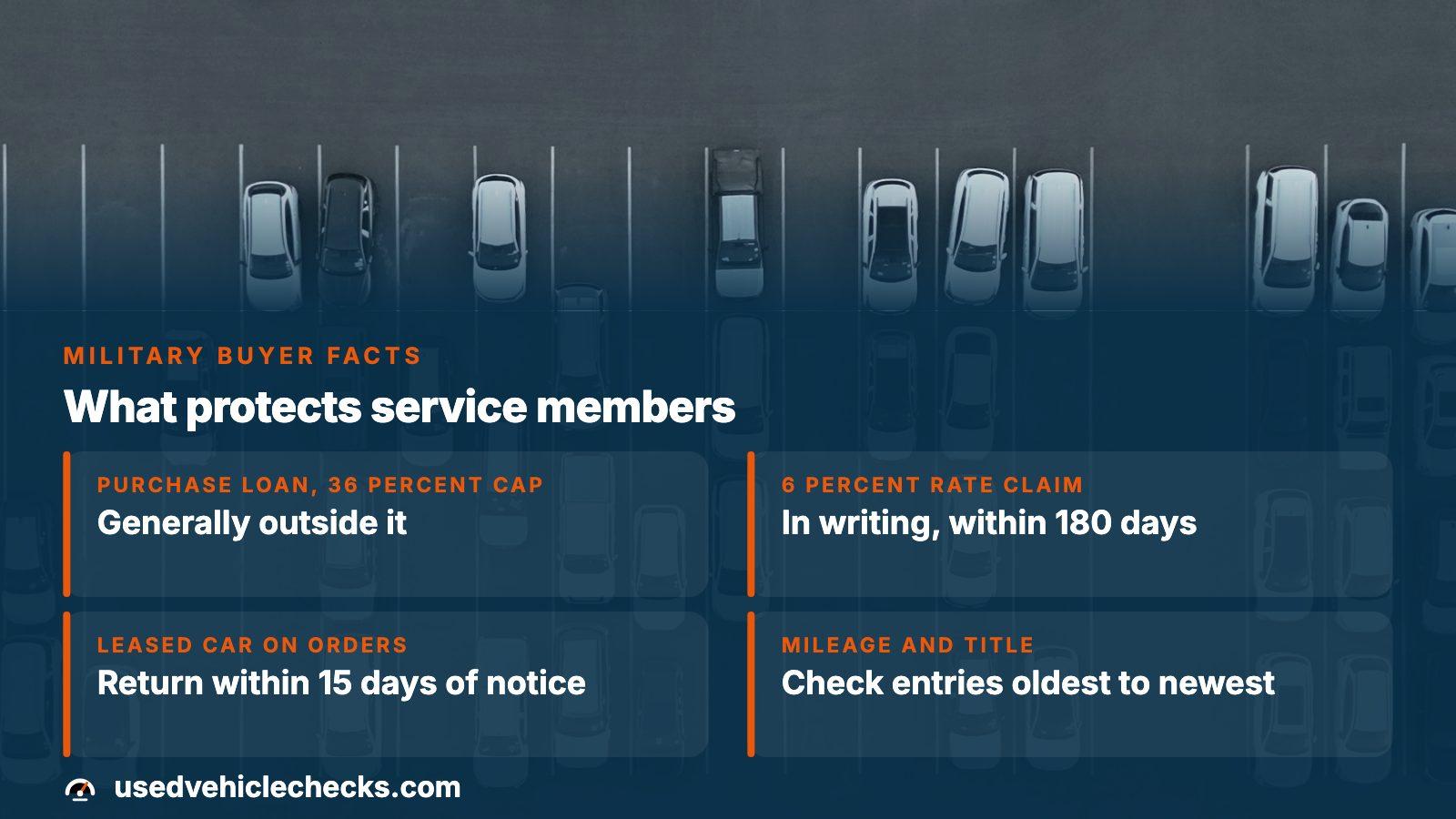
- Purchase loan and the 36 percent cap
- Generally outside it
- 6 percent rate claim
- In writing, within 180 days of release
- Leased car on qualifying orders
- Return it within 15 days of the notice
These rights govern the contract, not the car
Every legal protection below concerns credit, repossession or a lease. None of them tests whether a car matches its listing. A buyer in uniform gets no extra assurance about mileage, hidden damage or a branded title, so the odometer and the title paper remain the buyer's job. A mileage claim or a salvage brand is something you test against records, not against a statute. The sections run from the rules that usually miss a new purchase to the ones that matter most when orders change.
Four rules servicemembers ask about, compared
| Rule | Where it helps with a car | What triggers it |
|---|---|---|
| Military Lending Act cap | Credit such as a vehicle title loan; not a loan that buys the car and is secured by it | Being a covered borrower: active duty, some reservists and Guard members, spouses |
| 6 percent rate limit | A car loan taken out before service began | Written notice plus orders or a commander's letter |
| Court order before repossession | A contract with a deposit or installment paid before service | A lender must go to court; nothing for you to file |
| Lease termination | A car lease, on qualifying orders | Written notice, a copy of orders, return of the car |
The first row is the one people cite most, and the one that misses a dealer's purchase loan most often.
Why the 36 percent cap rarely touches a dealer loan
The Military Lending Act caps the yearly cost of covered credit at 36 percent, counting fees, credit insurance premiums and add-on products. The Consumer Financial Protection Bureau says a loan for the car you are buying, where the car itself backs the debt, is not covered. Cash borrowed against a car you already own is different: the bureau lists vehicle title loans among covered credit. Whether your financing counts as the excluded kind is a question for a legal assistance attorney, not the finance office.
The 6 percent rate belongs to debts from before service
The Servicemembers Civil Relief Act can lower the rate on a car loan to 6 percent, alone or with a spouse, but only if you took the loan before active duty began. The lower rate runs while you serve, and the difference is not tacked back on afterward. It does not switch on by itself:
- Write to the lender and say you are claiming the limit.
- Attach your orders, or a letter from your commanding officer showing when active duty began.
- Send it while you serve or within 180 days of release.
A lender cannot refuse you credit or report negative information because you used these rights. Late fees and collection still apply.

Repossession: when a judge has to approve it
Once you are serving, a lender cannot end a purchase contract or take the car back over a breach without a court order, provided you paid a deposit or an installment before service began. A car paid for from the first payment onward during service falls outside the rule, so the date of that first payment matters as much as the contract date. A judge can order earlier payments returned as a condition of ending the contract, or pause the case when service affects your ability to pay. Knowingly seizing the car in breach of the rule is a crime. If it happens, bring the contract and your orders to a legal assistance office instead of confronting the lender.
Waivers and add-ons in the finance office
You may waive these rights, but a waiver touching repossession or the end of a contract must be a separate written document, not a clause inside the finance contract, and it has to name the instrument it applies to. Type size is regulated too: 12 point or larger. The bureau notes that some lenders ask for one at signing, and that you can refuse and find another lender.
From an NHTSA owner complaint
An owner who wrote to NHTSA about a 2013 Ford Escape said they bought it in March 2018 after being permanently disabled from military service. Their credit had suffered while benefits were pending, the loan carried 18 percent interest, and they said they were made to buy an expensive warranty, with the bank having them hand over $1800 in cash for it. Both drive shafts had to be replaced inside a month.
Whatever the law covered in that case, the practical lesson holds: ask which items are optional, and have a legal office read the contract before you sign.
Ending a car lease on orders, and the mileage bill that stays
A lease can end early if you signed it before entering service under orders of 180 days or more. It can also end if you signed while serving and then received orders to move from the mainland to a post outside it, to leave a state such as Alaska or Hawaii, or to deploy for 180 days or more. A move between two mainland posts is not on the list. To end it:
- Give written notice and a copy of your orders by hand, private carrier, return-receipt mail or an electronic route the lessor can receive.
- Return the car within 15 days after the notice is delivered.
- Expect a bill: no early termination fee, but unpaid lease amounts, taxes, fees and reasonable charges for excess wear and mileage still apply.
Mileage is the item you can control. Photograph the odometer at hand-back and keep the lessor's receipt. Anything prepaid for months after the end date must come back to you within 30 days.
Buying through an overseas sales program or on the way to a new post
Servicemembers often buy a car that will not stay where it was sold, through a program abroad or in one state for use in another.
From an NHTSA owner complaint
An owner reported that a 2013 Ford Escape was sold to them through a military car sales program overseas. When they tried to get its recalls done there, the local Ford dealership said it could not obtain the parts to finish them in the UK.
Before you pay, look the car up in NHTSA's recall records and ask who will do any open repair where you will be stationed. Ask for the title and any written mileage statement before money moves, and hold them against the readings on record for the VIN.
Where a mileage and title check earns its place
UsedVehicleChecks starts from the odometer. Enter the VIN and the preview opens at no cost. The report is bought once, with no subscription, and sets dated odometer readings beside title brands and, where they exist, salvage and auction records with photos. Amounts are on the pricing page. Then work through this order:
- Read the odometer entries from oldest to newest and compare them with the dash.
- Match the title and the mileage statement to the report.
- Take the contract, any add-on list and your orders to a legal assistance office.
- Write down your service start date and the date of your first payment.
Where this information comes from
- CFPB: Military Lending Act — Who is covered, the 36 percent rate, title loans and the auto loan exclusion.
- CFPB: Servicemembers Civil Relief Act — The 6 percent claim steps, repossession, waivers and the auto lease routes.
- 50 U.S.C. 3952: installment contracts for purchase or lease — Court order before repossession, what a judge may order and the criminal penalty.
- 50 U.S.C. 3955: termination of motor vehicle leases — Qualifying lease routes, notice, the 15-day return and the charges that remain.
- 50 U.S.C. 3918: waiver of rights — A waiver must be a separate written instrument, in at least 12 point type.
- NHTSA owner complaint 11435325 — owner experience, paraphrased
- NHTSA owner complaint 11073755 — owner experience, paraphrased
Sources and photos: Facts checked against the sources above in November 2026. Photos by Ben Wicks, Scott Graham and Iain on Unsplash; diagrams by UsedVehicleChecks.
Keep reading
- Mileage Check by VIN: What the Recorded Odometer Readings ShowThe mileage check itself, with every recorded reading in date order.
- Buying a Car Out of State: Check the Mileage Before You TravelWhat to test from a distance when the car sits in another state.
- Financing fell throughWhat a dealer can and cannot do after you drive off on its financing.
- How to Buy a Used Car: Start With the Mileage, Then the RecordsThe full order of checks for any used car purchase.
Frequently asked questions
Does the Military Lending Act cap my dealer car loan?
Generally not. A loan that buys the car and is secured by it sits outside the Act, while vehicle title loans sit inside it. A military legal office can tell you how your particular deal is classed.
Can I still claim the 6 percent rate after I leave service?
Yes, for a debt taken on before service, if you write to the lender within 180 days of release. Include your orders or a commanding officer's letter. The lower rate covers the period you served.
Do I have to sign a rights waiver at the dealership?
No. You can refuse and find another lender. A waiver touching repossession must be a separate written document made during or after service. A line buried in a finance contract is a reason to stop and ask a legal office.
Can I end a car lease because I move between two bases in the United States?
Not on that basis. The qualifying routes are orders overseas, a move out of Alaska or Hawaii, a deployment of 180 days or more, or a lease signed before service under orders of that length. A move between two mainland posts is not listed.
Do these protections check that a car's mileage is accurate?
No. They deal with credit, repossession and leases. To test mileage, compare the title's statement and the dash with dated readings on record for the VIN. The preview here opens at no cost, and each report is a single payment.
Now check the car itself
The guide explains what to look for. The report shows what this VIN has on record.