THE SHORT ANSWER
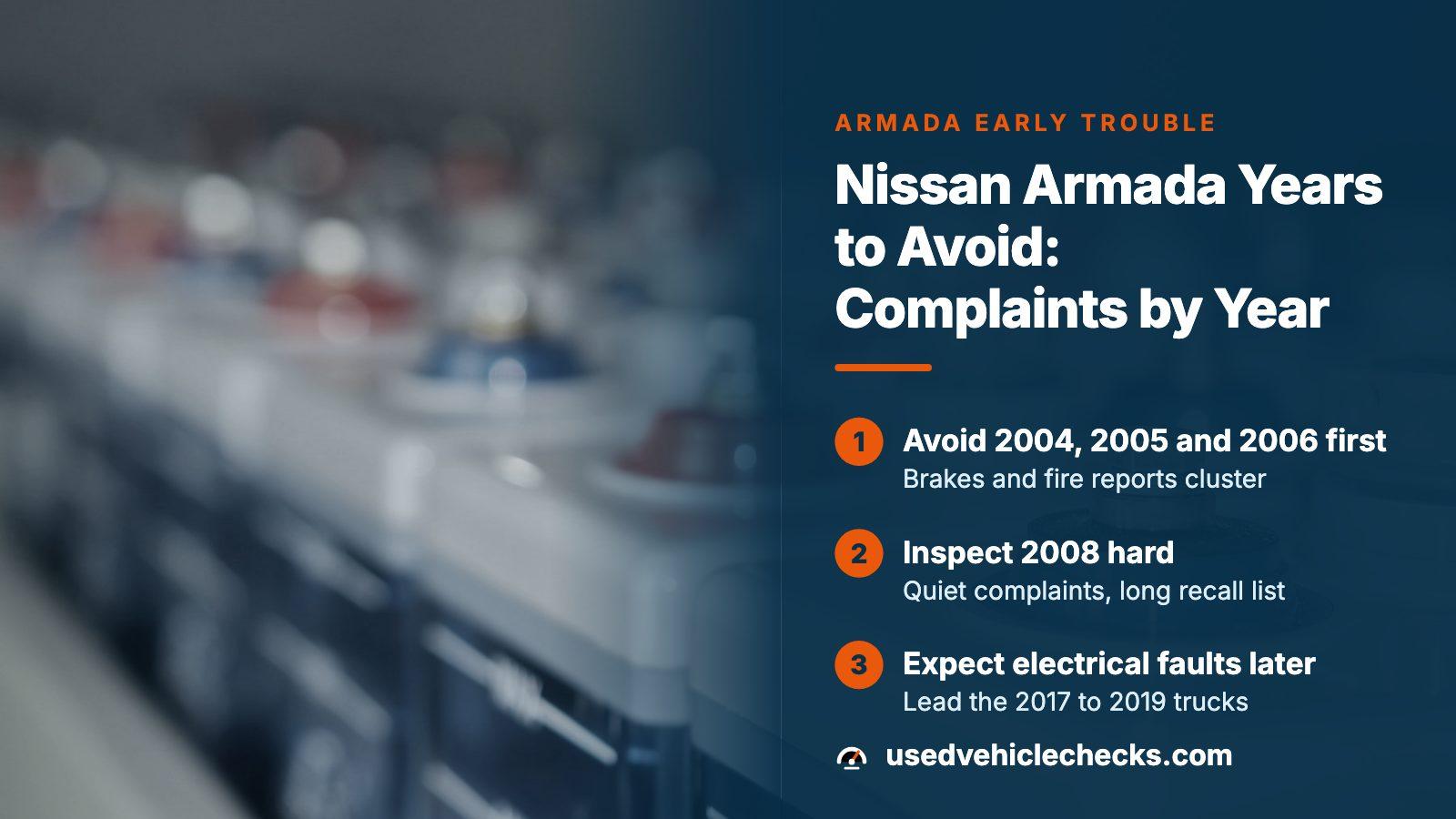
Avoid the 2004, 2005 and 2006 Armada first: 463, 373 and 266 complaints, with 20 of the fire reports. The 2008 year is the next one to inspect hard, followed by 2017 to 2019, where electrical faults lead. The 2009 to 2015 years and 2020 onward have thin complaint files. A year is only a starting point, so check each truck's own recalls and odometer readings.
- Complaints on file
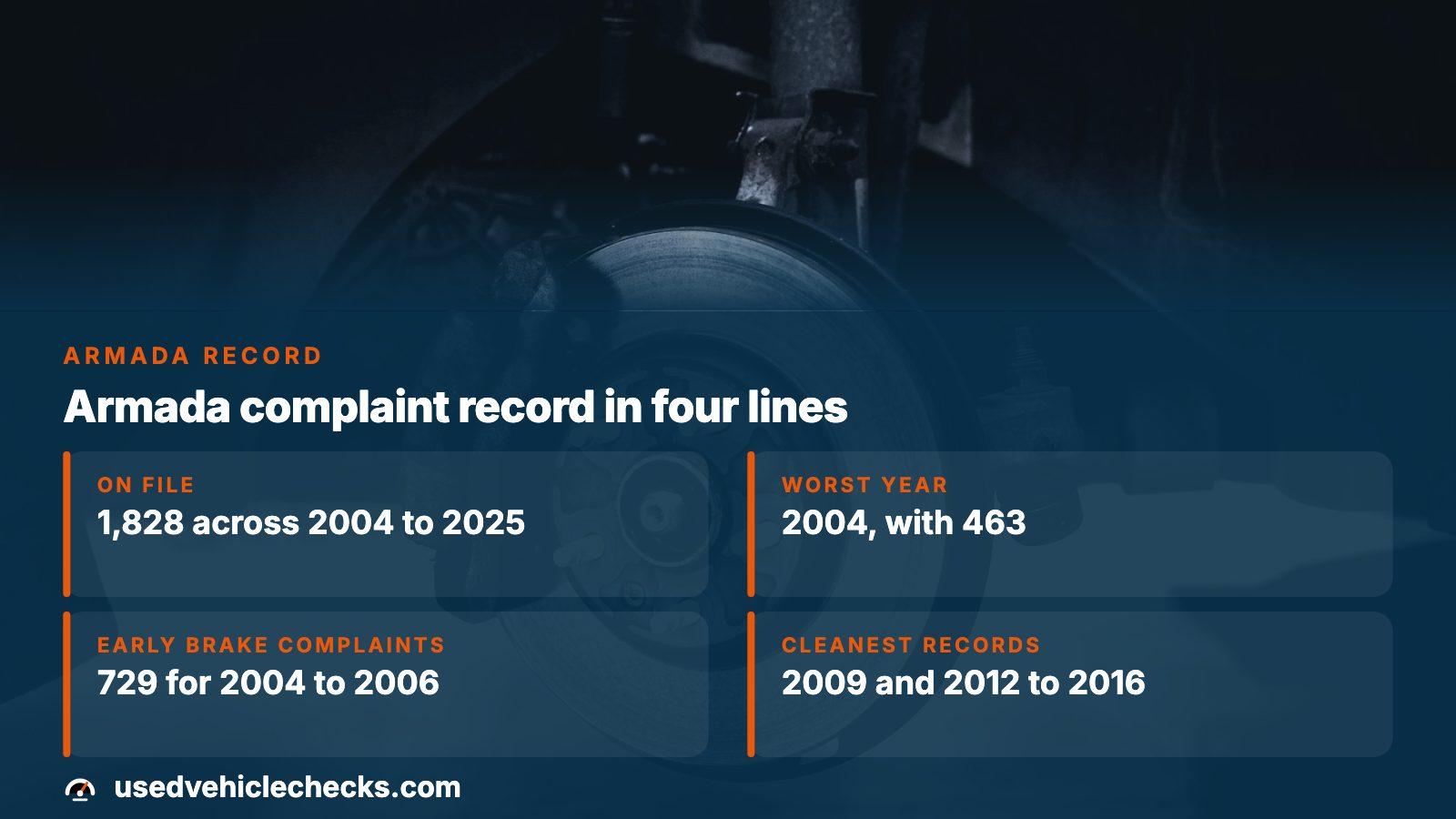
- 1,828 across 2004 to 2025
- Worst year
- 2004, with 463 complaints
- Brake complaints, 2004 to 2006
- 729
- Cleanest records
- 2009 and 2012 to 2016
The three Armada years that carry most of the complaints
Every Armada model year from 2004 to 2025 went through NHTSA's complaint and recall databases for this page. The total comes to 1,828 complaints, and about 60 percent of them sit on the first three years. After 2006 the volume drops sharply, so the year printed on the title explains a lot about the risk.
| Model year | Complaints | Crash reports | Fire reports | Recall campaigns |
|---|---|---|---|---|
| 2004 | 463 | 21 | 2 | 3 |
| 2005 | 373 | 8 | 5 | 5 |
| 2006 | 266 | 14 | 13 | 5 |
| 2007 | 86 | 0 | 0 | 3 |
Across all years, 68 complaints mention a crash, 29 a fire and 66 injuries. Most of the fires belong to 2005 and 2006, which is why those two earn a harder look than the raw counts alone suggest.
Brakes: the complaint that never became a recall
Brakes are the most-reported component in each early year: 318 reports on the 2004, 220 on the 2005 and 191 on the 2006. Hydraulic brake reports stack another 157, 94 and 51, which brings brake trouble to 729 across the trio.
None of the campaigns NHTSA lists for those years is a brake recall. The brake campaigns that do exist land later: a pedal pivot pin recall for 2008 to 2010 trucks, and a master cylinder recall for 2013 Armadas built in a short window early that year. So a seller's claim that all recalls are done says nothing about the brake complaints on a 2005. Have a mechanic check pedal feel, rotors and fluid on any early truck, and ask for the invoices.
Stalls and fires on the early trucks
Two campaigns matter most on 2005 and 2006 trucks. Campaign 10V517000 covers the engine control relay inside the power distribution module, where residue can form on the contacts and stall the engine. Campaign 08V284000 covers the air conditioning condenser fan motor on trucks built after March 17, 2005, where trapped water could corrode the motor and start a fire. Dealers handle both free of charge.
From an NHTSA owner complaint
The owner of a 2006 Armada told NHTSA the truck was rolling at about 20 miles an hour toward a stop sign when smoke, then fire, came from under the hood, with no warning light. She and her passenger got out unhurt apart from a sore hip, and firefighters could not save the truck. She tied the failure to those two recall campaigns. The incident happened in 2022, long after both recalls.
The takeaway is plain: a recall that is old enough to be forgotten may never have been performed on a particular VIN. Confirm completion with a Nissan dealer before you buy.
2008: a quieter year with a long recall list
The 2008 truck draws 161 complaints, far above its neighbors 2009 (23) and 2010 (48), and brakes lead again with 67, followed by structure with 39. It also carries 7 recall campaigns, more than any other Armada year. They range from the pedal pivot pin to a side curtain air bag issue on trucks built over a single week in February 2007 and a driver air bag cover that can shed its emblem.
- 2009 has 23 complaints and 4 recalls, so it is cleaner than the years around it.
- 2010 has 48 complaints and 5 recalls, including a pedal pin campaign and a seat hinge campaign.
- 2011 to 2014 sit between 13 and 40 complaints a year, with one or two recalls each.
- 2013 to 2015 trucks fall under a driver air bag inflator recall that NHTSA lists as a rupture risk.
The 2015 year adds a parking pawl campaign on trucks built in autumn 2014. A truck that rolls in Park is the kind of defect worth confirming as repaired.
2017, 2018 and 2019: a different kind of complaint
These three years draw 81, 76 and 79 complaints, a steady run that stands out against 2016 and the years after it. Electrical system leads each one, with 33, 41 and 42 reports, ahead of engine, power train and brakes. The only recall on file for 2018 and 2019 is a back-up camera software campaign shared with many other Nissan and Infiniti models.
From an NHTSA owner complaint
A 2018 Armada owner said the truck had failed to start perhaps 15 to 20 times, with the battery replaced two or three times every year or two. Repair shops checked the key fob, the brake pedal switch and the battery without finding the drain. The family had been left stranded at work and in other cities. The complaint was filed in 2026.
No recall exists for this pattern, so it will not show up as an open campaign. Ask the seller how many batteries the truck has had and what the dealer found.
2016 and the 2020 to 2025 years
The 2016 year lists one complaint and no recalls. The newest years are also light: 10 complaints for 2020, 13 for 2021, 10 for 2022, 5 for 2023, 4 for 2024 and 21 for 2025. A low count here mostly reflects how little time owners have had to file, not a proven clean record.
Recalls still apply. The 2020 and 2021 trucks with the V8 fall under a fuel pump campaign that could stall the engine, and a 2026 label campaign on 22 inch wheels touches 2020 through 2025 trucks. Run the VIN through the recall lookup rather than trusting the model year to keep you clear.
Where the odometer readings come in
A bad model year is a probability. The mileage history on one VIN is evidence. An early Armada that has had steady, dated readings, a clean brake service history and no brand on its title can be a better buy than a later truck whose mileage jumps or drops between records. For a vehicle this age, every reading should be higher than the one before it.
NMVTIS, the federal title database, tracks the odometer reading, brand history, total loss and salvage history, and it draws on state titling agencies, insurers and salvage yards. Before paying anything, run the VIN here for the preview. If the truck is a contender, one purchase of the full report puts each odometer reading in date order next to the title and damage entries.
A short routine before you commit
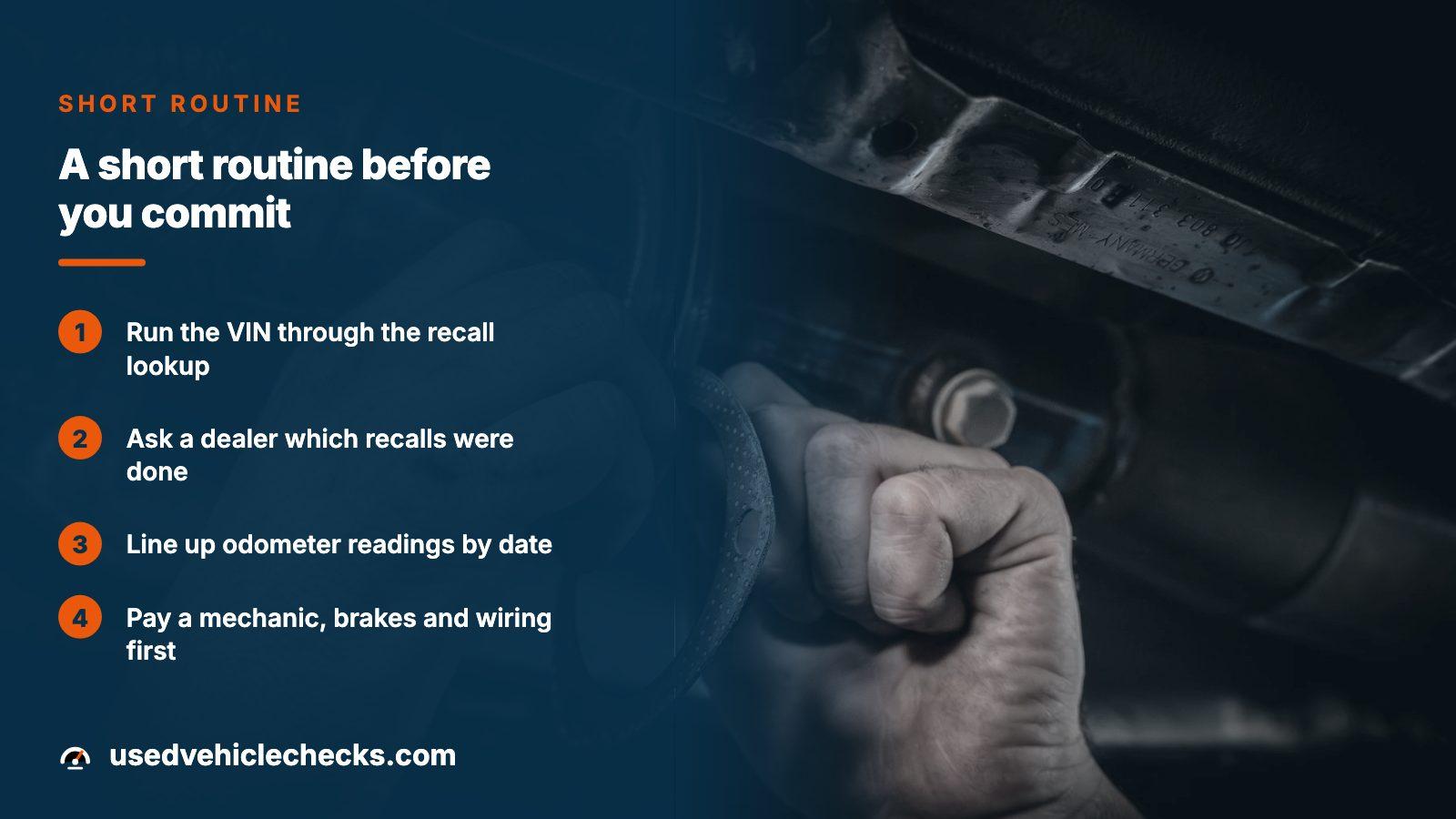
- Run the VIN through NHTSA's recall lookup and note every open campaign.
- Ask a Nissan dealer to confirm which recalls were performed on that exact truck.
- Line up the odometer readings by date and look for any step backward.
- Pay a mechanic for an independent inspection, with brakes and wiring first on a 2004 to 2006.
- Ask for maintenance records, and for battery and brake invoices on 2017 to 2019 trucks.
NMVTIS's own guidance recommends an independent inspection alongside a history report, and it describes a clean report as a good sign. It also says private providers cover items NMVTIS does not, such as repair history and recalls.
Where this information comes from
- NHTSA recalls API: Nissan Armada 2006 — Source of campaign numbers, dates and remedies; I queried each year from 2004 to 2025.
- NHTSA complaints API: Nissan Armada 2006 — Source of the complaint, crash, fire and component counts by model year.
- NMVTIS: understanding a vehicle history report — What the federal title database records and where its data comes from.
- NMVTIS: used car buying tips — Inspection and maintenance-record advice for used buyers.
- NHTSA owner complaint 11462598 — owner experience, paraphrased
- NHTSA owner complaint 11737392 — owner experience, paraphrased
Sources and photos: Facts checked against the sources above in November 2026. Photos by Vanya Smythe, Martin Fennema and ün LIU on Unsplash; diagrams by UsedVehicleChecks.
Keep reading
- Nissan Titan Years to Avoid: 2004 to 2006 Axles and the 2017 DieselThe Titan pickup shares several of these recall campaigns, so compare its year-by-year record.
- Odometer Rollback Check by VIN: Run the Mileage Test Before You PayHow to line readings up by date and spot a step backward.
- Mileage Check by VIN: What the Recorded Odometer Readings ShowWhat a mileage check on one VIN returns before you buy.
- How Many Miles Is Too Many on a Used Car? Age, Pace and ProofDecide what a high reading on a big SUV means for your budget.
Frequently asked questions
What is the worst year for the Nissan Armada?
On NHTSA complaints, 2004 is the worst with 463, followed by 2005 with 373 and 2006 with 266. Brakes are the leading complaint in all three. The 2006 year also has the most fire reports, at 13, so it deserves a careful inspection even though its complaint count is lower.
Which Nissan Armada years are the most reliable?
By complaint volume, 2009 and 2012 through 2016 are the lightest, with 23 or fewer complaints each. NHTSA data cannot prove reliability, since it only counts owner reports. Treat a low count as a good sign and still inspect the truck and check its recalls.
Does a recall make a used Armada a bad buy?
Not by itself. Recalls are repaired free by dealers, and a long list can mean problems were caught. The risk is a campaign that was never performed on that VIN, so ask a dealer to confirm completion before you pay.
Are newer Armadas safe from these problems?
The 2020 to 2025 years have few complaints, but they are young. Open campaigns still exist, including a fuel pump recall on 2020 and 2021 V8 trucks. Check the VIN against NHTSA's recall lookup and read the title and odometer history.
How do I check an Armada's mileage history?
Start with the VIN. A history report lists odometer readings with dates, so you can see whether they rise steadily. A drop or an unexplained jump between records is a reason to walk away or to ask the seller for service invoices that show the true mileage.
Now check the car itself
The guide explains what to look for. The report shows what this VIN has on record.