THE SHORT ANSWER
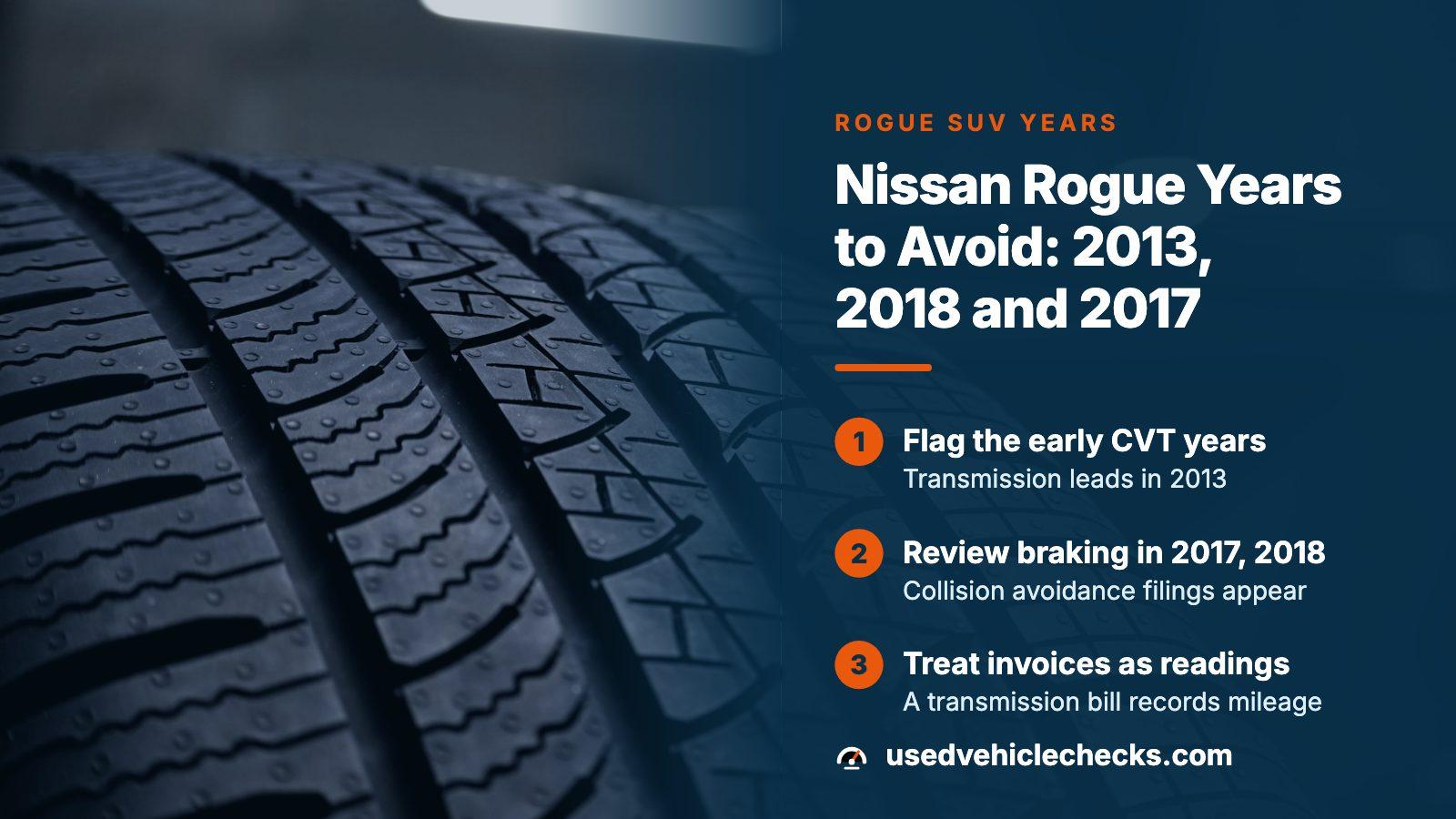
Across 2008 to 2022, NHTSA holds 6,128 owner complaints on the Rogue. The heaviest files belong to 2013 (610), 2018 (609), 2017 (601), 2015 (554) and 2016 (543). Power train, mostly the transmission, leads the 2013, while brakes and forward collision avoidance lead the 2018. The lightest files are 2020, 2022 and 2010, but the youngest years have had less time to draw filings.
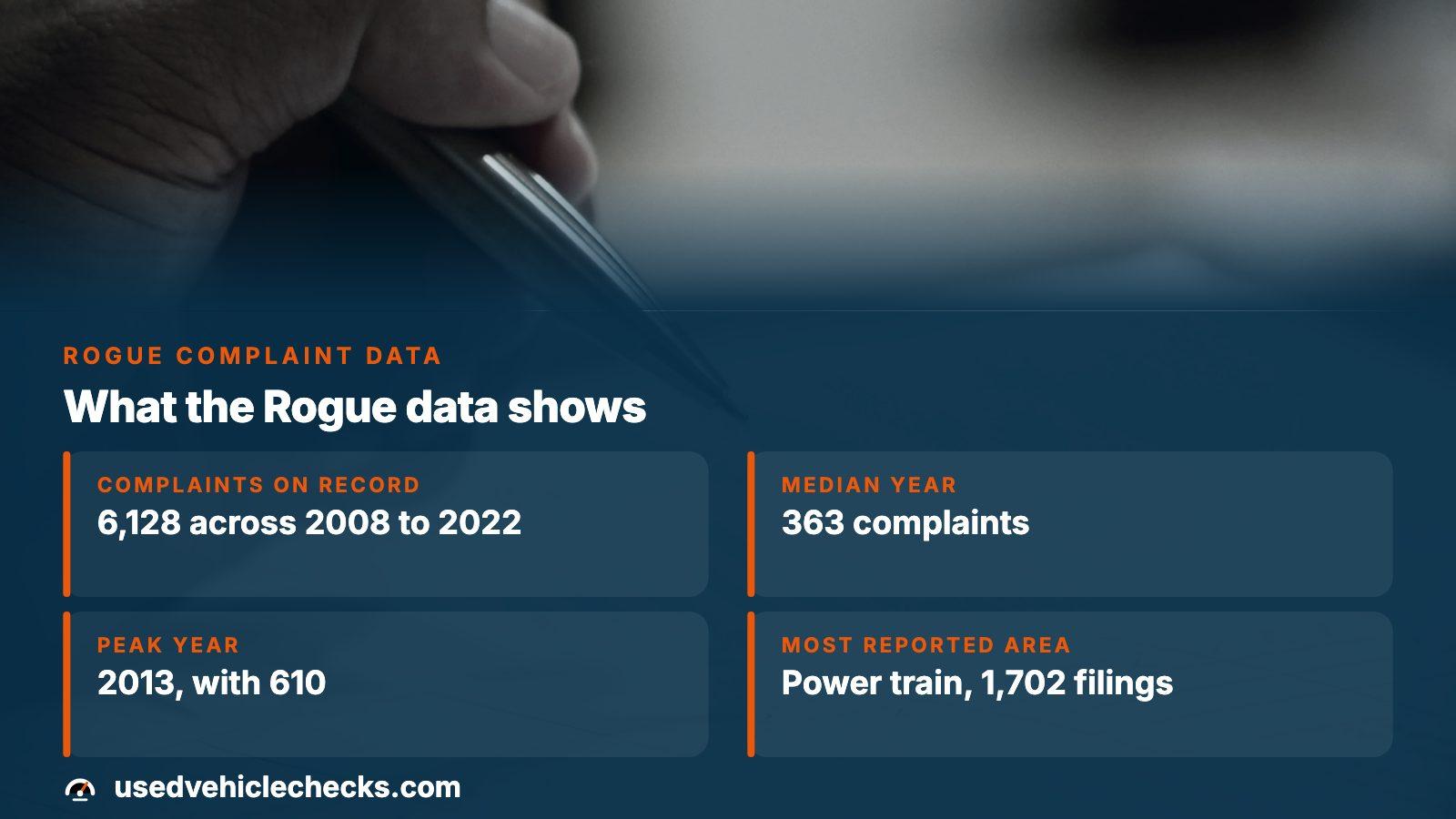
- Complaints on record
- 6,128 across 2008 to 2022
- Median year
- 363 complaints
- Peak year
- 2013, with 610
- Most reported area
- Power train, 1,702 filings
Five Rogue years sit well above the median
Across the Rogue's 2008 to 2022 span, NHTSA has logged 6,128 owner complaints. The median year sits at 363, and every year below is measured against that number. The smaller Rogue Sport has its own listing at NHTSA and is not counted.
| Model year | Complaints | Times the median | Recalls listed | Largest complaint area |
|---|---|---|---|---|
| 2013 | 610 | 1.68 | 1 | Power train |
| 2018 | 609 | 1.68 | 3 | Service brakes |
| 2017 | 601 | 1.66 | 5 | Unknown or other, then power train |
| 2015 | 554 | 1.53 | 9 | Power train |
| 2016 | 543 | 1.50 | 7 | Power train |
Treat each flag as a reason to look closer and negotiate. Healthy Rogues exist in every one of these years.
2013 and the early CVT years
The 2013 file is the largest on record, and its weight sits in one place. Power train accounts for 314 of the 610 complaints, and in 224 of those the owner's own words name the transmission or the CVT. The same area tops the files for 2008, 2010, 2011, 2012, 2014, 2015 and 2016. Only the 2009 ties it, with air bags at 101 apiece.
One recall reaches this generation, and it concerns wiring, not the gearbox. Campaign 15V032000 covers certain 2008 to 2013 Rogues and the 2014 Rogue Select: a connector under the driver's carpet can short when snow, water and salt get in, and NHTSA names fire as the consequence. The dealer fix is free.
On any of these, ask for proof the connector was inspected and for any transmission papers. Their dates and mileage are readings to hold against a history report.
2017 and 2018: braking and collision-avoidance filings
The pattern shifts after 2016. In the 2018 file, service brakes lead with 253 filings and forward collision avoidance follows with 161. The 2017 splits more evenly, at 123 for power train, 114 for service brakes and 76 for collision avoidance.
From an NHTSA owner complaint
A buyer who took home a certified pre-owned 2018 Rogue SL in July 2021 filed in January 2023. At 65 miles an hour the automatic emergency braking engaged three times with nothing ahead, and a car behind nearly hit them. Turning the system off did not last, the owner says. The owner wrote that they were "scared to drive the car".
NHTSA lists three recalls for the 2018, and none touches the brakes or collision avoidance, so a clean recall lookup settles nothing here. On a test drive, brake hard from highway speed, and ask the seller about any dealer visit over braking.
A transmission invoice is a mileage reading
On a CVT Rogue, the figure on a transmission invoice dates the repair and shows whether the car was inside the maker's cover when the part failed. A figure between two dated history readings fits. One outside them is a reason to ask questions.
From an NHTSA owner complaint
An owner of a 2017 Rogue wrote that the CVT was replaced in November 2021 with 62,735 miles showing, and again in January 2022 at 64,378. Each time the dealer said the 60,000-mile cover had ended, and each time Nissan paid under a goodwill program. A third failure came in 2025, and the owner says Nissan offered parts but wanted payment for labor.
The lesson is that the invoice mileage set the terms of the argument over who pays. A seller holding receipts whose dates and readings line up shows you something a bare dash cannot.
Rogues whose title carries no mileage statement
Federal law makes a seller put the odometer figure in writing on the title when ownership changes. NHTSA exempts vehicles that are 20 years old or older, and any model year 2010 vehicle or older. That leaves the 2008, 2009 and 2010 Rogues outside the rule, while 2011 and later stay covered until they turn 20.
| Rogue model years | Written mileage on the title | What fills the gap |
|---|---|---|
| 2008 to 2010 | Not required by the federal rule | Reading history from the VIN, plus maintenance records and dash wear |
| 2011 to 2022 | Required until the car turns 20 | Compare the title figure with the dash, then with the history readings |
From an NHTSA owner complaint
A buyer in Oakland answered a Craigslist ad in December 2016 for a 2008 Rogue advertised at 59,000 miles. Trouble followed that did not fit the figure, and a vehicle history report turned up a prior reading of 156,788. The buyer said the case went to the California DMV and to NHTSA.
With no mileage on the title, history readings and a physical look are what you have. NHTSA suggests comparing the dash with maintenance records and oil-change stickers, and judging pedal and tire wear against the miles shown.
Recall counts, and what the VIN lookup leaves out
Listed recall counts swing widely: 10 each for the 2014 and 2021, 9 for the 2015, 7 for the 2016, and a single one for the 2013 and the 2020. A long list does not make a bad year, because each campaign covers certain build dates rather than every car sharing a model year.
NHTSA's VIN lookup shows only recalls still awaiting repair. Repaired ones, campaigns older than 15 years without extended coverage, and non-safety customer-service programs stay hidden. Several 2008 and 2009 campaigns reached NHTSA between October 2008 and September 2010, so a lookup may skip them.
Two build-range campaigns are worth asking about: front hub bolts on certain 2014 and 2015 builds that may be under-torqued, which could let a brake caliper separate, and a selector knob on certain 2015 builds that allowed a shift out of Park without the brake pedal.
The lighter years, and what a thin file hides
The smallest files are the 2020 at 153, the 2022 at 270, the 2010 at 282 and the 2021 at 295, with the 2019 at 340. Age explains part of that: a newer Rogue has simply had fewer years in which owners could file.
The 2022 file leans toward the engine, with 147 of its 270 complaints, and NHTSA lists a June 2025 recall of 2021 to 2024 Rogues with variable compression turbo engines over bearings that may be defective. A quiet year also says nothing about use, so even a 2020 needs its odometer history read.
Checking one Rogue, odometer first
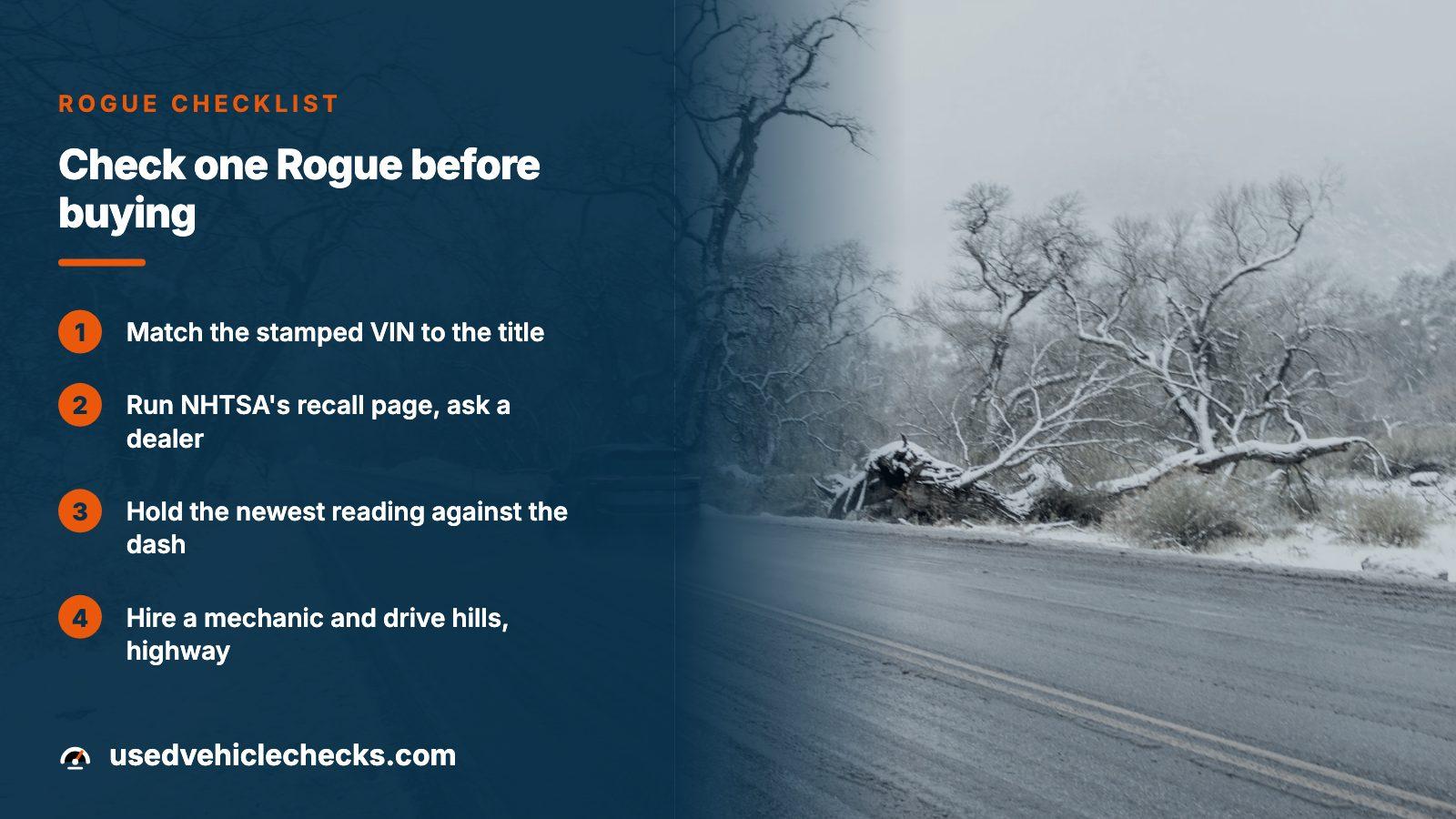
- Before you trust any lookup on a Rogue, confirm the VIN on the vehicle agrees with the one printed on the title.
- Run the VIN through NHTSA's recall page, then ask a Nissan dealer about open service campaigns.
- Open the preview on this site. If the Rogue makes your shortlist, buy the report and look for readings that rise steadily without a drop.
- Hold the newest reading against the dash, and the miles on any CVT or brake invoice against the dated readings.
- Weigh any title brand, salvage entry, accident record or lien against those miles.
- Run NICB's VINCheck, a no-charge screen limited to participating insurers' theft, salvage and flood records.
- Hire a mechanic, and test drive on hills and highway with one hard stop, then check the dash lamps at start-up.
The preview itself costs nothing. Each report is a single purchase, and anyone comparing a few Rogues can find multi-report pack sizes on the pricing page.
Where this information comes from
- NHTSA: Odometer fraud — The federal rule on mileage statements, the model-year exemption, and the buyer tips on titles, records and wear.
- NHTSA: Check for recalls — The VIN recall lookup and the list of what it does not show.
- NMVTIS: What a vehicle history report includes — The federal title-record program and its five indicators, odometer readings among them.
- NICB: VINCheck — A quick insurer-reported theft, salvage and flood screen, not a full history.
- NHTSA owner complaint 11500306 — owner experience, paraphrased
- NHTSA owner complaint 11663521 — owner experience, paraphrased
- NHTSA owner complaint 10980028 — owner experience, paraphrased
Sources and photos: Facts checked against the sources above in November 2026. Photos by Pablo Alvarez, Zoshua Colah and Masjid MABA on Unsplash; diagrams by UsedVehicleChecks.
Keep reading
- Odometer Rollback Check by VIN: Run the Mileage Test Before You PayHow a falling or flat run of readings gives a rolled-back dash away.
- Mileage Check by VIN: What the Recorded Odometer Readings ShowHow the dated odometer readings behind one VIN are collected and read.
- Nissan Murano Years to Avoid: Complaints by Year, Plus the Odometer CheckThe Rogue's bigger Nissan SUV sibling, ranked against its own median year.
- How Many Miles Is Too Many on a Used Car? Age, Pace and ProofDecide what a high number on the dash means before you shortlist a used SUV.
Frequently asked questions
Which Nissan Rogue years should I avoid?
Start with 2013, 2018 and 2017: 610, 609 and 601 NHTSA complaints against a median of 363. Caution means a harder inspection, a close read of the odometer record and a lower offer where paperwork is thin, not an automatic no.
Are the 2008 to 2010 Rogues worth buying?
Their files are middling at 429, 320 and 282 complaints, led by power train and air bags. The catch is the paperwork: a model year 2010 car or older needs no written mileage on the title, so lean on dated history readings and service invoices.
Which Rogue model years are the most reliable?
Complaint counts measure filings, not reliability. The 2020, 2022 and 2010 files are the lightest, though two of the three are young years. Open recalls, service records and odometer history say more about one car than any ranking.
What goes wrong most often on a Rogue?
Power train leads the whole run with 1,702 filings. Among named areas, electrical system, engine, air bags and service brakes follow, at 872, 825, 816 and 630. On a test drive, load the transmission on a hill, brake firmly and check the air bag lamp.
How do I check the mileage on a specific Rogue?
Use the VIN. Open the preview on this site, buy the report if the car is still in the running, and read its dated odometer readings against the dash. Then match any transmission or brake invoice to those dates. A 2008 to 2010 title may carry no mileage figure at all.
Now check the car itself
The guide explains what to look for. The report shows what this VIN has on record.