THE SHORT ANSWER
Start with the preview, then buy the report for a car that survives it. Open with the crash and damage entries, then lay them against the dated odometer readings. A crash with no repair paperwork, a brand, or mileage that falls after an entry is your cue to stop and question the seller. Since no database holds every crash, finish with a mechanic's inspection.
- Read together
- Each crash entry beside the dated mileage readings
- Federal title record
- Lists no accident or repair history
- Stolen, then found
- A car unrecovered after 30 days can still carry a total-loss label
- Preview
- No cost to run; the report is bought once
What an accident entry can and cannot show
The federal title database overseen by the Justice Department holds no repair history and lists no accident feature, according to its own FAQ. It returns title data, brands, the latest odometer reading, theft entries, and total-loss and salvage designations. Private providers add repair and recall data the national system lacks, the agency notes.
So treat an accident entry as something somebody reported, not a diary of the car's life. A crash that no insurer, shop or agency ever logged leaves nothing to find, and the national program warns that patchy reporting can produce a false negative. A clean result is a good sign. It is not proof.
Six steps, in the order that protects your money
- Photograph the VIN on the car itself and match it to the listing, the title and any papers the seller hands over. One wrong character ends the search.
- Run the preview to confirm the VIN decodes to the year and model on offer. It costs nothing, so do it for every car on your list.
- Buy the report for a car still in the running and read the accident and damage entries before anything else, noting each date.
- Copy the dated odometer readings into a second column and set them beside those crash dates. The line should rise steadily, with no drop and no long stall after an entry.
- Look for a brand, a total-loss label, or a salvage or auction entry, and study any auction photos for damage the listing left out.
- Ask for the repair invoice behind every entry, have an independent mechanic inspect the car, then reprice the deal or walk away.
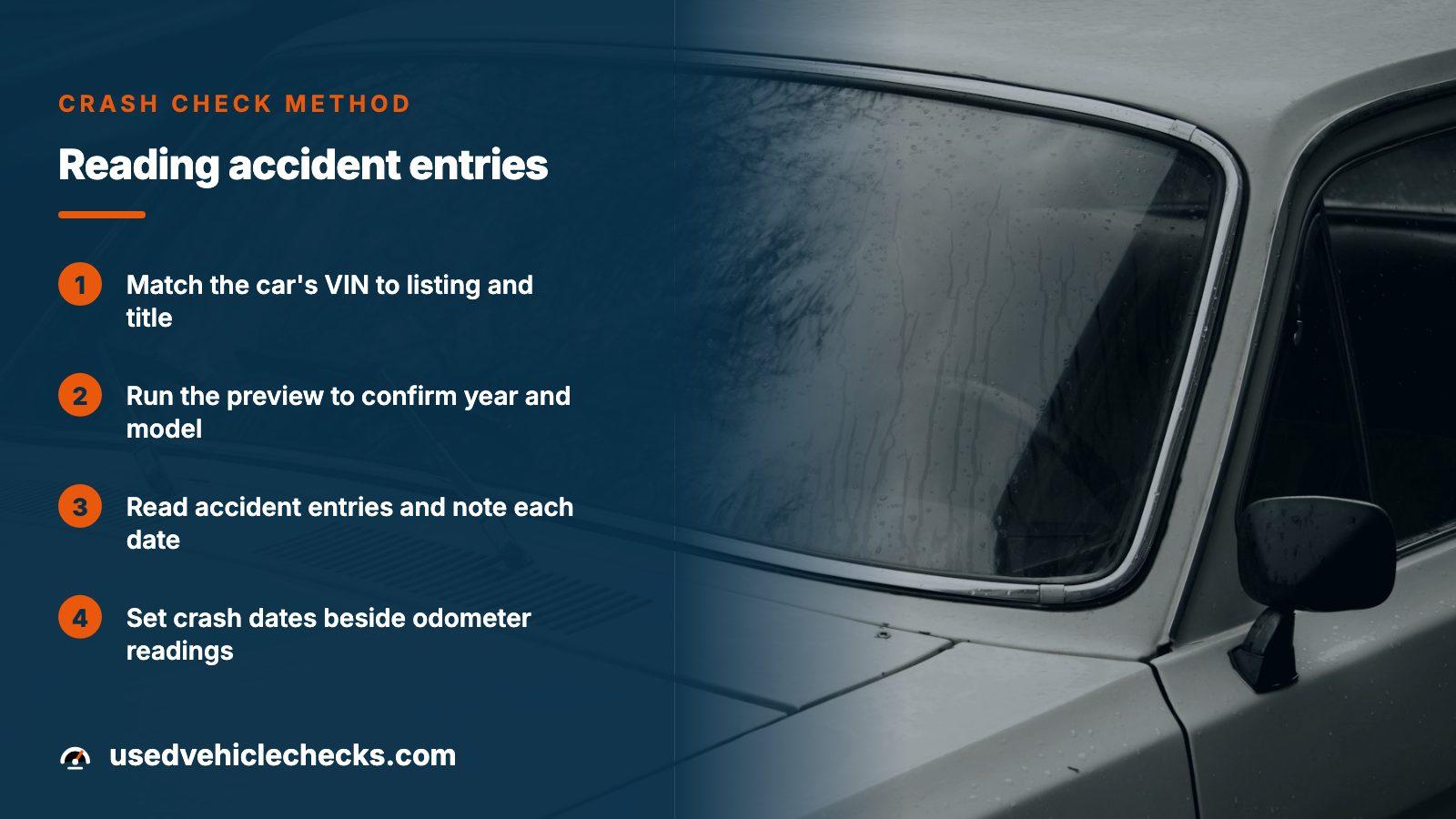
Steps three and four: set each crash beside the mileage
This is where UsedVehicleChecks looks first, because mileage is the one figure you can test against the dash in front of you. Every dated odometer reading is a point on a line, and a crash entry is a date on the same line.
| Pattern on the timeline | What it can mean | What to ask |
|---|---|---|
| Miles keep climbing through a crash entry | The car stayed in use, which fits a repaired car | Request the repair invoice for that date |
| A reading lower than an earlier one, after a crash entry | A rollback, a swapped gauge cluster or a keying error | Ask for paperwork on any instrument work, and hold your offer |
| Almost no miles between a crash entry and the next reading | The car may have sat unrepaired or in a yard | Ask where it was and who fixed it |
| The dash reads below the newest reading | The mileage may have been altered | Stop until the seller proves the figure |
From an NHTSA owner complaint
An owner who bought a 2012 Honda Accord in a private sale told NHTSA that a prospective buyer's history report, shown when the owner tried to sell it, flagged a mileage mismatch: roughly 135,000 miles at purchase against a recorded 248,870. A crash report turned up in the glove box too, though nobody had mentioned an accident when the car changed hands.
That owner heard about both problems from someone else's report, after the sale. Reading the timeline before you pay puts the same question to the seller while you can still walk.
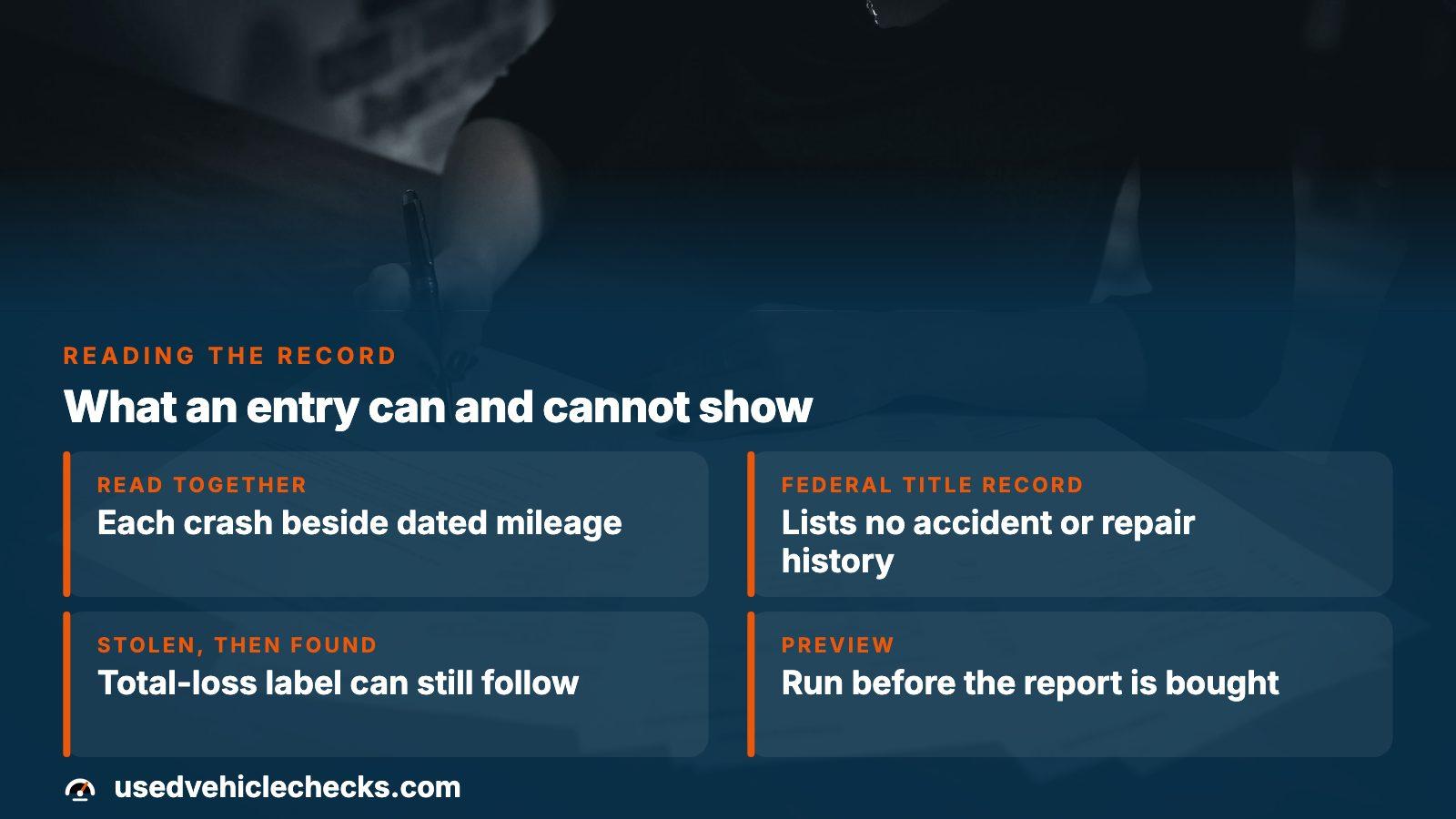
Which source answers which crash question
Each source covers only part of the question. The Federal Trade Commission's guide for dealers does not make them list accident history on the window form; it tells shoppers to get a history report and an independent inspection on their own.
| Source | What it answers about a crash | Where it stops |
|---|---|---|
| Seller's account and papers | Repairs the seller can document | Anything the seller leaves out |
| Federal title record, sold by approved providers | Brands, total-loss and salvage entries, latest odometer reading | Lists no accident or repair history |
| UsedVehicleChecks report | Accident and damage entries, dated odometer readings, brands, salvage and auction records with photos | Only what reached its record sources; a crash nobody logged will not appear |
| Independent mechanic | Present condition and safety problems | Cannot date a crash or read past mileage |
Reading brands and total-loss labels without over-reading them
A brand is a state's mark on a title recording something that changed what the car is worth or how safe it is; junk, salvage and flood are the common ones. Once applied, it stays in the national record. A car can still be retitled in a state that does not check earlier titles, which is how brands get washed off paper. Thresholds differ by state too: a damaged car could be branded salvage in one and escape the label in another.
Total loss is a blunter term than it sounds. It does not mean the car was destroyed. A stolen car that is not recovered within 30 days can receive the label and keep it after turning up in good shape. Read the entry as a reason to ask what happened, then let the auction photos and the inspection answer.
Red flags to tick off before you pay
- A crash or total-loss entry the seller never brought up.
- A mileage reading lower than one recorded earlier.
- A salvage, auction or insurance entry with no repair invoices to match.
- A clean paper title beside a brand in the report.
- Uneven panel gaps, mismatched paint or a warning light that stays on during the drive.
- A seller who refuses a mechanic's look, or who offers only their own printout of a report.
From an NHTSA owner complaint
The owner of a 2016 Dodge Grand Caravan told NHTSA that the report handed over by the dealer listed no accidents, yet a report the owner ran separately showed two: one logged in 2018 and another a few days before delivery. In the owner's telling, the dealer's copy had been doctored. That is one buyer's account, not a finding.
The lesson costs little to apply: run the VIN yourself rather than trusting the printout the seller hands you.
After a crash entry, ask about the airbags
In 2012 NHTSA issued an advisory about counterfeit airbags sold as replacement parts after collisions. Its tests showed the fakes could fail to deploy at all, or spray metal fragments when they did. Buyers of used cars whose bags might have gone off before the sale, and anyone holding a salvage, rebuilt or reconstructed title, were among those told to phone the manufacturer's call center.
The advisory is old and named certain models, but the question still fits: after a crash entry, ask who replaced the airbags and see the invoice.
Preview, report and cost
The preview asks for the VIN and nothing else. A car that survives it earns the report, a single purchase with no renewal; bundles of 3, 5 or 10 exist for shoppers lining up several cars. Today's amounts are on the pricing page. The federal buying tips also name NICB's VIN search, which covers flood damage and other history, so run it too.
Where this information comes from
- NMVTIS: understanding a vehicle history report — Lists the five indicators in the national report, calls it intentionally brief, and says private providers add repair, recall and maintenance data.
- NMVTIS: information for consumers — Source for how brands persist and get washed, the 30-day theft rule for total loss, state differences and the risk of false negatives.
- NMVTIS: frequently asked questions — States that repair history is not held and accident history is not a listed feature, and advises an independent inspection.
- FTC: dealer's guide to the Used Car Rule — Describes the window form and its advice to get a history report and an independent mechanic's inspection.
- NHTSA safety advisory on counterfeit air bags (2012) — Source for the air bag warning tied to crash repairs, used-car buyers and salvage, rebuilt or reconstructed titles.
- NHTSA owner complaint 11693439 — owner experience, paraphrased
- NHTSA owner complaint 11549296 — owner experience, paraphrased
Sources and photos: Facts checked against the sources above in November 2026. Photos by engin akyurt, Tigran Shishmanyan and Dimitri Karastelev on Unsplash; diagrams by UsedVehicleChecks.
Keep reading
- Mileage Check by VIN: What the Recorded Odometer Readings ShowA closer read of the odometer readings you set beside each crash.
- Odometer Discrepancy Check: Find a Mileage Mismatch Before You PayWhat to do when the readings and the dash disagree.
- Title Check by VIN: A Step-by-Step Check, Odometer Entries FirstHow brands and title dates are read once a crash entry turns up.
- Car Value by VIN and Mileage: Check the Miles Before You Price ItPutting a number on a car after the history changes the price.
Frequently asked questions
Is there a free way to check accident history by VIN?
Partly. The NICB database is searchable by VIN and, per the federal buying tips, covers flood damage and other history. The UsedVehicleChecks preview costs nothing too, while the full accident and damage entries come with the report. No lookup promises every crash, so add an inspection.
If the report comes back clean, was the car never wrecked?
Not necessarily. A report lists what reached its sources, and the national title program warns that incomplete reporting can give a false negative. A crash that no insurer, shop or agency logged leaves nothing to find. Take a clean report as a good sign, then have a mechanic check panels, paint and structure.
Will the report show who owned the car during the accident?
Not by name. Consumers do not receive owner names from the national title system; only law enforcement and certain regulators do. What you can use are dated entries: when a crash was recorded, the mileage around then, any brand and any salvage or auction record.
How current is the data behind a crash entry?
It varies. States must send title updates to the national system at least once every 24 hours, and some send them in real time. Insurers and salvage yards report monthly, so a very recent total loss may not have appeared yet. Ask the seller when the car was last repaired and when the title was last issued.
What if the seller's report and mine disagree?
Skip the argument over printouts. Ask the seller for the repair invoice behind each entry, check the VIN on the car against both reports, and request the state title record that each consumer title report links to. If mileage is the gap, treat it as a discrepancy. No answers, no deal.
Now check the car itself
The guide explains what to look for. The report shows what this VIN has on record.