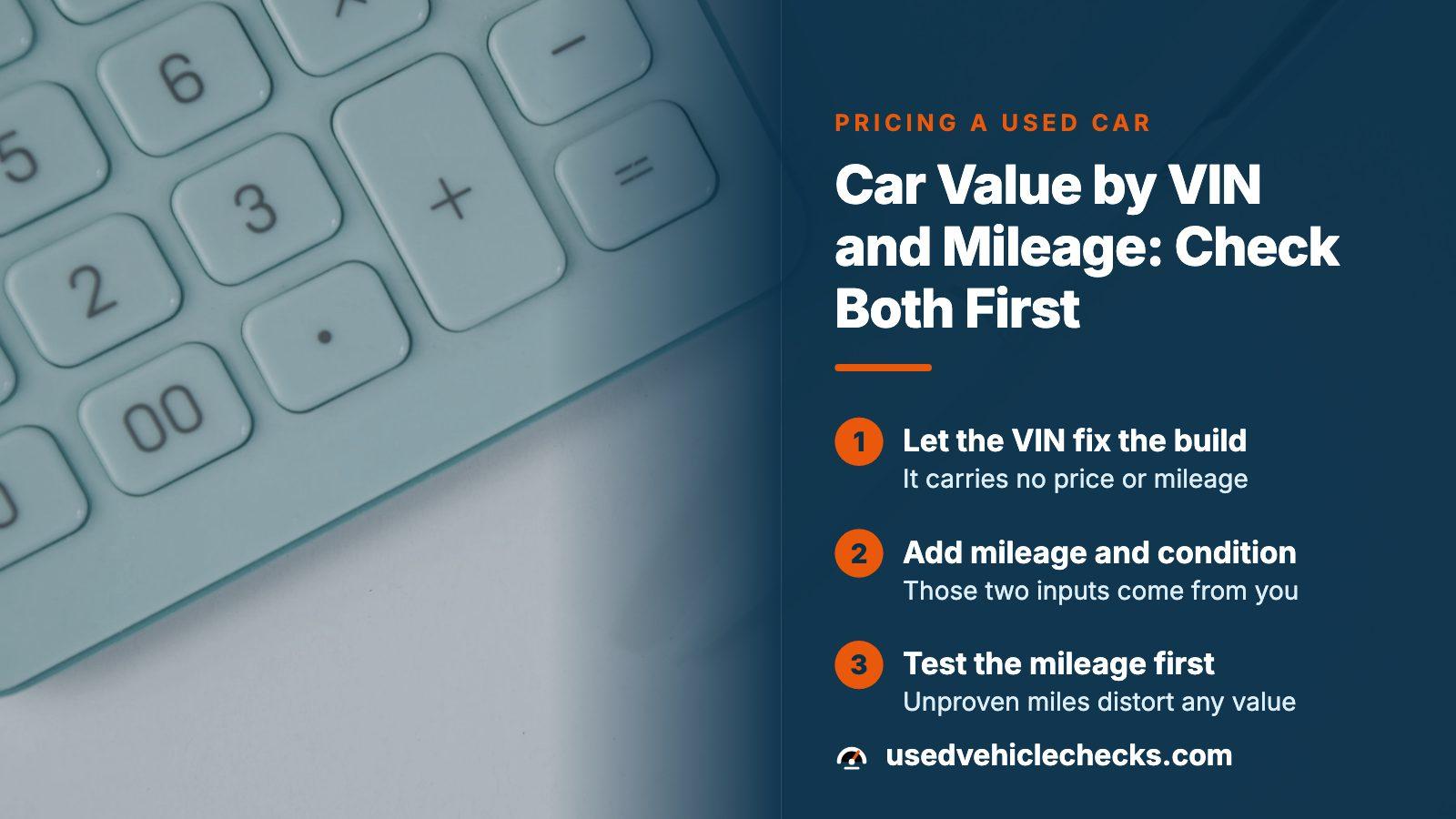
THE SHORT ANSWER
To get a car's value by VIN and mileage, use the VIN to pin down the exact build, then enter the mileage and an honest condition grade into a price guide. The VIN carries neither a price nor a mileage, so those come from you. Before you trust the mileage, compare the dash with the odometer readings on record for that VIN. A value built on a wrong mileage is wrong by the same margin.
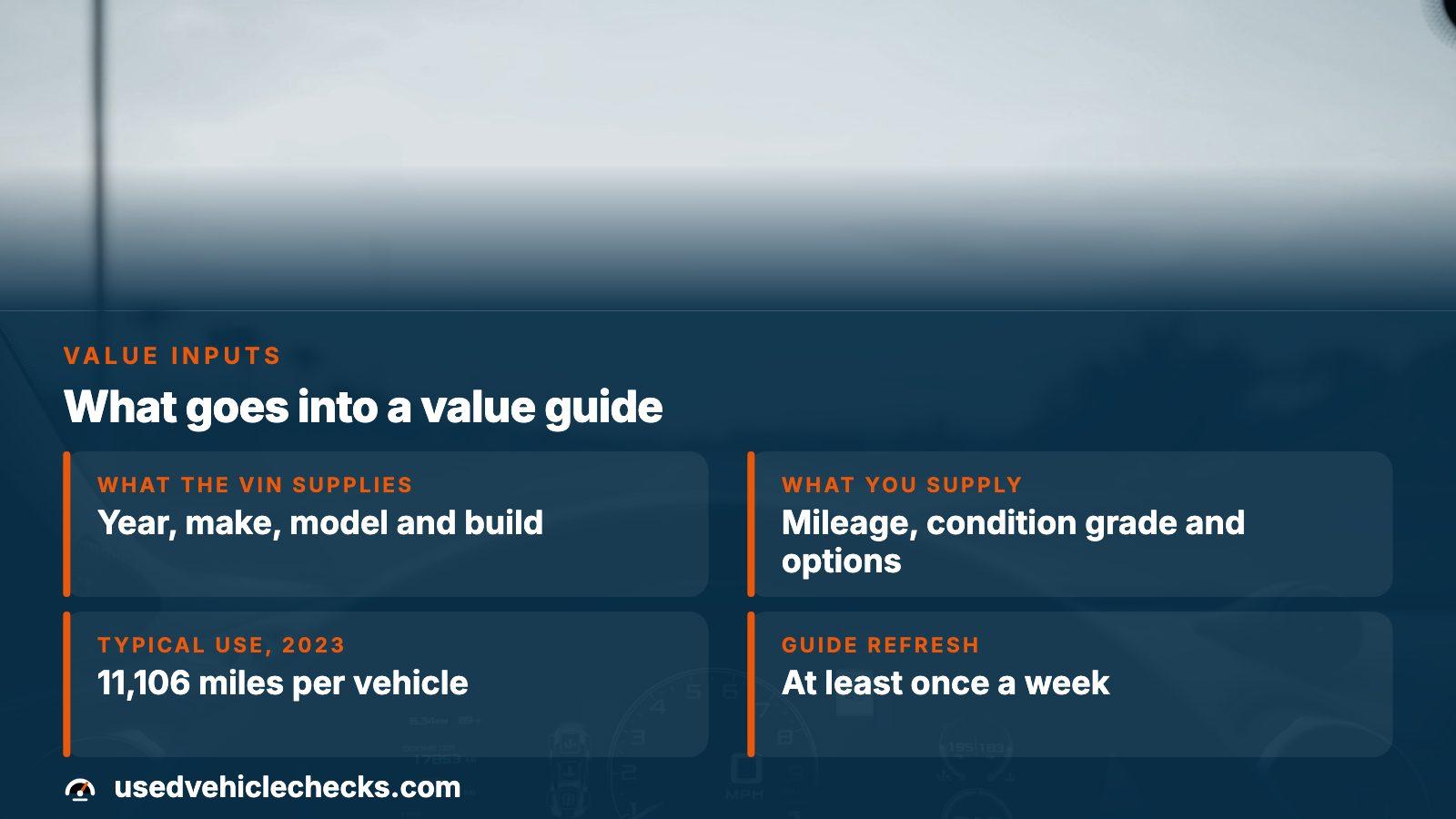
- What the VIN supplies
- Year, make, model and build, never a price or a mileage
- What you supply
- Mileage, condition grade and options
- Typical use, 2023
- 11,106 miles per light-duty vehicle
- Guide refresh
- At least once a week, so a value is a snapshot
What a VIN can and cannot tell a price guide
A VIN names one build. Seventeen characters, one of them standing for the model year, let a decoder report the year, make, model and body style. Price was never part of the design: four sample VINs sent through NHTSA's public decoder came back with 41 to 45 populated fields out of 154, the base price slot sat blank each time, and nothing resembling a mileage appeared.
| Input a price guide asks for | Where the answer comes from |
|---|---|
| Year, make, model, body | The VIN itself |
| Trim and options | The VIN as a start, then the car in front of you |
| Mileage | The odometer, checked against dated records |
| Condition | Your honest grade, then an independent mechanic |
| Title brands and damage | History records, since the dash cannot show them |
Why mileage moves the price
Kelley Blue Book says its statisticians mine sales records to learn what odometer reading is normal for a car of a given age, then raise or lower the value for cars above or below that norm. The IRS describes guides the same way: dealer prices, plus adjustments for unusual mileage, equipment and condition.
Federal highway statistics put the average light-duty vehicle at 11,106 miles driven in 2023, so multiply the car's age by roughly that figure for a first guess at normal. A reading far below the guess earns a premium only if it is true, which makes the low number the one worth checking.
Pricing a car whose mileage is unproven
A mileage copied from the dash is a claim until a record agrees. A guide returns a tidy number either way, so the checking falls on you.
| What the records show | Mileage to price from | Your move before an offer |
|---|---|---|
| Readings sit a little under the dash | The dash figure | Run two guides at that mileage |
| A reading above the dash | The higher figure, until proven otherwise | Ask for repair invoices |
| Few readings, none, or a not-actual note | Unknown mileage, so price under the range | Rely on an inspection and the service file |
From an NHTSA owner complaint
A buyer picked up a 2017 Toyota Camry from a private seller on an online marketplace. After a check-engine light and a new catalytic converter, the buyer used a diagnostic code reader and saw an estimated value far under the price paid. A history report ordered afterward put the true mileage at 297,000 against 107,000 on the dash, and the report shown at sale proved fake.
The value figure sounded the alarm after the money was gone. A record in hand before the offer would have sounded it sooner.
Running the check before you name a price
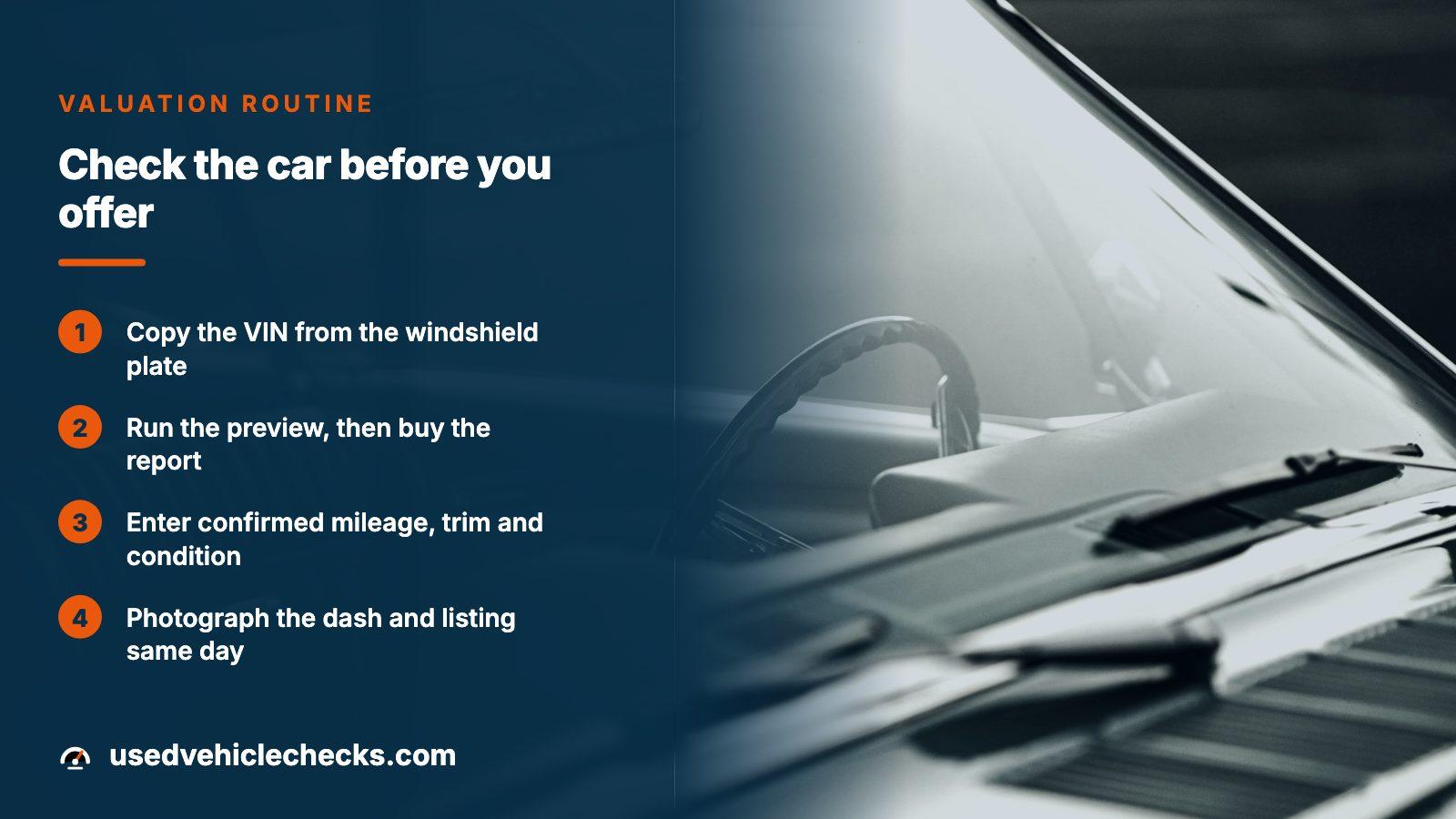
- Copy the VIN from the plate you can read in the glass corner at the driver's side, then from the title or Buyers Guide; if the copies differ, stop, because the car is not the one described.
- Run the preview first, a no-cost look that tells you if the car merits a report.
- For a car you still want, buy the report and read the dated odometer readings, then the brand and damage entries, then the market value section.
- Enter the confirmed mileage, trim, options and an honest condition grade into two price guides, not one.
- Photograph the dash and the listing the same day.
From an NHTSA owner complaint
A shopper eyeing a 2015 Honda Accord heard the seller claim roughly 123,000 miles. Records and an online valuation for the same VIN listed more than 180,000. The shopper confirmed that the plate on the car matched those records, kept screenshots of the ad and the seller's replies, and reported it before another buyer could be harmed.
That shopper worked in the right order: records first, price second.
Trade-in, private sale or dealer lot
One car carries several defensible values, so a seller and a buyer can quote different numbers and both be right. Kelley Blue Book shows a trade-in range, a private party value and dealer-side figures, and its listing-price figure presumes a car that has been reconditioned and has a clean title record.
- Trade-in: what a dealer offers when you hand the car over against another purchase.
- Private sale: what one individual pays another, the figure to use when no dealer sits in the middle.
- Dealer asking price: what a dealer lists after preparing the car for the lot.
The IRS rule for valuing a donated car is a good habit for any sale: use the private party price, not dealer retail, and trust a guide figure only when the guide's car matches yours in make, model, year, region, condition and equipment. Values also refresh at least once a week, so last month's screenshot is a stale quote.
What the history does to the number
A guide's headline figure is meant for a car with a clean record. The national title system reports five things: title status and the date of the last title, brands, odometer, total losses and salvage records. Its own page warns that a buyer who never learns the brand history may pay more than the car is truly worth, and that odometer fraud can have the same effect.
A salvage brand, a total loss entry or auction photos of a wrecked car each pull a price down whatever the dash says. Read those entries first and the market value last, so the number is judged against the facts that explain it.
What no value tool can see
Guides and history records are both blind to the car's present state. Neither knows about worn brakes, a seeping gasket or mismatched tires. The national title system says its report is no stand-in for a mechanic: repair histories and recall data sit outside it, and the page urges buyers to hire an independent inspector.
Where a fair offer comes from
Start from the guide's range at the confirmed mileage. Subtract what the mechanic finds. Subtract more if the title carries a brand. Offer from there, and be ready to leave.
Cost and your next move
The preview costs nothing. If the car passes, you pay once for the report, with no subscription, and a multi-report pack suits anyone comparing several cars. Current amounts are on the pricing page.
If the readings on record match the dash, price from them and move on to the inspection. If they contradict it, hold your offer until the seller explains in writing, and read the discrepancy guide first. Either way, keep the readings and the listing together until the sale closes.
Where this information comes from
- NHTSA vPIC API: decoding a VIN — Describes what the federal decoder returns; price and mileage are not among its fields.
- NMVTIS: understanding a vehicle history report — The five indicators, the warning about paying above fair value, and the inspection advice.
- IRS Publication 526: valuing a donated car — How used car guides treat mileage and condition, and the private party point.
- FHWA Highway Statistics 2023, Table VM-1 — Average miles per light-duty vehicle for 2023.
- Kelley Blue Book: used car value FAQ — How a guide sets typical mileage, what it assumes about condition and title, and how often values refresh.
- NHTSA owner complaint 11742289 — owner experience, paraphrased
- NHTSA owner complaint 11716510 — owner experience, paraphrased
Sources and photos: Facts checked against the sources above in November 2026. Photos by Sasun Bughdaryan, Dylan Michaud and Dennis Eusebio on Unsplash; diagrams by UsedVehicleChecks.
Keep reading
- Mileage Check by VIN: What the Recorded Odometer Readings ShowHow the dated odometer readings are gathered and how to read them.
- How Many Miles Is Too Many on a Used Car? Age, Pace and ProofHow high mileage changes what a buyer should accept.
- Title Check by VIN: A Step-by-Step Check, Odometer Entries FirstThe title brands that cut a price whatever the mileage.
- Odometer Discrepancy Check: Find a Mileage Mismatch Before You PayWhat to do when the records and the dash disagree.
Frequently asked questions
Can I find a car's value from the VIN alone?
Not a reliable one. The VIN names the build, and NHTSA's decoder returns specifications with the base price blank. A value also needs a mileage, a condition grade and a market. Use the VIN to fix the car, then supply the rest.
How much does mileage change what a car is worth?
Guides publish no flat rate. Kelley Blue Book compares each car with a typical mileage for its age and adjusts up or down, and the IRS notes that guides adjust for unusual mileage. Enter the real mileage, then test the result against a second guide.
Why do two value tools disagree for the same VIN and mileage?
They answer different questions. One may price a trade-in, another a private sale, another a dealer's asking price, each from its own sales data on its own schedule. Compare like with like and treat the spread as your range.
What if the mileage on record is higher than the dash?
Price from the higher figure until the seller shows paperwork that explains the gap, such as an invoice for a replaced instrument cluster. A gap can be a keying error or a rolled-back odometer, and a wrong guess costs you.
Does the report give me the car's market value?
Yes, a market value section sits beside the mileage and history entries, so you can read all three together. Treat it as one reading and compare it with a second guide. None of these figures see condition, so an inspection still matters.
Now check the car itself
The guide explains what to look for. The report shows what this VIN has on record.