THE SHORT ANSWER
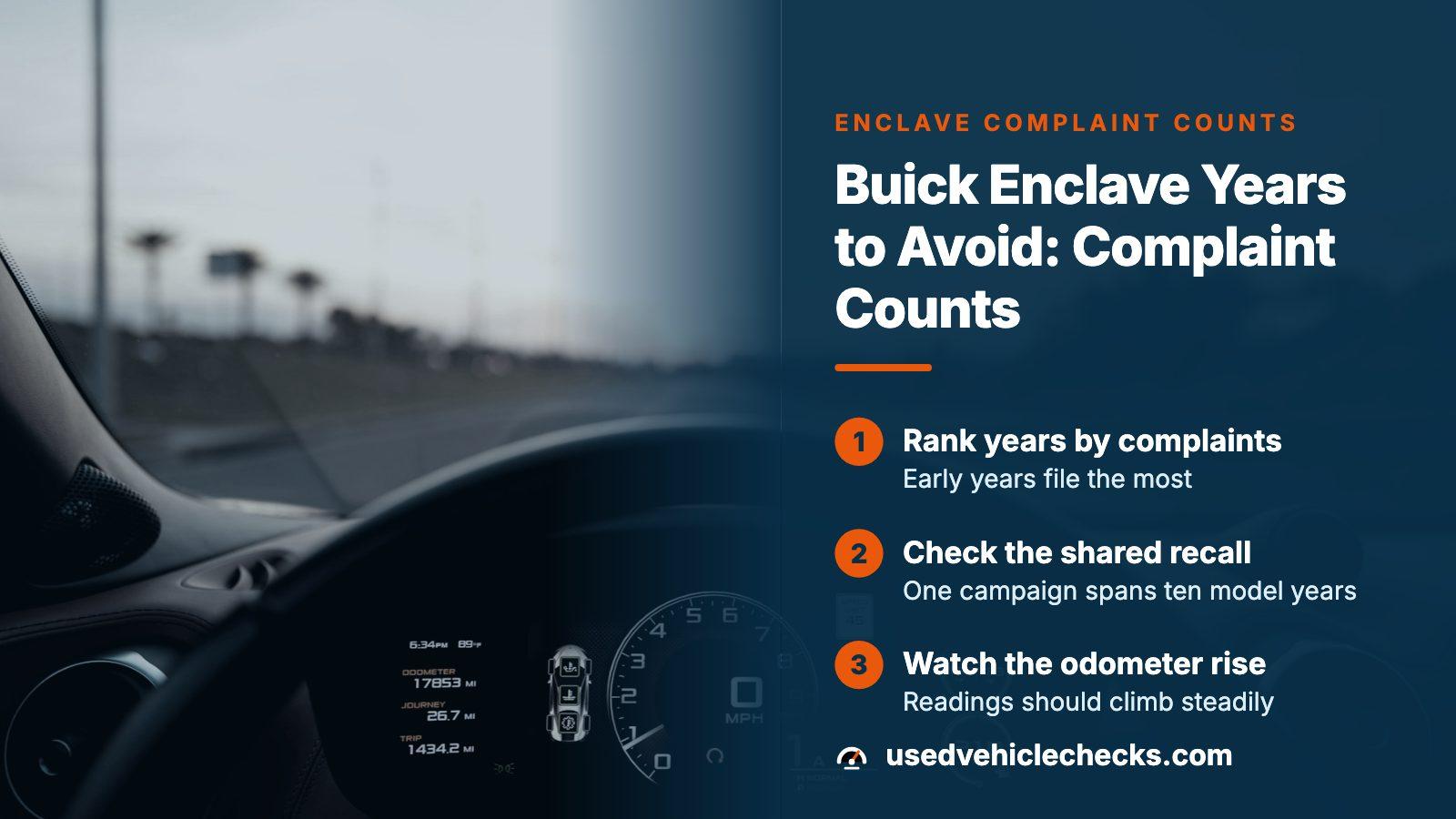
Be most careful with the 2008, 2009, 2010 and 2014 Buick Enclave. The 2008 model has 536 NHTSA complaints, and 2009 and 2010 are dominated by steering reports. The 2014 model has 292 complaints, mostly about air bags, plus seven recall campaigns. The 2018 and later years file far fewer complaints. Whatever the year, check that VIN for open recalls and for odometer readings that rise steadily.
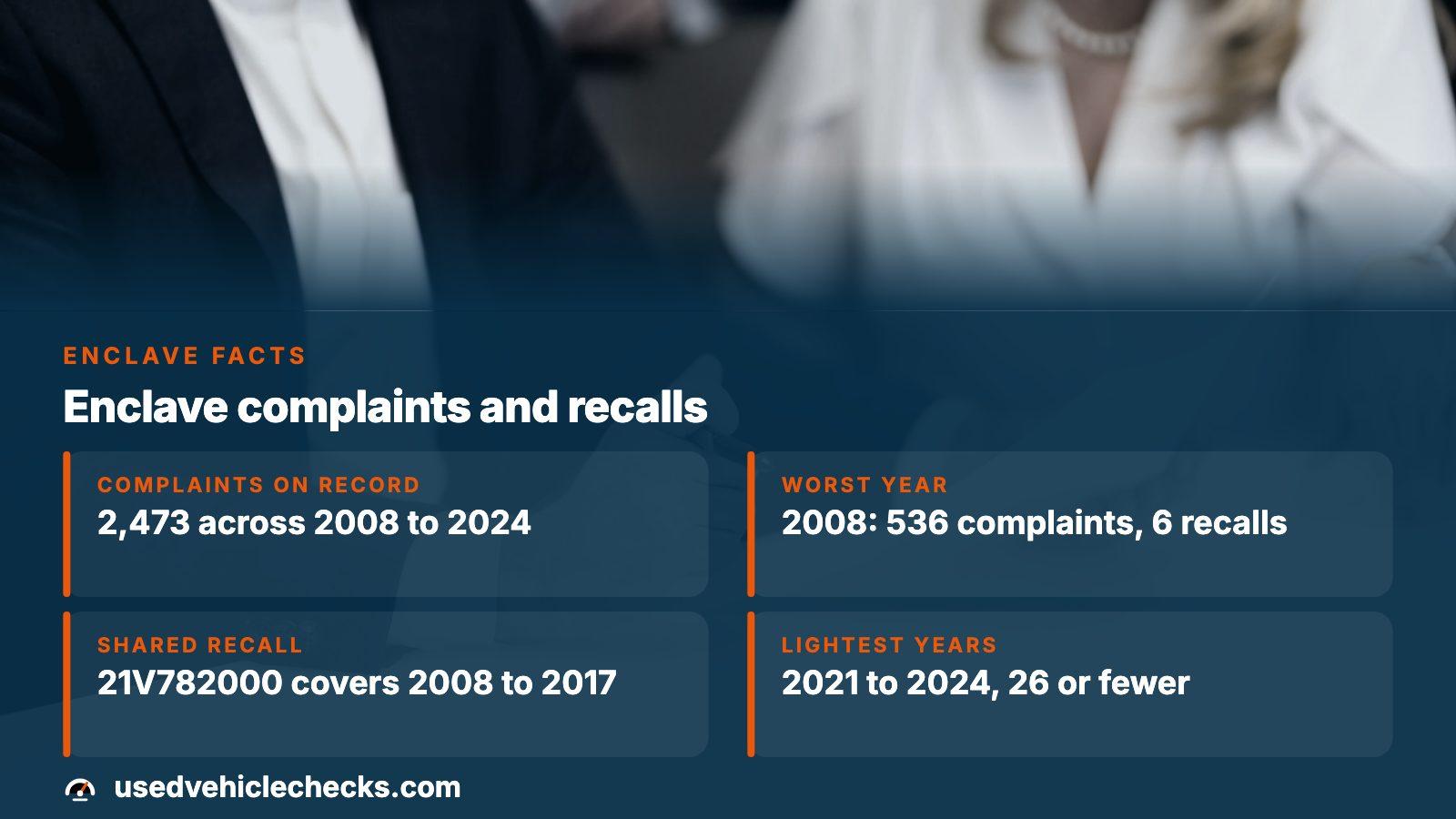
- Complaints on record
- 2,473 across 2008 to 2024
- Worst year
- 2008: 536 complaints, 6 recalls
- Shared recall
- 21V782000 covers 2008 to 2017
- Lightest years
- 2021 to 2024, 26 complaints or fewer
The Enclave years ranked by complaints and recalls
We pulled complaints and recalls for every Enclave model year from 2008 to 2024 from NHTSA's own data. Owners filed 2,473 complaints in total. Counts are not defect rates, since an old SUV has simply had longer to attract filings, yet the gaps between neighboring years are wide enough to read.
| Year | Filed | Campaigns | Top area |
|---|---|---|---|
| 2008 | 536 | 6 | Power train (139) |
| 2009 | 220 | 8 | Steering (108) |
| 2010 | 275 | 6 | Steering (126) |
| 2011 | 213 | 6 | Steering (41) |
| 2012 | 133 | 6 | Engine and structure |
| 2013 | 71 | 4 | Not dominated by one area |
| 2014 | 292 | 7 | Air bags (205) |
| 2017 | 179 | 3 | Air bags (145) |
| 2018 | 66 | 0 | Spread out |
| 2020 | 61 | 6 | Spread out |
| 2021 to 2024 | 26 or fewer each | 2, 1, 0, 0 | Too few to rank |
2008 to 2010: transmission, wiring and a steering problem
These three years together hold 1,031 complaints, close to half of everything filed on the nameplate. The 2008 model leads with 536, and its list is wide: 139 for the power train, 113 for air bags, 99 for steering and 73 for the electrical system. It also has 13 crash-flagged complaints and 10 fire-flagged ones, more of each than any other year.
The 2009 and 2010 years narrow to one theme. Of 220 complaints on the 2009, 108 name steering. Of 275 on the 2010, 126 do. Owners describe assist that drops out in low-speed turns, and the 2010 also has 72 engine complaints. Recalls add to the pile: 2009 has eight campaigns, the most of any year, covering seat belt buckles, a shift cable clip and a seat trim shield among others.
From an NHTSA owner complaint
One 2010 Enclave driver told NHTSA that power steering gave out at 15 mph or less while turning, with no warning light, so the wheel went manual. The SUV had roughly 135,000 miles, and nobody had diagnosed or fixed it.
Faults like this show up on worn, high-mileage examples, so a suspiciously low dash reading you cannot confirm should raise doubts.
2014 and 2017: the air bag years
The 2014 model draws 292 complaints, and 205 of them mention air bags. It also lists seven recall campaigns, including the driver inflator campaign, a seat belt cable campaign, a fuel gauge software fix on early builds and a chassis electronic module replacement. The 2017 model is quieter overall at 179 complaints, yet 145 are air bag reports, and it carries three campaigns.
Many of these filings describe waiting, not failure: the inflator fix needs a replacement module, and owners write that dealers could not get one.
From an NHTSA owner complaint
In June 2023 a 2017 Enclave owner received the letter for campaign 23V334000, yet the part was not in stock. Calls to the dealer and to GM went on repeatedly, and the owner called the delay unreasonable. The air bag had not failed.
A recall letter is not a repair. Ask for proof that the work was done on this exact VIN.
2011 to 2013: lighter, but not clean
The 2013 model is the quietest of the older group at 71 complaints and four campaigns, which makes it the most defensible early pick on paper. The 2011 and 2012 years sit at 213 and 133. They share the side curtain air bag campaign 21V246000, which covers 2010 through 2015 and 2017 Enclaves, plus the front seat belt cable campaign 14V266000 and the power liftgate campaign 15V415000 on 2008 through 2012 builds with that option.
On a 2011 or 2012, test the liftgate: the recall says worn struts may let it drop, and the software fix only slows its closing.
2018 and later: fewer complaints, with caveats
From 2018 the counts drop sharply: 66 for 2018, 45 for 2019, 61 for 2020, then 26, 14, 22 and 7. Part of that is simply age. The 2018 model lists no campaigns.
The 2020 model is the exception. It lists six campaigns, covering tires, a fuel pump, a roof-rail air bag inflator, a transmission accumulator and a cracked frame rail. For that last one, the remedy is to inspect the SUV and replace it where needed. A newer year still deserves a recall lookup on the specific VIN.
Why the odometer record matters more than the year
Complaints on this SUV rise with age and miles: failed steering assist at 135,000 miles, transmission trouble at 65,000 and 100,000 in another owner's list. So the first number to trust is the mileage, and a dash reading alone proves nothing.
A report for the VIN lists dated odometer readings from past sales, inspections and service. They should climb in a steady line. A reading that steps backward, or a long gap before a suddenly low figure, deserves a hard question. The same report also lists brands on the title, crash damage and unresolved recalls. You get a free preview first, then pay once for the report, with no subscription; the pricing page has the options.
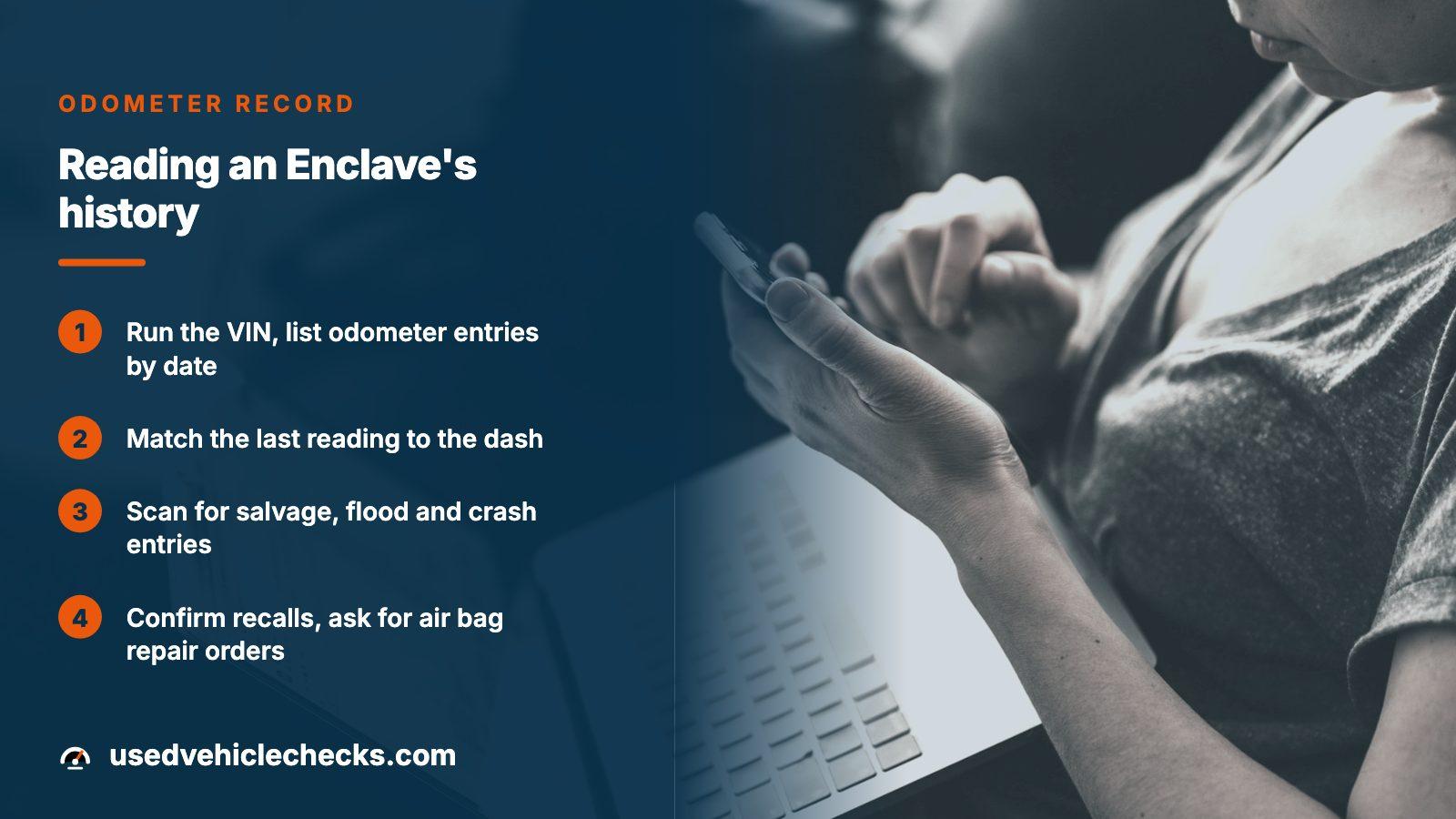
- Run the VIN and list its odometer entries by date.
- Match the last recorded reading to the dash, allowing for normal use since.
- Scan for salvage or flood brands and any crash entry.
- Confirm open recalls, then ask for repair orders on the air bag work.
Choosing a year to shop for
If you want the least complaint history, shop the 2018 and newer SUVs and read the recall list for the specific one. On a tighter budget, the 2013 stands out among older years, though it still falls under the shared inflator campaign and the 2014 seat belt campaign. Treat 2008, 2009, 2010 and 2014 as years that need a clear reason, such as a documented steering repair and proof of completed recalls, plus a lower price.
None of this is a ban. A clean-record SUV of any year can be a fine buy.
Where this information comes from
- NHTSA complaints API: Buick Enclave — Source of the complaint counts, components and crash, fire and injury flags for each year.
- NHTSA recalls API: Buick Enclave — Where each campaign number, date and fix on this page came from.
- VehicleHistory.gov: NMVTIS for consumers — Federal overview of the title database built to guard against fraud and unsafe cars.
- NHTSA owner complaint 11479499 — owner experience, paraphrased
- NHTSA owner complaint 11692530 — owner experience, paraphrased
- NHTSA owner complaint 11715839 — owner experience, paraphrased
Sources and photos: Facts checked against the sources above in November 2026. Photos by Dennis Eusebio, Michal Biernat and Carrie Allen www.carrieallen.com on Unsplash; diagrams by UsedVehicleChecks.
Keep reading
- Chevrolet Traverse Years to Avoid, and What the Odometer AddsThe Traverse shares the inflator recall with the Enclave, so compare its years.
- GMC Acadia Years to Avoid, and What the Odometer AddsAnother sibling SUV with several of the same GM campaigns.
- Mileage Check by VIN: What the Recorded Odometer Readings ShowRead a VIN's dated odometer readings before you shortlist an Enclave.
- How Many Miles Is Too Many on a Used Car? Age, Pace and ProofDecide what a high reading means for a large SUV of this age.
Frequently asked questions
Which Enclave model year is the worst?
On NHTSA data the 2008 model is the worst, with 536 owner complaints, six recall campaigns and the most crash-flagged and fire-flagged filings of any year. The 2009 and 2010 years follow, mainly on steering complaints. The 2014 model ranks next on air bag reports. Treat the ranking as a reason to inspect harder, since counts are not defect rates.
Which Buick Enclave years are the most reliable?
The lightest complaint records belong to 2021 through 2024, each at 26 filings or fewer, and the 2018 model shows no recalls. Among older SUVs, the 2013 has 71 complaints. Reliability depends on how a single vehicle was kept, so read its repair orders and recall status before you rely on the year.
Does the air bag recall affect every Enclave?
Campaign 21V782000 covers 2008 through 2017 models, the driver air bag inflator that may explode during deployment. Later years are not on that list, though 2021 and 2022 have a separate roof-rail air bag harness campaign. Enter the VIN to see which campaigns are open on the exact SUV you are considering.
Is a high-mileage Enclave a bad buy?
Not by itself. Owners report steering and transmission trouble at high mileage, so a worn example needs a careful inspection. The bigger risk is a mileage figure that is wrong. Dated odometer readings for the VIN should rise in a steady line, and a backward step is the warning sign to act on.
How do I check an Enclave's recalls and history?
Put the VIN into NHTSA's recall lookup to see open campaigns, then pull a history report for the title, crash entries and mileage. Ask the seller for repair orders carrying that VIN for any air bag, belt or steering work. The preview is free before you decide on the report.
Now check the car itself
The guide explains what to look for. The report shows what this VIN has on record.