THE SHORT ANSWER
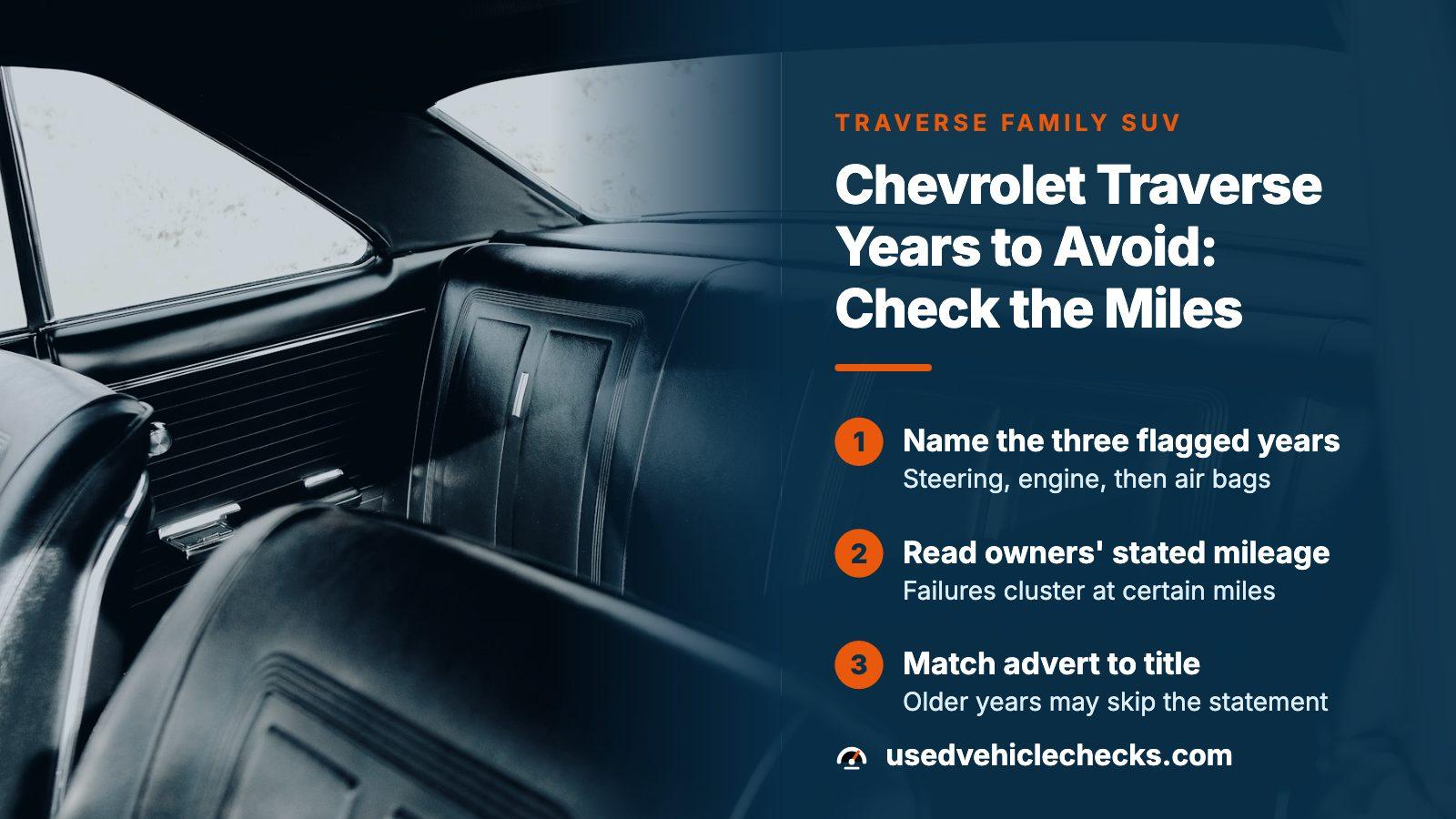
The Chevrolet Traverse years to avoid are 2010, 2011 and 2014, which draw 668, 608 and 547 NHTSA complaints against a model median of 357. Steering leads in 2010, engine in 2011 and air bags in 2014. Owners who state a mileage in the 2010 and 2011 complaints put it near 74,000 and 69,500 miles, so a flagged year means reading the odometer history hard, not dismissing a car that checks out.
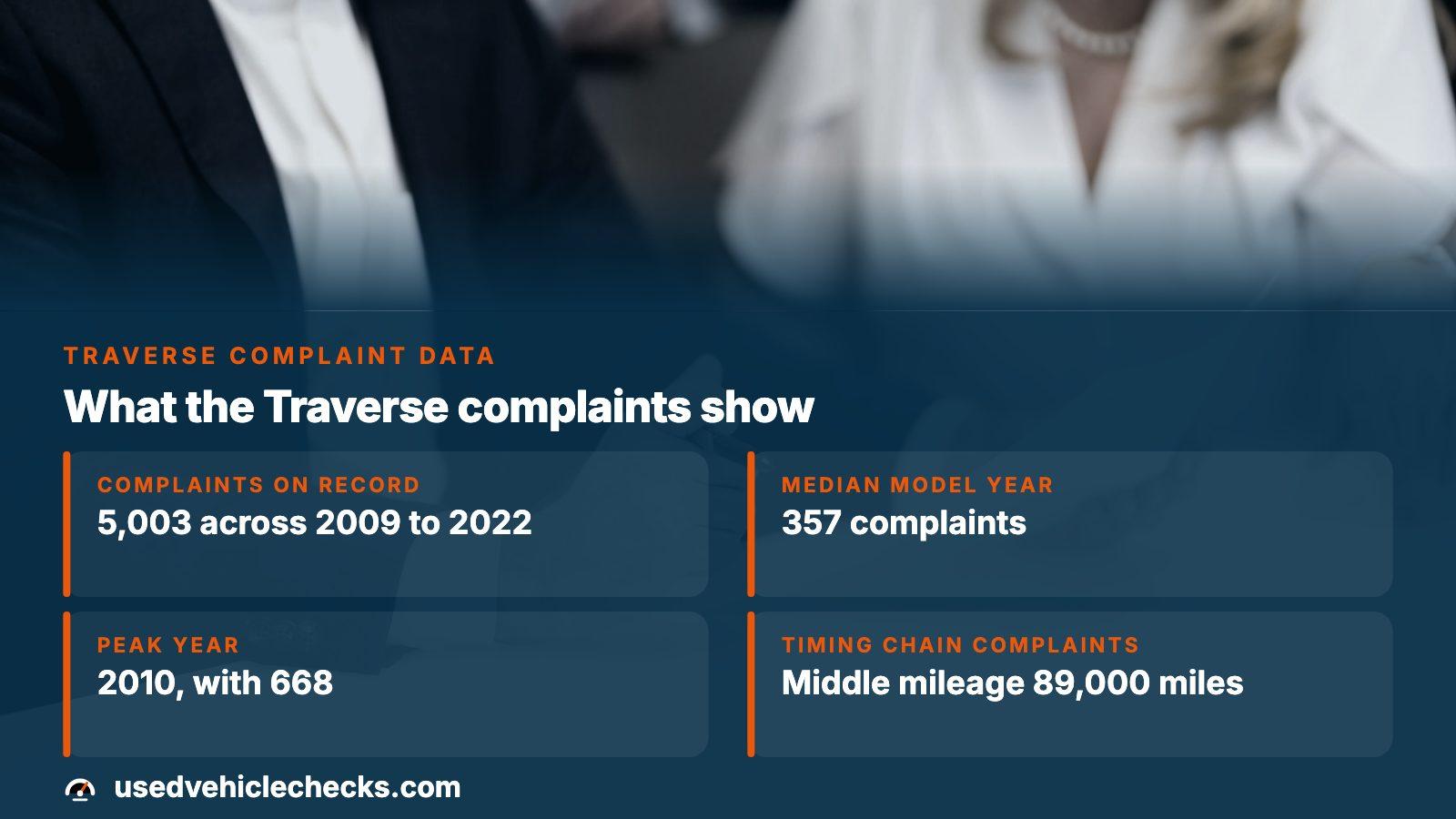
- Complaints on record
- 5,003 across 2009 to 2022
- Median model year
- 357 complaints
- Peak year
- 2010, with 668
- Timing chain complaints, middle mileage
- 89,000 miles
The three Traverse years that run above the median
NHTSA's record, pulled in August 2026, holds 5,003 owner complaints for the Traverse across model years 2009 to 2022. The middle year draws 357, and every year is measured against that figure, since setting it beside other SUVs would mostly measure how many each maker sold. Three years sit well above the line.
| Model year | Complaints | Times the median | Recalls on file | Leading area |
|---|---|---|---|---|
| 2010 | 668 | 1.87× | 5 | Steering |
| 2011 | 608 | 1.7× | 5 | Engine |
| 2014 | 547 | 1.53× | 7 | Air bags |
The 2009 year follows at 448 complaints and 8 recalls, near enough to the line to count as ordinary. The leap from 161 complaints for 2013 to 547 for 2014 needs a closer look, which a later section gives it.
The quieter years, and why a thin file proves little
The lightest records belong to 2021 with 86 complaints, 2022 with 95 and 2013 with 161, which is 0.24, 0.27 and 0.45 times the median. The two newest years look tidy partly because their owners have had little time to write anything down.
- 2015: 313 complaints, 0.88 times the median
- 2016: 291 complaints, 0.82 times the median
- 2020: 218 complaints, but 8 recalls on file
A short complaint list is not a clean bill. Recalls follow build dates, and a 2016 Traverse still carries 5 of them.
Three flagged years, three different stories
- 2010: steering leads with 331 complaints, and 220 of those name the power steering. Engine adds 178, and 92 of them mention a timing chain.
- 2011: engine leads with 204 complaints, 52 of them mentioning a timing chain.
- 2014: air bags lead with 259 complaints, and 165 of those were filed in 2023 or 2024.
The last line changes how to read 2014. Recall 23V334000 covers 2014 to 2017 Traverses whose driver's air bag inflator may explode when it deploys, and dealers swap the module at no charge. Of the 259 air bag filings, 190 mention a recall or an inflator. So the 2014 flag is mostly a question about whether this car's repair was done, and much less a verdict on wear.
What the odometer read when owners wrote in
Roughly one complaint in nine puts a mileage in the owner's own words. Taking the first figure in each of those summaries gives a rough picture of where on the odometer trouble gets reported.
| Group | Complaints naming a mileage | Middle mileage |
|---|---|---|
| Model year 2010 | 109 | 74,000 |
| Model year 2011 | 96 | 69,500 |
| Model year 2014 | 31 | 45,000 |
| Timing chain complaints, 2009 to 2012 | 90 | 89,000 |
Of those 90 timing chain complaints, 57 sit between 60,000 and 100,000 miles. The first figure is not always the mileage at failure, and owners who leave the number out are missing, so read this as a band to stay alert in, not a schedule.
From an NHTSA owner complaint
A 2010 Traverse owner wrote that the engine started rattling on start-up with the odometer a little short of 86,000 miles. A certified mechanic diagnosed a stretched timing chain and pulled a stored P0008 code, although the check engine light was not on. The entire chain assembly was due for replacement.
Take from it that the dashboard may stay quiet. A 2009 to 2012 Traverse in that band deserves a cold start with the hood up and a code scan, not only a glance at the warning lights.
The oldest flagged years sit outside the federal mileage statement
Section 580.17 of the federal odometer regulations, in 49 CFR, lets a seller skip the written mileage statement on an older vehicle. For model year 2010 or earlier, the exemption begins once the transfer falls at least ten years after January 1 of the model year, and the rule's own example says that for transfers in 2020, 2010 and older vehicles are exempt. Newer cars get longer: from model year 2011 on, the cutoff is twenty years after that January date, and the rule uses 2031 as its example for a 2011.
That covers 2009 and 2010 Traverses today, including the year with the most complaints. A 2011 stays inside the statement requirement until 2031. State title rules may ask for more, so check yours. Where no mileage statement is owed, dated readings from other sources carry more weight.
When the advert and the title disagree
From an NHTSA owner complaint
A buyer filed a complaint while still completing a private-sale purchase of a 2014 Traverse. The mileage before the sale was 118,000, but registration turned up 227,937. The filing is headed odometer fraud.
That gap surfaced at registration, in the middle of the purchase. A history report moves the comparison earlier, to before any money changes hands.
- Start with the oldest dated reading and move forward. Each later date should show a higher figure.
- Set the newest recorded reading against the dash. A dash that reads lower needs an explanation before price comes up.
- Look for long silences followed by a big jump, or the same figure on two different dates.
- Match a few service invoices to the series. Mileage on a repair order should land between two recorded readings.
- Weigh the use type. A rental or fleet Traverse can reach the 60,000 to 100,000 band sooner than its age implies.
A used Traverse bought around 80,000 miles
From an NHTSA owner complaint
A 2011 Traverse owner bought the SUV used with 80,000 miles and smelled burning oil within a week. The dealer called it a "normal Traverse smell", and so did every shop after it. Two years on, a local mechanic replaced timing parts, yet the smell stayed. Back at the same shop, the owner learned that a brass ring meant to be replaced had been left out. The owner blamed Chevrolet for knowing about the engine and refusing to cover it.
That reading sits in the middle of the band from the earlier table. Two points follow. A smell that a seller or dealer waves off still earns an independent mechanic's second opinion, and an invoice for timing work should name exactly which parts were replaced.
Checking one Traverse before you make an offer
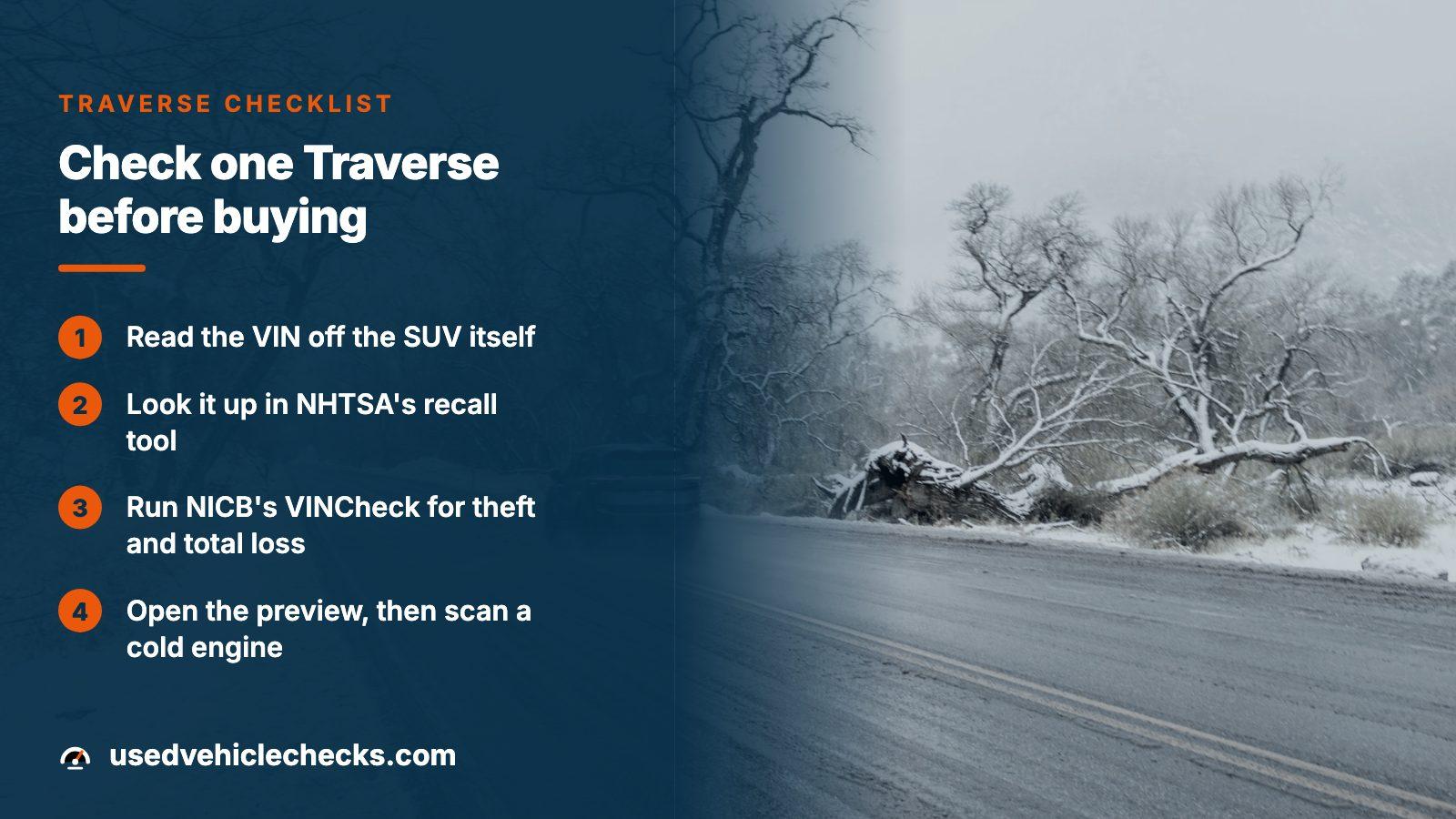
- Read the VIN off the SUV itself and confirm that its tenth character matches the year in the advert.
- Look the VIN up in NHTSA's recall tool, at no cost, and note every open campaign. On a 2014, watch for 23V334000.
- Run NICB's VINCheck for a no-cost theft and total-loss screen.
- Open the preview here, which is free. When the Traverse is still in contention after your first calls, buy the report and read the dated odometer series before the damage, title, lien and auction entries.
- Take a mechanic to a cold engine and a stored-code scan, then use what turns up when you negotiate.
One payment buys one report and nothing renews. Someone comparing several SUVs can buy a multi-report pack instead, and the pricing page spells out the choices.
Where this information comes from
- NHTSA: vehicle safety and owner complaints — The federal agency that receives the owner complaints behind each model-year count.
- NHTSA: recalls by VIN — A no-cost lookup for open recall campaigns, including 23V334000, on one specific car.
- eCFR: 49 CFR 580.17, odometer disclosure exemptions — The federal rule that sets which older vehicles need no written mileage statement.
- NICB: VINCheck — A quick theft and total-loss screen for one VIN.
- NHTSA owner complaint 11727518 — owner experience, paraphrased
- NHTSA owner complaint 11466949 — owner experience, paraphrased
- NHTSA owner complaint 11360883 — owner experience, paraphrased
Sources and photos: Facts checked against the sources above in November 2026. Photos by Wesley Tingey, Zoshua Colah and Carrie Allen www.carrieallen.com on Unsplash; diagrams by UsedVehicleChecks.
Keep reading
- How Many Miles Is Too Many on a Used Car? Age, Pace and ProofDecide what a six-figure reading on a family SUV means before you shortlist one.
- Odometer Rollback Check by VIN: Run the Mileage Test Before You PayHow to line readings up by date and spot a step backward.
- Mileage Check by VIN: What the Recorded Odometer Readings ShowThe check itself: dated readings for one VIN, ahead of any offer.
- GMC Acadia Years to Avoid, and What the Odometer AddsA GM sister SUV covered by several of the same recall campaigns.
Frequently asked questions
What are the Chevrolet Traverse years to avoid?
Start with 2010, 2011 and 2014, which hold 668, 608 and 547 filings against a median of 357. Treat the flag as a cue to inspect closely and negotiate. Each of those years also produced sound cars, and a steady mileage record with finished recalls says more about one Traverse than its model year.
Which Traverse years look the most reliable?
Complaint counts measure filings, not reliability. The lightest files are 2021, 2022 and 2013, with 86, 95 and 161 complaints, but the newest cars look clean partly because owners have had less time to write. For any year, look the VIN up in NHTSA's recall tool and have a mechanic check the engine and steering.
At what mileage do Traverse engine problems show up?
Among 2009 to 2012 complaints that mention a timing chain and state a mileage, the middle figure is 89,000 miles, and 57 of the 90 fall between 60,000 and 100,000. That is a rough band from unverified reports, so use it to time an inspection, not to predict a failure.
Does a seller have to state the mileage on an older Traverse?
Under the federal rule, not for a model year 2010 or older vehicle transferred at least ten years after January 1 of that year, so 2009 and 2010 Traverses are exempt now. A 2011 stays covered until 2031. State rules can differ, so ask your title office before reading anything into a seller's silence.
How do I check the mileage on a specific Traverse?
Start from the VIN. Open the preview on this site, then buy the report if the car is still in the running and read its dated odometer readings oldest to newest. Hold the latest against the dash and the repair invoices, and resolve any earlier, higher reading before you pay.
Now check the car itself
The guide explains what to look for. The report shows what this VIN has on record.