THE SHORT ANSWER
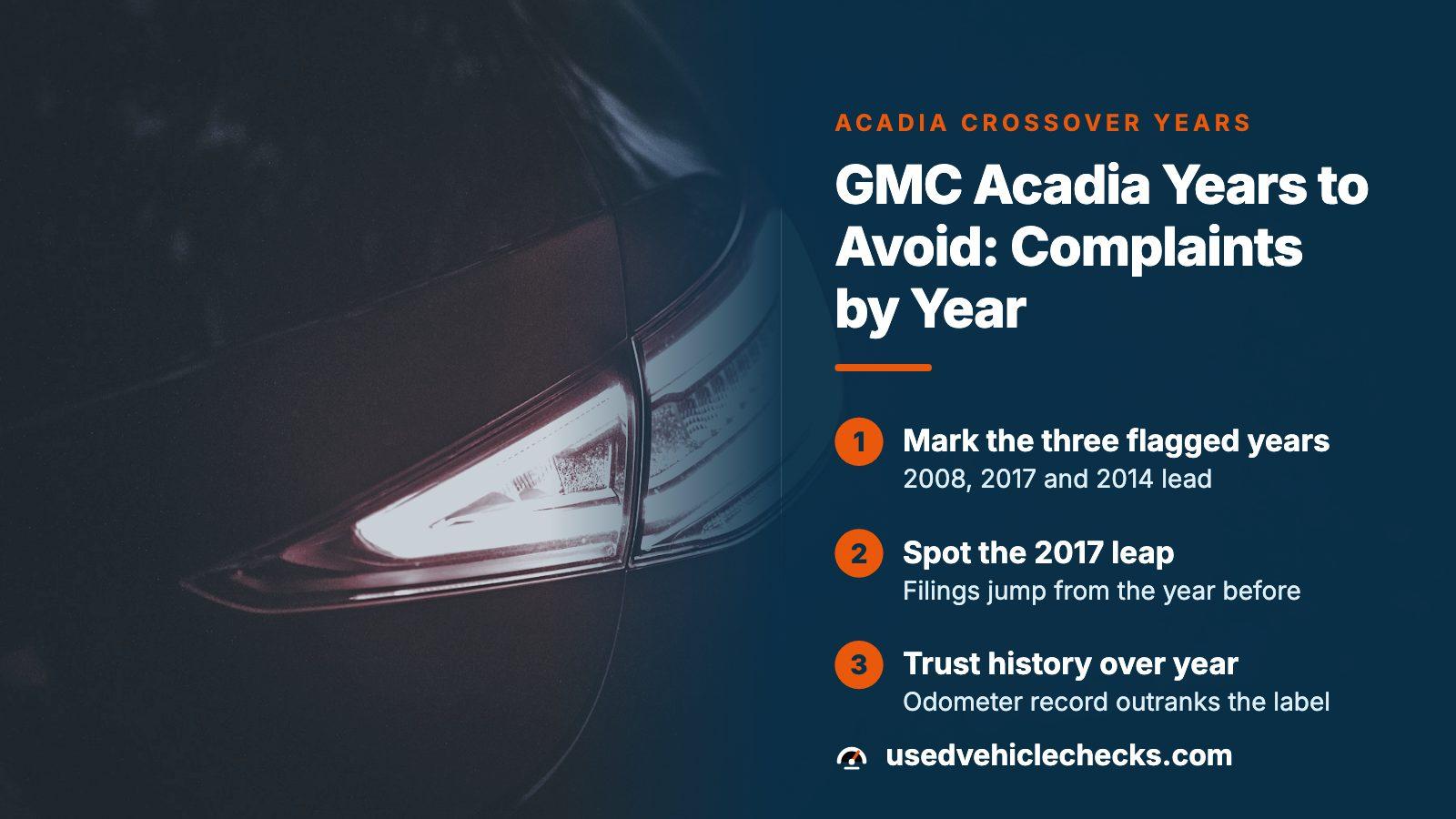
On NHTSA complaint counts, the Acadia years to approach with care are 2008, 2017 and 2014, at 2.84, 2.32 and 1.54 times the model's median of 302 complaints a year. The lightest records are 2022, 2020 and 2013, and power train draws the most complaints overall. A year describes a group of SUVs, not yours, so read that VIN's odometer readings, open recalls and title record before you pay.
- Complaints on record
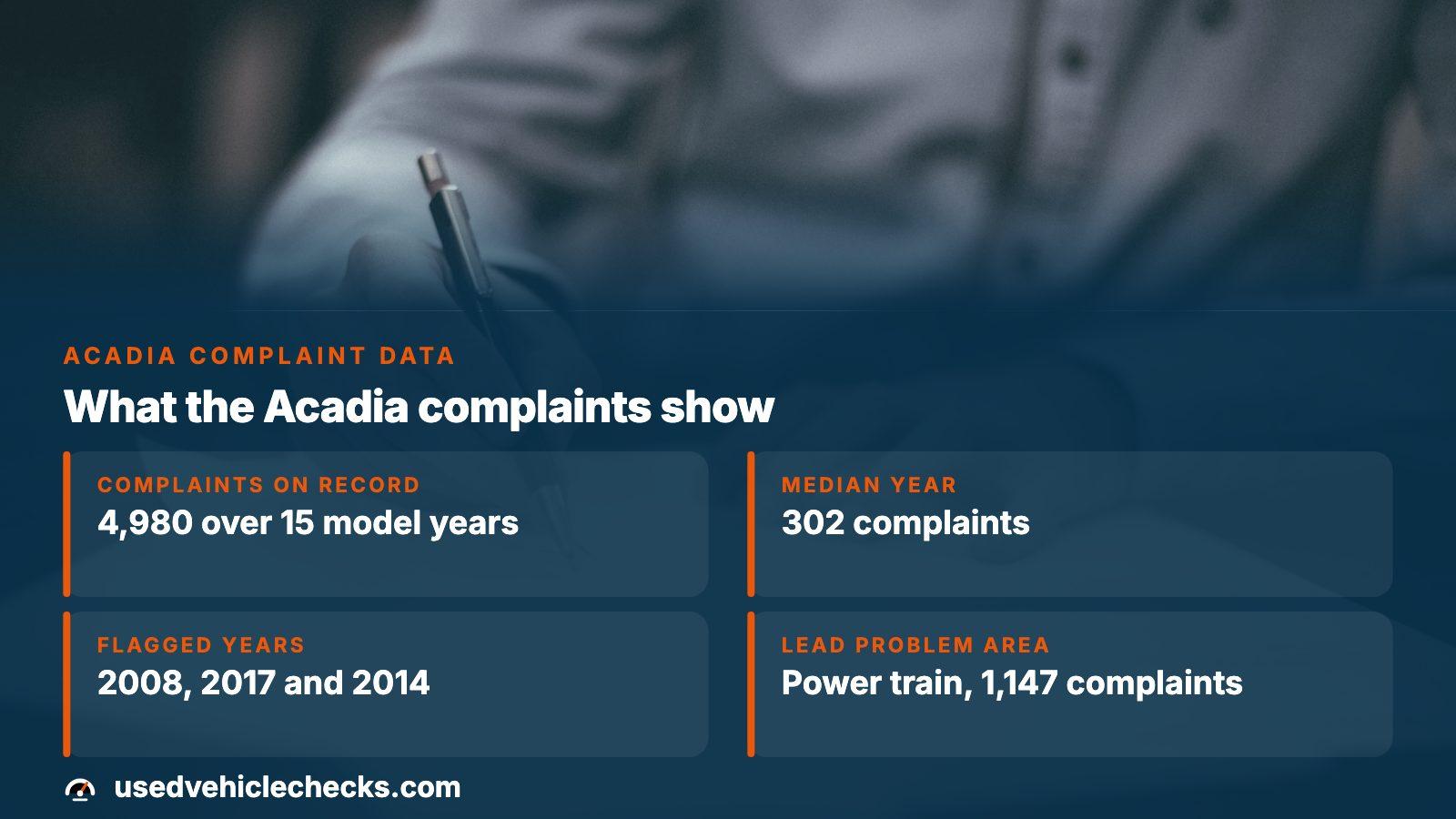
- 4,980 over 15 model years
- Median year
- 302 complaints
- Flagged years
- 2008, 2017 and 2014
- Lead problem area
- Power train, 1,147 complaints
The three Acadia years that sit furthest above the line
NHTSA's Acadia records span 15 model years, 2008 through 2022, with 4,980 complaints in all. The fair yardstick is the SUV's own middle year, 302, and a year is flagged only when it runs well above that. Three do.
| Model year | Complaints | Times the median | Recalls | Most reported area |
|---|---|---|---|---|
| 2008 | 858 | 2.84× | 5 | Power train |
| 2017 | 701 | 2.32× | 4 | Power train |
| 2014 | 466 | 1.54× | 6 | Air bags |
Read 2014 as the milder case, about half again the median. The 2008 and 2017 years are where a power train story is likeliest, so ask for service invoices and book a lift inspection.
From an NHTSA owner complaint
A 2008 Acadia owner who had bought the SUV used six months earlier told NHTSA it lurched hard shifting from first to second and nearly left the road at under 15 mph. A dealer blamed a failed interlock shift solenoid, a part that had to come from out of state. The filing puts the failure at 158,000 miles.
A used 2008 can shift badly within months of the sale. Ask for the transmission service file before you talk price, and feel that first-to-second shift cold.
Every model year ranked against the median
Times the median is each year's complaint count divided by 302, so 1× is an average year.
| Model year | Complaints | Times the median | Recalls |
|---|---|---|---|
| 2008 | 858 | 2.84× | 5 |
| 2009 | 333 | 1.1× | 7 |
| 2010 | 348 | 1.15× | 4 |
| 2011 | 280 | 0.93× | 5 |
| 2012 | 302 | 1× | 5 |
| 2013 | 139 | 0.46× | 3 |
| 2014 | 466 | 1.54× | 6 |
| 2015 | 260 | 0.86× | 4 |
| 2016 | 234 | 0.77× | 4 |
| 2017 | 701 | 2.32× | 4 |
| 2018 | 390 | 1.29× | 2 |
| 2019 | 379 | 1.25× | 2 |
| 2020 | 97 | 0.32× | 6 |
| 2021 | 146 | 0.48× | 2 |
| 2022 | 47 | 0.16× | 3 |
Eight years count as ordinary, 2012 at exactly 1×, so complaints alone cannot separate them. Recalls do not track complaints either: 2009 has the most at 7, on an unremarkable 333.
The jump from 234 complaints in 2016 to 701 in 2017
The 2016 year sits under the median at 0.77×, then 2017 more than doubles it. That leap more likely reflects a redesign or heavy mechanical rework than a slow slide in quality, so two Acadias that look alike in photos can come from different populations.
Afterward, 2018 and 2019 stay above the median at 390 and 379 before 2020 drops to 97. Treat 2017 through 2019 as one block.
From an NHTSA owner complaint
A 2017 Acadia owner told NHTSA that after parking, the SUV would not register that the shifter was in park, so it would not switch off. Wiggling the lever eventually worked, sometimes after up to 10 minutes. The owner had read about a recall for the fault but said "my vin number was not included", and the problem was worsening.
Recall coverage follows production runs rather than model years, so only a VIN lookup settles it. The listing's year is the seller's word; the tenth VIN character encodes it and shows which side of the 2017 step the SUV sits on.
Why the odometer history outranks the year
A complaint count describes a whole year. Mileage describes this Acadia, if the record hangs together. Read the dated odometer entries for these patterns.
- Readings in date order, each above the last, climbing at a pace that fits how the SUV was used.
- A long silence followed by a big jump, which deserves a question.
- The same number on several dates, a sign the odometer may have stopped working.
- A lower reading after a higher one, the classic mark of rollback or an unreported cluster swap.
- Use type on the record: rental, fleet or taxi history adds miles faster than a single owner.
When the record is ahead of the dashboard
If an earlier reading is higher than the display shows now, either the mileage was altered or the instrument cluster was replaced and nobody wrote it down. Ask the seller for the invoice for the swap. With no paper, the safe answer is no.
Where Acadia complaints land, and what each asks of you
Over the whole 2008 to 2022 run, complaints gather in six places.
| Complaints | Problem area |
|---|---|
| 1,147 | Power train |
| 1,004 | Electrical system |
| 745 | Air bags |
| 635 | Steering |
| 594 | Engine |
| 583 | Unknown or other |
- Power train: the lead complaint in 2008 and 2017. Take a long test drive and ask for transmission service records.
- Electrical system: work every switch, window, screen and light before you talk price.
- Air bags: the lead complaint in 2014. Look up open recalls and read the damage entries, since a replaced air bag can point to a past collision.
- Steering: drive a straight road and listen for pull, play or noise at full lock.
- Engine: insist on a cold start and ask when the oil was last changed.
The quietest years, and the fine print that goes with them
Four years run well below the median: 2022 with 47 complaints, 2020 with 97, 2013 with 139 and 2021 with 146. Of the four, 2013 has been on the road longest, so its low count carries the most weight.
Recalls give a second reading. The 2020 year has 6 on file, as many as 2014, against 3 each for 2022 and 2013. A long recall list beside a thin complaint file may mean fixes landed early, but check each campaign against the VIN itself.
From an NHTSA owner complaint
A 2014 Acadia owner told NHTSA that an air bag recall notice arrived, but repeated dealer visits led nowhere: the parts that came in were wrong, and months passed with no repair. Nothing had failed yet, though the owner called the risk major.
A recall on the VIN is the seller's to-do item, not a finished repair. Ask for the dated repair order.
Five ways these numbers can mislead you
- Volume: popular years collect more filings. The Acadia's 4,980 sits near the Toyota RAV4's 5,738 and Subaru Forester's 5,042.
- Age: an old year has had longer to collect reports, and a young year looks clean by default.
- Source: every complaint, including the three above, is one owner's unchecked account.
- Recalls: they measure something else, a defect repaired at no charge. Federal law ends that duty 15 years after first sale, so the oldest Acadias here may no longer qualify.
- Scope: none of it describes the SUV parked in front of you.
Before you pay for one specific Acadia
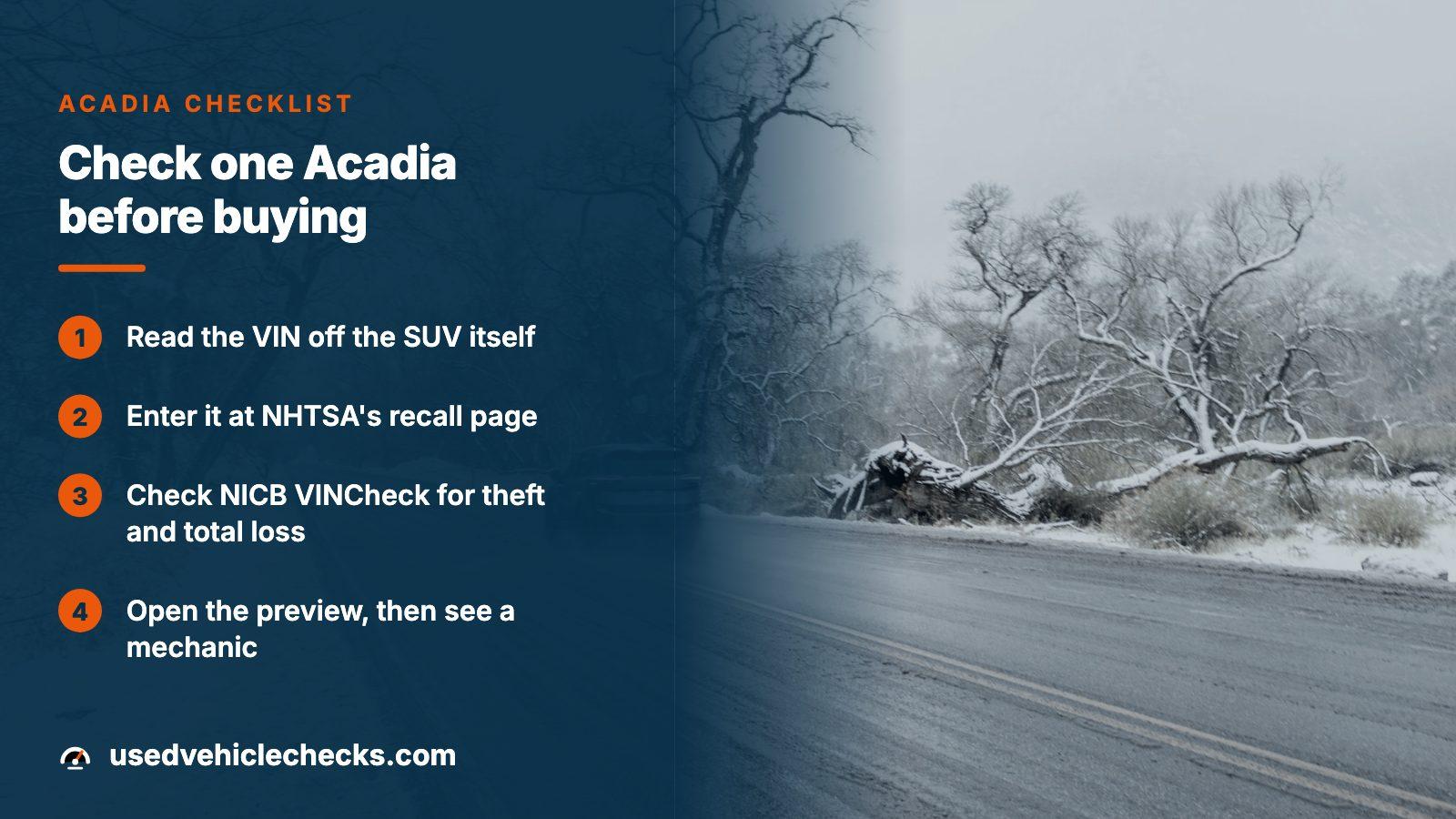
- Read the VIN off the SUV itself, from the dash-corner plate seen through the glass or the sticker inside the driver's door, and compare the model year it encodes with the listing.
- Enter the VIN at NHTSA's recall page, no charge, and jot down any open campaign.
- Check NICB VINCheck, also at no cost, for a theft or total-loss report on that VIN.
- Open the preview here, which costs nothing. If the Acadia stays on your list, buy the report and read the odometer readings first, oldest to newest, then the title and damage entries.
- Hand the findings to a mechanic and point them at the power train, electrical system, air bags and steering.
Payment happens once and nothing renews. Shoppers weighing several Acadias can buy 3, 5 or 10 reports together; the pricing page has the options.
Where this information comes from
- NHTSA: vehicle safety and owner complaints — The federal agency whose complaint filings produce the model-year counts used here.
- NHTSA: recalls by VIN — A no-cost lookup of open recall campaigns for the one Acadia you are considering.
- NMVTIS: national title record — The federal title history program, which covers a single vehicle's record, something a year table cannot.
- NICB: VINCheck — A no-cost screen of one VIN for theft and total-loss records.
- NHTSA owner complaint 11229161 — owner experience, paraphrased
- NHTSA owner complaint 11692520 — owner experience, paraphrased
- NHTSA owner complaint 11679166 — owner experience, paraphrased
Sources and photos: Facts checked against the sources above in November 2026. Photos by Maurice Sahl, Zoshua Colah and Scott Graham on Unsplash; diagrams by UsedVehicleChecks.
Keep reading
- Odometer Rollback Check by VIN: Run the Mileage Test Before You PayPut an Acadia's mileage readings in order and spot the entry that steps backward.
- How Many Miles Is Too Many on a Used Car? Age, Pace and ProofDecide what a high number on the dash means before an SUV makes your shortlist.
- Chevrolet Traverse Years to Avoid, and What the Odometer AddsThe same year-by-year read for another family crossover on a shopper's list.
- Toyota RAV4 Years to Avoid: Complaints by Year and the Odometer CheckA high-volume SUV ranked against its own median year, for a like-for-like comparison.
Frequently asked questions
Which GMC Acadia years should I avoid?
Start with 2008, 2017 and 2014, which draw 858, 701 and 466 NHTSA complaints against a median of 302. Treat that as a prompt to inspect harder, not a ban. A flagged year with steady odometer readings and no open recalls can still be fair value.
What is the most reliable GMC Acadia year?
Complaint counts measure filings, not reliability, but 2013 is the most telling low record: 139 complaints, 0.46 times the median, after many years on the road. The 2022, 2020 and 2021 years run lighter partly because they are newer.
What goes wrong most often on the GMC Acadia?
Power train leads with 1,147 NHTSA complaints from 2008 to 2022, then the electrical system with 1,004 and air bags with 745. Start any inspection with a long drive, the transmission service history and an air bag recall check.
Does high mileage rule out a used Acadia?
No. What counts is whether the readings rise steadily with their dates and fit how the SUV was used. A high number backed by invoices is easier to trust than a low one with a gap or a step backward.
How do I check one particular Acadia before buying?
Start with its VIN. NHTSA's recall page and NICB's VINCheck cost nothing, so run both, then open the preview here. If the SUV stays on your list, the paid report adds that vehicle's odometer readings, title brands and damage history.
Now check the car itself
The guide explains what to look for. The report shows what this VIN has on record.