THE SHORT ANSWER
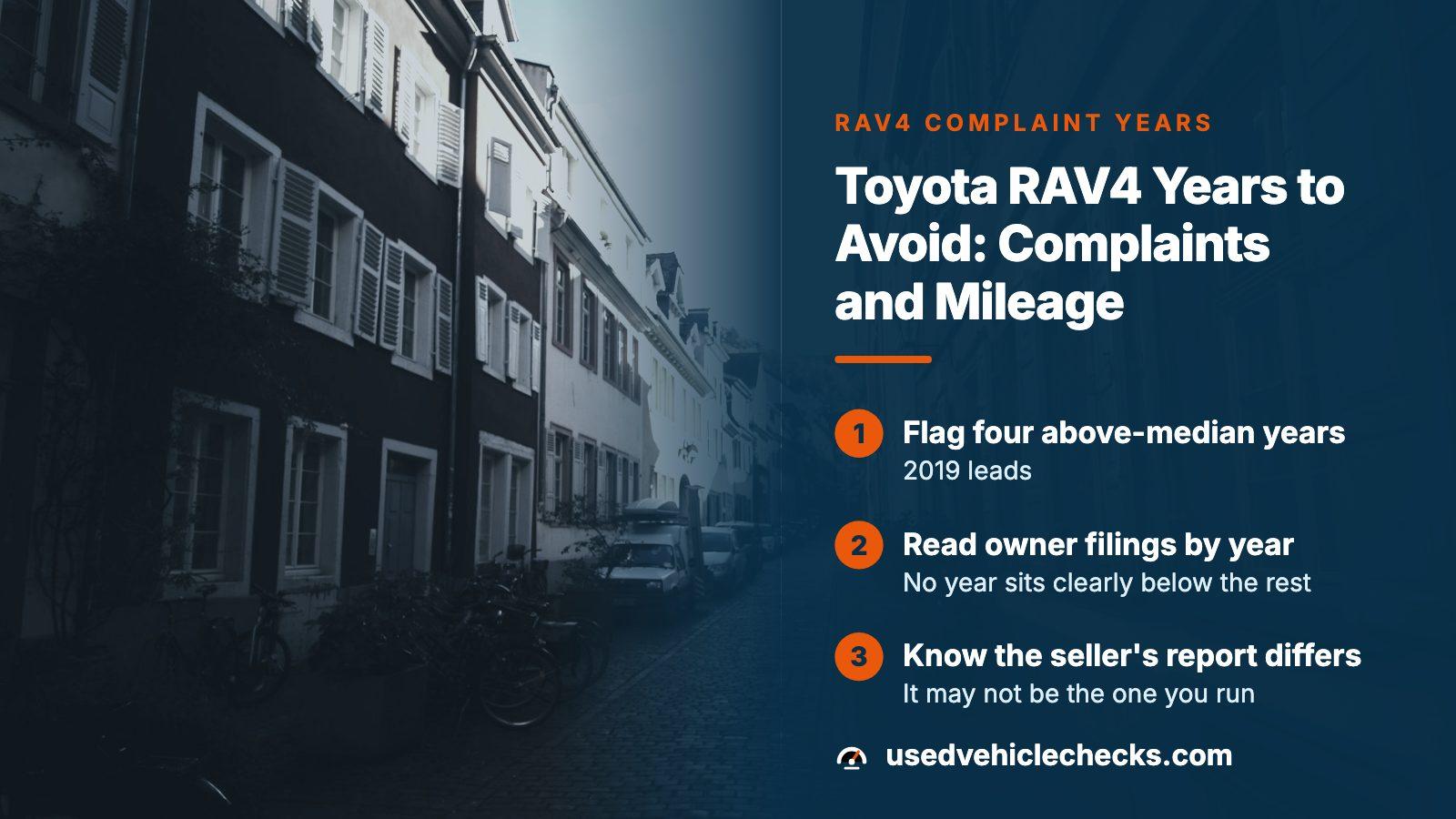
By NHTSA complaint count, the 2019, 2020, 2008 and 2021 RAV4 deserve extra scrutiny: they run 2.81, 2.01, 1.81 and 1.58 times the nameplate's median of 318 complaints a year. No model year sits clearly below the rest. A flagged RAV4 year is a cue to inspect more closely and offer less, not a ruling on the car. Whatever the year, read that VIN's dated mileage readings, open recalls and title record before you pay.
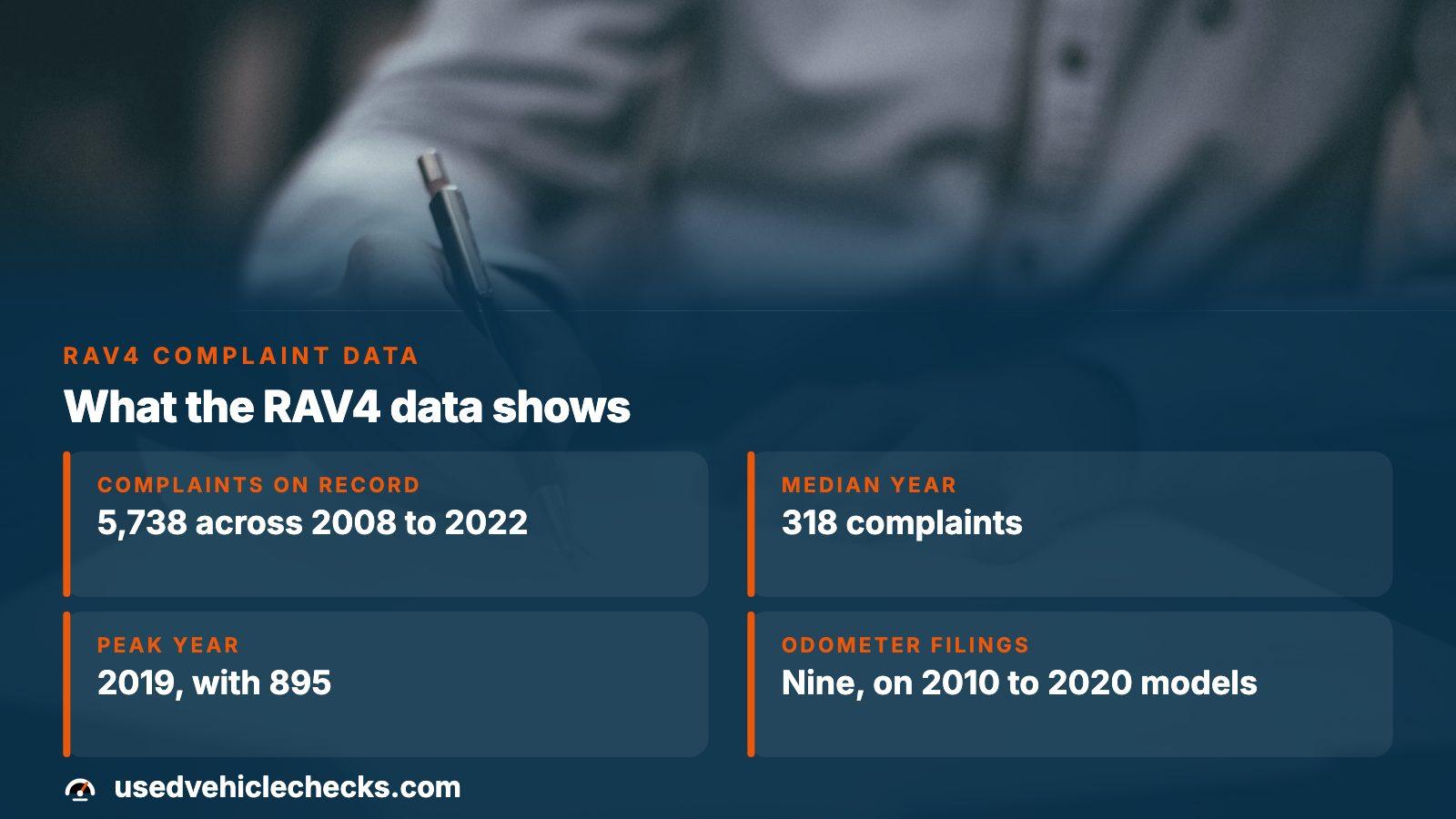
- Complaints on record
- 5,738 across 2008 to 2022
- Median year
- 318 complaints
- Peak year
- 2019, with 895
- Odometer filings
- Nine, on 2010 to 2020 models
The four RAV4 years that sit above the median
Across model years 2008 to 2022, NHTSA holds 5,738 owner complaints about the Toyota RAV4. The middle year of those 15 sits at 318, so each year is read against that figure rather than against other SUVs.
| Model year | Complaints | Times the median | Recalls on file |
|---|---|---|---|
| 2019 | 895 | 2.81× | 7 |
| 2020 | 640 | 2.01× | 6 |
| 2008 | 575 | 1.81× | 14 |
| 2021 | 501 | 1.58× | 1 |
The sharpest step in the run is 345 for 2018, then 895 for 2019. A leap that size may mark a design or mechanical change, so a 2018 and a 2019 can behave like different SUVs a year apart. Every year listed has good examples, and the flag mostly buys bargaining room.
What the owner filings in each flagged year describe
Read what owners wrote under the top category, and each flagged year turns out to be a different story.
| Model year | Most reported area | What owners describe most |
|---|---|---|
| 2019 | Fuel and propulsion | A tank that stops taking fuel near three quarters full, with many owners naming the hybrid |
| 2020 | Engine | A leaking coolant bypass valve, with some owners finding repair help ended near 100,000 miles |
| 2008 | Engine | Heavy oil consumption |
| 2021 | Air bags | Recall notices where the repair part was not yet in stock |
Only some of that points to an SUV unsafe to drive today. A fuel-fill complaint is a range problem, and a recall waiting on parts is a question one VIN lookup answers. The 2020 pattern matters most to buyers: some owners say the help stops at a mileage ceiling, so the odometer figure becomes part of the repair bill.
The quieter years, and why they are not a clean bill
Counts run lowest for 2022 at 165, then 2014 at 206 (0.65 times the median), 2016 at 251, 2013 at 260 and 2012 at 266. The 2022 number is provisional, since the newest SUVs have had the shortest time on the road to collect filings, and a low count can reflect fewer sales as much as fewer faults. Among the older years the gaps are narrow enough that none stands clearly apart.
Service invoices, a recent inspection and a mileage history that holds together outweigh any model year.
Odometer complaints do not follow the complaint ranking
NHTSA's RAV4 file also holds nine filings headed Odometer Fraud, submitted from August 2025 to July 2026. Seven describe private sales and two describe dealer sales. Only one of the nine, the 2020, belongs to a year the table above flags.
| Model year | How it was sold | Dash at purchase | Figure found later |
|---|---|---|---|
| 2010 | Private | 111,000 | 290,055 |
| 2011 | Private | 89,000 | 230,000 |
| 2011 | Private | 146,000 | 190,000 |
| 2013 | Private | 89,704 | 251,351 |
| 2013 | Private | 105,836 | 311,581 |
| 2016 | Private | 98,000 | 170,000 |
| 2017 | Private | 110,000 | 300,000 |
| 2017 | Dealer | 85,887 | 237,660 |
| 2020 | Dealer | 59,475 | 176,009 |
From an NHTSA owner complaint
A shopper weighing a 2009 RAV4 Sport at a used-car lot filed this with NHTSA, though not as its owner. An NMVTIS history report showed a dealer listing the SUV at 150,439 miles in December 2020. The lot now advertised 108,540, a gap of about 42,000 miles in five years, and the title's odometer field read exempt. The filer called it suspected fraud and offered the report as supporting paperwork.
That shopper found it before paying, from a dated record the lot had not chosen. Each of the nine buyers in the table learned the true figure only after the sale.
The report a seller hands you is not the one you pull
A flagged year steers your attention to engines and oil. Mileage history is where buyers get hurt more quietly, especially when the seller supplies the report.
From an NHTSA owner complaint
A 2008 RAV4 owner wrote that the dealer's history report showed two owners and a mileage near the dash. A fuller report the owner ran afterward showed four owners and a reading of about 172,000 before the SUV passed through the dealer. The owner says the odometer tampering entry never appeared on the version supplied, the SUV can no longer be driven because of the repairs it needs, and over $9,000 is still owed. The owner calls it "a very expensive lawn ornament."
Run the VIN yourself before you sign, so what you read is not limited to the pages a seller chose to print.
How a rollback looks in dated readings
A modern gauge cluster shows one number. The dated entries behind it are where a step backward shows up.
| What the dated readings do | How to take it |
|---|---|
| Rise at a pace that suits the SUV's age | Ordinary use |
| Sit at one figure across several dates | A stalled gauge or a reporting gap; ask why |
| Show a later entry below an earlier one | Rollback or an unreported gauge swap; ask for paperwork, or walk |
| Climb far faster than the age explains | Hard use or a missing stretch; ask for service invoices |
From an NHTSA owner complaint
A 2017 RAV4 buyer filed an odometer complaint with two dealer readings in it: roughly 86,000 miles at the first, roughly 46,000 at the next. The SUV was bought in Michigan, about $20,000 once taxes and fees were in. The dash now shows 120,000, and the owner fears the true figure is closer to 160,000. The owner calls it an illegal rollback.
One dash reading cannot expose that. Two dated entries, with the later one lower, expose it at once.
What owners report most, and why recalls keep their own calendar
| Problem area | Reports, 2008 to 2022 |
|---|---|
| Electrical system | 908 |
| Engine | 838 |
| Unknown or other | 787 |
| Fuel and propulsion system | 394 |
| Vehicle speed control | 393 |
| Service brakes | 305 |
NHTSA filed all nine odometer complaints above under the electrical system heading, so a sliver of that 908 is mileage trouble and not wiring.
Recalls follow their own pattern. The 2008, 2009 and 2010 years carry 14, 15 and 14 on file, against 7 for 2019, which partly reflects how long the older years have been on the road. A campaign covers a span of production, not a whole year, and the maker's obligation to repair without charge lapses 15 years after first sale. The oldest years in the table are already past that, so look up each VIN.
Check this RAV4 before you pay
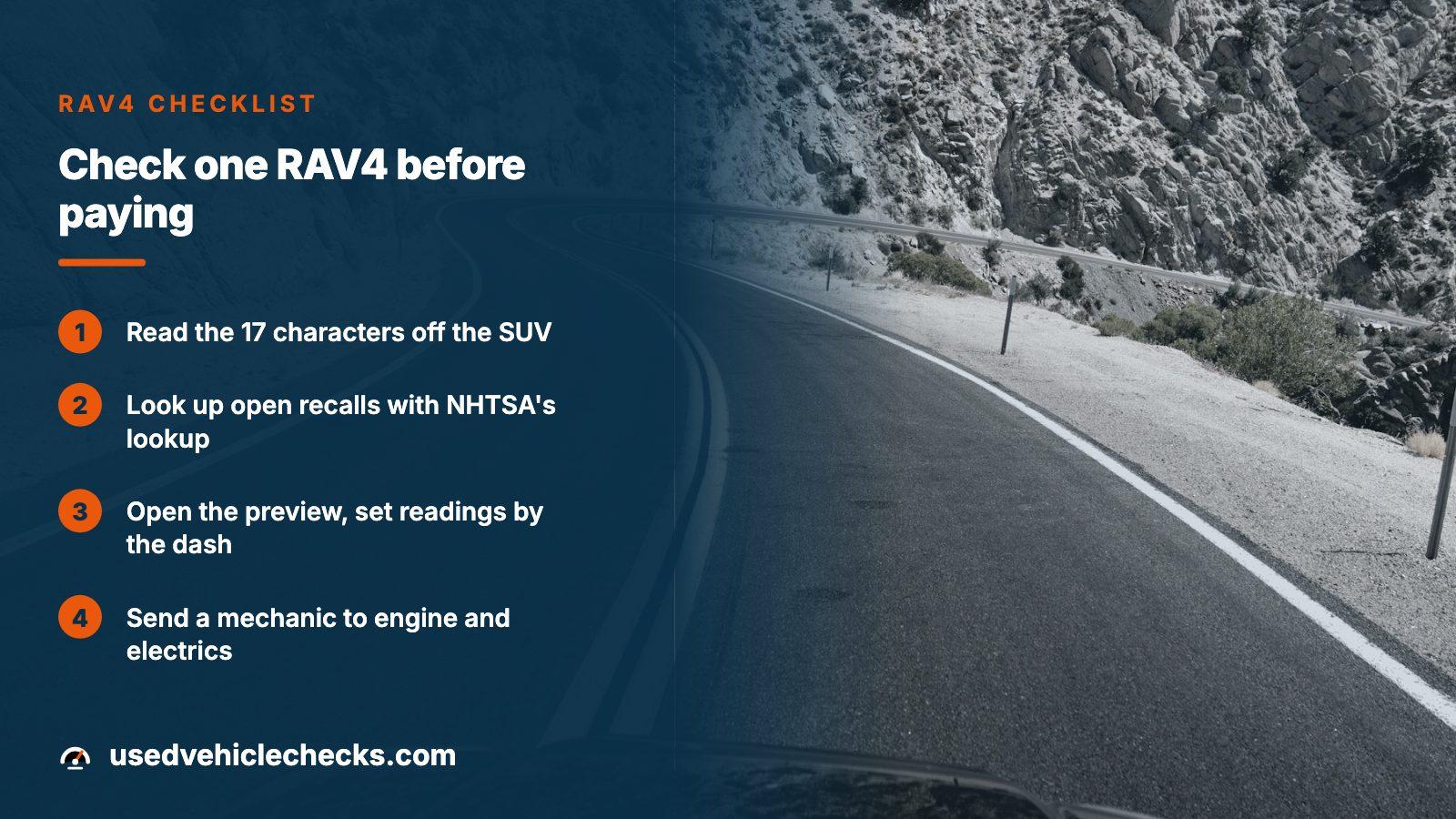
- Read the 17 characters off the SUV, not the ad, and confirm the model-year character matches the seller's claim.
- Look up open recalls on that VIN with NHTSA's lookup, which costs nothing, and note any repair still waiting.
- Open the preview here. If this RAV4 survives your shortlist, buy the report and start with the oldest dated mileage reading.
- Set those readings beside the dash figure, then look at the title brands, accident entries and use type.
- Send a mechanic to the engine, cooling system, electrical system and brakes, and ask for service invoices that fit the mileage.
The RAV4 preview is free to open. A report is purchased once and does not renew, with the single report and the packs priced on the pricing page.
Where this information comes from
- NHTSA: vehicle safety and owner complaints — The federal source of the owner complaint filings behind each model year's count and the nine odometer filings.
- NHTSA: recalls by vehicle — A no-cost way to look up open recall campaigns for one VIN.
- NMVTIS: national title record — Federal title history for a single vehicle, which a year-by-year table cannot supply.
- NHTSA owner complaint 11737014 — shopper experience, paraphrased
- NHTSA owner complaint 11643081 — owner experience, paraphrased
- NHTSA owner complaint 11639829 — owner experience, paraphrased
Sources and photos: Facts checked against the sources above in November 2026. Photos by Karwin Luo, Will Truettner and Scott Graham on Unsplash; diagrams by UsedVehicleChecks.
Keep reading
- Odometer Rollback Check by VIN: Run the Mileage Test Before You PayHow to line up a vehicle's mileage entries and spot a step backward.
- Mileage Check by VIN: What the Recorded Odometer Readings ShowWhat a VIN-based mileage check lists and how to read it.
- Odometer Discrepancy Check: Find a Mileage Mismatch Before You PayWhat to do when the dash figure and the records disagree.
- Nissan Rogue Years to Avoid: Complaints by Year and the Mileage CheckThe same year-by-year read for another compact SUV shoppers weigh against the RAV4.
Frequently asked questions
Which RAV4 model years are worst on NHTSA complaints?
Be most careful with 2019, 2020, 2008 and 2021 first. The 2019 model year has 895 NHTSA complaints, where the median year has 318. Those years justify a closer look and a tougher price, though a clean mileage and title record on the VIN counts for more.
Which RAV4 years have the fewest complaints?
Among the older years, 2014 shows 206 and 2016 shows 251. The 2022 figure of 165 is lower but provisional, because the newest SUVs have had little time on the road to collect reports. No year stands far below the rest, so judge each SUV on its own records.
Is the 2019 RAV4 a bad year?
It has the highest count, 895, and the biggest cluster is fuel and propulsion filings, many about a tank that stops taking fuel before it is full. That reads as a range and refueling nuisance more than a failure. Still run a recall lookup and read the mileage history before paying.
What is the most common RAV4 problem?
Electrical system tops the list at 908 reports from 2008 to 2022, with the engine next at 838. Nine of the electrical filings are odometer complaints that NHTSA coded there. Begin any inspection with the wiring, the cooling system and the oil level.
How do I check the mileage on a used RAV4?
Use the VIN. A report lists dated readings for that one SUV, which you can lay beside the dash. Each entry should be higher than the one before. A drop, a long stall at one figure or a jump that looks wrong is a reason to ask for service invoices or walk away.
Now check the car itself
The guide explains what to look for. The report shows what this VIN has on record.