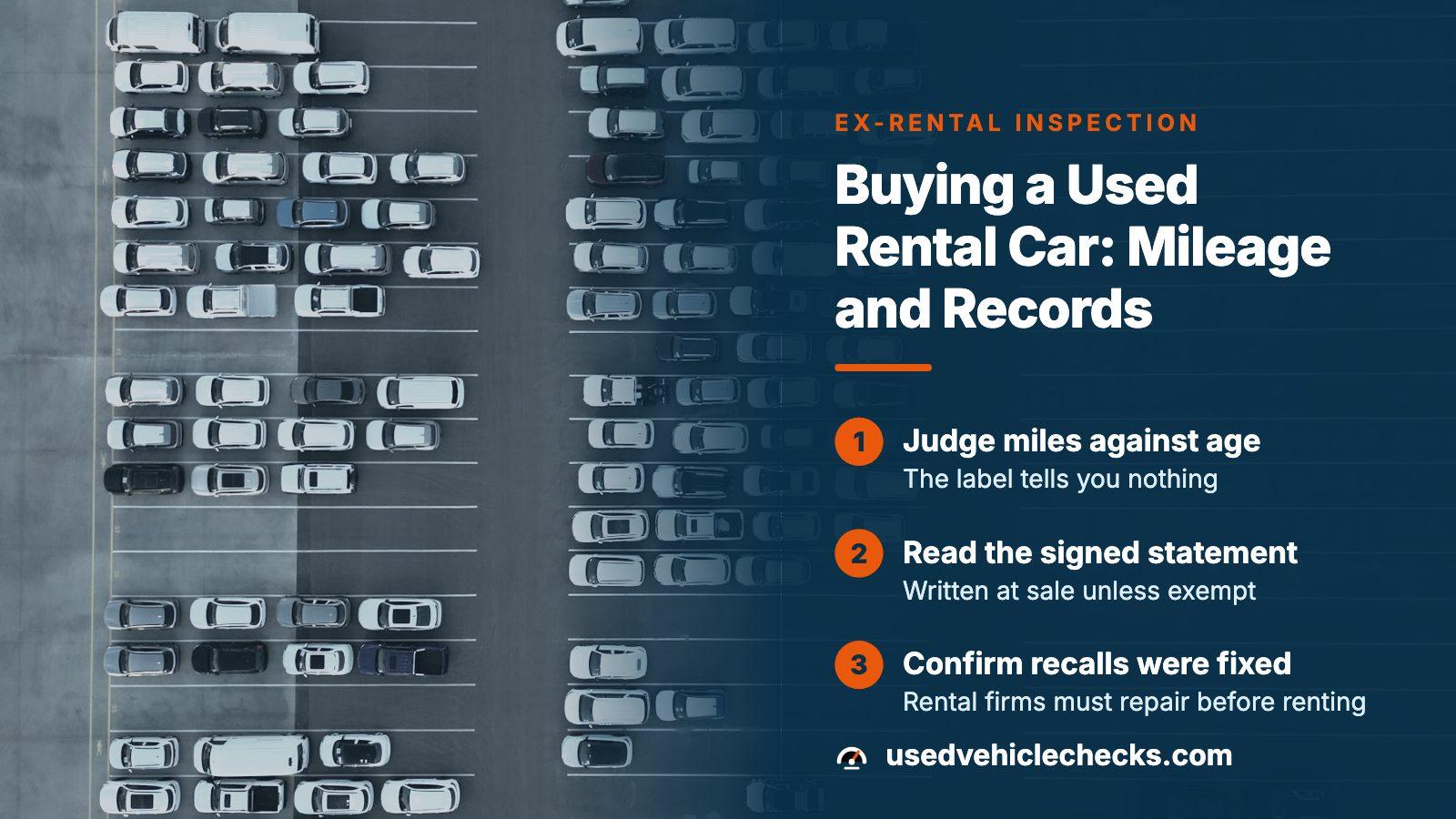
THE SHORT ANSWER
Buy an ex-rental on evidence, not on the label. Compare the odometer with the car's age, read the signed mileage statement, run the VIN for dated readings and open recalls, and get an independent mechanic's inspection. Federal law makes a rental company fix a covered recall before it sells, but that duty stops when the car changes hands, and the federal title record never flags rental use.
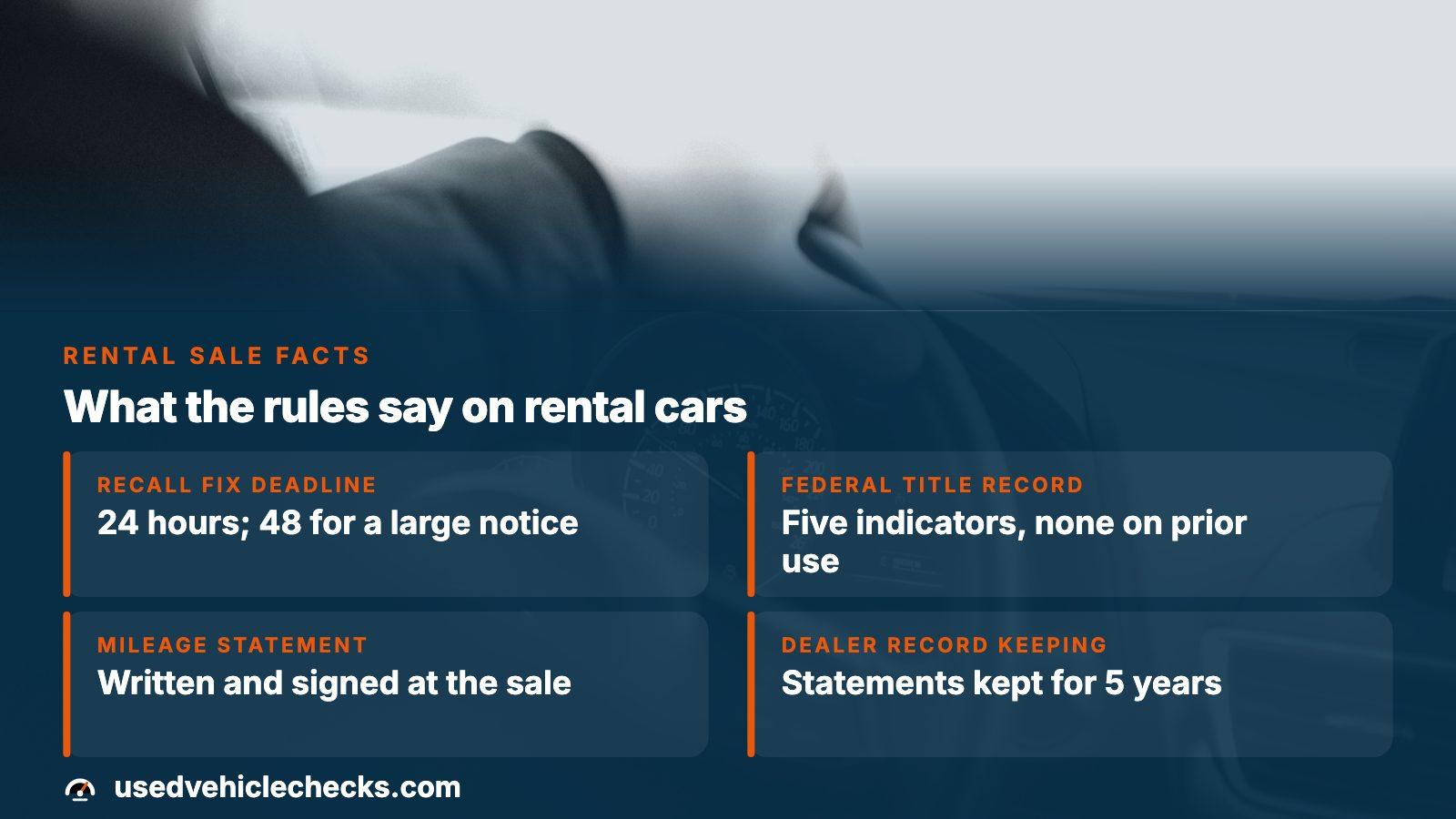
- Recall fix deadline
- 24 hours, or 48 when a notice covers more than 5,000 cars
- Federal title record
- Five indicators, none about prior use
- Mileage statement
- Written and signed at the sale, unless the car is exempt
- Dealer record keeping
- Statements kept for 5 years
Why the odometer comes first on an ex-rental
UsedVehicleChecks begins with mileage on every car, and an ex-rental shows why. A rental company keeps a vehicle in service briefly, then sells it, often while it is still a recent model year. The FTC groups these under program cars and calls them low-mileage returns from short leases or rentals.
Low is relative. The federal pages reviewed for this guide give no typical reading for a car leaving a fleet, and companies hold cars for different lengths of time. Test the dash against the car's age and the dated readings recorded over its life.
Setting the reading against the car's age
| On the dash | Could mean | Next step |
|---|---|---|
| Modest for the model year, but pedals and wheel look worn | Replaced parts, or a figure that hides the real use | Ask for repair invoices and match them to dated readings |
| High for the model year, with steady fleet service on record | Honest miles from short, busy use | Price the miles and ask what coverage is left |
| Below an earlier recorded reading | Tampering, or a cluster swap nobody wrote down | Stop and get the seller's explanation in writing |
| A huge leap between two dates | Hard commercial use, or one mistyped entry | Check the use type, then the service records |
From an NHTSA owner complaint
A buyer of a 2018 Kia Soul told NHTSA the car had about 86,000 miles when bought and had been a rental, with oil changes and new tires done. The engine ticked and slowed on a mountain drive, and days later it shuddered and died on the freeway. A tow shop said it had run dry of oil, and the owner reports no warning and a $15,000 quote for a new engine.
A rental past predicts nothing. Even with upkeep the owner calls careful, the engine failed, so ask who covers the powertrain before the miles run out. A high reading is also fair grounds to ask for less.
The signed mileage statement you are owed
On the odometer, a rental company that sells a car is a seller like any other. Under 49 U.S.C. 32705, whoever transfers ownership gives the buyer a written statement of the odometer mileage, or states in writing that the true mileage is unknown when the display is known to be wrong. A business buying to resell may not accept an incomplete one.
- The reading, which should agree with the dash on the day you look.
- The date, with the printed names and addresses of both parties.
- A description of the car that agrees with it: make, model, year, body style and VIN.
- One of three declarations: the reading is accurate, the odometer has gone past its mechanical limit, or the figure does not match the true mileage and must not be relied upon.
A fleet car is young, so the age exemptions in 49 CFR part 580 rarely apply: from model year 2011 on, the statement is needed until the car is 20 years old. Dealers must keep the ones they receive for 5 years.
What a federal title check can and cannot say about a rental past
The national title database, NMVTIS, rests on five indicators: the title's current state and latest date, brands, the odometer, total losses and salvage records. Mileage is covered. Use history is not, so a federal check can hand you a reading and any brand on record but no line saying the car was a rental, taxi or police unit.
Proof of fleet service comes from elsewhere: the seller, paperwork naming a rental or leasing firm among earlier owners, or a history report that shows ownership and use type. A UsedVehicleChecks report sets dated odometer readings beside that entry, the place a fleet past would turn up if anyone recorded it. A private seller's word that the car was never a rental is only a claim; read the title.
The recall rule that applies to rental companies
Under 49 U.S.C. 30120(i), once a manufacturer has told a rental company about a covered car in its possession, it is allowed to sell, lease or rent that car only once the defect is repaired. The deadline is within 24 hours of the notice, which includes the VIN, first arriving, sooner if practicable. A notice that names more than 5,000 cars in the fleet doubles the window to 48 hours.
- If the repair is not ready, the company may rent the car after temporary steps but may not sell or lease it.
- A car that qualifies as a junk automobile, is retitled as junk and is reported as required may still be sold.
- The subsection names dealers and rental companies. A private seller is not named in it.
The shield is tied to the moment the company holds the car. A campaign announced after the car moved through an auction to another lot is not covered. Run the VIN through the free NHTSA recall lookup on the day you sign.
A mechanic's look beats any label
A history report lists title and loss events, and the FTC puts it flatly: no report stands in for an independent inspection. Pay a mechanic you pick, get findings on paper with a repair estimate, and bring it to the price talk. A dealer that refuses an outside inspection, the FTC suggests, can be crossed off.
- Compare wear on the pedals, wheel and driver's seat with the odometer figure.
- Look for curbed wheels and scuffed bumper corners, the mark of many drivers.
- Have brakes, tires and fluids checked, because the fleet's service records may not travel with the car.
From an NHTSA owner complaint
A buyer of a 2012 Chevrolet Equinox told NHTSA the car came from a used-car chain with about 45,000 miles and a rental past. With no idea how it had been serviced, the owner had a mechanic check the car and service the fluids. That visit turned up cracked brake rotors, and all four, with pads, cost more than $900.
That buyer paid for the look right after the sale. Pay for it before. Read the Buyers Guide a dealer must post on every used car, program cars included: it states whether coverage comes with the car or the buyer takes it as is, and its wording wins over a contract that says otherwise.
Running the VIN before you commit
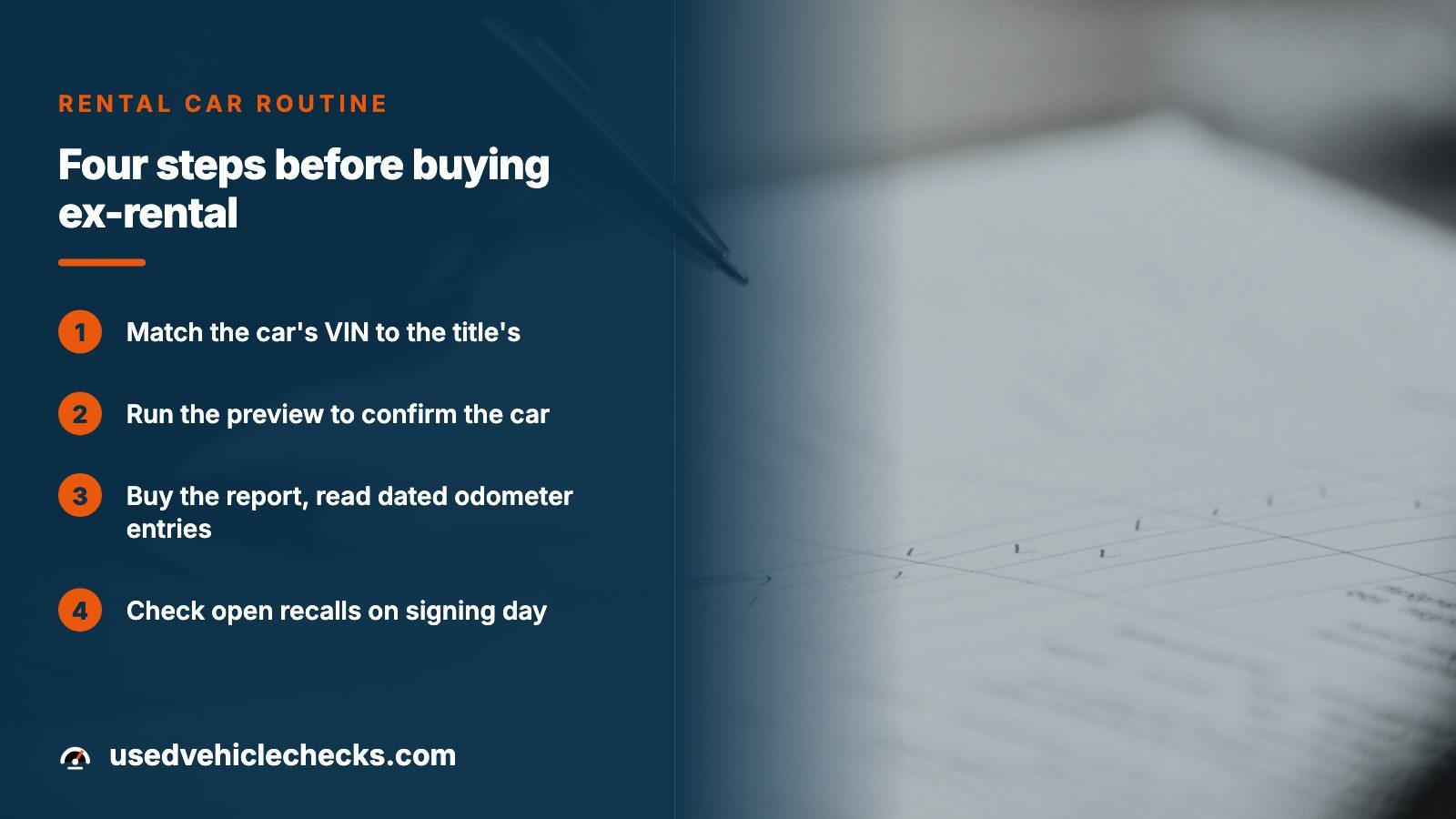
- Check the car's VIN against the title's, character by character, first.
- Run the preview, which costs nothing, to confirm what car you are looking at.
- For a car you still want, buy the report and read the dated odometer readings first, then brands, accident and salvage entries, and ownership and use type.
- Hold the newest reading against the dash and the signed statement.
- Check open recalls on the day you sign.
One payment buys the report, with nothing to cancel later; if you are comparing several cars, packs of 3, 5 or 10 are offered. Amounts are on the pricing page.
Where this information comes from
- 49 U.S.C. 30120: remedies for defects and noncompliance — Subsection (i): the sale limit, the 24-hour and 48-hour clocks, the rent-but-not-sell rule and the junk automobile exception.
- 49 U.S.C. 32705: odometer disclosure — The written mileage statement at transfer, the unknown-mileage disclosure and the bar on accepting an incomplete one.
- 49 CFR part 580: odometer disclosure requirements — What the statement lists, the three declarations, dealer record keeping and the age exemptions.
- NMVTIS: understanding a vehicle history report — The five indicators in the federal title record and the advice to get an independent inspection.
- FTC: buying a used car from a dealer — Program cars, the Buyers Guide and the independent inspection with a written estimate.
- NHTSA owner complaint 11523866 — owner experience, paraphrased
- NHTSA owner complaint 10726984 — owner experience, paraphrased
Sources and photos: Facts checked against the sources above in November 2026. Photos by Iain, Masjid MABA and Miles Loewen on Unsplash; diagrams by UsedVehicleChecks.
Keep reading
- Mileage Check by VIN: What the Recorded Odometer Readings ShowHow to pull the dated readings and set them beside the dash.
- How Many Miles Is Too Many on a Used Car? Age, Pace and ProofA way to weigh a high reading against what the car has done.
- Odometer Discrepancy Check: Find a Mileage Mismatch Before You PayWhat to do when the records and the dash disagree.
- How to Buy a Used Car: Start With the Mileage, Then the RecordsThe wider buying steps that sit around the mileage question.
Frequently asked questions
Is it a bad idea to buy a used rental car?
Not on its own. No public record shows how a car was driven, so neither the abuse worry nor the upkeep defense can be tested. Mileage against age, dated readings, the signed statement, open recalls and a mechanic's findings can be. Buy on those and walk away when they disagree.
How do I learn whether a car was fleet-owned?
The federal title record cannot say, because use history is outside its five indicators. Read the title and sales paperwork for a rental or leasing firm, ask the seller outright, and look at ownership and use type on a history report. A private seller's denial stays unverified until paperwork agrees.
Do ex-rental cars have high mileage?
Sometimes. The federal pages reviewed give no figure, and fleets keep cars for different times. A few NHTSA owner complaints describe ex-rentals bought at about 45,000 and 86,000 miles. Judge each car by its own reading, age and dated records.
Must a rental company fix recalls before selling a car?
Yes, for a covered car it holds when the manufacturer's notice arrives: within 24 hours, or 48 when the notice names more than 5,000 cars. If the repair is not ready it may rent after temporary steps but cannot sell. Check the VIN yourself, since later campaigns are not covered.
Will a rental company give me a mileage statement?
It must. The seller owes you a written mileage disclosure at transfer, or a written note that the true mileage is unknown, and a young car is not exempt. Ask for your copy, check that figure, date, names and VIN are filled in, and compare the number with the dash.
Now check the car itself
The guide explains what to look for. The report shows what this VIN has on record.