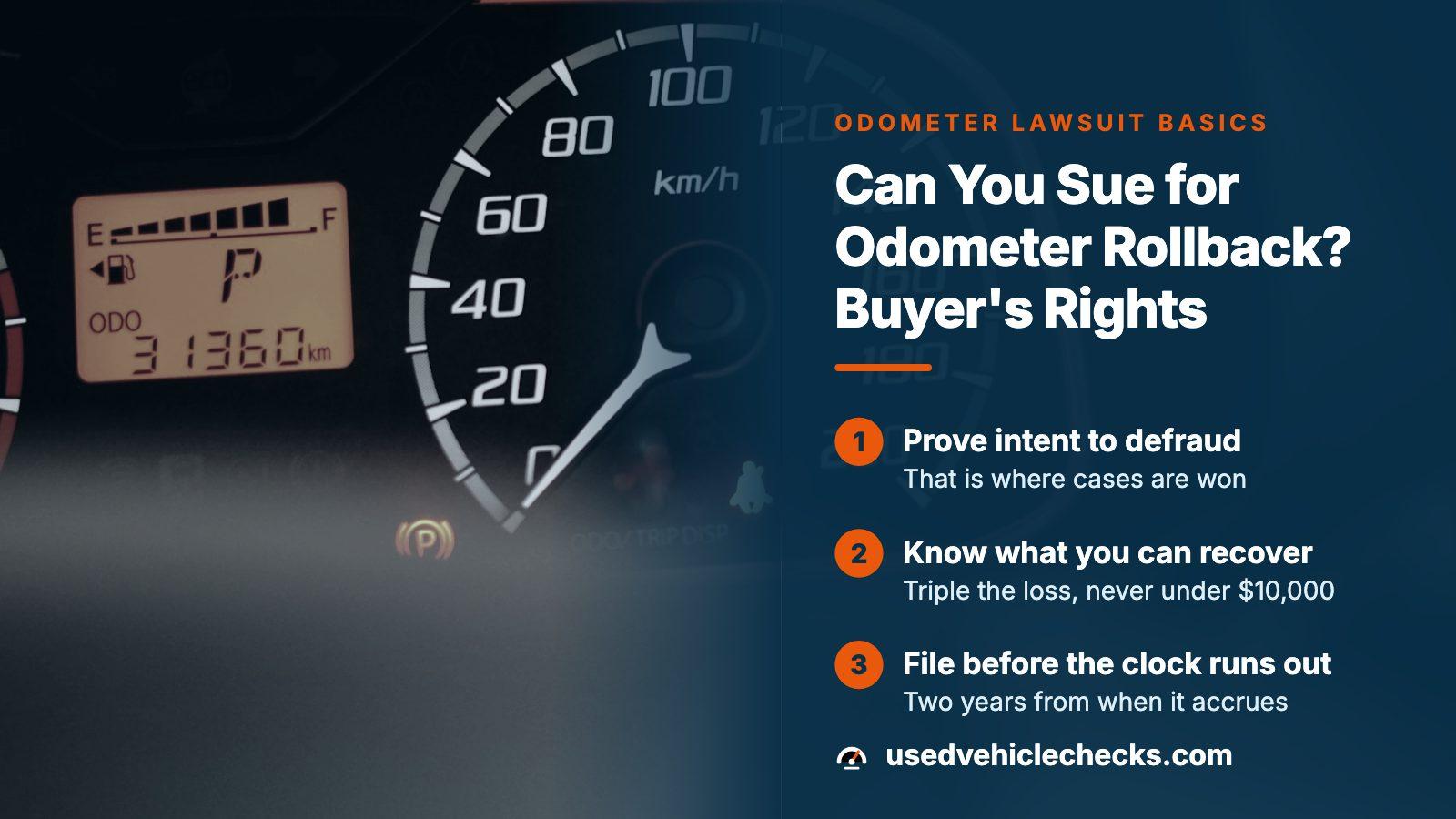
THE SHORT ANSWER
Yes. Under 49 U.S.C. 32710, a buyer who proves the seller acted with intent to defraud can recover triple the proven loss, never less than $10,000, plus costs and a reasonable attorney's fee. The suit must be filed within 2 years of when the claim accrues, in federal court or another court of competent jurisdiction. Dated mileage records are the proof. NHTSA does not pursue claims for individual buyers, so see a private attorney.
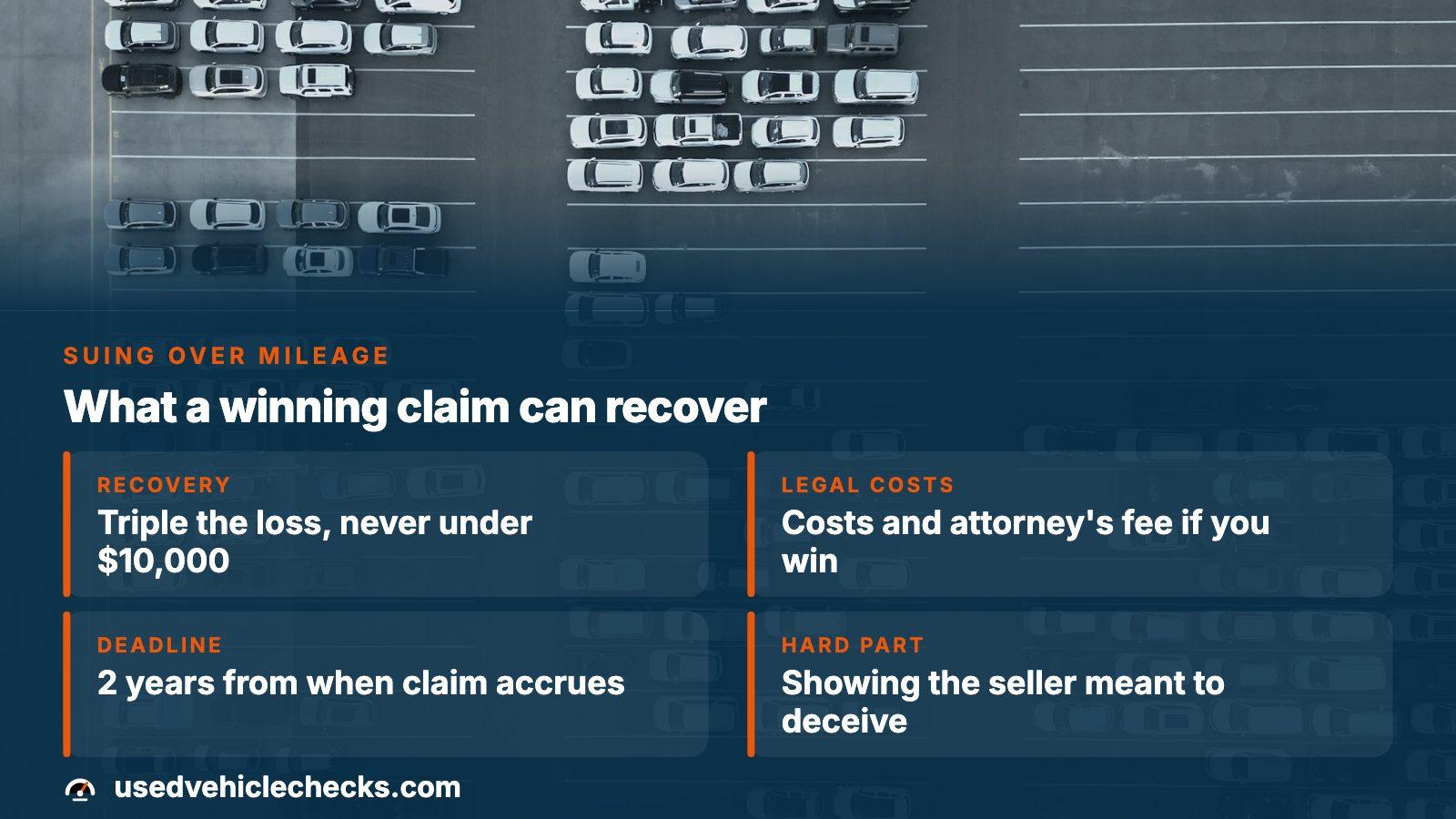
- Recovery
- Triple the proven loss, never under $10,000
- Legal costs
- Court adds costs and attorney's fee for a winning buyer
- Deadline
- 2 years from when the claim accrues
- Hard part
- Showing the seller meant to deceive
What the federal damages section gives a buyer
The claim comes from one short section of the federal odometer chapter. Anyone who breaks the chapter intending to defraud owes the injured buyer triple the proven loss, and never less than $10,000. A 2012 amendment raised that floor from $1,500, so older articles quoting the smaller number are out of date.
| Piece of the claim | What the statute says |
|---|---|
| Who pays | Whoever breaks the chapter intending to defraud, licensed dealer or not |
| How much | Triple the proven loss, with a $10,000 minimum |
| Legal costs | A buyer who wins gets costs and a reasonable attorney's fee from the court |
| Where to file | A federal district court or another court of competent jurisdiction |
| Deadline | Within 2 years of the date the claim accrues |
Do the arithmetic both ways. If triple your loss comes to less than $10,000, the minimum applies. If it comes to more, the tripled loss applies.
Intent to defraud is where the case is won or lost
A wrong number on the dash does not win by itself. The damages section requires intent to defraud, so you must show the seller knew and meant to deceive. Two federal rules supply the violation. One bars tampering, meaning disconnecting, resetting or altering an odometer so the display shows different miles. The other requires whoever transfers a vehicle to give the buyer a written mileage statement, including a written note that the true mileage is unknown whenever the seller knows the display is wrong.
The second rule helps buyers because it does not depend on who touched the odometer. A seller who certified one mileage while holding records of a higher one is the kind of conflict a lawyer builds on. Someone buying a car for resale also may not accept an incomplete statement, so dealers carry a duty to read what they take in.
Dealer, private seller or the owner before them
The statute says person, not licensed business. Transfer covers selling a car, giving it away or any other handover of ownership, and the law counts as a dealer only someone who made at least 5 sales to ordinary buyers over the previous 12 months. The mileage statement duty is written for anyone who transfers ownership, so a private seller who signs a false statement is inside the rule.
The owner who actually rolled the number back is often impossible to find. The seller who signed your title is the one you can name, and a seller who knew the reading was wrong and stayed silent broke the disclosure rule even if someone else turned the dial.
The evidence a lawyer asks for first
Start a folder before you call anyone:
- The title and bill of sale, with the mileage each one states.
- Screenshots of the listing, plus any texts or emails where the seller quoted a mileage.
- Dated readings from inspections, emissions tests, service stickers and repair orders.
- A history report that shows an earlier reading above today's dash number.
- A mechanic's written note on pedal wear and tires measured against the miles shown.
From an NHTSA owner complaint
An owner of a 2017 Jeep Grand Cherokee told NHTSA that the dash and the dealer's own sales papers both said about 64,000 miles. The gap surfaced only when the owner's bank processed the title, which listed 101,985, nearly 40,000 higher. The vehicle had shown no warning lights or symptoms, no dealer or shop had confirmed the problem yet, and the owner kept the dealer paperwork.
The lesson: this kind of case lives in paper. The dash is the one record the seller controlled, so collect records someone else wrote down, with dates.
First moves once the numbers disagree
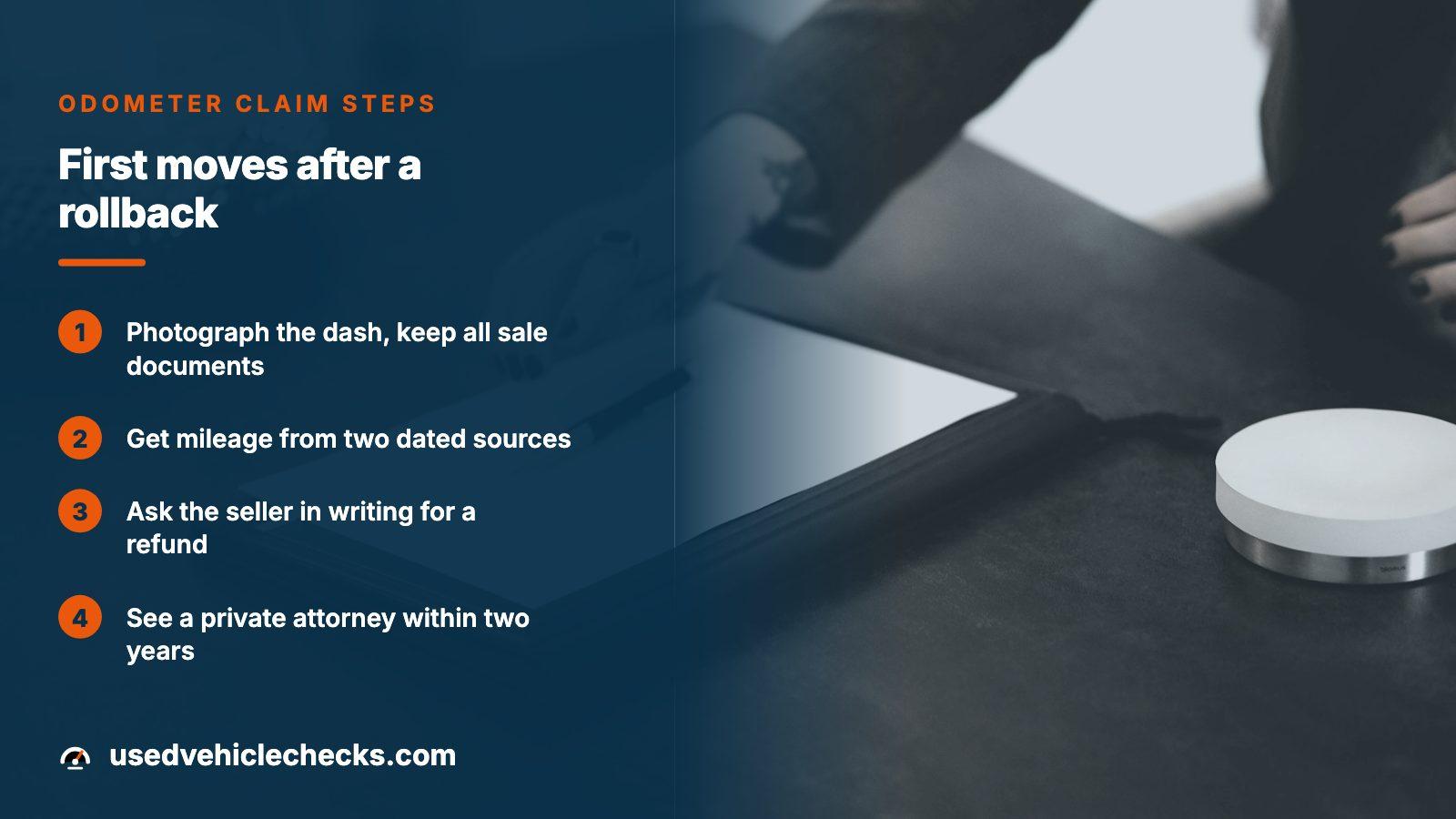
- Photograph the dash today, then keep every sale document in one place.
- Get the mileage from two independent dated sources, such as a VIN history report and a repair shop invoice.
- Ask the seller in writing to explain the gap and refund the sale. The reply, or silence, becomes evidence.
- See a private attorney early, since the 2-year limit counts from when the claim accrues.
- Report it to your state enforcement agency, which NHTSA names as the place for an individual case.
From an NHTSA owner complaint
An owner of a 2017 Chevrolet Silverado 1500 told NHTSA that a mechanic working on the engine found a mileage discrepancy after a private sale. The seller refused to return the money. The owner phoned a state attorney general's office, which pointed to NHTSA's hotline.
A referral loop like that does not replace a lawyer: NHTSA says it cannot bring claims for individual buyers and strongly advises talking to a private attorney about your rights and remedies.
Who else can act besides you
| Who | What the sources say they can do |
|---|---|
| You, through a private attorney | Bring the damages claim within 2 years of when it accrues |
| The state's chief law enforcement officer | Seek an injunction, or recover the same amounts for each buyer the office acts for, inside the same 2 years |
| NHTSA investigators | Build criminal cases for the Justice Department and help state agencies, but cannot pursue individual consumer claims |
| Transportation Department | Impose a civil penalty up to $10,000 per violation, capped at $1,000,000 for a related series, paid to the government |
| A criminal court | Fine a knowing and willful violator and impose up to 3 years in prison |
NHTSA reports convictions above 250 across more than 30 states, with prison terms from one month to 10 years and restitution orders above $15 million. Large-scale schemes go to its Vehicle Safety Hotline and individual cases to the state enforcement agency, so ask that agency which state rules also apply.
Where a lawsuit gets weak
Four things make these claims fail.
- Proof of intent. A seller who truthfully wrote that the actual mileage is unknown met the disclosure rule, whatever you think of the car.
- Age. Vehicles 20 years old or older, and model year 2010 or older, need no written disclosure under NHTSA's description, so a false-statement claim is off the table there.
- Time. The 2-year limit counts from when the claim accrues, and an attorney can tell you which date applies to your facts.
- Cost. The fee award arrives only when judgment is entered for you, so expect a lawyer to ask for documents before taking the case.
Where a mileage check fits, before and after the sale
Before you pay, a VIN check is a second opinion on the dash. UsedVehicleChecks lists the odometer readings on record for a VIN with their dates, so a reading above today's display shows up while the seller is still across the table. Start with the free preview; the report is a single payment.
After a purchase, the same dated list can become an exhibit. NHTSA advises ordering a history report by VIN when the seller has none, and calls a detailed report one of the best clues on digital odometers, which have no visible moving parts. A report cannot prove intent: a clean list means no recorded reading disagrees with the dash, not that the dash is honest.
Where this information comes from
- U.S. Code, 49 U.S.C. 32710: civil actions by private persons — The tripled damages, the $10,000 floor, the fee award, where to file and the 2-year limit.
- U.S. Code, 49 U.S.C. 32705: disclosure on transfer — The written mileage statement, the ban on false statements and the rule for buyers acquiring a car for resale.
- U.S. Code, 49 U.S.C. 32703: preventing tampering — The ban on disconnecting, resetting or altering an odometer to change the reading.
- U.S. Code, 49 U.S.C. 32709: penalties and enforcement — Civil and criminal penalties, and the state officer's power to sue for buyers.
- NHTSA: Odometer Fraud — Who to contact, conviction totals, the age exemption and NHTSA's statement that it cannot pursue consumer claims.
- NHTSA owner complaint 11723642 — owner experience, paraphrased
- NHTSA owner complaint 11727214 — owner experience, paraphrased
Sources and photos: Facts checked against the sources above in November 2026. Photos by muhammad dennisa, Annika Wischnewsky and Iain on Unsplash; diagrams by UsedVehicleChecks.
Keep reading
- How to Report Odometer Fraud: Evidence, Agencies and DeadlinesWhere to send a complaint, which can run alongside any lawsuit.
- Odometer Discrepancy Check: Find a Mileage Mismatch Before You PayWhat a mismatch between the title, the dash and the records looks like.
- Mileage Check by VIN: What the Recorded Odometer Readings ShowThe check that produces the dated readings a claim depends on.
- Can I Return a Used Car? What the Rules Allow and Why Mileage MattersOther ways out of a purchase besides a lawsuit.
Frequently asked questions
Can I sue for odometer fraud if I bought the car as is?
The federal damages section asks about intent to defraud and says nothing about warranties or sale terms. That points away from an as-is label ending the claim, but have a private attorney check how courts in your state treat that wording.
How long do I have to sue for odometer rollback?
A federal civil claim must be filed within 2 years of when it accrues. An attorney can say which date that is on your facts, so gather records and ask as soon as the mileage disagrees. A state officer's suit under the same chapter has the same 2-year limit.
Is the $10,000 amount guaranteed if I win?
It is the minimum, and only after you prove a violation with intent to defraud. The court then awards triple your proven loss or $10,000, whichever is larger, plus costs and a reasonable attorney's fee.
Can I sue a private seller, or only a dealer?
The damages section reaches anyone who breaks the chapter intending to defraud. The mileage statement duty covers whoever transfers ownership, and a transfer includes a sale or a gift. A private seller who signs a false statement is covered; proving what the seller knew is the harder step.
Do I need a lawyer to report odometer fraud?
No. Individual cases go to your state enforcement agency, and NHTSA's Vehicle Safety Hotline takes information about large schemes. Suing is different: NHTSA strongly advises talking to a private attorney and says it cannot pursue claims for consumers.
Now check the car itself
The guide explains what to look for. The report shows what this VIN has on record.