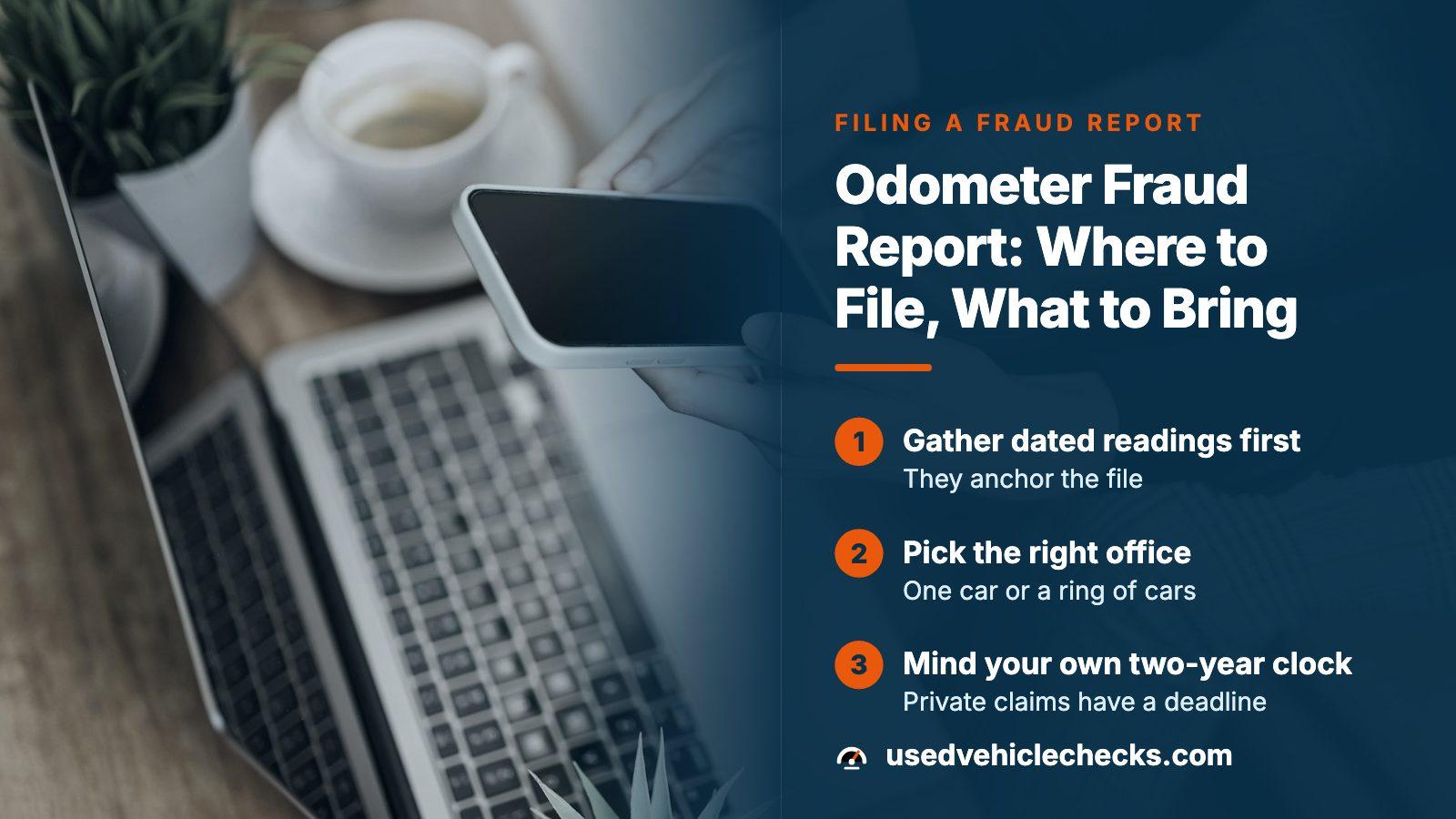
THE SHORT ANSWER
For one car, contact the office your state uses for odometer cases, which may be a DMV investigations unit, a state police section or an attorney general's consumer division. For a ring of cars, call NHTSA's Vehicle Safety Hotline at 888-327-4236. Bring the VIN, your purchase papers, listing screenshots and a dated mileage record. NHTSA does not bring claims on a buyer's behalf, so see a private attorney about recovering your money.
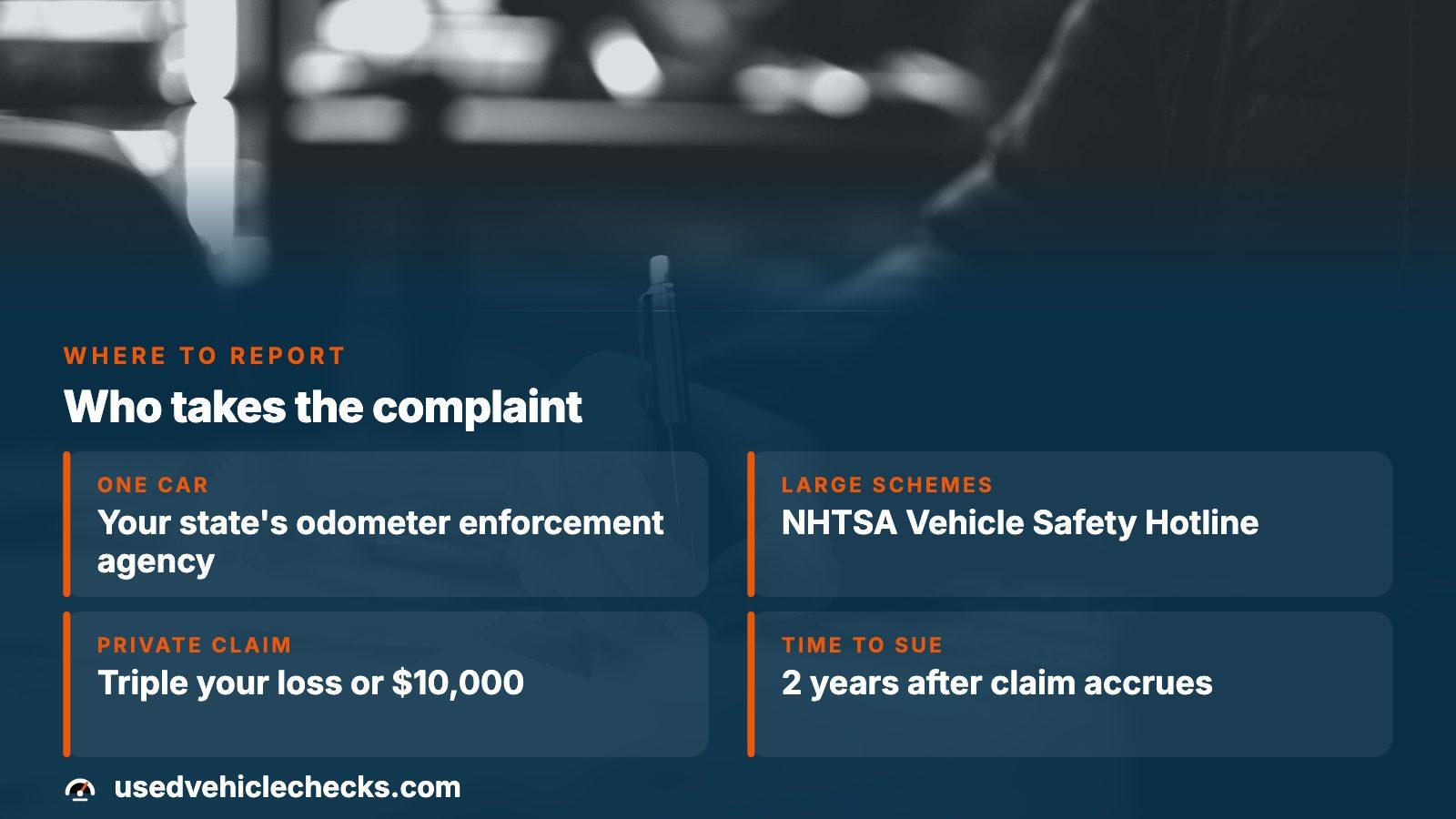
- One car
- Your state's odometer enforcement agency
- Large schemes
- NHTSA Vehicle Safety Hotline, 888-327-4236
- Private claim
- Triple your loss, or $10,000 if higher
- Time to sue
- 2 years after the claim accrues
Why the file starts with dated mileage readings
A complaint that says the dash looks wrong is an opinion. A complaint that shows a reading logged on a known date, by someone other than the seller, is evidence. That is the check this site is built around: enter a VIN and the report lists odometer readings by date, beside the title brands and the salvage, auction, theft and lien entries filed under the same number.
Federal law wants the seller's mileage figure in writing on the title at each sale, and the title must flag it when the mileage is wrong. A recorded reading that outruns what the seller wrote down is the gap your complaint describes.
Run the VIN before you contact anyone
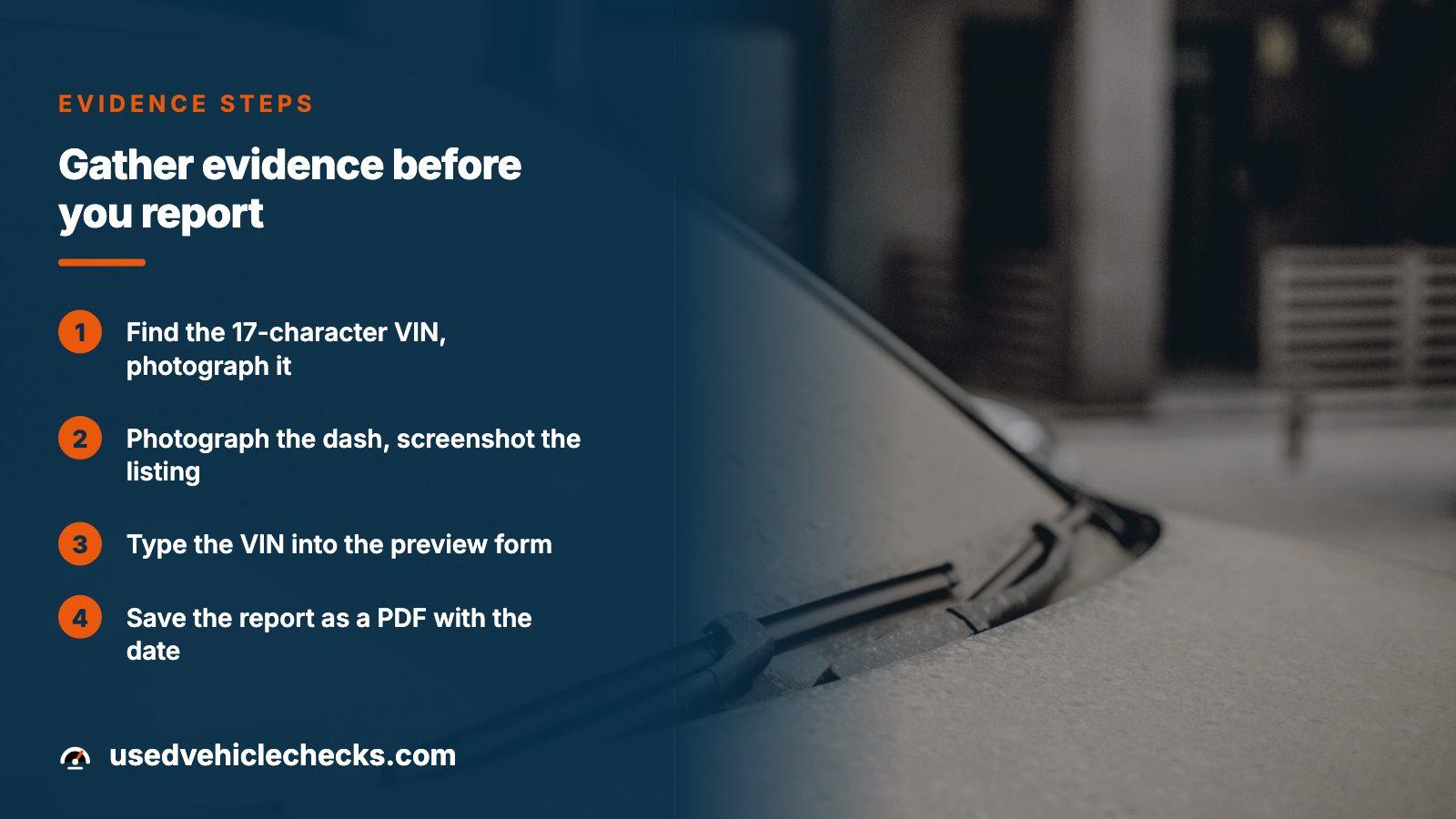
Work through these in order, while the ad is still up and the seller still answers.
- Find the 17-character VIN in the windshield's lower left corner, then see whether the registration card and the title carry the same one.
- Photograph the dash with the ignition on. Screenshot the listing and the seller's profile before either one changes.
- Type the VIN into the form on this page. The preview is free.
- Buy the report for the car you bought or are about to buy. Read the odometer readings from oldest to newest and mark each one that sits above your dash.
- Save the report as a PDF and note the date you ran it, so the file shows what was on record when you looked.
NHTSA gives buyers the same advice: if the seller has no history report, order one by VIN.
Which office takes the complaint
| Your situation | Where to report | Why there |
|---|---|---|
| One car, and you were the buyer | Your state's odometer enforcement agency | NHTSA sends individual cases to the state. |
| Several cars, a ring or a repeat seller | NHTSA's Vehicle Safety Hotline, 888-327-4236 | The federal odometer office investigates large schemes for prosecution. |
| A dealer sold you the car | The state attorney general's consumer office, where your state lists it | Several states name that office for odometer complaints. |
| A private seller who stopped answering | Local police, alongside the state agency | Odometer fraud is a crime, so police can take the report. |
The state office is not the same everywhere. NHTSA's list names an attorney general's consumer protection division in Alabama, the DMV Investigations Division in California, the State Police auto theft section in Arkansas and an Odometer Crimes Unit inside the New York DMV. Look up yours on that list before you write.
What to put in the file
New York's DMV tells buyers what its Odometer Crimes Unit needs. That list, plus a few additions, is a sound starting point in any state.
- The VIN and the odometer reading on the day you bought.
- The date and place of the sale, the seller's name and how the car was advertised.
- The price you paid, with proof of payment.
- Every document from the deal, including the title, the bill of sale and any mileage statement.
- The mileage record for the VIN with the date you ran it, plus your photos of the dash.
- A daytime phone number where an investigator can reach you.
From an NHTSA owner complaint
A shopper checking out a 2017 Hyundai Elantra advertised online at 65,000 miles ran a history report. The car had logged 98,000 back in 2018 and now stood above 300,000 on record. Once confronted, the seller blocked the shopper and deleted the ad, and an ad for the same car soon surfaced on a different account. The shopper had saved the ad, the report and the chat, and offered them to NHTSA on request.
Screenshots outlive a deleted listing. Capture the ad, the profile and the conversation the day you doubt the number.
What happens after you report
A report starts an investigation. It does not refund you. NHTSA states that it lacks power to bring claims for a consumer and strongly urges a private attorney. What it does is build criminal cases for the Justice Department and help state offices with theirs. Its cases so far add up to over 250 criminal convictions across more than 30 states, with sentences that ran from a single month to 10 years in prison, and restitution orders above $15 million.
From an NHTSA owner complaint
A buyer of a 2016 Honda Accord from a private seller paid when the dash read 67,500 miles. A Honda dealership later found the car at 300,000. The local police department could not help, and the state motor vehicle agency's advice was to hire an attorney.
Answers at the front desk can be thin, so keep every document in one folder an attorney can start from. Ring cases cross state lines, which is why local officers rarely handle them alone.
Your own claim has a two-year clock
Federal law lets a private buyer sue a seller who broke the odometer rules with intent to defraud. Under the statute, a buyer who proves it can collect triple the actual loss or a flat $10,000, whichever is larger, and the judge must also add court costs and the buyer's reasonable attorney fees.
- A lawsuit has to be on file no more than 2 years after the claim accrues, so an agency complaint is no substitute for a lawyer's calendar.
- Intent to defraud is the hinge, which is why dated records and saved messages matter.
- State law may offer its own remedies, so ask an attorney which route and which deadline apply.
Signs that justify a report, and how to read a gap
Warning signs published by NHTSA and the Justice Department overlap. If one shows up, run the VIN before you pay, or gather your records if you already did.
- A seller who dodges requests to see the title, or who is not the person named on it.
- Names or numbers on the title look changed, or the title was issued only recently, especially by another state.
- A dated record on file is higher than today's dash.
- Service stickers in the door frame or under the hood show more miles than the display.
- Tires, pedals and wheel look newer or more worn than the miles claimed. NHTSA says a car showing 20,000 or fewer miles should still wear its original tires.
Write the complaint around facts, not a verdict: what the dash showed, what the record shows and the date of each. A quiet record is not proof of an honest dash, so have a trusted mechanic look at the car too.
Cost, the preview and your next step
Enter the VIN and the preview opens without charge. Each report costs one payment and nothing recurs; the pricing page lists amounts, and packs exist for anyone sizing up several cars. Run it before any money moves, or right away if it already has.
Your next three moves
Save the report, the listing and every message. Pick the office from the table above and send it the file. Book a consult with a consumer attorney well inside the two-year window.
Where this information comes from
- NHTSA: odometer fraud — The hotline, the state-or-federal split, what NHTSA cannot do for buyers, its conviction record and the buyer tips.
- NHTSA: state enforcement agencies for odometer fraud — Which office takes odometer complaints in each state.
- New York DMV: report a problem to DMV — What one state's odometer unit asks a buyer to send.
- U.S. Code, 49 U.S.C. 32710: civil actions by private persons — Treble damages or $10,000, the intent requirement, the fee award and the two-year limit.
- Department of Justice: 10 tips for used car buyers (archived) — Title warning signs and why ring cases cross state lines.
- NHTSA owner complaint 11718507 — owner experience, paraphrased
- NHTSA owner complaint 11746048 — owner experience, paraphrased
Sources and photos: Facts checked against the sources above in November 2026. Photos by Jakub Żerdzicki, JavyGo and Owen Michael Grech on Unsplash; diagrams by UsedVehicleChecks.
Keep reading
- Can You Sue for Odometer Fraud? What Federal Law Gives a BuyerHow the civil claim works once your file is built.
- Odometer Discrepancy Check: Find a Mileage Mismatch Before You PayRead the title brands and signed statements that point to a mismatch.
- Odometer Rollback Check by VIN: Run the Mileage Test Before You PayTest the dated readings for a backward step before you file.
- Mileage Check by VIN: What the Recorded Odometer Readings ShowThe full mileage check, with every recorded reading in date order.
Frequently asked questions
Who do I call to report odometer fraud?
For one vehicle, contact the odometer enforcement office in your state; NHTSA keeps a state-by-state list with addresses and phone numbers. For a large scheme, call NHTSA's Vehicle Safety Hotline at 888-327-4236, or 888-275-9171 on the TTY line. Police take reports too, because odometer tampering is a crime.
Will reporting get my money back?
Not on its own. Criminal cases can end in restitution orders, but a private suit is the route you control: triple your actual loss, or $10,000 if that is higher, plus lawyer's fees if you win. Speak to a consumer attorney early, since a suit carries a 2-year limit.
Should I report a car I did not buy?
Yes, if the evidence is real. NHTSA says it welcomes information that helps its law enforcement work. Send the listing, the VIN and the dated readings to the hotline or the state office, and keep the wording factual: what the ad said, what the record shows.
Does the seller have to know the odometer was changed?
For a private lawsuit, yes: the federal claim requires intent to defraud. Someone who knows the display is off is required to put that on the title, because the law demands a statement when mileage is incorrect. Your file should show what the seller wrote and said, and when. An attorney decides whether intent can be proved.
What if the car is more than 20 years old?
Written mileage disclosure is not required for a car at least 20 years old, or for model year 2010 and earlier, NHTSA says. So a missing mileage statement on an old title proves little. The dated record on file and a mechanic's look at the wear still tell you plenty.
Now check the car itself
The guide explains what to look for. The report shows what this VIN has on record.