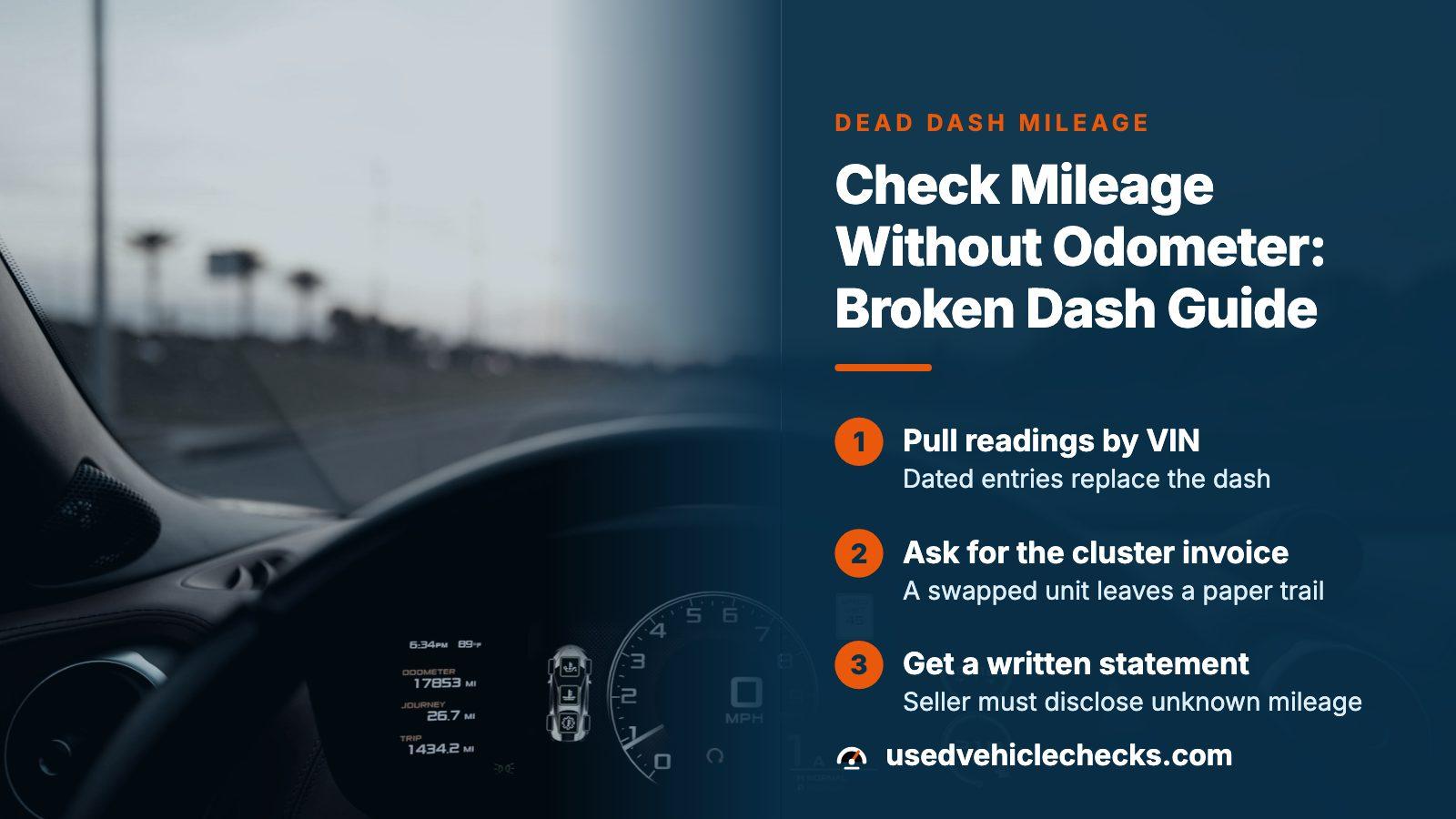
THE SHORT ANSWER
To check mileage without a working odometer, set the dash aside and pull the readings recorded for the VIN, then compare them with service and inspection dates. If the cluster was replaced, request the repair invoice, and have the seller state in writing that the true mileage is unknown. The preview costs nothing, so pay for a report only when the car survives it.
- Dead dash, what to use
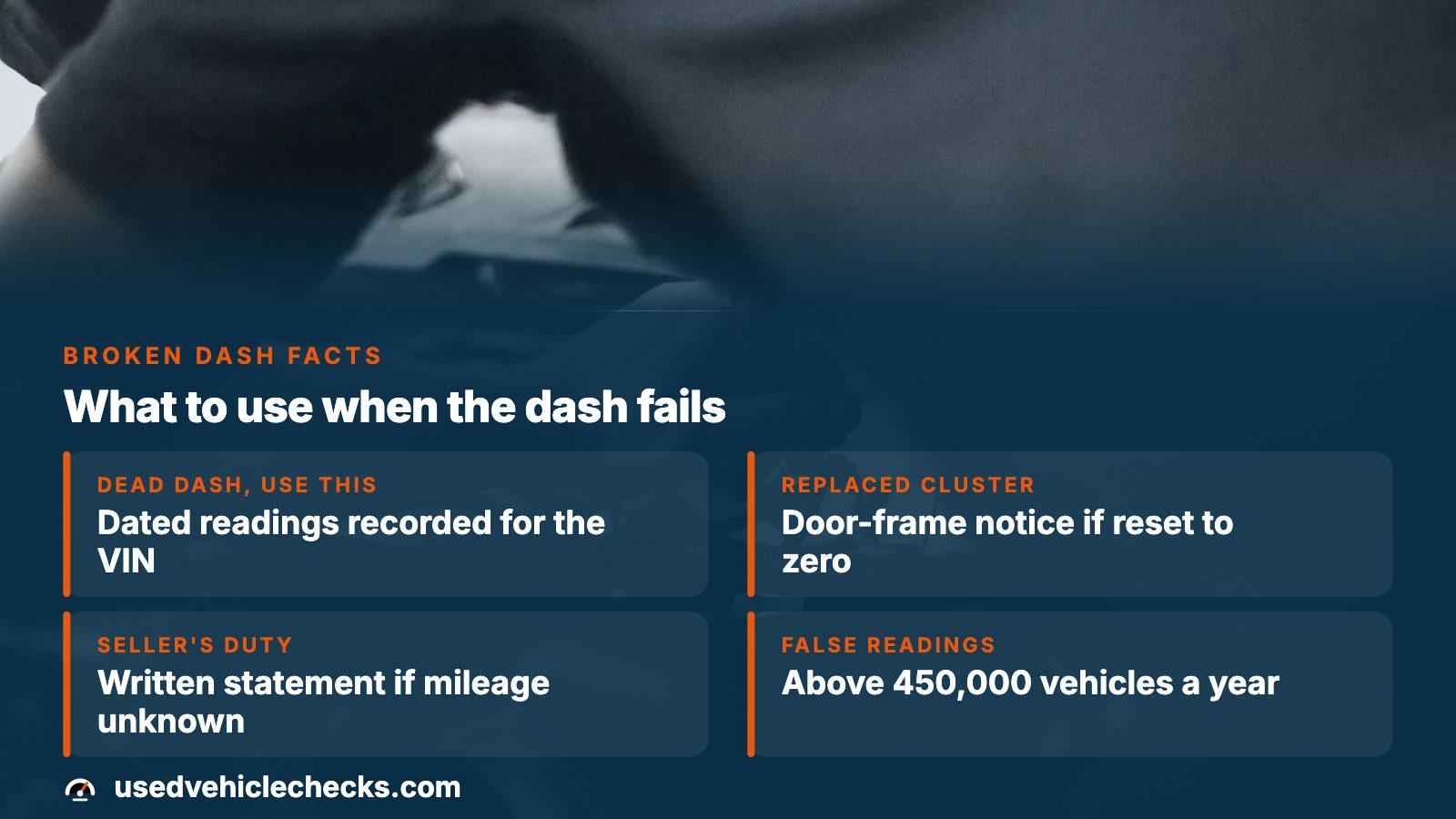
- Dated readings recorded for the VIN
- Replaced cluster
- A zeroed unit needs a left door-frame notice with the old mileage and the date
- Seller's duty
- A written statement when the true mileage is unknown
- False readings
- NHTSA puts the yearly total above 450,000 vehicles
Without a dash figure, the mileage lives in the records
A blank, frozen or newly fitted odometer says nothing about the car's past, but that past was written down along the way. Each title transfer carries a mileage the seller stated. Insurers, salvage yards and state title offices add entries, and NMVTIS, the national title database, gathers them, including the newest odometer reading on file, brand history and any total-loss ruling.
UsedVehicleChecks lists the readings recorded for a VIN by date, with title brands and damage or salvage entries beside them, so a gap can be read against what happened to the car.
Blank, stuck or zeroed: what each failure usually means
| What the dash shows | What it can mean | What to ask for |
|---|---|---|
| Blank digits | A failed display or a swapped unit. Oregon's DMV has sellers record a blank digital display as not readable. | The repair invoice and the last mileage anyone wrote down |
| A figure that never moves | A stuck unit. Oregon has the seller give the number and mark it not actual. | The date it froze and the figure shown then |
| A low figure on a worn car | A replacement unit reset to zero, or an altered reading | The door-frame notice and the invoice behind it |
No failure proves fraud alone, and none can be waved away. NHTSA notes that a digital unit has no visible moving parts to give tampering away, which makes it harder to spot. The dash settles little; the records settle more.
Run the VIN before you argue about the dash
The VIN stays with the car when the cluster does not. Run it before you bargain.
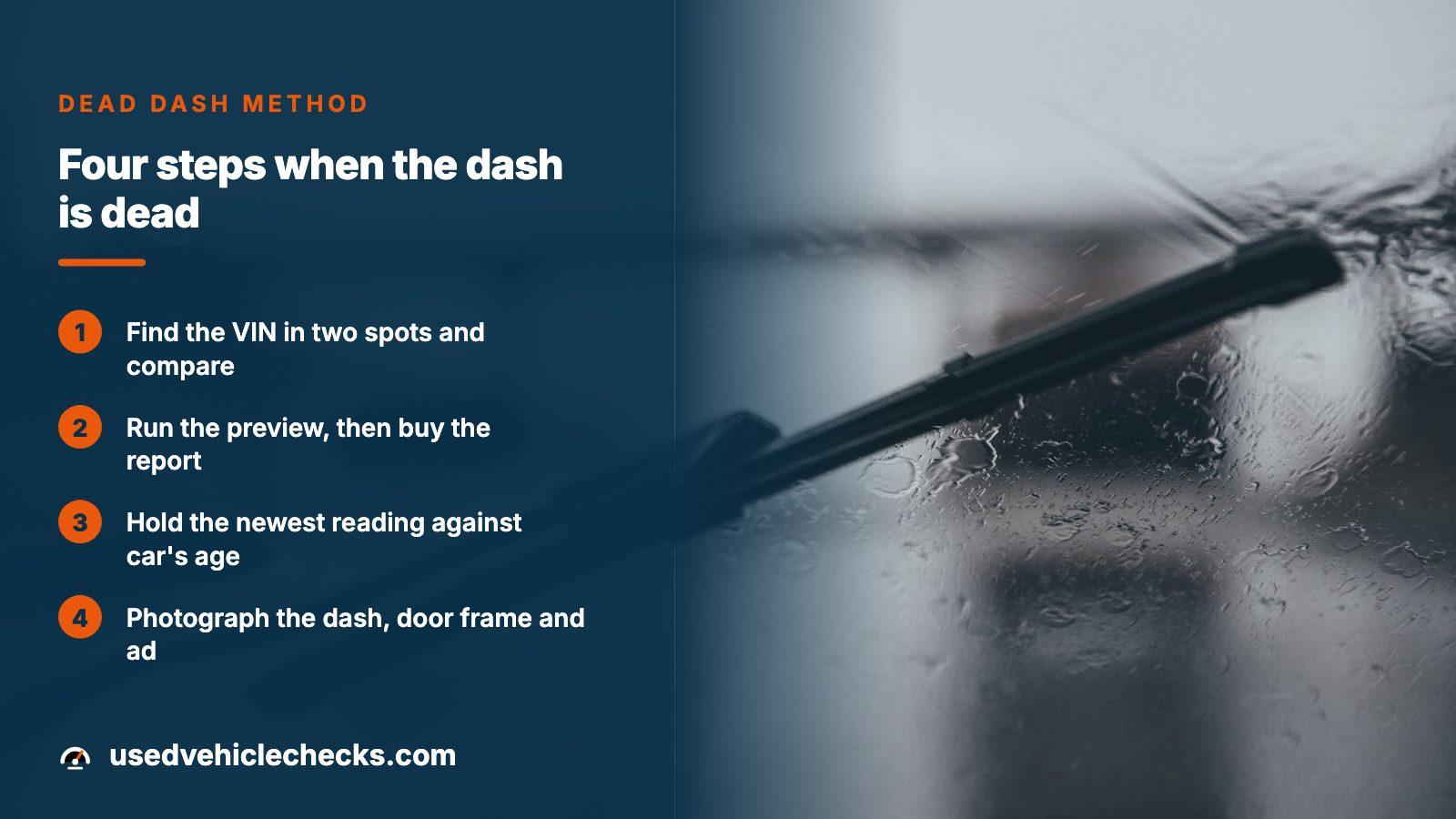
- Find the VIN in two spots on the car and check both against the title and the ad. A mismatch ends the talk; mileage can wait.
- Run the preview, then buy the report for a car you still want and read its readings oldest to newest, dated.
- Hold the newest reading up against the car's age, the seller's claim and the wear inside the cabin.
- Photograph the dash, the door frame and the ad before leaving; ads change once questions start.
A short or empty list is no clean bill: NMVTIS calls its report concise and warns that a search can miss a problem.
Reading the readings on a car with a dead dash
- Readings that climb steadily to a recent date: the true figure is probably near the newest one, plus what the car has driven since.
- A newest reading far above the seller's number: ask where the seller got it.
- A reading that drops between two dates, or one that surfaces after years of silence: suspect a swapped or altered unit.
- A not-actual or not-readable note on the title: it stays on the title for good in Oregon, so price the car as unknown mileage.
Size is not the verdict: a delivery van and a garage-kept weekend car of one model year live different lives, so read the slope, not the total. A reading that clashes with a dated record is what should stop you.
Paper and wear: cross-checks the dash cannot blank out
NHTSA's buyer tips cover evidence that does not need the cluster.
- The title's mileage, set against every other figure you can find.
- Service and inspection papers: invoices usually state mileage, so check the dates and the climb.
- Oil-change stickers on the windshield or door post, in the glovebox or in the engine bay.
- Tires and pedals: a car said to show 20,000 or less should wear its original tires, and gas, brake and clutch pedals should match the claimed use.
From an NHTSA owner complaint
An owner of a 2006 Ford Explorer told NHTSA the digital odometer had failed and Ford could not supply a replacement cluster part. Without that reading, the owner said, there was no telling when to change the oil, and the vehicle could not be inspected.
Unreadable mileage also takes away the maintenance clock, so ask what mileage the last invoice recorded.
A replaced cluster should leave a notice on the door frame
Federal law allows an odometer to be serviced, repaired or replaced. When the new unit cannot carry the same mileage, it is set to zero and a written notice goes on the left door frame, naming the old mileage and the work date. Altering or removing that notice to deceive someone is banned.
From an NHTSA owner complaint
An owner of a 2004 Chevrolet Trailblazer told NHTSA the gauges began reading wrong and then quit. GM charges a fee for a new cluster, the owner wrote, while a used one would carry the wrong odometer reading because GM will not reset it, which the owner called fraud.
A used cluster can carry the wrong mileage unless the swap was handled properly. No notice and no invoice means unknown mileage, so price the car that way.
What the seller must put in writing when the number is wrong
The title carries a signed mileage statement at transfer. A seller who knows the dash differs from the real mileage must say the actual mileage is unknown. For an invalid display, the rules have the seller state that the figure is not the true mileage and cannot be trusted, with a warning to the buyer.
- Oregon: a blank display is noted as not readable; a stuck odometer is disclosed with its figure and marked not actual. Neither note can be removed later, so ask how your own state treats it.
- Model year 2010 and older are exempt, and 2011 and newer fall out of the rule at 20 years.
No statement on an exempt car proves nothing. A newer car without one, or a signature over a figure the seller knew was wrong, is a problem.
When a dead odometer stops being an innocent repair
A failed odometer is not a crime by itself; the law turns on intent. Driving a car on public roads while knowing its odometer is dead is banned only when meant to deceive. Disconnecting or resetting the unit to change the mileage it shows is banned as well. A knowing and willful violation can bring a fine, a prison term of up to 3 years, or both.
A buyer who proves intent to defraud can sue for damages of 3 times the actual loss or $10,000, whichever is larger, and a buyer who wins also recovers costs and a reasonable attorney's fee. The clock runs 2 years from when the claim arises. NHTSA does not pursue claims for individuals; it points them to the state enforcement agency and a private attorney, and takes large-scheme reports on its Vehicle Safety Hotline.
Paying for the report, and what follows
Running the preview costs nothing. If the car holds up, you pay once for the report and nothing recurs; buying 3, 5 or 10 together suits a longer shortlist. Amounts are listed on the pricing page.
Three items to demand first
Ask for three things in writing: a statement that the mileage is unknown or not actual, the invoice or door-frame notice for any cluster work, and the last service mileage on record. If one is missing, bargain as if the mileage were unknown, or leave.
Where this information comes from
- NHTSA: odometer fraud — Buyer tips on titles, records, stickers, tires and pedals, the warning about digital units, and where to report.
- 49 U.S.C. chapter 327: odometers — Statute text on driving with a dead odometer, the door-frame notice, the unknown-mileage statement and the penalties.
- 49 CFR part 580: odometer disclosure requirements — The seller's three declarations, the warning for an invalid display and the age exemptions.
- NMVTIS: information for consumers — What the national title report holds, where its data comes from and why a search can miss a problem.
- Oregon DMV: odometer disclosure — One state's treatment of a blank or stuck odometer and the notes that stay on the title.
- NHTSA owner complaint 10342133 — owner experience, paraphrased
- NHTSA owner complaint 10414130 — owner experience, paraphrased
Sources and photos: Facts checked against the sources above in November 2026. Photos by Dennis Eusebio, Thibault Valjevac and Mustafa Sheikhmouss on Unsplash; diagrams by UsedVehicleChecks.
Keep reading
- Mileage Check by VIN: What the Recorded Odometer Readings ShowHow the dated reading list is built and how to read it line by line.
- Odometer Discrepancy Check: Find a Mileage Mismatch Before You PayWhat to do when the records and the dash tell different stories.
- Odometer Rollback Check by VIN: Run the Mileage Test Before You PayTests for a backward step once you have the readings in hand.
- How to Report Odometer Fraud: Evidence, Agencies and DeadlinesWhere to take the case if the dead dash was hiding something.
Frequently asked questions
How can I find a car's mileage if the odometer is not working?
Pull the readings recorded for the VIN at past title transfers, then compare them with service invoices, inspection papers and maintenance stickers. A replaced cluster should also leave a door-frame notice with the old mileage. If nothing lines up, treat the mileage as unknown.
Is it illegal to sell a car with a broken odometer?
The rules focus on honesty, not the repair. If you know the reading is wrong, you must say in writing that the true mileage is unknown, and a false statement is illegal. Hiding a dead odometer to mislead a buyer is where fraud rules bite.
Does a replaced instrument cluster mean the mileage was rolled back?
No. Replacement is lawful and the law expects a record of it. Ask for the repair invoice and look for the notice with the old mileage and date. A zeroed unit with no notice and no invoice deserves suspicion.
Can a history report show mileage when the dash is blank?
Yes, where readings were recorded for the VIN, since they come from title and other records rather than the dash. Look at the free preview first. The dated readings are in the full report, bought once.
Who do I contact if I think a seller hid a dead odometer?
Start with your state's enforcement agency. Keep the title, the listing and your photos together, and ask a private attorney about a claim; NHTSA's hotline is for large schemes.
Now check the car itself
The guide explains what to look for. The report shows what this VIN has on record.