THE SHORT ANSWER
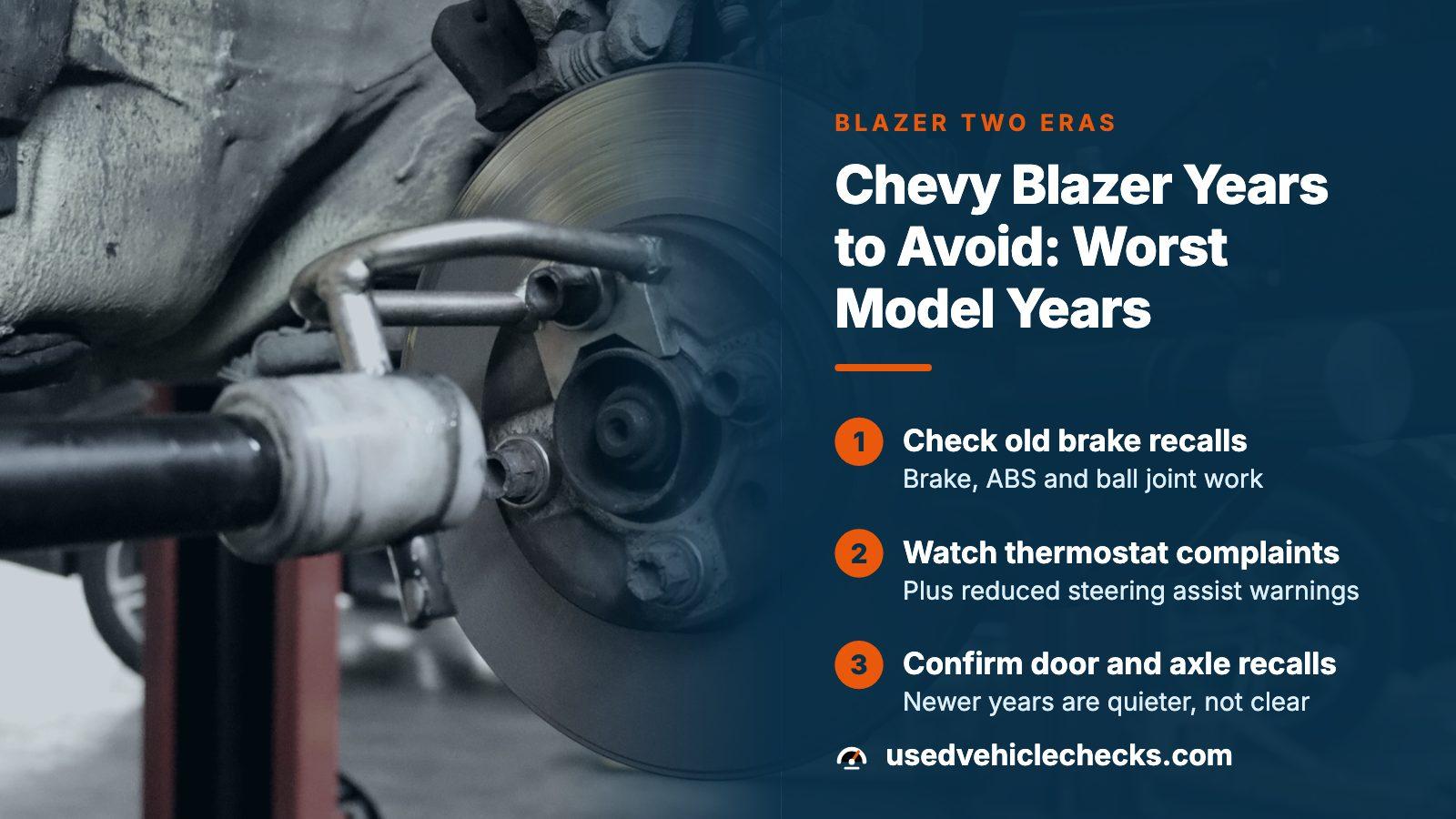
Avoid the 1995 to 1998 Blazers unless the brake, ABS and ball joint recalls are documented as done. Of the 2019 and later crossovers, 2019 and 2020 draw the most complaints, with 190 and 224, many about the cooling thermostat and a reduced steering assist warning. 2022 to 2025 cars are quieter but carry door striker and axle recalls to confirm.
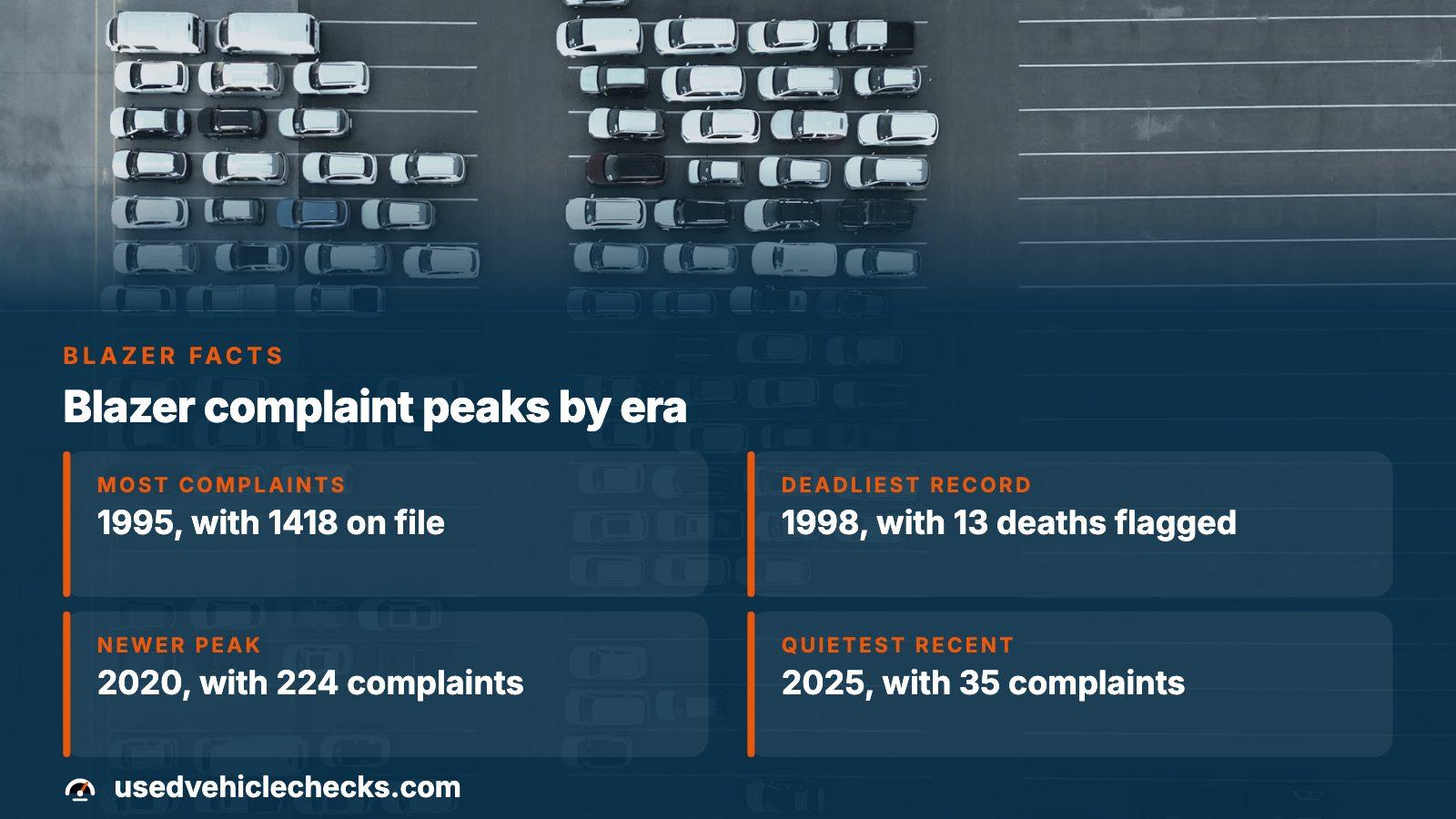
- Most complaints
- 1995, with 1418 on file
- Deadliest record
- 1998, with 13 deaths flagged
- Newer peak
- 2020, with 224 complaints
- Quietest recent year
- 2025, with 35 complaints
Blazer model years ranked by complaints and recalls
I pulled the complaint and recall records for each Blazer year from NHTSA's public API. NHTSA lists two unrelated generations under one name here: an older sport utility sold through 2005, and a crossover that came back for 2019. The table keeps both runs apart, ordered by complaints inside each.
| Model year | Complaints | Recalls on file | Verdict |
|---|---|---|---|
| 1995 | 1418 | 11 | Avoid unless recalls are closed |
| 1996 | 1280 | 11 | Avoid unless recalls are closed |
| 1997 | 826 | 7 | Inspect closely |
| 1998 | 782 | 3 | Inspect closely |
| 2000 | 626 | 4 | Check the hazard switch recall |
| 2020 | 224 | 3 | Check the thermostat history |
| 2019 | 190 | 2 | Check the thermostat history |
| 2021 | 142 | 1 | Reasonable with a clean record |
| 2022 | 55 | 1 | Reasonable with a clean record |
| 2025 | 35 | 1 | Fewest complaints, confirm door strikers |
Age inflates the old totals, since those cars have had decades to collect reports. Even so, 1995 to 1998 together hold 4306 complaints, against 745 for every crossover year from 2019 to 2025 combined.
Why 1995 and 1996 sit at the bottom
Brakes dominate both files. Service brakes are named in 563 of the 1995 complaints and 462 of the 1996 ones, and about 261 of the 1995 summaries mention ABS. Those two years also carry the most crash flags, 165 and 161, plus 93 and 104 injuries.
Recall 99V193000 explains part of it. On four-wheel-drive trucks and SUVs with ABS built from September 1989 through August 1996, a faulty two-wheel or four-wheel signal switch could lengthen stopping distances. Dealers replace or repair that switch.
Fire risk shows up too. Recall 96V234000 covers four-door four-wheel-drive models where the prop shaft could rub the fuel tank and let gasoline leak, with extra tank shielding as the fix. The 1996 file adds 112 or so complaints naming ball joints.
Reading an old file
An old recall can still be unrepaired on a truck that has changed hands five times. Ask the seller for the paperwork and have a shop look at the brake lines, ABS light and front suspension before you talk price.
1997 to 2002: fewer brake stories, other problems
The 1998 file is the one that worries me most for a different reason. It logs 13 deaths among 782 complaints, the highest of any Blazer year, and 261 of those complaints involve visibility. Recall 98V150001 addresses wipers that work intermittently because of cracked solder joints.
- 2000: suspension 103, power train 84 and fuel system 82 are the leading complaint areas
- 2000 to 2002: GM recalled 5862 cars for a hazard switch that could kill the stop lamps, campaign 08V231000
- 1996 and 1997: upper ball joint corrosion in recall 01V200000, aimed at cars from northern and rust-belt states
- 2003 to 2005: 104, 50 and 15 complaints, the quietest stretch for the older design
If you want an older Blazer at all, the late run from 2003 to 2005 is the better pick on paper, and 2005 shows no recalls and no injuries.
2019 and 2020: the thermostat and steering-assist pattern
The crossover has a very different problem profile. Among the 2019 complaints, 44 mention a thermostat, coolant sensor or P0128 code and 32 mention a reduced steering assist message. In 2020 those figures rise to 73 and 62. The pattern fades fast: 19 thermostat mentions in 2021, 11 in 2022, 2 in 2023 and none in 2024 or 2025.
Owners describe a temperature gauge stuck on cold, a cooling fan running hard, weak cabin heat or cooling, and a steering warning that makes the wheel heavier.
From an NHTSA owner complaint
The owner of a 2020 Blazer V6 who bought it new reported a check engine light, a fan stuck on high, warm air from the vents and a steering assist warning at around 54,000 miles. A P0128 code was stored. The owner said newer cars got special coverage and theirs did not, and worried about losing steering with grandchildren aboard.
Take from this that coverage depends on the exact model year, which I could not confirm on a GM page. Ask the dealer in writing about any open program on the VIN, and ask for the cooling repair history.
Shift-to-park messages and one hard-pedal brake report
A second 2019 and 2020 theme is a shift-to-park warning that appears while the car is already in park, so the engine will not shut off cleanly. That message turns up in 67 of the 2019 summaries and 45 of the 2020 ones, and in none of the 2021 ones.
From an NHTSA owner complaint
A 2019 Blazer owner wrote that the brake pedal went hard without warning after leaving a highway, and the car rolled into the back of a stopped semi. A mechanic found a failed brake booster. The owner believed the Blazer had been left out of a recall covering other models.
One report is an anecdote, not a pattern, and the 2019 file shows only 14 brake component entries out of 190. Still, it is worth pressing the pedal hard during a test drive and checking for any open campaign.
2021 to 2025: quieter, with recalls to confirm
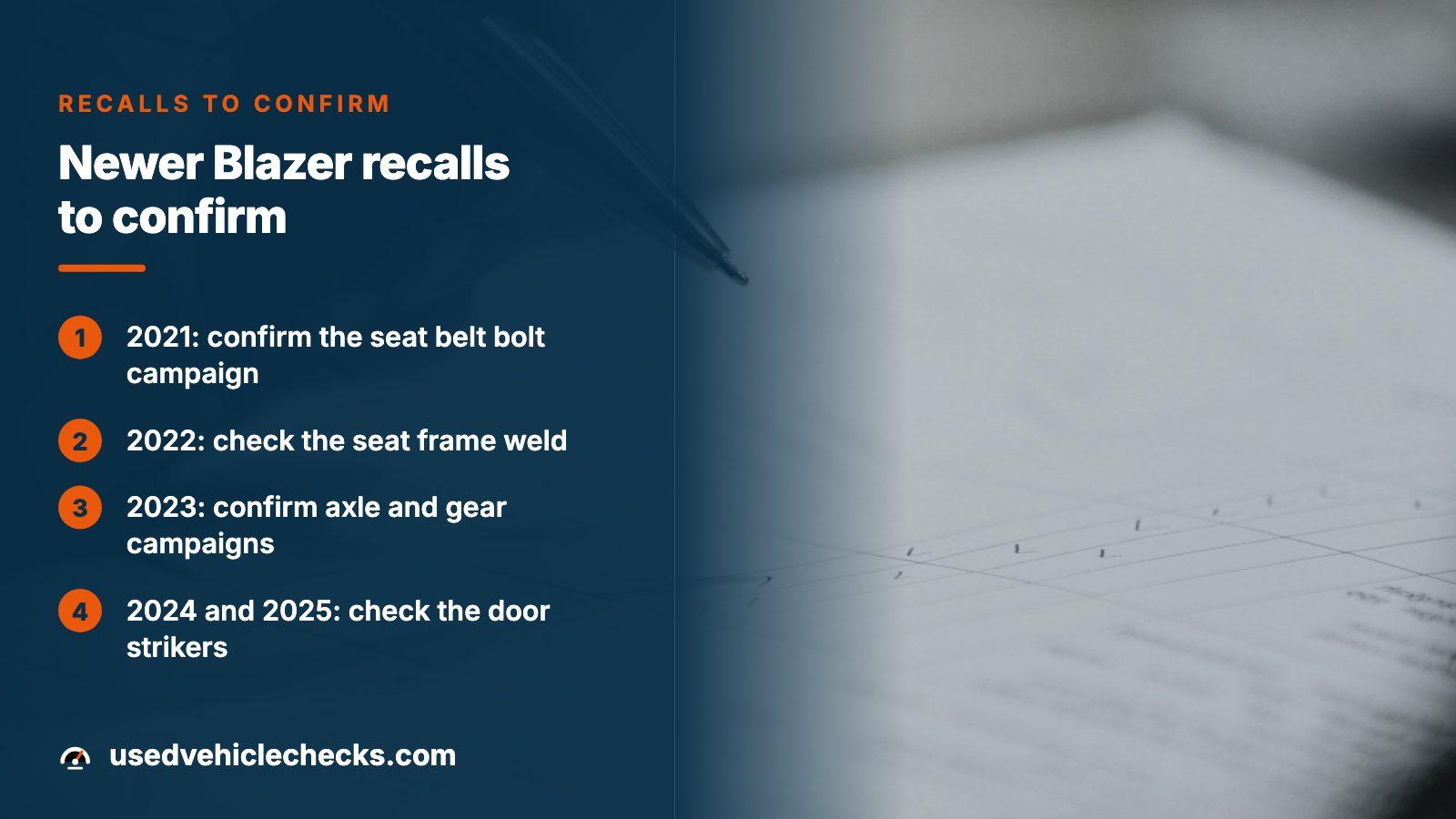
The later cars draw far fewer complaints, with 142, 55, 44, 55 and 35 from 2021 through 2025. They are not recall free.
- 2022: driver's seat cushion frame weld, campaign 22V359000
- 2023: left half-shaft retaining ring and a wrong transmission sun gear, campaigns 23V042000 and 23V172000
- 2024 and 2025: door strikers that could fracture, campaigns 23V869000 and 24V737000
- 2021: seat belt bolts, campaign 20V811000
Every remedy is a free dealer repair, so the useful question is whether the work was actually done on the car in front of you, not which year it is.
Check the mileage history before you hand over cash
Odometer history is where a used Blazer succeeds or fails. An older truck with a pile of dated readings and a steady climb tells you how it was used. A reading that drops, or a gap of several years, tells you to walk away or negotiate hard.
Run the VIN through a mileage check first. The preview is free and shows whether a report exists. The paid report, a one-time payment with no subscription, lists dated odometer readings, title brands, salvage and accident records and open recalls together, so you can match them against the seller's story.
VehicleHistory.gov, run by the Justice Department, explains that the national title system holds title data, the latest odometer reading and brand history, and that saltwater flooding can make air bag sensors and wiring more prone to failure.
Where this information comes from
- NHTSA complaints API: 2020 Blazer — The public record behind the complaint counts by model year.
- NHTSA recalls API: 2020 Blazer — Campaign numbers, dates and remedies for each year.
- VehicleHistory.gov: NMVTIS for consumers — What the federal title system records and why brands matter.
- NHTSA owner complaint 11773043 — owner experience, paraphrased
- NHTSA owner complaint 11602686 — owner experience, paraphrased
Sources and photos: Facts checked against the sources above in November 2026. Photos by Media Digital, Masjid MABA and Iain on Unsplash; diagrams by UsedVehicleChecks.
Keep reading
- Chevrolet Traverse Years to Avoid, and What the Odometer AddsAnother GM crossover with its own year-by-year record.
- Mileage Check by VIN: What the Recorded Odometer Readings ShowWhat a dated mileage history shows before you make an offer.
- How Many Miles Is Too Many on a Used Car? Age, Pace and ProofDecide what a high reading means on an older SUV.
- Title Check by VIN: A Step-by-Step Check, Odometer Entries FirstSee which title brands a VIN check can turn up.
Frequently asked questions
What are the worst years for the Chevy Blazer?
On NHTSA data, 1995 leads with 1418 complaints, then 1996 with 1280, 1997 with 826 and 1998 with 782. Brakes drive the first two. Among the 2019 and later crossovers, 2020 leads with 224 complaints and 2019 follows with 190.
Is the 2019 Chevy Blazer a reliable year?
It is mixed. The 2019 file holds 190 complaints, with power train and electrical issues leading. Owners report a thermostat fault and shift-to-park messages. Few crashes are flagged, four in all, so many are annoyances, but get the repair history.
Are older Blazers safe to buy?
The 1995 to 1998 cars carry the heaviest complaint load, including brakes and fuel tank shielding recalls. A later truck from 2003 to 2005 has far fewer reports. Any age needs a brake and suspension inspection and proof that recalls were done.
How do I check whether a Blazer has open recalls?
Look up the VIN with NHTSA's recall tools or ask a dealer. Remedies are free, as the 2020 air bag and 2024 door striker campaigns show. A history report also lists open recalls beside the odometer readings and title records.
Does a bad model year mean I should never buy it?
No. A year with many complaints just means more to inspect. A single car with documented repairs, closed recalls and a steady mileage history can be a better buy than a quiet year with gaps in its record.
Now check the car itself
The guide explains what to look for. The report shows what this VIN has on record.