THE SHORT ANSWER
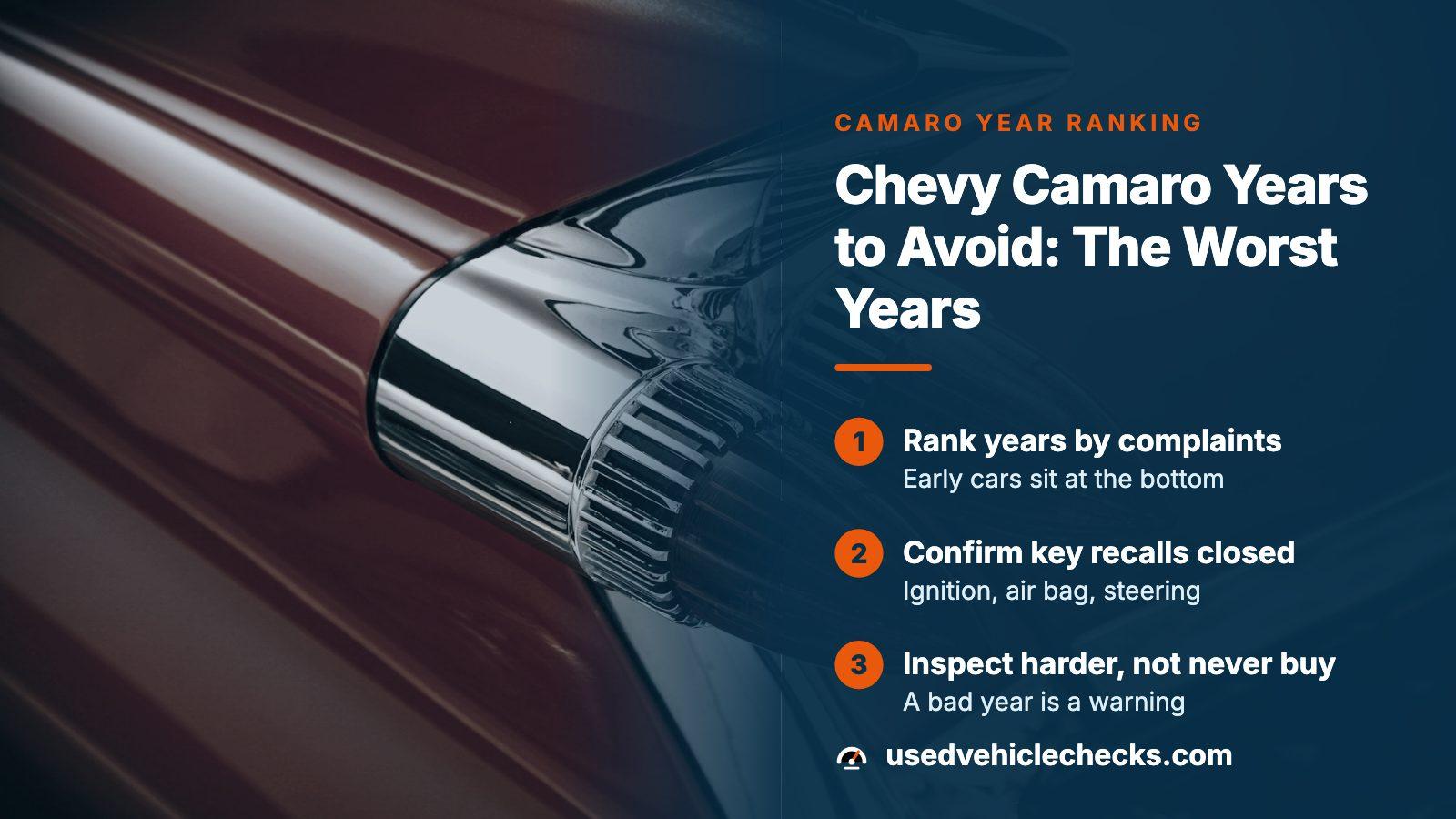
Avoid 2010 first, then 2011, 2014, 2015 and 2017, unless the ignition key, air bag and steering recalls are shown as closed on that car's VIN. The cars from 2018 to 2022 draw far fewer complaints, though 2020 to 2022 models with the ten-speed automatic carry a transmission recall. A bad year means inspect harder, not never buy.
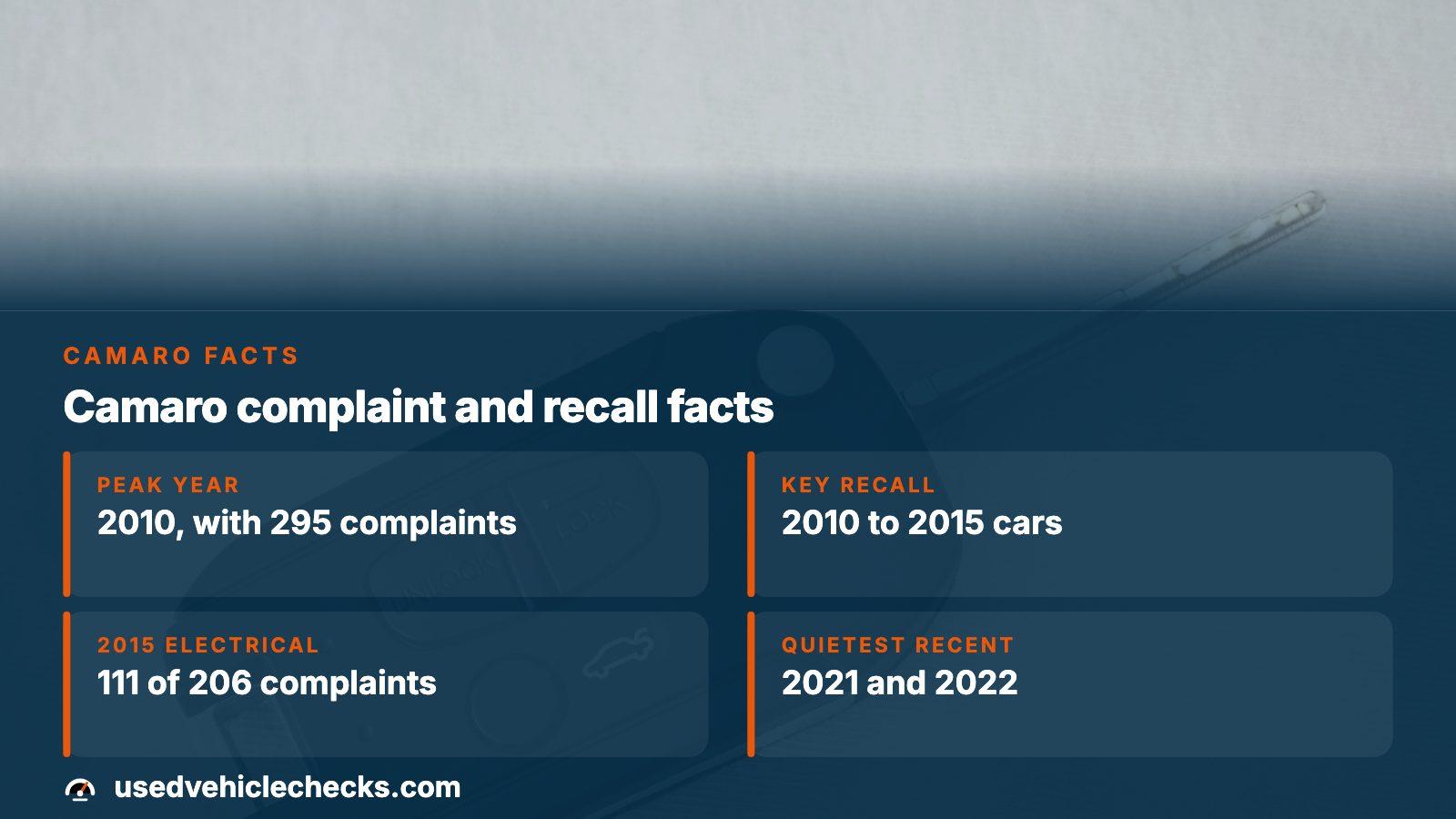
- Peak year
- 2010, with 295 complaints
- Ignition key recall
- 2010 to 2015 cars
- Electrical complaints
- 111 of 206 on the 2015 model
- Quietest recent years
- 2021 and 2022, with 20 and 14 complaints
Camaro model years ranked by complaints and recalls
I pulled NHTSA's complaint and recall records for each Camaro year myself. The car came in three runs: 1998 to 2002, 2010 to 2015, and 2016 onward. The table covers the years that decide most shopping lists.
| Model year | Complaints | Recalls on file | Verdict |
|---|---|---|---|
| 2010 | 295 | 3 | Avoid unless every recall is closed |
| 2015 | 206 | 2 | Inspect closely |
| 2011 | 194 | 3 | Inspect closely |
| 2017 | 191 | 3 | Verify the steering work |
| 2014 | 188 | 4 | Inspect closely |
| 2013 | 187 | 4 | Check the air bag recall |
| 2016 | 141 | 1 | Reasonable with a clean record |
| 2018 | 81 | 2 | Reasonable with a clean record |
| 2022 | 14 | 1 | Fewest complaints, check transmission |
Older cars have had more time to collect complaints, so some of the gap is simply age. Even so, the 2010 to 2015 run holds 1183 complaints against 532 for 2016 to 2022.
Why 2010 and 2011 sit at the bottom
Air bags and engines drive the 2010 file: 83 of its 295 complaints name air bags and 74 name the engine. The 2010 year also logged 24 injuries and one death, the highest injury total of any Camaro year I checked.
Many of the air bag reports are the same story. A passenger air bag warning keeps flashing, or the seat reads as empty with someone sitting there. A 2011 owner said a dealer quoted upwards of $900 to chase the cause, which is why a light that seems minor on a test drive can become a real bill.
The 2010 V8 cars also had an early campaign over a battery cable that could rub on the starter housing. GM found the problem in 1,243 cars and the fix was to reroute the cable.
The knee-and-key recall that touches every early car
Recall 14V346000 covers every 2010 to 2014 Camaro built between December 2008 and May 2014. A driver's knee can bump the flip key out of the run position, which shuts the engine off. That can cost power steering and braking, and air bags may not fire in a crash.
The remedy is a dealer visit to remove the key blade and supply new keys. In 2019 GM added a second campaign because some replacement keys sold over the counter were the recalled design all over again.
From an NHTSA owner complaint
A 2010 Camaro owner told NHTSA that at about 40 mph the driver's knee struck the key, which snapped off inside the ignition switch. The car could not be shut off, so the battery had to be disconnected. The owner reported about 110,000 miles on it.
Take from this that a recall can be open on a car that has been through several owners. Ask whether the original keys are still in the car, then check the VIN for the campaign status.
Electrical trouble on the 2013 to 2015 cars
Electrical faults dominate the later fifth-generation cars. They make up 81 of 187 complaints in 2013, 99 of 188 in 2014 and 111 of 206 in 2015. Owners describe a stereo that cuts out when the brake is pressed, turn signal chimes that stop, and a key that sticks in the ignition.
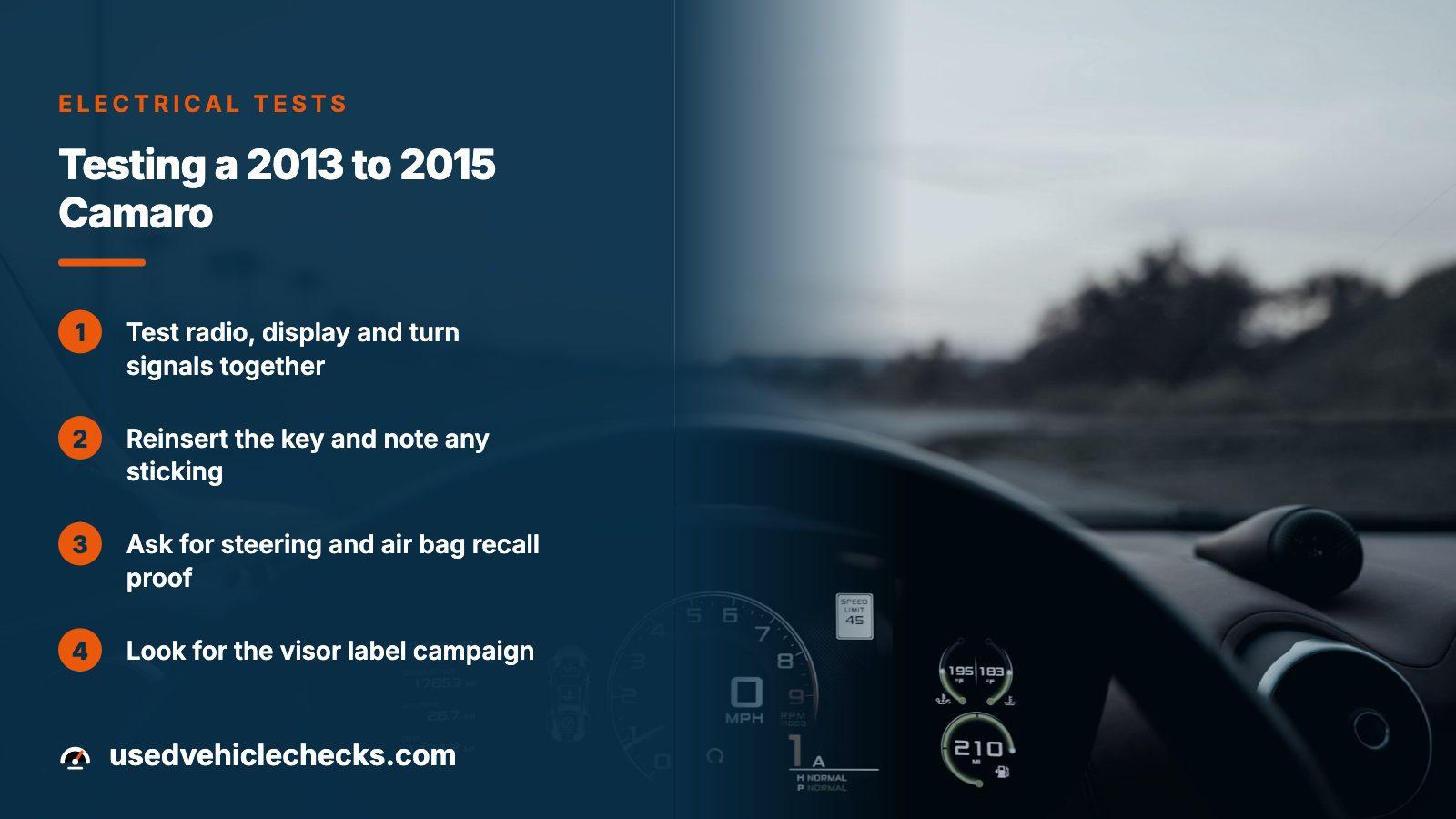
- Test the radio, display and turn signals together, with the brake pedal pressed
- Remove and reinsert the key several times and note any sticking
- Ask for proof that the 2014 steering fastener and 2015 side air bag recalls were done
- Look for the 2013 and 2014 coupes covered by the visor label campaign
The 2013 car also drew a 2023 campaign over a driver air bag inflator that could burst, so a 2013 with no record of that work is worth a pointed question.
The 2017 steering problem
In 2017 the leading complaint area flips to steering, with 58 of 191 reports, just ahead of 54 for the power train. GM recalled 2017 cars in 2019 and again in 2025 because the electric power assist could fail, with the same remedy each time: a new steering gear.
From an NHTSA owner complaint
A 2017 Camaro owner said the steering stopped working without warning at only 12,000 miles. The symptoms sounded like the steering recall, yet the owner's VIN fell outside it, so the whole repair bill at a local shop was theirs.
The lesson is that coverage depends on the VIN, not the year. A seller who says all 2017 cars were fixed has not looked it up.
The better years, and one catch
From 2018 on, complaint counts fall: 81, 53, 32, 20 and 14 across 2018 to 2022. Two things keep that from being a clean pass. Recent cars are younger, so owners have had less time to write in, and some campaigns arrived years after the cars were built.
The 2020 to 2022 Camaros with the ten-speed automatic were recalled in 2025 because the transmission can fail inside and lock the wheels. The 2021 year carries four recalls, including an axle shaft that could separate. NHTSA returned no complaints and no recalls for 2023 and 2024, but a thin file is not the same as a clean car.
What about the 1998 to 2002 cars
The fourth-generation run is old enough that condition outweighs year. The 1998 model is the worst of it, with 202 complaints, and 96 of them name the service brakes. Later cars in the run settle between 54 and 99 complaints, still led by brakes and hydraulic systems.
Cars this age have often had a cluster replaced, a dash opened or an owner who lost track of mileage. Treat any reading you cannot trace as unconfirmed.
Where the odometer history settles the question
A Camaro is a car people drive hard and sometimes modify, so the mileage story matters as much as the year. Picking between a 2015 with a spotless record and a 2018 with a stalled history is not a decision the complaint table can make.
Run the VIN through a mileage history before you inspect the car in person. The free preview shows whether a report exists. The paid report lists dated odometer readings from inspections, titles and service events, flags a reading that steps backward, and lists open recalls and title brands alongside. A single payment covers one report, with packs for shoppers comparing several cars.
The federal NMVTIS title system, described on VehicleHistory.gov, exists to protect buyers from fraud and unsafe vehicles. A report built on that data is a sensible first filter, then the inspection comes second.
Where this information comes from
- NHTSA complaints API: 2010 Camaro — The public record behind the complaint counts by model year.
- NHTSA recalls API: 2014 Camaro — Campaign numbers, dates and remedies for each year.
- VehicleHistory.gov: NMVTIS — The federal title record system built to guard buyers against fraud.
- NHTSA owner complaint 11580846 — owner experience, paraphrased
- NHTSA owner complaint 11755358 — owner experience, paraphrased
Sources and photos: Facts checked against the sources above in November 2026. Photos by Clem Onojeghuo, Dennis Eusebio and Shadow Photography on Unsplash; diagrams by UsedVehicleChecks.
Keep reading
- Mileage Check by VIN: What the Recorded Odometer Readings ShowWhat a dated mileage history shows before you make an offer.
- Odometer Rollback Check by VIN: Run the Mileage Test Before You PayHow to line up readings and catch one that steps backward.
- How Many Miles Is Too Many on a Used Car? Age, Pace and ProofDecide what a high reading means on a used performance car.
- Check Accident History With a VIN Number: Six Steps, Mileage IncludedFind out whether a hard-driven coupe has a crash record.
Frequently asked questions
What are the worst years for the Chevy Camaro?
On NHTSA data, 2010 leads with 295 complaints, followed by 2015 at 206, 2011 at 194, 2017 at 191 and 2014 at 188. The causes differ by year: air bags and engines early, electrical faults mid-run, steering in 2017.
Is the Chevrolet Camaro a reliable car?
It depends on the year and the car's history. Complaint counts drop sharply after 2017, and the 2021 and 2022 files are small. Reliability on a specific car comes down to whether recalls were closed and whether the mileage and service record are consistent.
Are there Camaro years that are safe to buy?
The 2018 to 2022 cars draw the fewest complaints, with 2022 lowest at 14. Check the VIN for the air bag emblem recall and, on 2020 to 2022 cars with the ten-speed, the transmission campaign. No year is safe without a record check.
How do I find out if a Camaro has open recalls?
Enter the VIN into NHTSA's recall lookup, or read it in a vehicle history report. Recalls attach to VINs and build dates, so a seller saying a year was covered does not prove the work was done on that car.
Does mileage matter on an older Camaro?
Yes. Cars from 2010 to 2015 are old enough to have changed hands several times, and a stalled or backward odometer reading is a warning sign. A history of dated readings lets you compare the claimed mileage with what was recorded.
Now check the car itself
The guide explains what to look for. The report shows what this VIN has on record.