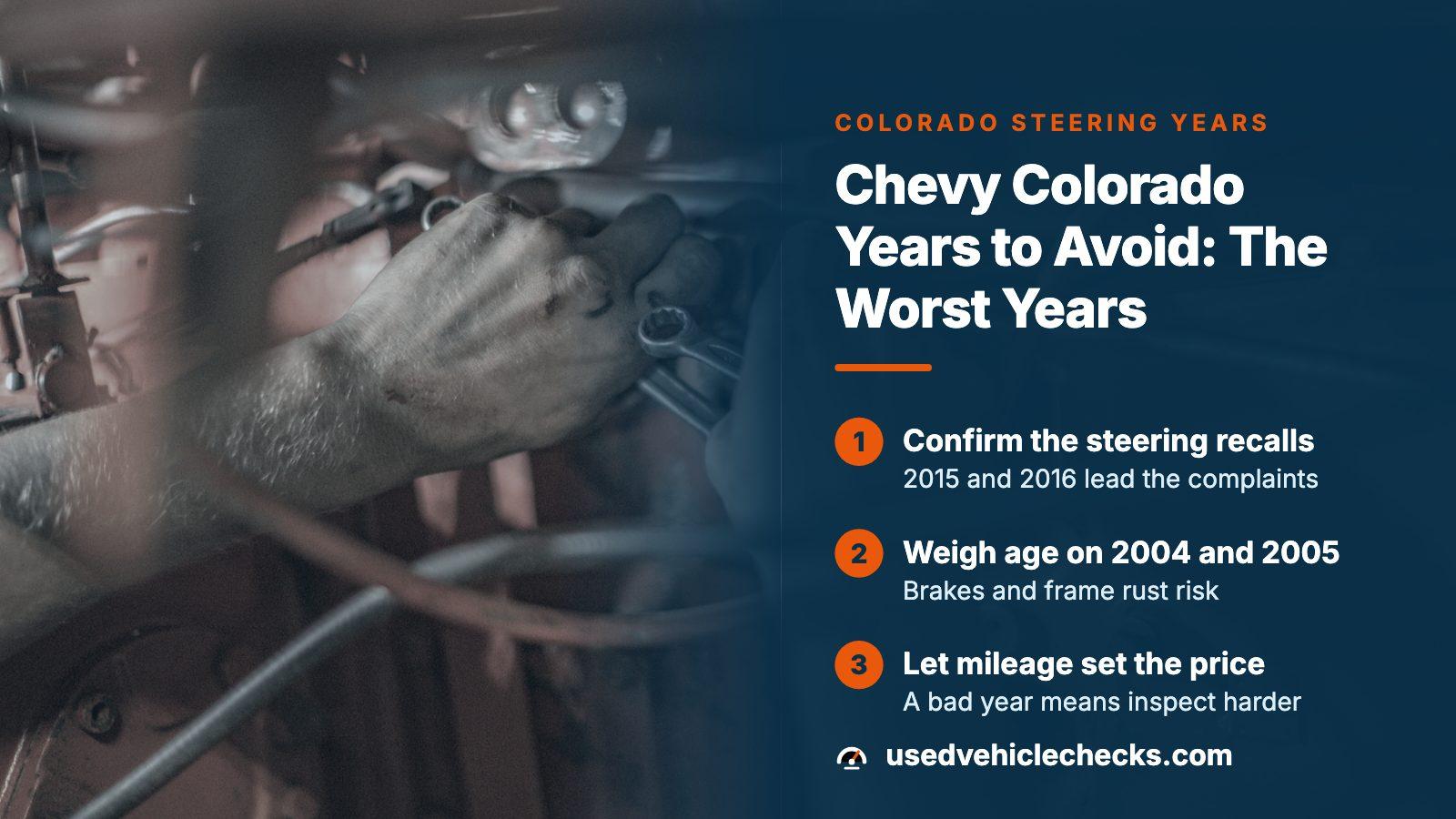
THE SHORT ANSWER
Avoid 2015 and 2016 unless the steering recalls are confirmed closed, since steering draws 830 of their 1,214 complaints. Treat 2004 and 2005 as high-risk for age, brakes and frame rust. The 2017 to 2022 trucks have thinner files, and 2023 and 2024 carry three recalls each. A bad year is a reason to inspect harder, not an automatic no.
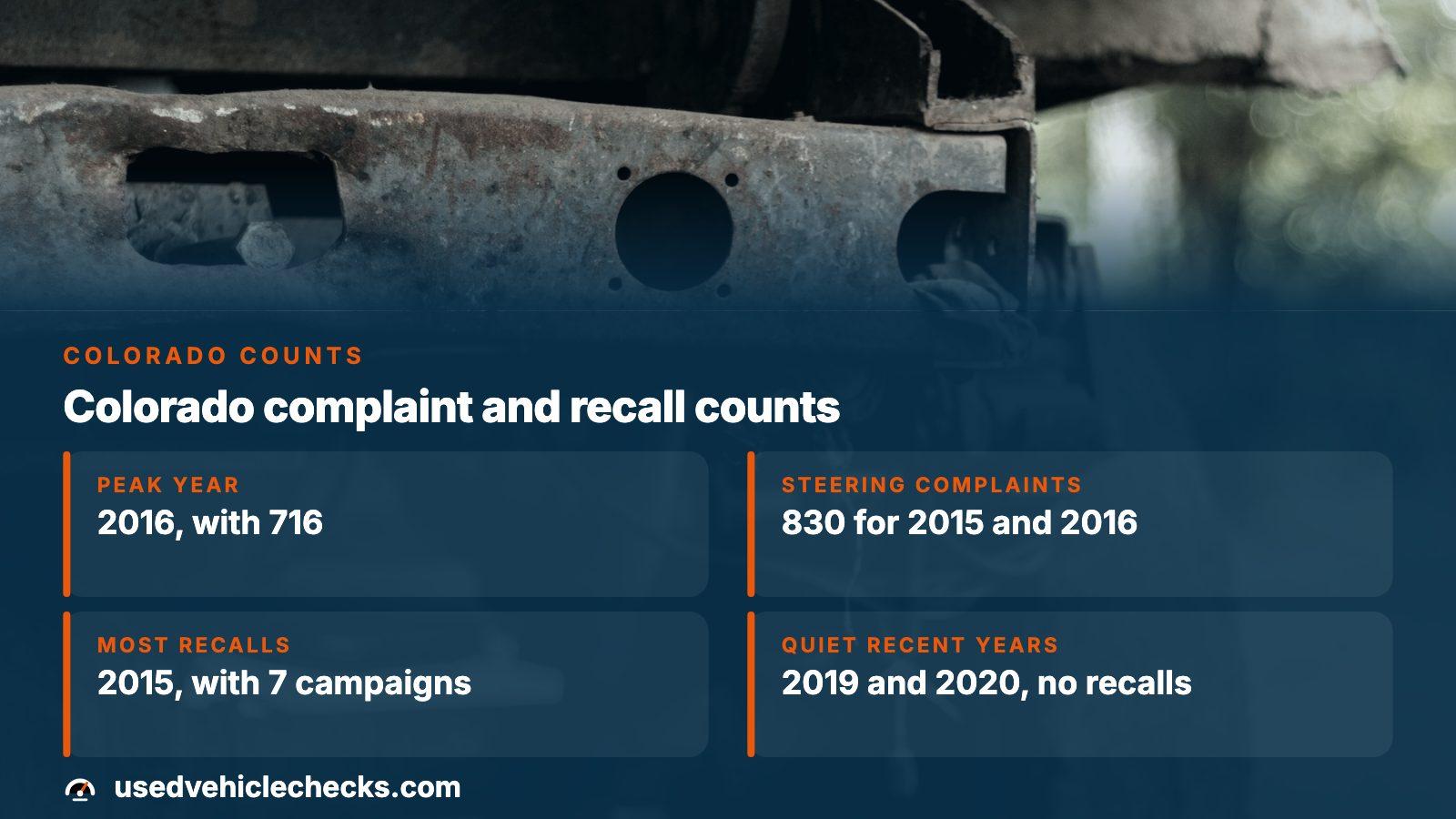
- Peak year
- 2016, with 716 complaints
- Steering, 2015 and 2016
- 830 complaints combined
- Most recalls
- 2015, with 7 campaigns
- Quietest recent years
- 2019 and 2020, no recalls
Every Colorado year ranked by complaints and recalls
I pulled NHTSA's complaint and recall records for each Colorado model year myself. The truck was built in two runs, 2004 to 2012 and 2015 onward, and the years between them hold almost nothing. The table shows the years that stand out, with the recall campaigns filed against each.
| Model year | Complaints | Recalls on file | Verdict |
|---|---|---|---|
| 2016 | 716 | 4 | Avoid unless steering work is done |
| 2015 | 498 | 7 | Avoid unless steering work is done |
| 2004 | 361 | 3 | High risk for age |
| 2005 | 356 | 3 | High risk for age |
| 2006 | 236 | 4 | Inspect closely |
| 2017 | 216 | 1 | Reasonable with a clean record |
| 2018 | 183 | 1 | Reasonable with a clean record |
Counts rise with age because owners have had longer to write to the agency, so a high figure for a 2004 truck is partly a measure of time. The 2015 and 2016 figures are more worrying because those trucks are younger and still drew so many.
Why 2015 and 2016 sit at the top
Steering explains most of it. Of the 498 complaints for 2015, 365 name the steering system, and for 2016 the figure is 465 out of 716. Owners describe the electric power assist dropping out while driving, usually without a warning light first.
GM answered with a campaign in 2016 to replace a torque sensor cover on part of the 2015 build, then another in 2021 for the same family of fault, after power assist could be lost through a poor electrical connection. The remedy in both cases was free at a dealer.
From an NHTSA owner complaint
A 2015 Colorado owner told NHTSA the truck suddenly lost electric power steering assist from a failed module. The owner said the failure matched a GM recall exactly, but the VIN had been left out because of the build-date limits on that campaign.
Take from that story how narrow these campaigns are. A recall covers a range of build dates, so the only way to know whether a particular truck was included, and whether the work was done, is to look up its own VIN.
Reading the recall list on the 2015 and 2016 trucks
The 2015 year carries seven campaigns, the longest list of any Colorado year. They cover driver air bag parts and sensing software, seat installation, front brake calipers, and the two steering campaigns.
- Air bag work in 2015 and again in 2017, when the driver's module on 2015 and 2016 trucks was replaced
- A fuel pump campaign from 2018 covering 2016 to 2018 trucks, where the pump can detach and damage the fuel line, raising fire risk
- A console door latch campaign on 2016 trucks built in a short window in late summer 2015
- Front brake caliper inspection on early 2015 builds
Long lists are not all bad news. Each campaign means GM found the fault and offered a free fix. What hurts a buyer is an open campaign on the truck in the driveway, which no advert will mention.
The first-generation trucks, 2004 to 2012
The 2004 and 2005 years draw 361 and 356 complaints, with 2006 next at 236. Electrical faults top the 2004 list, and brakes lead for 2005, including ABS sensors that were replaced more than once without curing a flashing warning light. The 2005 year also has the highest crash-flagged count of any year, at 27.
Frame rust is the other thing to watch on trucks this old. One 2004 owner described buying from a dealer with 135,428 miles showing, then learning from a mechanic that the frame had rusted through and the truck should not be driven.
From an NHTSA owner complaint
A 2004 Colorado owner said a brake job led a mechanic to find a frame rusted with holes, and he refused to repair the brakes or the ABS sensor. The truck came from a dealer about two and a half years earlier, and the owner still owed money on it.
Complaints fall away after 2006, to 140 for 2007, 81 for 2008 and 67 for 2009. Treat the 2010 to 2012 years cautiously rather than as proven safe: NHTSA returned no complaints for 2010 and only 42 each for 2011 and 2012, which suggests few trucks reported rather than few problems.
2017 to 2025, the better end of the range
From 2017 the picture calms. That year holds 216 complaints and one recall, mostly power train concerns, and 2018 holds 183 with the same fuel pump campaign. The 2019 and 2020 trucks show 151 and 88 complaints with no campaigns, and 2021 and 2022 each show one recall.
The newest trucks are not spotless. The 2023 year has three campaigns, covering a front camera that could falsely detect an obstacle, front wheel hub bolts, and seat belt buckle bolts. The 2024 year also has three, for incorrect tires, a fuel pump lock ring, and the same buckle bolts. A young file proves little, so read recall status truck by truck.
Where the mileage record decides the price
A Colorado that has worked as a fleet or contractor truck can wear out well ahead of its year, and a rolled-back dash reading hides exactly that. Fraud also pays most on a popular midsize pickup, which makes a clean-looking mileage figure worth testing.
- Line up each recorded reading by date and look for a step backward
- Compare the latest reading with the dash and with the wear on the pedals, seat and bed
- Ask what the gap between readings says: a long silence can mean a truck that sat or one that was altered
A UsedVehicleChecks report puts dated odometer readings next to title brands and recall status for one VIN, and you see a free preview before paying for anything. On a 2015 or 2016, those readings plus recall status are what to settle before talking money.
A short checklist before you buy any Colorado
- Enter the VIN at NHTSA's recall lookup and make sure no campaign is still open
- Study the odometer readings by date, and the title history for brands or gaps
- Test the steering at highway speed on a 2015 or 2016, and look at the frame on a 2004 to 2006
- Ask for service records on the fuel system, brakes and electrical parts
- Have an independent mechanic inspect the truck, and use what turns up to negotiate
A truck from a flagged year with closed recalls and a steady mileage trail can be a better buy than a newer one with a hole in its history. Price the risk, and walk away if the seller will not let you check.

Where this information comes from
- NHTSA complaints API: 2016 Colorado — The public record behind the complaint counts by model year.
- NHTSA recalls API: 2015 Colorado — Campaign numbers, dates and remedies for each model year.
- VehicleHistory.gov: NMVTIS — The federal title record system used to guard buyers against fraud and unsafe vehicles.
- NHTSA owner complaint 11774234 — owner experience, paraphrased
- NHTSA owner complaint 11271366 — owner experience, paraphrased
Sources and photos: Facts checked against the sources above in November 2026. Photos by Nina Mercado, Anastasiia Nelen and Zoshua Colah on Unsplash; diagrams by UsedVehicleChecks.
Keep reading
- Odometer Rollback Check by VIN: Run the Mileage Test Before You PayHow to line up dated readings and catch a step backward.
- Mileage Check by VIN: What the Recorded Odometer Readings ShowWhat a mileage history by VIN shows before you make an offer.
- How Many Miles Is Too Many on a Used Car? Age, Pace and ProofDecide what a high reading means on a used pickup.
- Toyota Tacoma Years to Avoid: Judge the Odometer Before the Model YearThe main rival midsize truck, ranked the same way.
Frequently asked questions
What are the worst years for the Chevy Colorado?
On NHTSA data, 2016 and 2015 lead with 716 and 498 complaints, mostly about steering. The 2004 and 2005 trucks follow with 361 and 356, tied to electrical faults, brakes and rust. Any of them can still be a fair buy if recalls are closed and the mileage history holds together.
Is the 2015 Chevrolet Colorado a good truck?
It is the first year of the second generation, and it shows: seven recall campaigns, the most of any Colorado year, plus 365 steering complaints. If the steering and air bag campaigns were done, it can be sound, so confirm that by VIN.
Which Colorado years are the most reliable?
The 2019 and 2020 trucks have the cleanest recall records, with none on file, and complaints of 151 and 88. Newer trucks have had less time to collect reports, so reliability here means a thin file, not a guarantee.
Are the 2010 to 2012 Colorados safe to buy?
The data cannot say. NHTSA returned no complaints for 2010 and 42 each for 2011 and 2012, which points to few reports. Inspect the frame and brakes, check recalls, and read the odometer history instead of trusting the thin file.
How do I check one Colorado for recalls?
Type the VIN into NHTSA's free recall lookup and write down anything still open. A recall list is silent on hidden mileage or past damage, so follow it with a look at the odometer readings and title record.
Now check the car itself
The guide explains what to look for. The report shows what this VIN has on record.