THE SHORT ANSWER
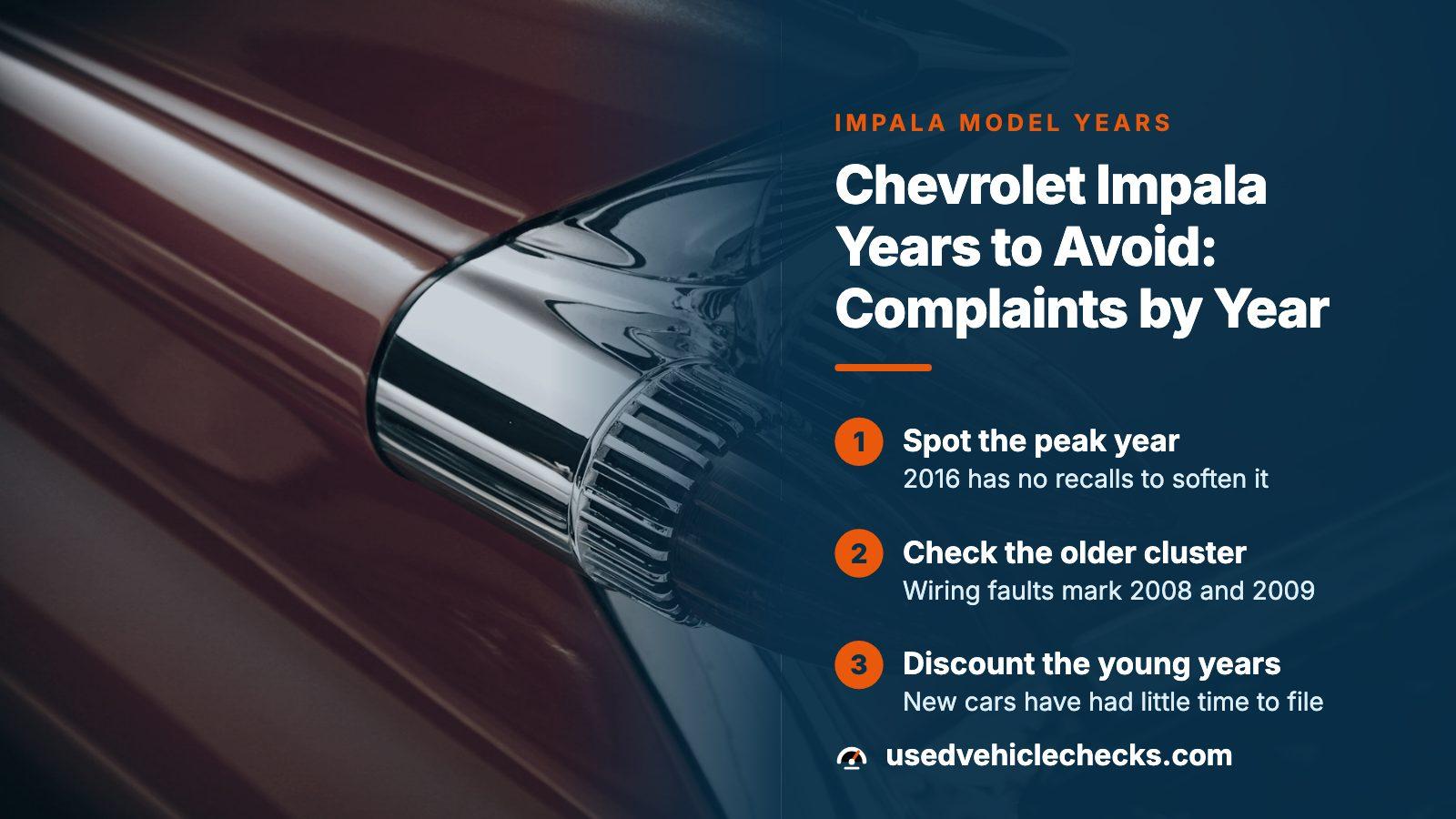
The Impala years to avoid are 2016, 2009, 2008 and 2014, running from 2.11 to 3 times the model's median year of 299 complaints. The lightest files are 2017 to 2020, though recent cars look tidy partly because owners have had little time to write in. Electrical system is the most reported area. Read a flagged year as a nudge to look closer and check the mileage history, not as a ruling on one car.
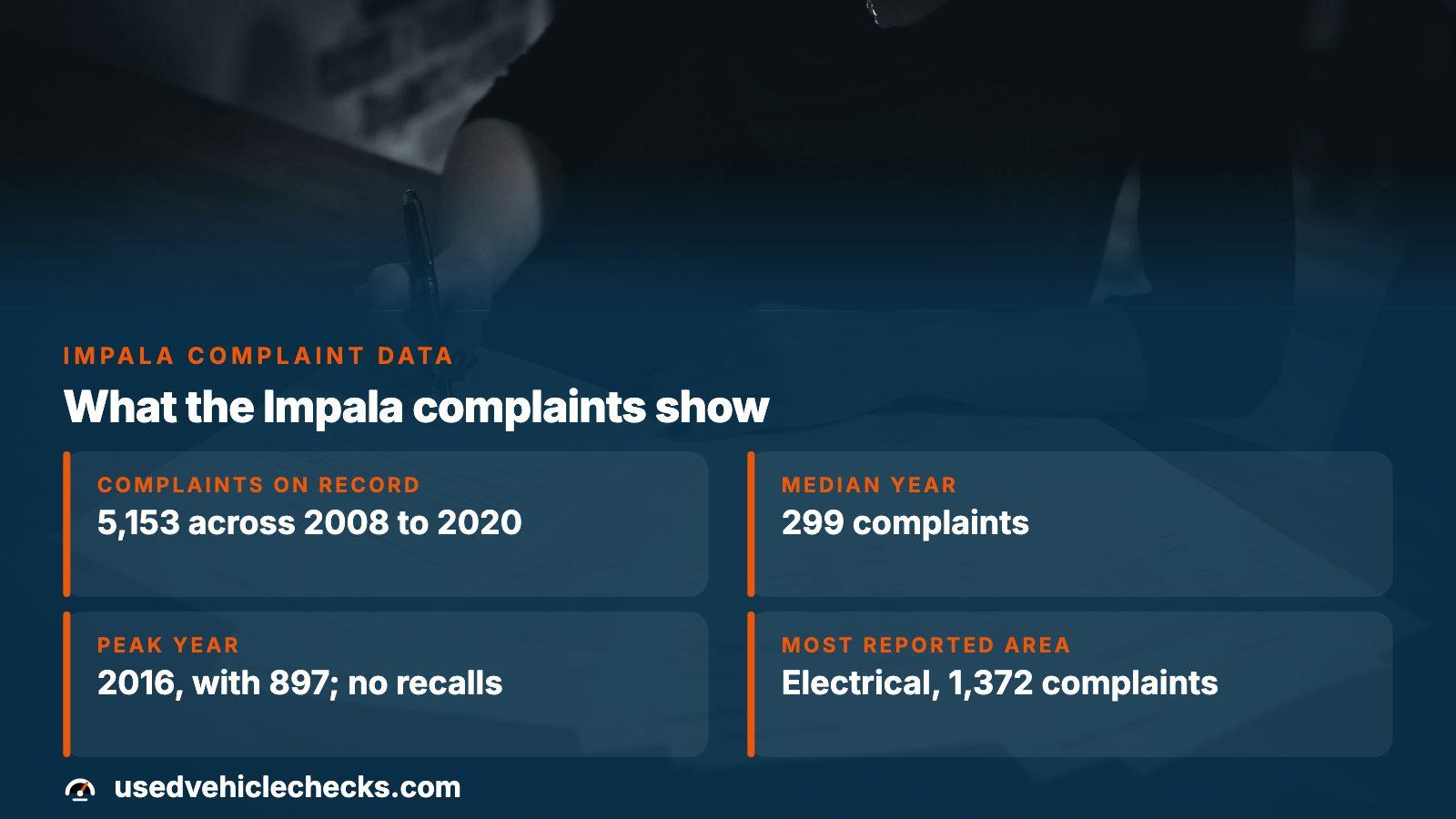
- Complaints on record
- 5,153 across 2008 to 2020
- Median year
- 299 complaints
- Peak year
- 2016, with 897 and no recalls on file
- Most reported area
- Electrical system, 1,372 complaints
The Impala years that sit above the median
NHTSA holds 5,153 owner complaints for the Impala across model years 2008 to 2020, spread unevenly. The middle year draws 299, so that is the yardstick, and each year is set against the Impala's own median instead of other sedans. Five years stand clearly above it.
| Year | Complaints filed | Multiple of median | Recalls | Top area |
|---|---|---|---|---|
| 2016 | 897 | 3× | 0 | Engine |
| 2009 | 824 | 2.76× | 5 | Air bags |
| 2008 | 810 | 2.71× | 2 | Electrical system |
| 2014 | 631 | 2.11× | 12 | Electrical system |
| 2011 | 505 | 1.69× | 2 | Electronic stability control |
A complaint count describes a batch of cars, never the one in the driveway.
Why 2016 stands out, with no recalls to soften it
Look at the step first. The 2015 Impala sits right on the median at 299 complaints, then 2016 jumps to 897, with no recalls on file. A recall obliges the maker to repair a defect for nothing, so heavy complaints with zero recalls leave owners paying for whatever fails. Engine is the area named most.
From an NHTSA owner complaint
A 2016 Impala owner wrote that the car lost power at about 35 mph while turning into a parking lot, then smoked from the engine bay. Flames were visible when the hood went up. Firefighters put it out and the car was towed away. It showed about 200,000 miles, and the owner reported no crash and no injuries.
One report proves nothing about a year. It does show why a 2016 deserves a mechanic's eye on the engine bay, and why the odometer reading matters.
The older cluster: 2008, 2009 and wiring faults
The 2009 year files 824 complaints, led by air bags, with 5 recalls. The 2008 year files 810, led by the electrical system, with 2 recalls. They run at 2.76 and 2.71 times the median. Behind them comes 2011 with 505, where electronic stability control tops the list.
From an NHTSA owner complaint
A 2009 Impala owner reported a car that would not start properly, followed by smoke in the engine compartment and a lit check engine light. A mechanic outside the dealer network traced it to a failed wiring harness whose conductors were exposed, and nothing was fixed. The owner linked it to an electrical recall, but the VIN fell outside that campaign. The car showed 222,000 miles.
A recall does not always reach wiring faults on a car this old. On a 2008 to 2011 Impala, ask when the harness, ignition and air bag systems were last examined.
2014: a dozen recalls and a wiring lean
The 2014 year has the longest recall list at 12, yet draws 631 complaints, 2.11 times the median, mostly electrical. A long list can mean faults were caught and fixed, which beats silence, but it also means more items to confirm on the specific car, and some repair programs expire.
From an NHTSA owner complaint
A 2014 Impala owner told NHTSA that the mirror side-detection sensors stopped working at about 44,786 miles. A special customer program had run, but the owner missed its closing date by a month. The dealer said the sensor, the modules and the wiring all had to be replaced, and the owner afterward heard that the harness corrodes. The car was repaired, yet the fault still came and went.
Ask for proof that each recall or program was done on this car, because a deadline an earlier owner missed is yours now. A low reading does not make an Impala immune to electrical trouble.
Quieter years and what a short file does not prove
Three years sit near the median: 2012 with 258 complaints, 2013 with 270 and 2015 with 299. After 2016 the counts shrink to 116, 59, 28 and 15 for 2017 through 2020.
Discount those four. Young cars had less time to attract complaints, so a 2019 with a thin file is not proven clean. Even the 2012 to 2015 group is old enough that miles outweigh the year on the listing.
Where Impala owners say the trouble sits
- Electrical system: 1,372 complaints, the largest group across the run
- Engine: 891
- Electronic stability control: 580
- Vehicle speed control: 441
- Air bags: 385
- Unknown or other: 380
Each heading bundles several faults, so use the totals to aim a mechanic, not to name a broken part. Electrical leads comfortably, which fits the stories above. Have the mechanic read stored fault codes, and work every lock, window and sensor on a test drive.
Read the odometer history before the model year
A flagged year labels a whole batch of cars. The one you are weighing has had an easy life or a hard one, and its dated odometer readings say which. Two of the three stories above involve a car past 200,000 miles.
- Start at the oldest dated reading and work forward. A healthy history climbs steadily.
- Set the newest figure against the dash. A display lower than an earlier entry needs an explanation before price comes up.
- Watch for the same figure on different dates, or a long silence followed by a jump.
- Read the use type. Rental or fleet service tends to pack miles on quickly.
- Hold repair invoices against the readings. A mileage printed on an invoice should fit between two recorded figures.
The report places those readings beside title brands, damage entries, salvage and auction photos and any lien, so each is weighed against the miles. One odd entry earns a question. A pattern earns a different car.
Recalls follow build ranges, and the free repair can lapse
A year's recall count cannot say which campaign covers which car. Campaigns follow production ranges, so one Impala can be included while its twin is not, as the 2009 owner above found. Look up open recalls on the VIN in NHTSA's tool, which costs nothing.
Age matters as well. Federal law (49 U.S.C. §30120(g)) drops the no-charge repair duty for a recall announced more than 15 years after a car's first sale. The 2008 to 2011 Impalas are at or near that line for any new notice, so ask a dealer, not the seller, whether it will still be honored.
Checking one Impala before you make an offer
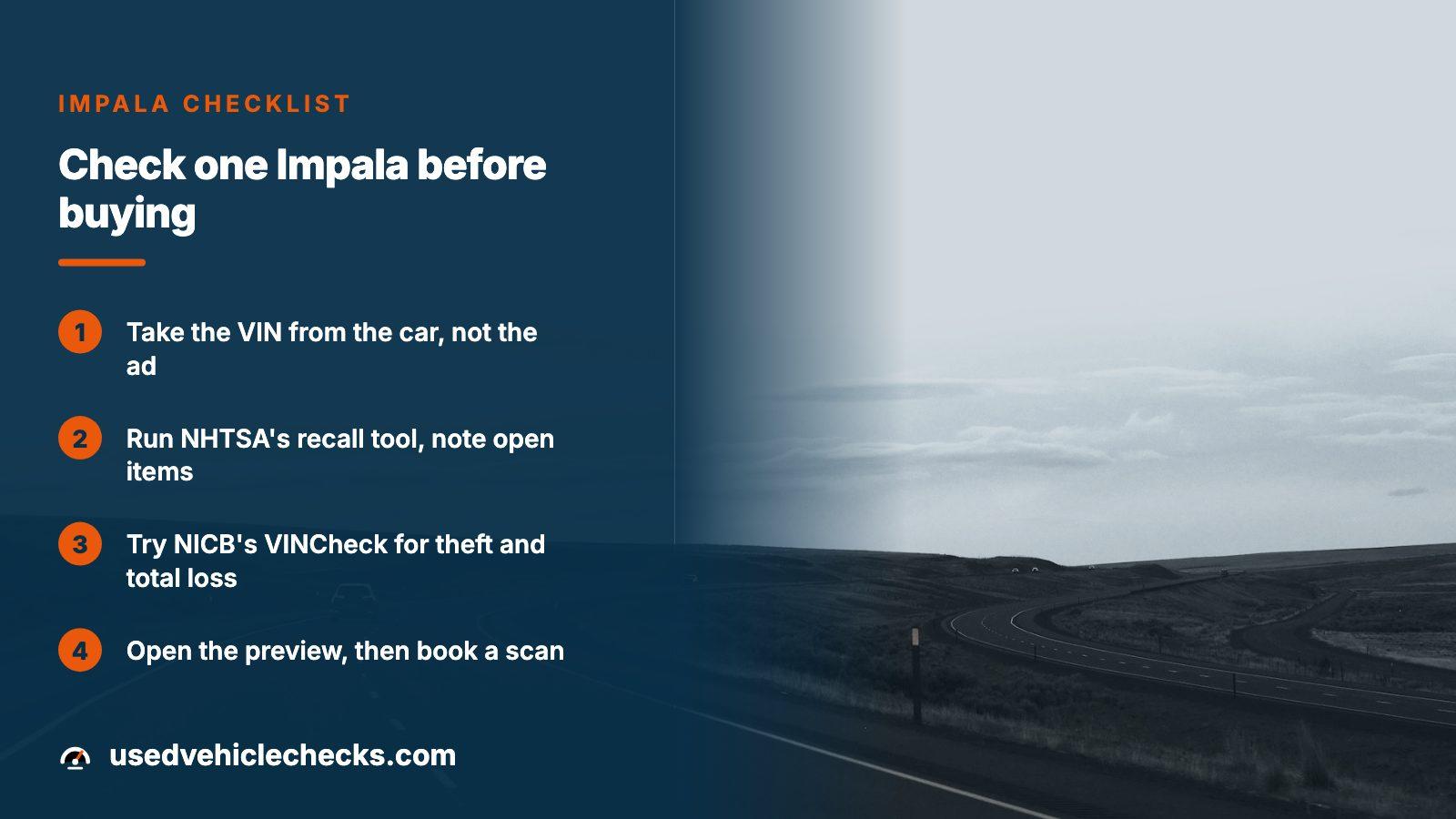
- Take the VIN from the car, not the advert, and confirm the model-year character matches the year claimed.
- Run it through NHTSA's recall tool and note every open campaign.
- Try NICB's VINCheck, whose theft and total-loss lookup carries no fee.
- Open the preview on this site, which is free. If the Impala makes your last two or three, buy the report and start with the odometer readings, then the title, damage, salvage and lien entries.
- Ask a mechanic to scan for stored fault codes, inspect the engine bay for burn marks and leaks, and test every electrical function.
Payment is a single charge, nothing recurring. Packs of 3, 5 or 10 reports exist for buyers comparing several Impalas; the pricing page has the details.
Where this information comes from
- NHTSA: vehicle safety and owner complaints — The federal agency that receives the owner complaints behind each model-year count.
- NHTSA: recalls by VIN — A no-charge lookup for open recall campaigns on one specific car.
- NICB: VINCheck — A quick theft and total-loss screen for one VIN.
- 49 U.S.C. 30120: remedy without charge — The statute behind the free recall repair and its 15-year limit.
- NHTSA owner complaint 11756028 — owner experience, paraphrased
- NHTSA owner complaint 11589955 — owner experience, paraphrased
- NHTSA owner complaint 11458962 — owner experience, paraphrased
Sources and photos: Facts checked against the sources above in November 2026. Photos by Clem Onojeghuo, John Kakuk and Dimitri Karastelev on Unsplash; diagrams by UsedVehicleChecks.
Keep reading
- Odometer Rollback Check by VIN: Run the Mileage Test Before You PayHow to line readings up by date and spot a step backward.
- How Many Miles Is Too Many on a Used Car? Age, Pace and ProofDecide what a six-figure reading on a full-size sedan means before you shortlist one.
- Nissan Altima Years to Avoid: Complaints and MileageA rival sedan ranked against its own median for a like-for-like comparison.
- Buying a Used Rental Car: Mileage, Records and the Recall RuleWhat a rental or fleet use type changes about the miles and the price.
Frequently asked questions
Which Chevrolet Impala years should I avoid?
Start with 2016, 2009 and 2008, which hold 897, 824 and 810 filings against a median of 299, then 2014 at 631 with 12 recalls. Avoiding them really means inspecting harder and offering less, since each produced good cars too. Steady odometer readings and finished recalls matter more than the year.
Is the 2016 Chevrolet Impala a bad car?
It is the year to examine most: 897 complaints, three times the median, engine the leading area and no recalls on file, so repairs usually fall on the owner. That describes the year, not one car. A 2016 with steady dated readings and a clean mechanic's report differs from one with gaps.
Which Impala years are the most reliable?
Complaint counts measure filings, not reliability. The lightest records are 2017, 2018, 2019 and 2020, at 116, 59, 28 and 15, though recent cars look good partly because owners had little time to write in. Whatever the year, check open recalls by VIN and have the electrical system and engine inspected.
Which problem do Impala owners report most often?
Electrical system draws the most complaints, 1,372 across 2008 to 2020, then engine at 891 and electronic stability control at 580. Each heading bundles many faults, so use the totals to decide where a mechanic looks first. The owner stories above point to wiring and sensors.
How do I check the mileage on a specific Impala?
Start from the VIN, because mileage belongs to one car, not a model year. The report lists dated readings, so go through them in order and check each is higher than the last. Then compare the newest with the display and any repair invoices. A reading that drops anywhere needs a written explanation.
Now check the car itself
The guide explains what to look for. The report shows what this VIN has on record.