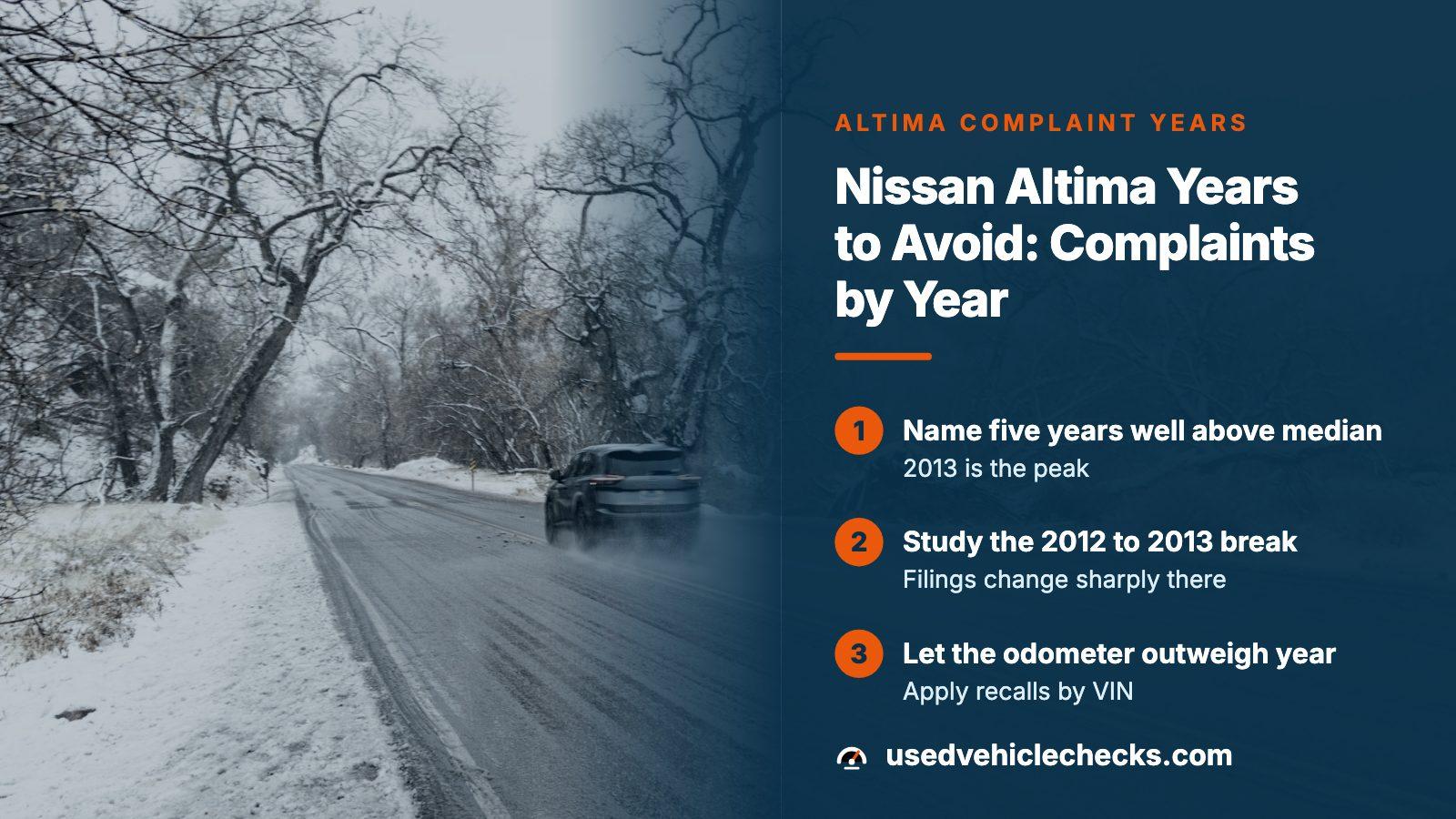
THE SHORT ANSWER
Across 2008 to 2022, the Altima years that deserve the closest scrutiny are 2013, 2009, 2014, 2008 and 2015, which run from 2.41 to 5.89 times the median year of 392 complaints. The lightest settled records belong to 2022, 2021 and 2020. Power train draws the most complaints overall. Read these as reasons to inspect harder and check the mileage history, not as reasons to rule a car out.
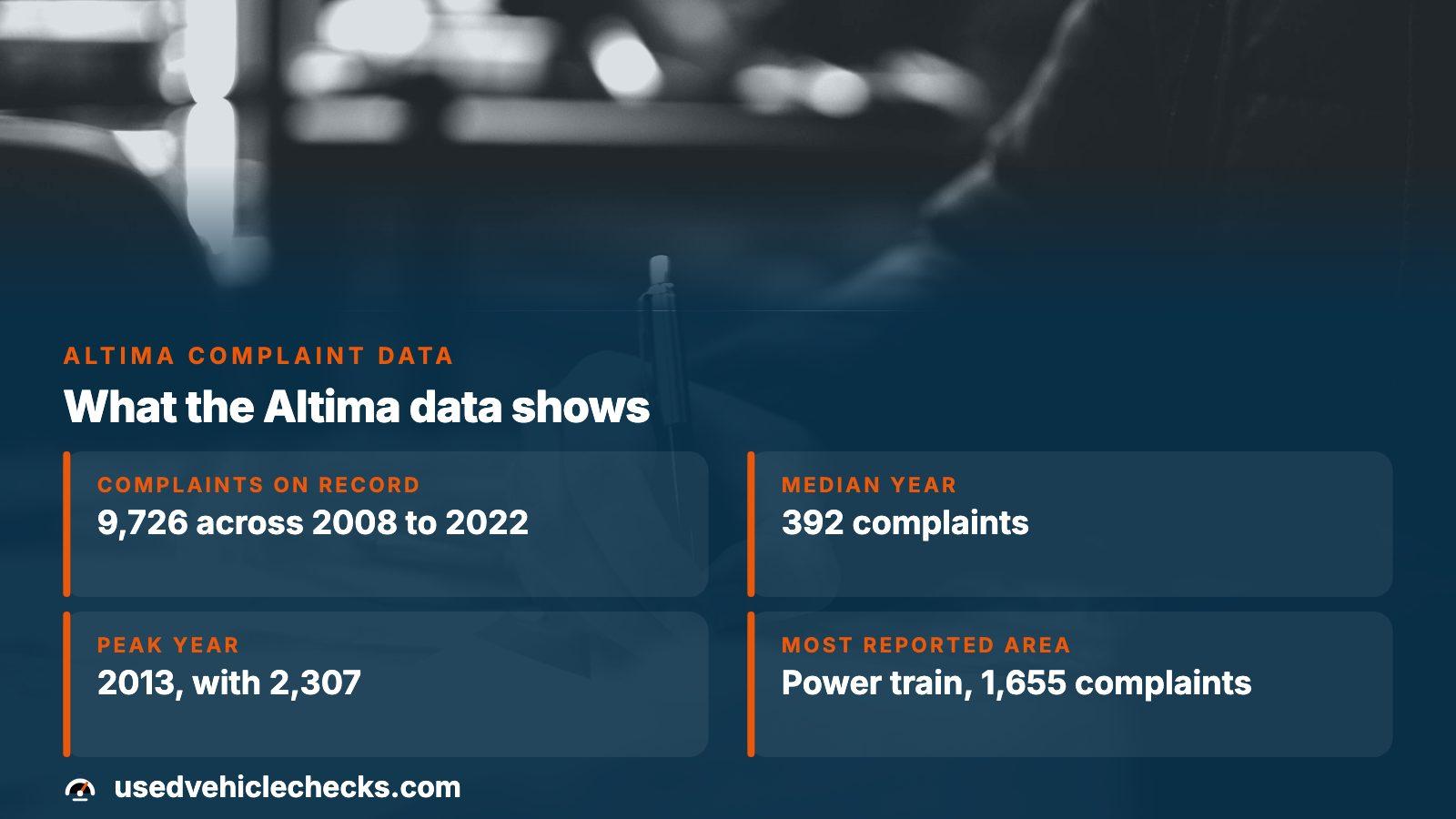
- Complaints on record
- 9,726 across 2008 to 2022
- Median year
- 392 complaints
- Peak year
- 2013, with 2,307
- Most reported area
- Power train, 1,655 complaints
The five Altima years that sit well above the median
As of mid-August, NHTSA held 9,726 owner complaints for the Altima across model years 2008 to 2022, spread unevenly. The middle year draws 392, so every year is read against the Altima's own median, never against other sedans. Five years run at more than twice that level.
| Model year | Complaints | Times the median | Recalls on file | Most reported area |
|---|---|---|---|---|
| 2013 | 2,307 | 5.89× | 12 | Air bags |
| 2009 | 1,601 | 4.08× | 4 | Steering |
| 2014 | 1,112 | 2.84× | 8 | Exterior lighting |
| 2008 | 1,044 | 2.66× | 4 | Structure |
| 2015 | 945 | 2.41× | 10 | Exterior lighting |
Read the list as a cue to inspect harder and offer less. Sound Altimas come out of all five years, and so do worn ones; filings cannot tell you which kind you are looking at.
The break between 2012 and 2013
The step matters more than the peak. The 2012 model year stands at 424 complaints, barely above the median, and then 2013 arrives with 2,307. A jump that size usually points to a reworked car or deeper engineering changes. Whether a car was built before or after that change matters more than the year printed in the advert.
Air bag and power train complaints stand out most in 2013, and the year logs 12 recalls, more than any other. Confirm the year from the tenth character of the VIN, because adverts can be sloppy.
From an NHTSA owner complaint
A 2013 Altima owner, filing in October 2025, described pulling away from a stop with the revs climbing and the car surging. After reaching a parking lot, the car lost power and the engine shut off. A dealership blamed the transmission and said it had to be replaced. The owner put the failure mileage at about 52,000.
Among 2013 power train filings that state a mileage, the middle figure is about 84,000, and the range is wide. A given car could sit anywhere on that scale, which is why the odometer history matters next.
Why the odometer can outweigh the model year
A year sorts Altimas into complaint groups. It cannot say whether one car did short school runs, long highway commutes, rental duty or ride-share shifts. A dated list of odometer readings can, and it shows how much of a flagged year's record could be waiting for you.
| What the readings show | What it suggests | What to do |
|---|---|---|
| A steady climb with evenly spaced dates | Ordinary use for the age | Treat the year's flag as a normal inspection prompt |
| A fast climb, or a rental, fleet or taxi use type | Hard duty on power train and steering | Ask for service invoices and price in the wear |
| The same figure on different dates | A stalled display or stale entries | Ask the seller to explain before talking price |
| An earlier reading above today's dash | A rollback, or a cluster swap nobody recorded | Ask for the swap invoice; without one, trust the higher figure |
The lighter years, and why a low count needs a second look
Three settled years sit well under the median: 2022 with 20 complaints, 2021 with 69 and 2020 with 177, carrying 0, 2 and 6 recalls. The years in between land near the median, from 2010 to 2012 and again from 2016 to 2019, with 2016 a shade higher at 1.41 times.
Young years flatter themselves, because few owners have filed anything yet, so the newest Altimas are treated as provisional. A thin file also says nothing about mileage. A 2020 that spent its early years in a rental pool can carry far more miles than a private car of the same age, so on a young Altima a high reading needs explaining.
Where Altima owners report trouble
| Complaints | Problem area |
|---|---|
| 1,655 | Power train |
| 1,335 | Air bags |
| 1,233 | Unknown or other |
| 1,007 | Exterior lighting |
| 912 | Steering |
| 764 | Electrical system |
Power train leads, and it is the NHTSA category covering the transmission and the parts that carry drive to the wheels. The test drive is the main exam on any Altima: cold start, steady acceleration, smooth shifts, no shudder. Lighting complaints cluster in 2014 and 2015. Steering tops 2009, mostly as a starting fault with a locked column.
From an NHTSA owner complaint
A 2009 Altima owner filed in December 2019 after the car would not start and had to be towed. A dealer diagnosed a failed steering lock. The owner said the dealer had fitted the same part in 2014 and again in 2019, and that the owner paid for the repair.
On a 2009, ask whether the steering lock has ever been replaced, and ask to see the invoice.
Recall counts by year, applied by VIN
A recall means the maker has acknowledged a defect and owes a free repair, although that duty ends 15 years after first sale. The 2013 year has 12, 2015 has 10 and 2014 has 8, yet 2019 and 2020 hold 7 and 6 despite light complaint files.
A long list can mean faults were caught and fixed, which beats a quiet record that hides them. Campaigns follow build dates, so the year alone cannot say whether one is open on a given car. The VIN can, and NHTSA's lookup costs nothing.
From an NHTSA owner complaint
A 2013 Altima owner wrote to NHTSA in May 2024 about a passenger air bag sensor fault. Two dealers said the car was outside the occupant sensor recall, and Nissan's customer service said it had been handled earlier but gave no date or place. The owner's usual dealers held no record of the repair, so the owner suspected an earlier owner had it done.
A recall can be marked done with nothing to show for it. Ask for the paperwork, run the VIN through NHTSA's lookup, and check the air bag warning light on the test drive.
Why complaint counts are not verdicts
- Volume: a big seller collects more letters than a rarer car of equal quality.
- Age: an older year has been on the road longer and so attracts more reports, which flatters the youngest.
- Source: each complaint is one owner's account, and nobody has verified it.
- Scope: a year describes a population of cars, while title, damage and mileage records belong to a single VIN.
Other midsize sedans carry similar piles, such as 9,764 complaints for the Sonata, but only against each model's own median.
Checking one Altima before you hand over money
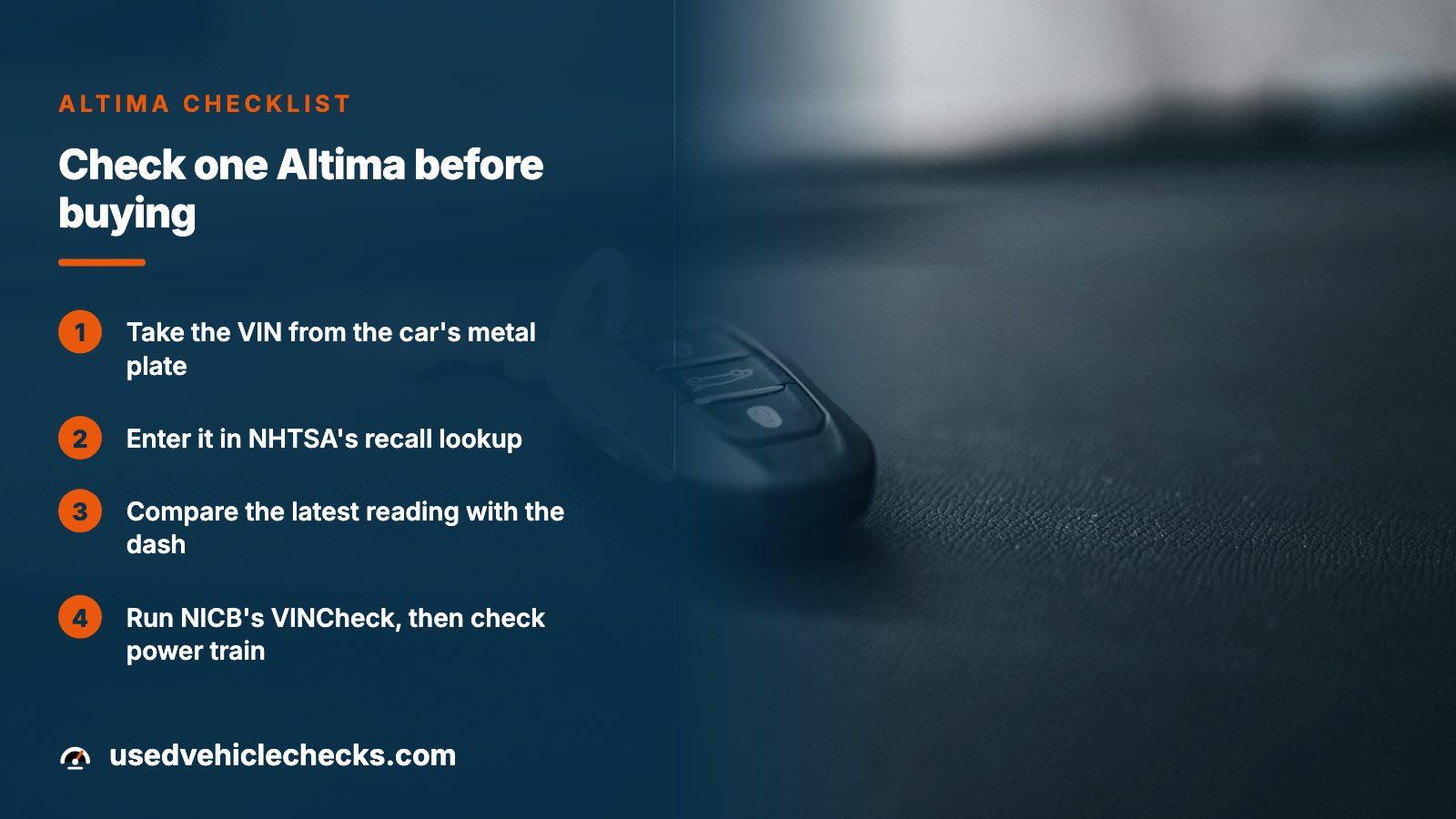
- Take the VIN from the car's own metal plate, not the listing. It has 17 characters, and the tenth should fit the year claimed.
- Enter it in NHTSA's recall lookup, a no-charge tool, and note any open campaign.
- Open the free preview on this site. If the car stays on your shortlist, buy the report and start with the odometer readings, oldest first.
- Compare the latest reading with the dash and with any mileage on repair invoices.
- Weigh any salvage or auction photos, accident entries and title brands against those miles.
- Run NICB's VINCheck for a no-cost theft and total-loss screen.
- Have a mechanic check the power train, steering and air bag warning light before you settle on a price.
Buying is a one-time payment with nothing recurring: one report for your favorite car, or a pack when several Altimas are in the running. The pricing page lists the options.
Where this information comes from
- NHTSA: vehicle safety and owner complaints — The federal agency that receives the owner complaints behind each model-year count.
- NHTSA: recalls by VIN — A no-cost lookup for open recall campaigns on one specific car.
- NMVTIS: national title record — The federal title program, which covers the single vehicle that a year table cannot.
- NICB: VINCheck — A quick theft and total-loss screen for one VIN.
- NHTSA owner complaint 11691235 — owner experience, paraphrased
- NHTSA owner complaint 11286482 — owner experience, paraphrased
- NHTSA owner complaint 11589325 — owner experience, paraphrased
Sources and photos: Facts checked against the sources above in November 2026. Photos by Zoshua Colah, Bence Balla-Schottner and Owen Michael Grech on Unsplash; diagrams by UsedVehicleChecks.
Keep reading
- Odometer Rollback Check by VIN: Run the Mileage Test Before You PayHow to line readings up by date and spot a step backward.
- How Many Miles Is Too Many on a Used Car? Age, Pace and ProofDecide what a high number on the dash means before you shortlist a sedan.
- Hyundai Sonata Years to Avoid, and the Mileage That MattersA midsize rival ranked against its own median for a like-for-like comparison.
- Chrysler 200 Years to Avoid, and What the Odometer AddsA shorter model run where one year towers over the rest.
Frequently asked questions
Which Nissan Altima years should I avoid?
Start your caution with 2013, 2009 and 2014, which carry 2,307, 1,601 and 1,112 complaints against a median year of 392. Caution means a closer inspection and a lower offer, not a ban.
Is the 2013 Nissan Altima a bad car?
Not automatically, but it is the year to scrutinize most, with 2,307 complaints, 5.89 times the median, and 12 recalls. A 2013 with every recall completed and readings that climb in order is a different car from one with gaps in its history.
Which Altima model years are the most reliable?
Complaint counts measure filings, not reliability, but 2022, 2021 and 2020 carry the lightest settled records. Young cars look clean mainly because few owners have filed yet, so look up open recalls on the VIN and book a mechanic's inspection whatever the year.
Where do Altima owners report the most trouble?
Power train draws the most complaints, 1,655 across the 15 years on record, followed by air bags at 1,335. Ask a mechanic to road test the car and check the air bag warning light, and confirm recalls by VIN.
How do I check the mileage on a specific Altima?
Use the VIN. Open the free preview on this site, buy the report if the car stays in the running, and read the dated odometer readings oldest to newest. Treat any earlier figure higher than the dash as a warning.
Now check the car itself
The guide explains what to look for. The report shows what this VIN has on record.