THE SHORT ANSWER
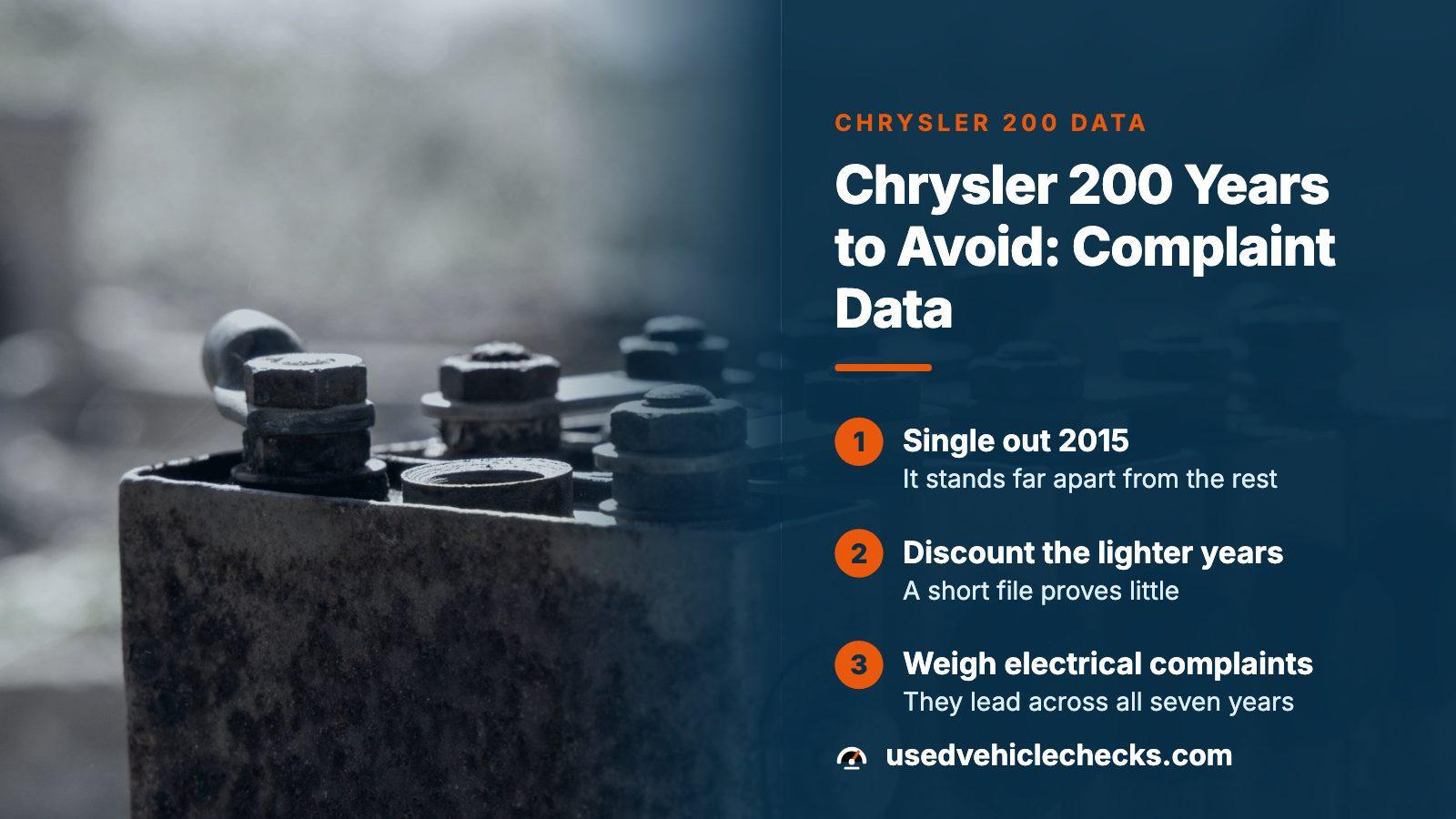
The Chrysler 200 model years to approach with care are 2015, 2012 and 2013, which run at 5.8, 1.87 and 1.83 times the nameplate's median of 342 complaints a year. The lightest settled record belongs to 2017, and electrical system draws the most complaints overall. A year only places a car in a group, so read that VIN's odometer readings, open recalls and title record before you pay.
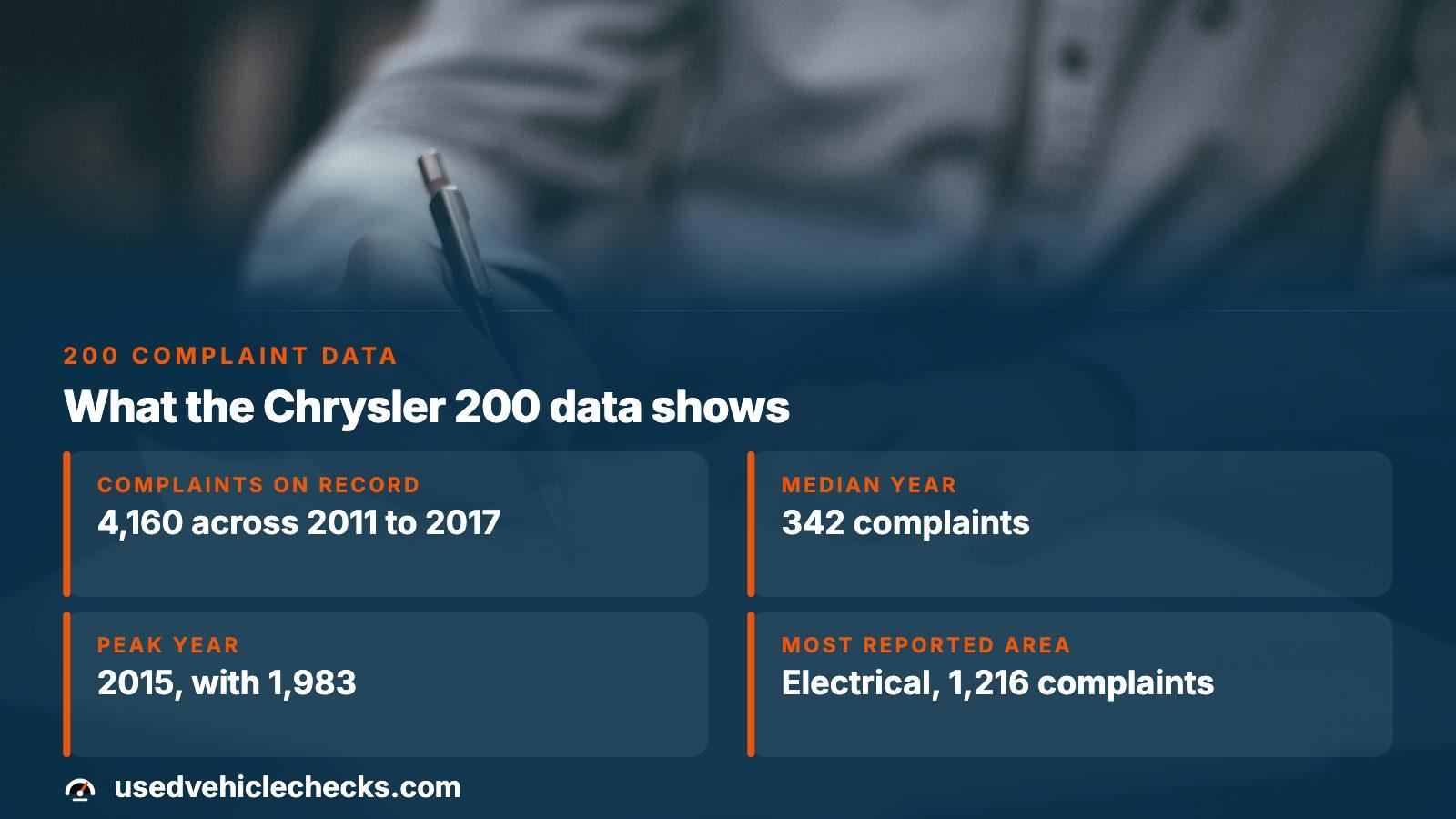
- Complaints on record
- 4,160 across 2011 to 2017
- Median year
- 342 complaints
- Peak year
- 2015, with 1,983
- Most reported area
- Electrical system, 1,216 complaints
The three Chrysler 200 years that run above the median
NHTSA holds 4,160 owner complaints for the Chrysler 200 across model years 2011 to 2017, and they are not spread evenly. The middle year of the seven sits at 342, so each year is read against the car's own median, not against other sedans. Three years clear that bar.
| Model year | Complaints | Times the median | Recalls on file |
|---|---|---|---|
| 2015 | 1,983 | 5.8× | 8 |
| 2012 | 638 | 1.87× | 4 |
| 2013 | 627 | 1.83× | 5 |
Those are reasons to inspect harder and offer less, not reasons to write off a particular car. Sound, well-kept 200s turn up in all three years, and so do neglected ones.
Why 2015 stands so far apart
The jump is the story. Complaints climb from 192 for the 2014 model year to 1,983 for 2015, a step that more often traces back to a redesign or deeper mechanical changes than to slow drift. What matters is which side of that break a car sits on, not the year printed in the listing.
In that peak year, electrical system and power train complaints stand out most, and recalls peak too, at 8 against 1 for 2014. Recalls measure something else: the maker admits a defect and fixes it without billing the owner, although that obligation ends 15 years after the car was first sold.
From an NHTSA owner complaint
A 2015 owner told NHTSA the car jerked and stalled at any speed while the odometer display blinked on and off, at roughly 39,000 miles. The dealer said nothing could be done, and the maker answered that no recall covered it.
Ask any seller of a 2015 what happened to dash faults like this one. A shrug from a dealer and a no-recall answer can leave the repair bill with whoever owns the car next.
The lighter years, and what to discount about them
Four model years sit at or under the median, though a low count can have a quiet explanation. Here is how they compare.
| Model year | Complaints | Times the median | Recalls on file |
|---|---|---|---|
| 2017 | 43 | 0.13× | 1 |
| 2014 | 192 | 0.56× | 1 |
| 2011 | 335 | 0.98× | 3 |
| 2016 | 342 | 1× | 2 |
Treat 43 filings for 2017 as a mild point in the car's favor, not a guarantee. A year that sold fewer cars, or has had less time on the road, collects fewer letters for the same quality.
Why one car's mileage outranks its model year
The year drops a 200 into a complaint group. It cannot say whether the car idled through short commutes or ran all day for an employer. The odometer history can, and a dated list of readings is the cheapest way to see how hard a car was used. Look for these things.
- Readings that climb in order across every recorded event, at a pace that fits how the car was used.
- Several readings that stay identical across different dates, which can mean the display stopped counting.
- A recorded reading higher than the number on the dash today.
- A use type of rental, fleet or taxi, which puts miles on fast.
- Wear that matches the figure: the brake pedal pad, the shifter, the steering wheel rim and the driver's door sill.
When the record runs ahead of the dash
An earlier reading above today's display points to a rollback or an undisclosed instrument swap. Ask for the repair invoice showing the mileage at the swap. With no paper, price the car as though the higher number is true, or walk away.
Electrical complaints and what they mean for the dash
Electrical system is the largest complaint area on the 200, with 1,216 reports, just ahead of engine at 1,204. A car with a record of electrical faults is also a car that may have had parts replaced, and the part that matters here is the instrument cluster. A replacement cluster should carry the car's true mileage, and the work order should note the figure at the time.
From an NHTSA owner complaint
Another 2015 owner reported the whole instrument cluster, speedometer included, going dark on the highway. Turning the car off and on brought it back. It had happened four times, seemed tied to hot weather, and the dealer's codes were inconclusive.
A fault that clears on restart leaves nothing to see on a test drive. Ask whether the cluster was ever replaced, then compare the mileage on that work order with the dated readings in the vehicle history. If the two disagree, press the seller before any price talk.
Where owners report trouble across all seven years
| Complaints | Problem area |
|---|---|
| 1,216 | Electrical system |
| 1,204 | Engine |
| 837 | Air bags |
| 804 | Power train |
| 496 | Unknown or other |
| 191 | Seat belts |
Engine leads for 2012 and air bags for 2013. Scan for fault codes, listen to a cold start, and drive far enough to feel the transmission shift. The air bag and seat belt filings are a cue to look up open recalls on the VIN, not to assume the fix was done.
From an NHTSA owner complaint
A 2015 owner described a radio screen that went blank, then a flashing odometer and a check engine light. The battery had been replaced three times since 2019 and a fourth was due. The dealer charged a fee just to troubleshoot, and the owner suspected a short somewhere.
A history of dead batteries on a 200 deserves a question to the seller, since the cause may sit in the wiring and not in the battery.
Reading the counts without being misled
- Volume: a car that sold in large numbers draws more letters than a rarer one that is equally sound.
- Age: the oldest years have been on the road longest, which flatters the youngest ones by comparison.
- Source: every complaint is a single owner's account, and nobody has checked it.
- Recalls: a long list can mean faults were caught and repaired under the maker's expense, which beats a quiet file that hides them.
Totals mislead across nameplates too. The Nissan Altima's 9,726 complaints span 2008 to 2022, far more years than the 200's seven, so compare a year only with its own car's median.
Checking one Chrysler 200 before you pay
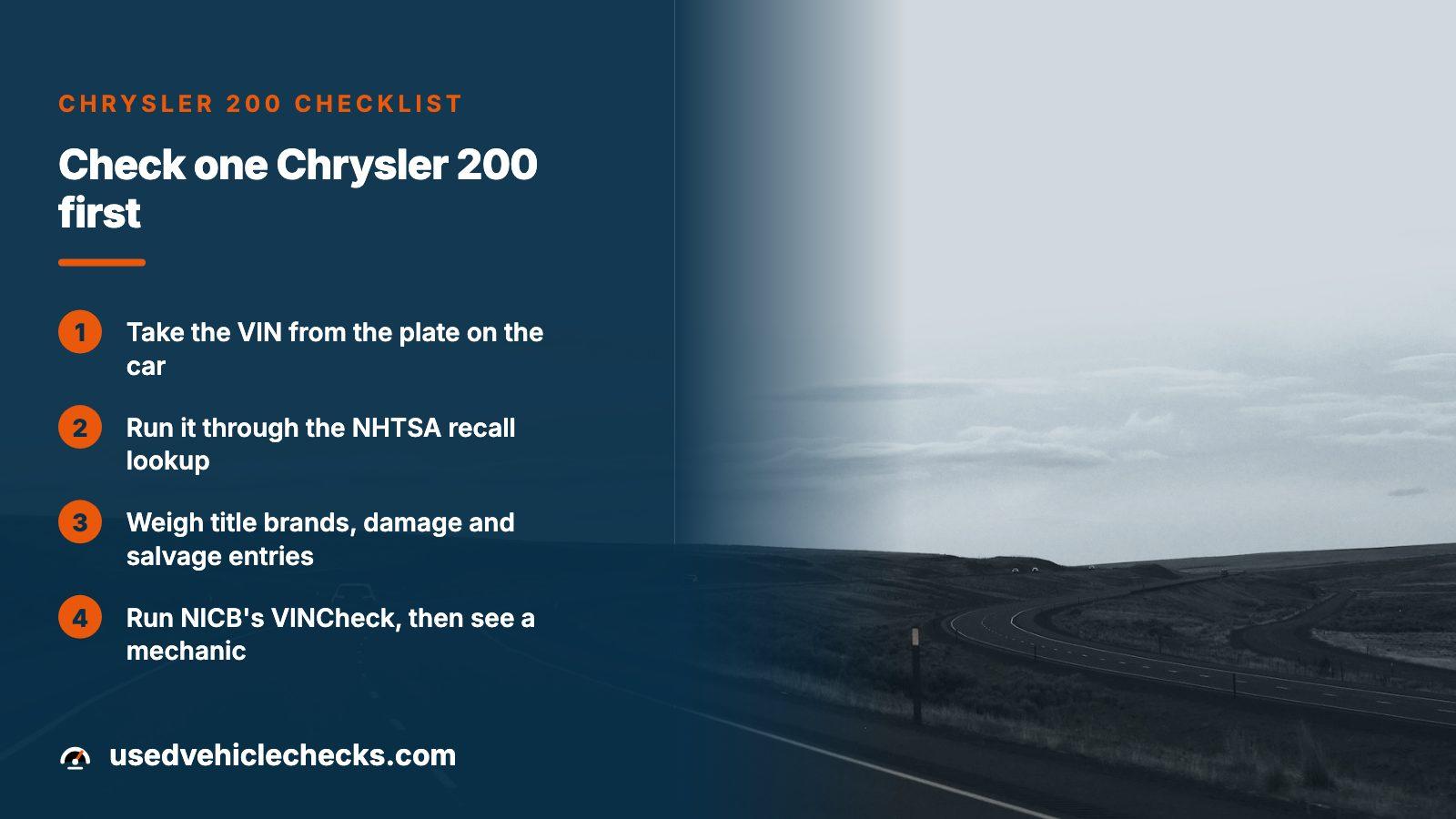
- Take the VIN from the metal plate on the car rather than from the advert. It has 17 characters, and the tenth should fit the year the seller claims.
- Run it through the NHTSA recall lookup, which costs nothing. A campaign covers certain production runs, so only the VIN settles whether one applies.
- Open the free preview here. Should the car survive your shortlist, buy the report and start with the odometer readings, oldest first.
- Weigh title brands, damage and accident entries, salvage and auction photos, liens and use type against those readings.
- Run NICB's VINCheck for a no-cost theft and total-loss screen.
- Finish with a mechanic who goes over the electrical system, engine and power train.
Payment is a single charge with nothing recurring, whether you buy one report or a pack to compare several cars. The pricing page has the details.
Where this information comes from
- NHTSA: vehicle safety and owner complaints — The federal agency where owners file the complaints behind each model-year count.
- NHTSA: recalls by VIN — A no-cost lookup for open recall campaigns on one specific car.
- NMVTIS: national title record — The federal title history program, which speaks to one vehicle in a way a year table cannot.
- NICB: VINCheck — A quick theft and total-loss screen for a single VIN.
- NHTSA owner complaint 11010237 — owner experience, paraphrased
- NHTSA owner complaint 11196785 — owner experience, paraphrased
- NHTSA owner complaint 11618448 — owner experience, paraphrased
Sources and photos: Facts checked against the sources above in November 2026. Photos by Stephen Mabbs, John Kakuk and Scott Graham on Unsplash; diagrams by UsedVehicleChecks.
Keep reading
- Odometer Rollback Check by VIN: Run the Mileage Test Before You PayHow to line up a car's mileage readings and spot a step backward.
- How Many Miles Is Too Many on a Used Car? Age, Pace and ProofDecide what a high number on the dash means before you shortlist a sedan.
- Nissan Altima Years to Avoid: Complaints and MileageThe same year-by-year read for a midsize sedan with a bigger complaint pile.
- Hyundai Elantra Years to Avoid, and What Mileage AddsA compact sedan ranked against its own median, for a like-for-like comparison.
Frequently asked questions
Which Chrysler 200 years should I avoid?
Start your caution with 2015, 2012 and 2013, which carry 1,983, 638 and 627 NHTSA complaints against a median year of 342. Caution means a closer inspection and a lower offer, not a ban. A flagged car with steady odometer readings and service invoices can still be a fair purchase.
Which Chrysler 200 model years have the cleanest record?
Complaint counts measure filings, not reliability, but 2017 has the lightest settled record at 43, followed by 2014 at 192. Thin files can also reflect fewer cars sold. Whatever the year, look up open recalls on the VIN and book a mechanic's inspection.
Where do Chrysler 200 owners report the most trouble?
Electrical system, with 1,216 complaints over the seven years on record, narrowly ahead of engine at 1,204. Air bags and power train follow. Ask a mechanic to scan for fault codes and to test the car on the road before you settle on a price.
Is a 2015 Chrysler 200 a bad buy?
Not automatically. The year draws 1,983 complaints, 5.8 times the median, and has 8 recalls on file, so it deserves the closest look. A car with its recalls done, a clean title record and odometer readings in order can still be worth buying at a price that reflects the year.
How can I check the mileage on a specific Chrysler 200?
Use the VIN. Open the free preview here, then buy the report if the car is still in the running and read its dated odometer readings from oldest to newest. Compare the latest one with the dash, and with any mileage written on repair invoices, especially after electrical work.
Now check the car itself
The guide explains what to look for. The report shows what this VIN has on record.