THE SHORT ANSWER
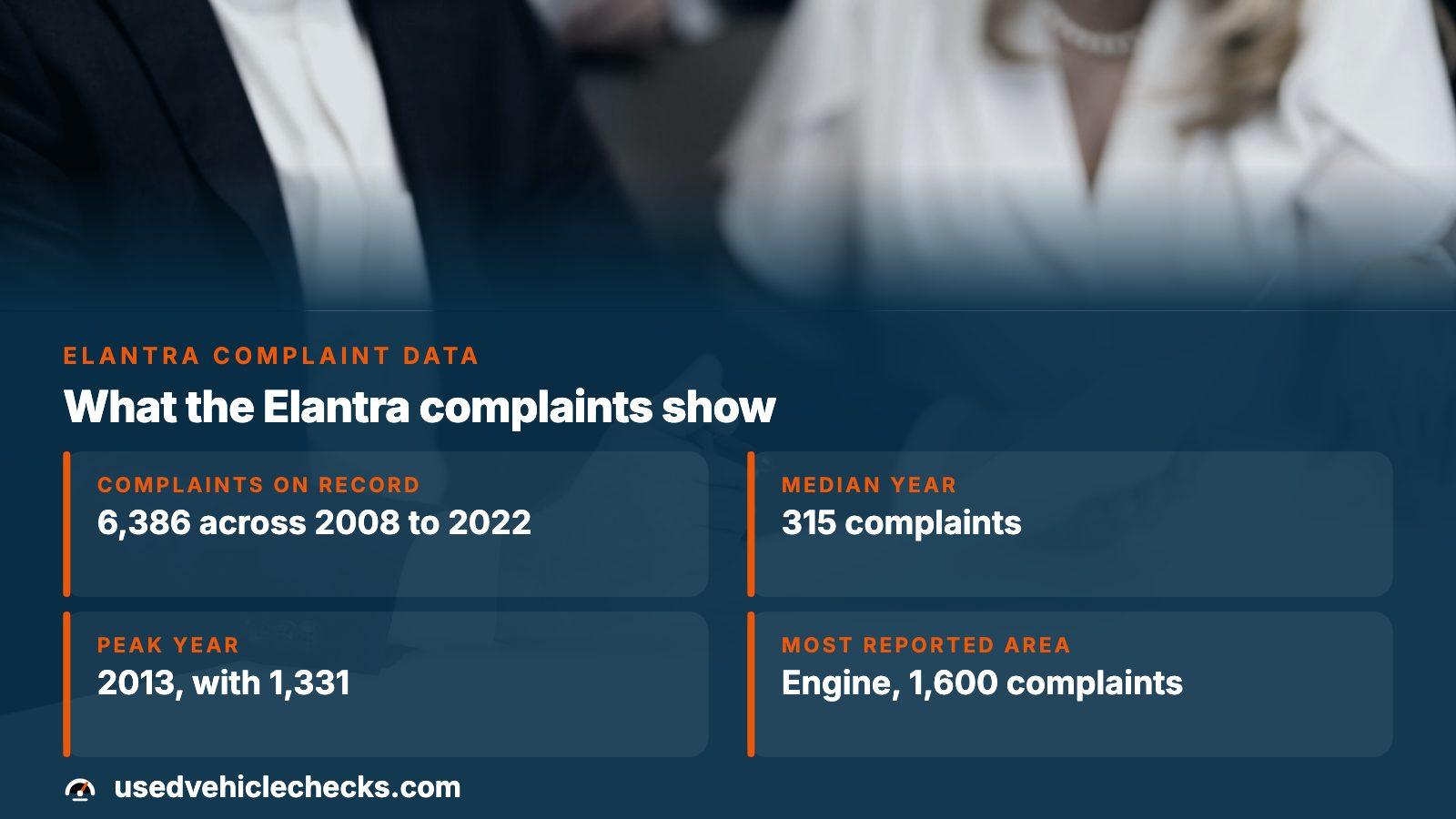
Across model years 2008 to 2022, the Elantra years that deserve the hardest look are 2013, 2017, 2012, 2011 and 2010, each at least 1.44 times the median year of 315 complaints. The lightest settled records belong to 2022 and 2021. Engine is the most reported area overall, at 1,600 complaints. A flagged year calls for a longer test drive and a mileage check, not for walking away.
- Complaints on record
- 6,386 across 2008 to 2022
- Median year
- 315 complaints
- Peak year
- 2013, with 1,331
- Most reported area
- Engine, 1,600 complaints
The five Elantra years that sit above the median
As of mid-August, NHTSA held 6,386 owner complaints on the Elantra for model years 2008 through 2022. The middle year logs 315, so every year is weighed against that figure, not against other sedans. Five land well above it, and each leans on a different part of the car.
| Model year | Owner filings | Versus median | Recalls | Most reported area |
|---|---|---|---|---|
| 2013 | 1,331 | 4.23× | 4 | Service brakes |
| 2017 | 787 | 2.5× | 4 | Engine |
| 2012 | 673 | 2.14× | 4 | Engine |
| 2011 | 460 | 1.46× | 5 | Engine |
| 2010 | 453 | 1.44× | 3 | Steering |
Each count is one owner's unverified account, so the table shows where to press during an inspection, not which cars are bad.
2013: the jump from 673 to 1,331 filings
Filings roughly doubled from the 2012 model year to the 2013, and three of that year's four recalls involve braking. Two concern one worn part, a pedal stopper pad that can crumble, which keeps the brake lights glowing and lets the gear lever slip out of park with no pedal pressed. The third, from 2023, covers an ABS module that can leak internally, short and risk a fire, so owners were told to park outdoors until a fuse swap is done. That ABS notice also appears for 2011 and 2012. Only a VIN lookup shows whether one car falls in range and what the record says about the repair.
2017, 2012 and 2011: engine complaints without an engine recall
Engine tops the complaint list for all three years, and its 1,600 filings are the biggest category overall. Recalls point elsewhere. For 2017 they cover driver air bag modules, a steering assist connector and a brake booster. For 2012 and 2011 they cover a stability control sensor, a headliner bracket, an accessory socket and the ABS module. No campaign touches the engine.
From an NHTSA owner complaint
The original owners of a 2017 Elantra with about 136,000 miles filed in October 2024 after the engine began knocking as they drove. No warning light had come on first. A Hyundai dealer said the car needed a new engine, and the owners said it had been serviced and had its oil changed regularly.
A tidy recall lookup therefore leaves the engine unexamined on these years. Ask for dated oil-change invoices and have a mechanic check what a dashboard will not show.
2011 and 2010: road salt and a steering assist fault
Five recalls sit on the 2011 year, and one rewards a question about geography. Early builds sold or registered in a set of salt belt states carry a corrosion risk: road salt may eat at the front coil springs until one cracks. NHTSA says a car since moved out of those states still qualifies for the inspection and repair, so ask where a 2011 spent its first winters.
About half of the 2010 filings name steering, and one of its three recalls fits. On 2008 to 2010 builds, the control unit for the electric power steering can shut off assist, and the fix is a check plus an update to that unit.
What the odometer adds to a flagged year
A model year sorts Elantras into groups, but only the odometer history shows how hard one car has worked. The federal title database, NMVTIS, lists the odometer reading among five report items because fraud can inflate what a buyer pays and a reading exposes gaps in the story.
| What the mileage record shows | What it suggests | What to do |
|---|---|---|
| An even climb with evenly dated readings | Ordinary use for the car's age | Take a longer test drive |
| Very few miles for a 2010 to 2013 car | Light use, or a figure that needs proof | Ask for service invoices; match each entry to the dash |
| A past reading above today's display | A rollback, or an unrecorded gauge swap | Ask for the swap invoice; without one, believe the higher number |
From an NHTSA owner complaint
A 2013 owner who filed in November 2020 reported a steering wheel that clicked and sometimes snapped back to center on the road. The diagnosis, as the owner relayed it, was the power steering coupler. With 101,000 on the odometer, just 1,000 past the warranty limit, the dealer declined to cover it.
Mileage can decide who pays. Ask the seller what coverage remains, and confirm it with Hyundai for the VIN.
Second owners and the coverage question
Ownership can matter as much as miles. A second owner takes on whatever the car has coming, and the maker's terms for later owners may differ from the first owner's, so ask before the sale. The report's ownership and use entries are where to see how many owners the car has had.
From an NHTSA owner complaint
A 2012 owner filed in December 2018 after the engine gave out mid-drive and the car stopped immediately. It had fewer than 100,000 miles, routine servicing and no history of trouble. The writer, its second owner, said that left the car outside factory coverage.
A low reading is not protection in itself. Price a possible engine repair into the offer when the car is a flagged year.
The quieter years, and why they prove less than they seem
The lightest records belong to 2022, with 152 filings, and 2021, with 158, among cars old enough to give a fair sample. Newer cars look tidy partly because fewer owners have had a chance to file, and the higher recall counts on 2021 and 2022 can mean faults were fixed at the maker's cost. A young Elantra can still have lived hard on rental or ride-share duty, so a thin complaint file never replaces the odometer record.
What complaint counts cannot tell you
- Sales volume: strong sellers attract more reports than scarce models, whatever the quality.
- Age: an older year has had longer to attract complaints, so the newest look cleaner.
- Accuracy: every report is a single owner's view, and none is verified.
- Scope: a year covers thousands of cars, while title, damage and mileage records belong to one VIN.
Recalls differ, since the maker admits the fault and pays. The statute does end that duty once a notice lands over 15 calendar years after a car's first sale, so a very old Elantra may get a new campaign with no free fix.
Checking one Elantra before you pay
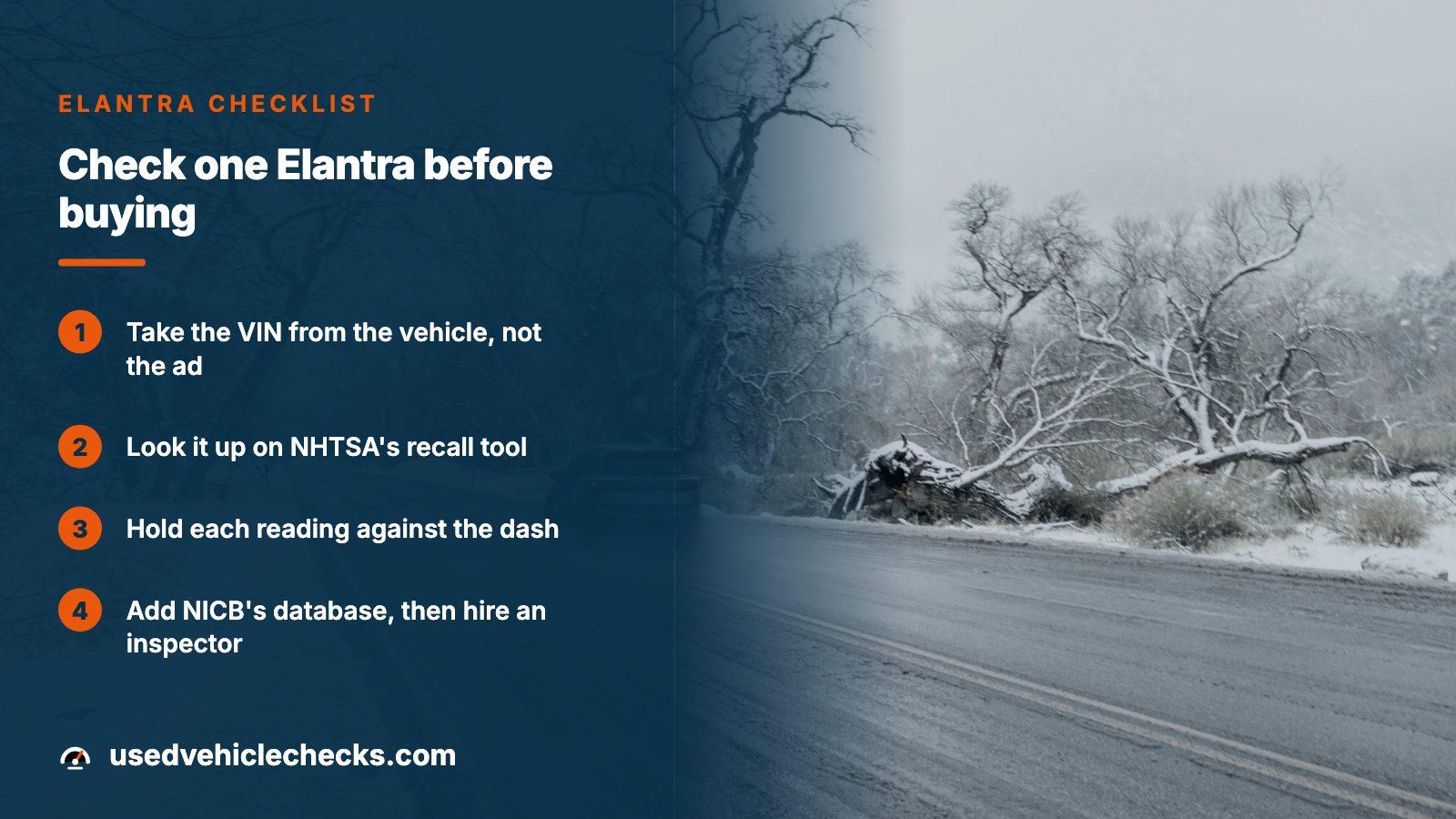
- Take the VIN from the vehicle itself rather than the ad, and confirm its model-year character fits the year advertised.
- Look it up on NHTSA's recall tool, which costs nothing, and note any open campaign. Campaigns follow build ranges, so a neighboring Elantra may not be covered.
- Open the free preview here, and if the Elantra is still in play, buy the report and start with its oldest odometer entry.
- Hold each dated reading against the dash and against mileage printed on service invoices.
- Weigh any title brand, salvage or auction entry, accident record and ownership change against that mileage story.
- Add NICB's no-cost database, which covers flood damage and other history items.
- Have an independent mechanic inspect it, name the year's weak spot, and take a test drive that mixes hills, fast roads and crawling traffic.
You pay per report, with no recurring charge; the pricing page covers the single report and the packs.
Where this information comes from
- NHTSA: recalls by VIN — Where a VIN lookup shows open campaigns for one car; campaign details here come from NHTSA's recall data for each model year.
- NMVTIS: understanding a vehicle history report — The five items in the federal title report and why the odometer reading is one of them.
- NMVTIS: used car buying tips — Federal advice on inspections, varied test drives and maintenance records, with a pointer to NICB's database.
- 49 U.S.C. 30120: remedies for defects and noncompliance — The 15 calendar year limit on a free recall remedy.
- NHTSA owner complaint 11617934 — owner experience, paraphrased
- NHTSA owner complaint 11374126 — owner experience, paraphrased
- NHTSA owner complaint 11162907 — owner experience, paraphrased
Sources and photos: Facts checked against the sources above in November 2026. Photos by Erik Mclean, Zoshua Colah and Carrie Allen www.carrieallen.com on Unsplash; diagrams by UsedVehicleChecks.
Keep reading
- Mileage Check by VIN: What the Recorded Odometer Readings ShowWhat dated odometer readings show for one VIN before money changes hands.
- How Many Miles Is Too Many on a Used Car? Age, Pace and ProofWork out whether a high reading rules an Elantra out.
- Hyundai Sonata Years to Avoid, and the Mileage That MattersThe same ranking for the Elantra's bigger Hyundai sedan.
- Odometer Discrepancy Check: Find a Mileage Mismatch Before You PayWhat to do when a reading in the record disagrees with the dash.
Frequently asked questions
Which Hyundai Elantra years should I avoid?
Start with 2013, 2017 and 2012, which drew 1,331, 787 and 673 complaints against a median year of 315. Each still has sound cars, so treat the flag as a reason for a longer test drive, an inspection and a close read of the mileage record.
Is the 2013 Hyundai Elantra a bad car?
Not automatically, but it is the year to inspect hardest: 1,331 filings, 4.23 times the median, led by service brakes. Check the VIN against its four recalls, confirm the work was done, and read the odometer history before making an offer.
Which Elantra years are the most reliable?
Filings measure complaints, not reliability, but 2022 and 2021 carry the lightest records, at 152 and 158. Newer cars look clean partly because few owners have filed yet, so run the recall lookup and read the odometer record whatever the year.
Which part of an Elantra gives owners the most trouble?
Engine, with 1,600 complaints across 2008 to 2022, ahead of steering at 964 and the electrical system at 792. The engine-led years 2017, 2012 and 2011 have no engine recall on NHTSA's lists, so a mechanic's inspection and dated oil-change records matter.
How do I check the mileage on a specific Elantra?
Begin with the VIN. The preview on this site is free; if the car stays in contention, buy the report and read its dated odometer entries, earliest first. A past reading higher than the dash needs an explanation, with paperwork, before you pay.
Now check the car itself
The guide explains what to look for. The report shows what this VIN has on record.