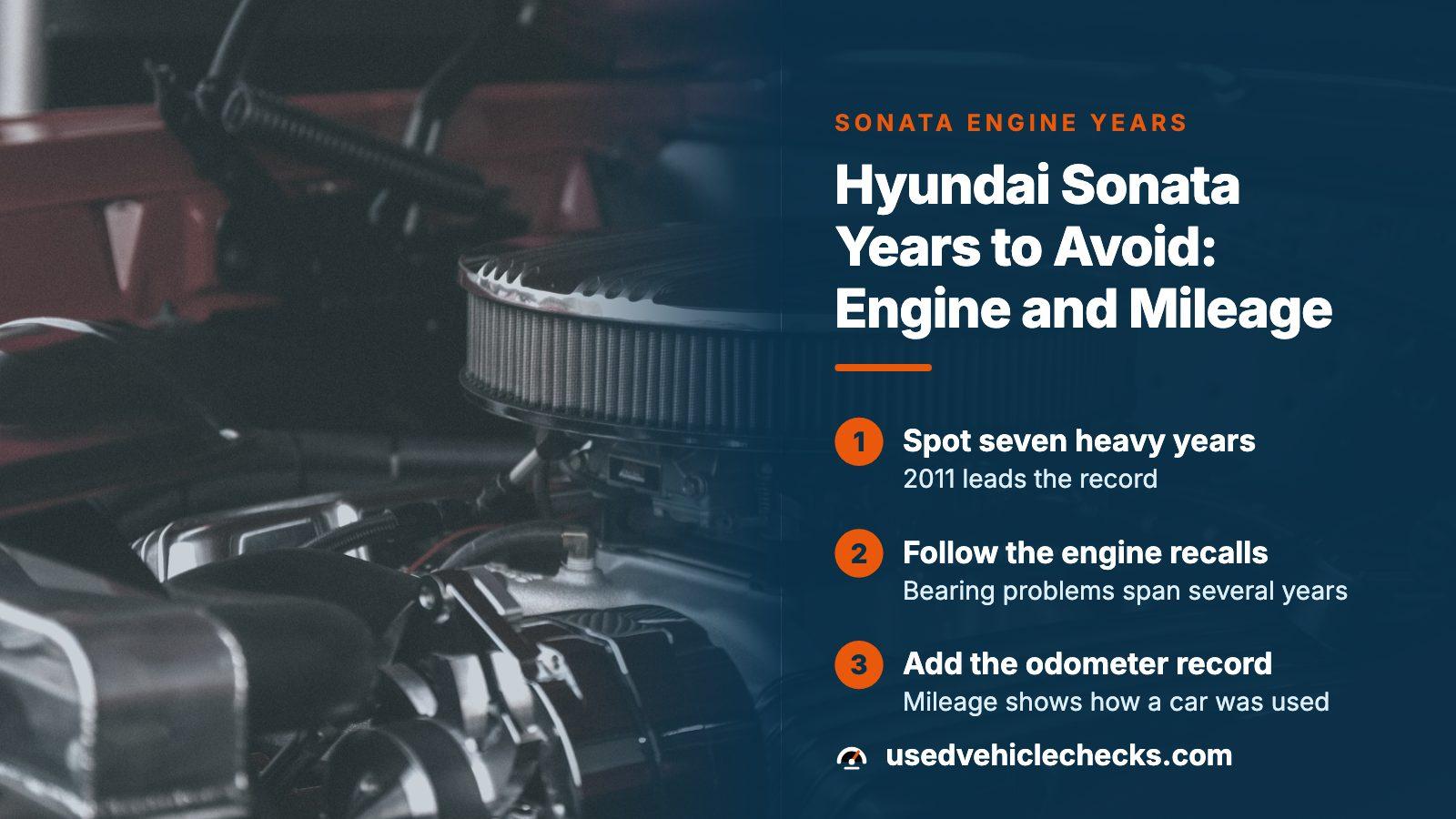
THE SHORT ANSWER
Of the Sonata model years from 2008 to 2022, 2011, 2013, 2012 and 2015 carry the heaviest complaint records, with 2017, 2014 and 2016 trailing them. The lightest records belong to 2022, 2021 and 2019. Engine is named in 4,570 complaints, more than any other area. A flagged year means a closer look at recalls, repair history and dated odometer readings, not an automatic no.
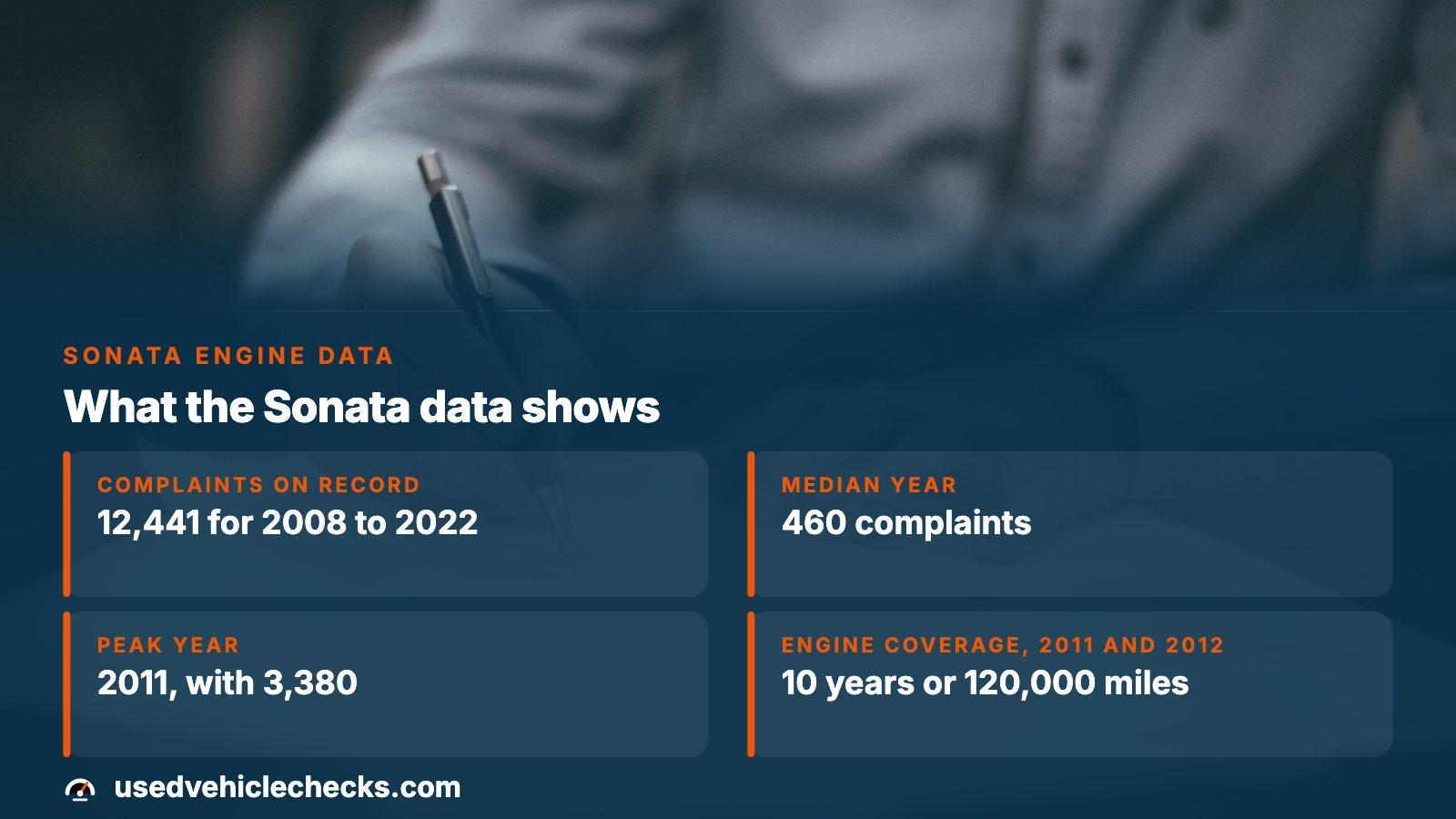
- Complaints on record
- 12,441 for 2008 to 2022
- Median year
- 460 complaints
- Peak year
- 2011, with 3,380
- Engine coverage on 2011 and 2012 builds
- 10 years or 120,000 miles
Seven Sonata years sit above the median
As of early November, NHTSA's public database holds 12,441 owner complaints on the Sonata sedan for model years 2008 through 2022. The middle year logs 460, so every year is judged against that figure, not against other cars. Seven land above it, and the oldest of them leads by a wide margin.
| Model year | Filings | Times the median | Recalls | Most named area |
|---|---|---|---|---|
| 2011 | 3,380 | 7.35 | 14 | Steering |
| 2013 | 1,917 | 4.17 | 9 | Engine |
| 2012 | 1,559 | 3.39 | 8 | Engine |
| 2015 | 1,156 | 2.51 | 9 | Engine |
| 2017 | 769 | 1.67 | 3 | Engine |
| 2014 | 751 | 1.63 | 7 | Engine |
| 2016 | 728 | 1.58 | 6 | Engine |
The Sonata Hybrid sits under its own model name at NHTSA, so its filings are left out. Treat every count as an unverified owner report: a prompt for the mechanic, not a verdict on any car.
2011 and 2012: Alabama-built engines and a 120,000-mile line
Recall 15V568 covers 2011 and 2012 Sonatas assembled in Alabama between December 11, 2009 and April 12, 2012. It names both direct-injection engines, the 2.0 and 2.4 liter. Metal debris left from machining the crankshaft can starve the connecting rod bearings of oil, which brings a rhythmic knock and can end in a stall. Where a dealer's inspection finds trouble, the engine is replaced. Hyundai also lifted the warranty on the engine's short block to 10 years or 120,000 miles, for later owners as well as the first.
From an NHTSA owner complaint
A buyer who filed in August 2018 had just bought a 2011 Sonata Turbo showing 146,000 miles. Inside a month the engine began stalling and smelling of smoke. Hyundai declined to inspect it under the 2015 recall because the car was past the mileage limit, so the owner was paying for a new engine and asking NHTSA about reimbursement.
These cars are now well past 10 years old, so ask Hyundai, with the VIN in hand, whether any of that cover survives. Mileage matters too, which makes a seller's odometer claim a claim about your coverage as well.
2011 also leads on steering, with 14 recalls
Steering is named in 1,171 of the 3,380 filings for 2011, ahead of the engine at 968. In 112 of those filings the owner reported a fire, and in 116 a crash. Those flags are self-reported, yet worth a question to the seller. Recalls attach to build dates: two 2010 campaigns on a steering column shaft joint stop at cars built by September 10, 2010, and a power steering control unit that can lose assist covers builds to October 31, 2010. A 2011 built after those dates falls outside them, which is why the VIN counts for more than the model year in an advert.
2013 and 2014: a second bearing recall, then fuel hoses
Engine is the leading area for 2013, at 739 of its 1,917 filings. Recall 17V226 covers 2013 and 2014 cars where machining errors can wear the bearings early and seize the engine, and dealers replace the short block as needed. Later campaigns 20V121 and 22V312 cover a fuel hose that can crack from heat. Recall 18V934 reaches back to 2011 through 2014 cars whose engine was swapped under the earlier campaigns. The swap may have left the high-pressure fuel line damaged, out of line or poorly torqued, so fuel can leak.
From an NHTSA owner complaint
The owner of a 2013 Sonata filed in April 2023 after the car stalled with no warning light or noise and coasted to the shoulder. A dealer said the engine needed replacing. With 111,000 miles showing, the owner said, Hyundai would not contribute, citing the car's age and a lapsed warranty, and called the bearing recall inapplicable.
A replaced engine leaves the odometer where it was, so the repair order is the only record of when the swap happened.
2015 to 2017: engine complaints, no engine recall
The engine is named in 631 of the 1,156 filings for 2015, 451 of 728 for 2016 and 386 of 769 for 2017. NHTSA lists no engine campaign for any of the three. The nine 2015 recalls cover things like brake calipers, a steering wiring harness and a panoramic sunroof that can detach. A clean recall lookup therefore says little about the engine on these years.
From an NHTSA owner complaint
An owner who bought a 2015 Sonata new filed in August 2026. The engine and turbo were replaced at 97,000 miles, and at 155,844 the owner was told all four cylinders showed low compression and another engine was needed. The owner said nothing was done to the car to cause it.
Ask for dated oil-change invoices and have a mechanic check oil condition and listen for a knock before any price is agreed.
What the odometer record adds to a flagged Sonata
The federal title database lists the odometer reading among five key indicators, because fraud can leave a buyer overpaying or driving something unsafe. On a Sonata the number also sets which repairs a maker may cover. A paid report from this site lists dated readings alongside title brands and accident and salvage records, which gives you a series to hold against the dash.
| Pattern in the readings | Possible meaning | Next step |
|---|---|---|
| A steady climb with regular dates | Ordinary use for the age | Go on to the inspection |
| A reading near or past 120,000 on a 2011 or 2012 | The mileage limit on engine coverage may already apply | Ask Hyundai what applies to that VIN |
| A past reading higher than the dash | A rollback, or a gauge swapped without paperwork | Ask for the swap invoice; without one, trust the higher figure |
| Very few miles for a 2011 to 2013 car | Light use, or a number that needs proof | Match each entry to service invoices |
The quieter years, and what a count cannot tell you
The lightest records are 2022 with 96 filings, 2021 with 135, 2019 with 162 and 2020 with 183, and 2019 has no recalls at all. Young cars look tidy partly since fewer owners have had the chance to file, and a recent Sonata can still have worked hard before you met it. Recalls differ from complaints: the maker accepts the defect and pays. A maker may decline the no-charge fix when a car's first owner bought it over 15 years ahead of the announcement, so an old Sonata may meet a new campaign without that cover.
Before you pay for one particular Sonata
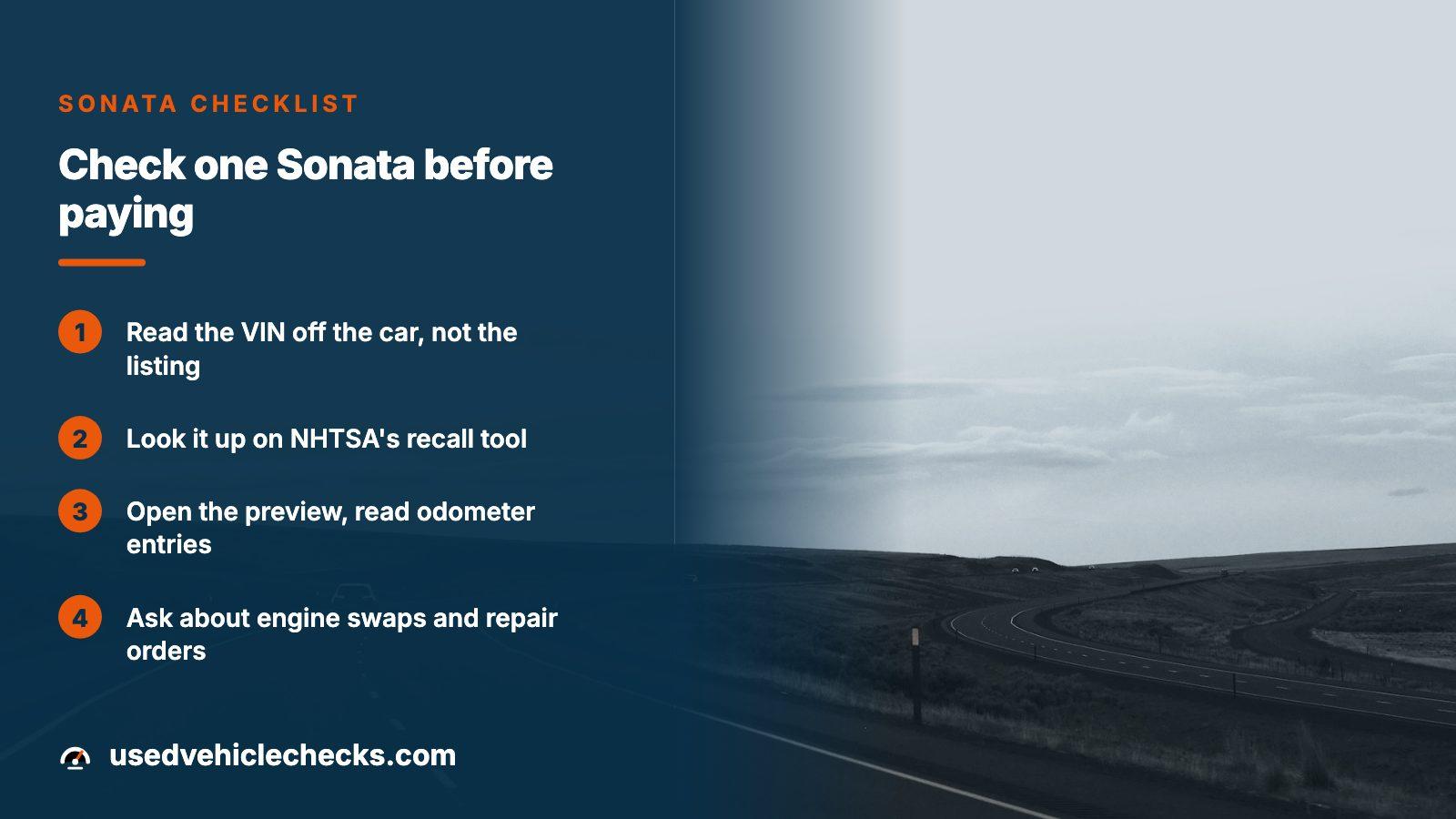
- Read the VIN off the car, not the listing, and confirm that it fits the year being sold.
- Look it up on NHTSA's recall tool at no cost and see whether campaigns 15V568 or 17V226 show as open or done.
- Open the preview here. If the Sonata stays in contention, buy the report and read its odometer entries from the oldest forward.
- Ask whether the engine has ever been swapped out, and ask to see the repair order, with its date and mileage.
- On a 2011 to 2014 car with a swapped engine, look for recall 18V934 on the fuel pipe.
- Have a mechanic inspect it, and drive it on hills, highways and in heavy traffic.
There is no subscription: you pay once for a report or a pack, and the pricing page has the details.
Where this information comes from
- NHTSA: recalls by VIN — Where a VIN lookup shows open campaigns for one car; the campaign details here come from NHTSA's recall data for each model year.
- NMVTIS: understanding a vehicle history report — The five indicators in the federal title report, odometer reading among them, and why they matter.
- NMVTIS: used car buying tips — Federal advice on a mechanic's inspection, varied test drives and service records.
- 49 U.S.C. 30120: remedies for defects and noncompliance — The 15 calendar year limit on a free recall remedy.
- NHTSA owner complaint 11122750 — owner experience, paraphrased
- NHTSA owner complaint 11518116 — owner experience, paraphrased
- NHTSA owner complaint 11759071 — owner experience, paraphrased
Sources and photos: Facts checked against the sources above in November 2026. Photos by Victor Hughes, John Kakuk and Scott Graham on Unsplash; diagrams by UsedVehicleChecks.
Keep reading
- Mileage Check by VIN: What the Recorded Odometer Readings ShowWhat dated odometer readings show for one VIN before money changes hands.
- How Many Miles Is Too Many on a Used Car? Age, Pace and ProofDecide whether a high reading rules a Sonata out, or only changes the price.
- Hyundai Elantra Years to Avoid, and What Mileage AddsThe same complaint ranking for the smaller Hyundai sedan.
- Odometer Discrepancy Check: Find a Mileage Mismatch Before You PayWhat to do when a recorded reading disagrees with the dash.
Frequently asked questions
Which Hyundai Sonata years should I avoid?
Start with 2011, 2013 and 2012, which drew 3,380, 1,917 and 1,559 filings against a median year of 460. The 2015 year follows at 1,156. Good cars exist in each, so a flag calls for a recall lookup and an inspection.
Is the 2011 Hyundai Sonata a bad car?
It has the heaviest record: 3,380 filings, 14 recalls and 1,171 steering mentions. Confirm that engine recall 15V568 was handled, and weigh the mileage against the 120,000-mile engine coverage before agreeing a price.
Which Sonata years are the most reliable?
Complaint counts measure filings, not reliability, but 2022, 2021 and 2019 are the lightest at 96, 135 and 162. Newer cars look clean partly because fewer owners have had time to file, so these years still need a VIN check.
How does mileage affect Sonata engine coverage?
For the 2011 and 2012 Alabama builds, Hyundai raised the short block warranty to 10 years or 120,000 miles, later owners included. Owners of a 2011 and a 2013 who filed NHTSA complaints, at 146,000 and 111,000 miles, said Hyundai declined to help. Ask Hyundai what applies to a given VIN.
Do more complaints mean a worse Sonata?
Not by themselves. Counts follow sales volume and age as much as quality, which is why each year is set against the Sonata's own median of 460. Recalls differ because the maker accepts the defect. Neither describes the car in front of you; its VIN does.
Now check the car itself
The guide explains what to look for. The report shows what this VIN has on record.