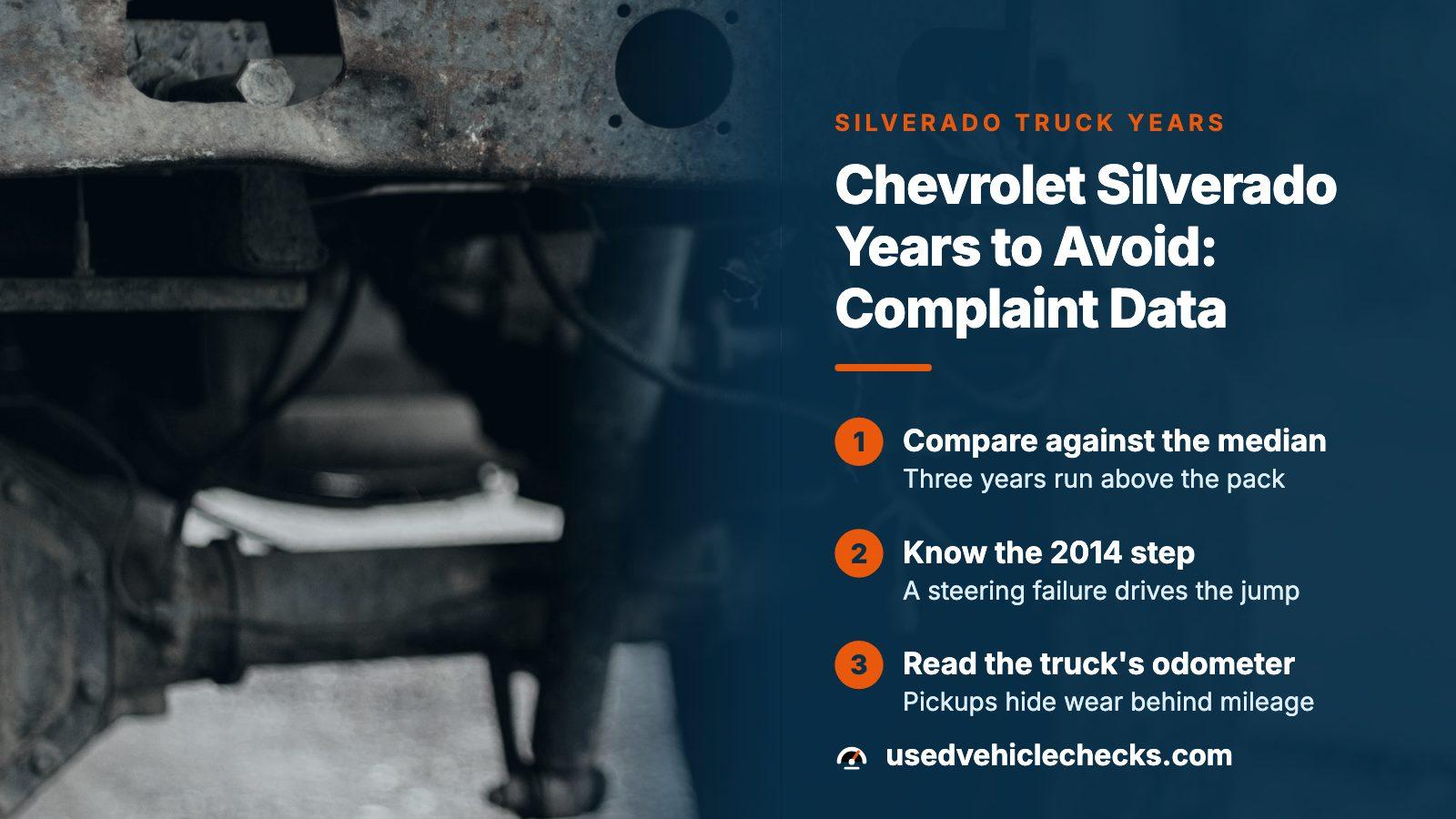
THE SHORT ANSWER
On NHTSA complaint counts, the Silverado 1500 years to approach with care are 2014, 2015 and 2019, which run at 1.94, 1.7 and 1.39 times the truck's median of 826 complaints a year. The lightest settled record is 2012, and engine draws more complaints than any other area. A model year says little about one truck, so read that VIN's odometer readings, recalls and title record before you pay.
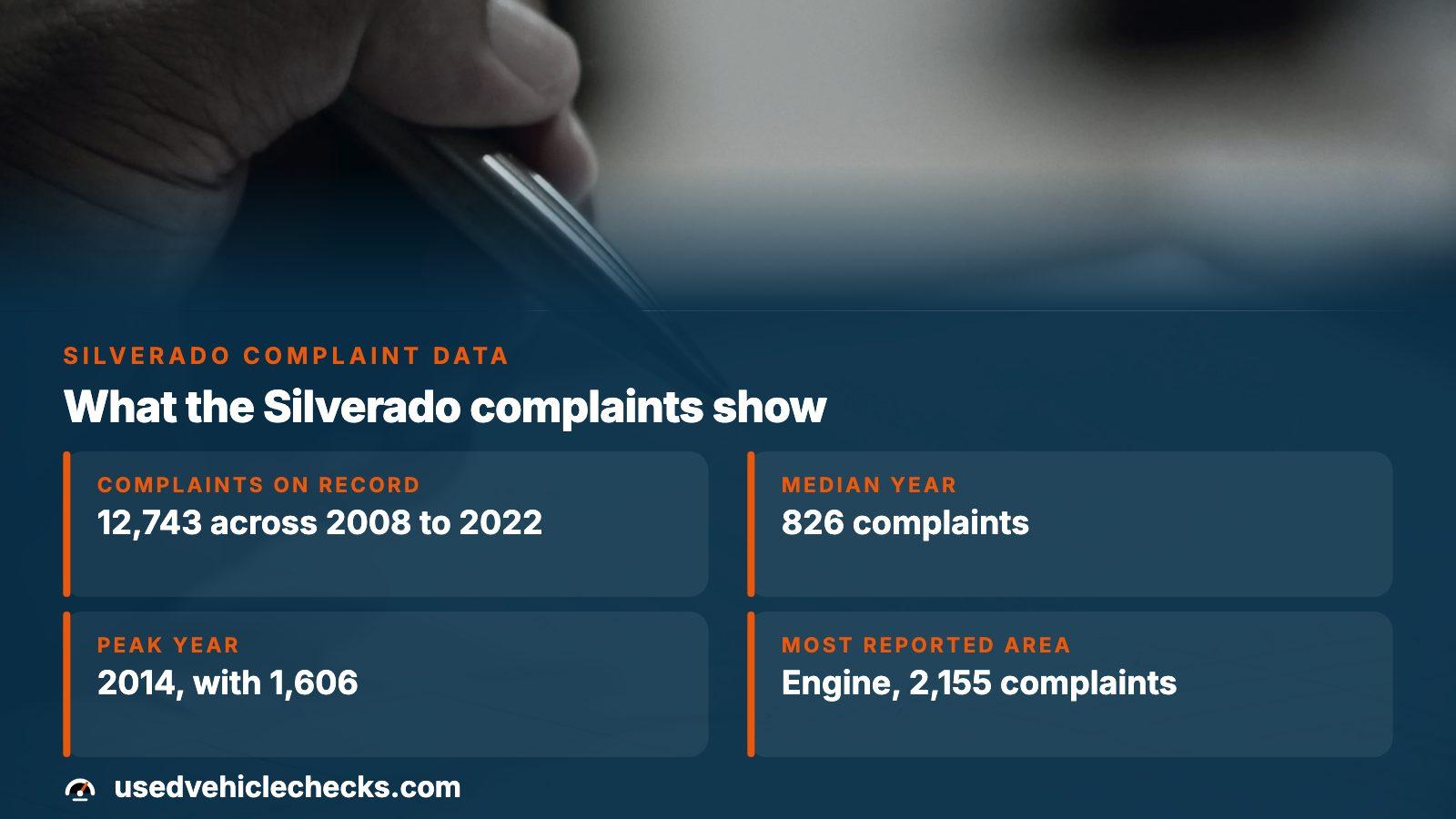
- Complaints on record
- 12,743 across 2008 to 2022
- Median year
- 826 complaints
- Peak year
- 2014, with 1,606
- Most reported area
- Engine, 2,155 complaints
The three years that run above the pack
NHTSA holds 12,743 owner complaints for the Silverado 1500 across model years 2008 to 2022, and a handful of years hold a lopsided share of them. The middle year of the 15 compared sits at 826, so each year is read against that figure, not against other trucks. Three years clear it by a wide margin.
| Model year | Complaints | Times the median | Most reported area | Recalls |
|---|---|---|---|---|
| 2014 | 1,606 | 1.94× | Steering | 14 |
| 2015 | 1,405 | 1.7× | Service brakes | 7 |
| 2019 | 1,151 | 1.39× | Engine | 0 |
Read the recall column beside the complaints. 2014 shows 14 recalls in this data, so some of its faults have a no-charge fix on record. 2019 shows none, which leaves its engine complaints without a campaign a seller could point to.
The step from 2013 to 2014, and a steering failure after a recall
Complaints leap from 442 for the 2013 model year to 1,606 for 2014. A step this large often traces back to a new design or deeper mechanical rework, and the complaint data cannot say which. What matters to a buyer is the side of the line a truck sits on, so settle the year from the VIN, not from the seller's wording.
From an NHTSA owner complaint
An owner of a 2014 Silverado 1500 told NHTSA the electric power steering stopped working at 75 mph. The truck had already been through the steering recall, yet the failure persisted. The dealer answered that no warranty applied and that the recall work was done, and the owner reported it to GM by phone. The filing puts the mileage at about 100,000.
A recall marked complete on a VIN says the repair was performed, but a symptom can outlive it. Request the repair order, then try the steering in tight turns and again at highway speed.
Why the odometer comes first on a pickup
A model year sorts trucks into a bucket. The odometer says how hard one truck worked, and towing, hauling, plow work and fleet duty put miles on a pickup fast, none of which shows in a complaint table. That makes a false number the costliest mistake in this purchase, because the wear, the service schedule and the asking price all hang on it.
From an NHTSA owner complaint
A buyer of a 2015 Silverado 1500 filed a complaint with NHTSA under the heading odometer fraud. The truck came from a private sale showing 107,015 miles. When the buyer registered it at a local DMV agency, the record showed 233,000. The filing does not say what the seller claimed or how the dispute ended.
The buyer learned of the gap at a DMV counter, after the money had changed hands. The dash and the seller's word are statements; a run of dated readings from independent sources is evidence.
How a clean Silverado odometer record reads
- Every reading is higher than the one before it, at a pace that fits the truck's job.
- No earlier reading beats what the dash shows now. If one does, suspect tampering or an unreported instrument cluster swap.
- Quiet stretches with no readings are ordinary. Several identical readings across different events are not.
- The use type on the record fits the story, since fleet or commercial work explains fast miles.
- The wear agrees with the number: pedal rubber, the driver's seat bolster, the steering wheel rim and the bed floor.
The national title system, NMVTIS, lists the latest reported odometer readings and keeps a state's title brand on file for good. Its own consumer page cautions that gaps in state reporting can make a bad truck look clean, so treat it as one source among several. The paid report here sets the readings beside the title brands, accident and damage entries and use type, which is where a rollback tends to show.
The lightest records, and the catch behind them
Among settled years, 2012 has the thinnest file with 359 complaints, 0.43 times the median, and 2 recalls. The 2013 and 2010 trucks sit near half the median too, at 442 and 445. The newest years are left out of any cleanest list, since newer trucks have had little time to build a file.
The catch is age. A 2012 has had more years to pile up miles and owners than a recent truck, so a light complaint file is a reason to look at it, not a reason to skip the mileage check. An older truck with a believable odometer sequence and service invoices beats a younger one nobody can document.
What goes wrong most often, in any year
Across the full run, complaints gather in a few systems, and the engine leads.
| Complaints | Problem area |
|---|---|
| 2,155 | Engine |
| 1,939 | Electrical system |
| 1,892 | Power train |
| 1,807 | Service brakes |
| 1,695 | Air bags |
From an NHTSA owner complaint
An owner of a 2019 Silverado 1500 with the 6.2-liter engine bought it used at 92,000 miles and says recalls were checked first. While towing a trailer on an interstate in New Mexico, a lifter collapsed with a bang and a flashing check engine light. The truck and trailer were towed about 40 miles, the engine showed about 123,000 miles, and the owner puts a replacement at roughly $15,000.
Engine is the top-reported area for 2019, so a used buyer should ask what the truck pulled, read its odometer history beside the service invoices, and have a mechanic listen to a cold start.
Reading the counts without being misled
- Volume: popular trucks draw more filings than rare ones of equal quality.
- Time: the longer a year has been on the road, the more filings it has collected, which flatters the newest trucks.
- Source: each complaint is one owner's account, and nobody has checked it.
- Recalls: a campaign means the maker accepts the fault and fixes it for nothing, but that obligation stops 15 years after a truck's first sale, so the oldest Silverados may be out of reach.
None of this describes the truck in front of you. Its own readings, recalls and title history do, and those answer to the VIN.
Before you pay for a specific Silverado
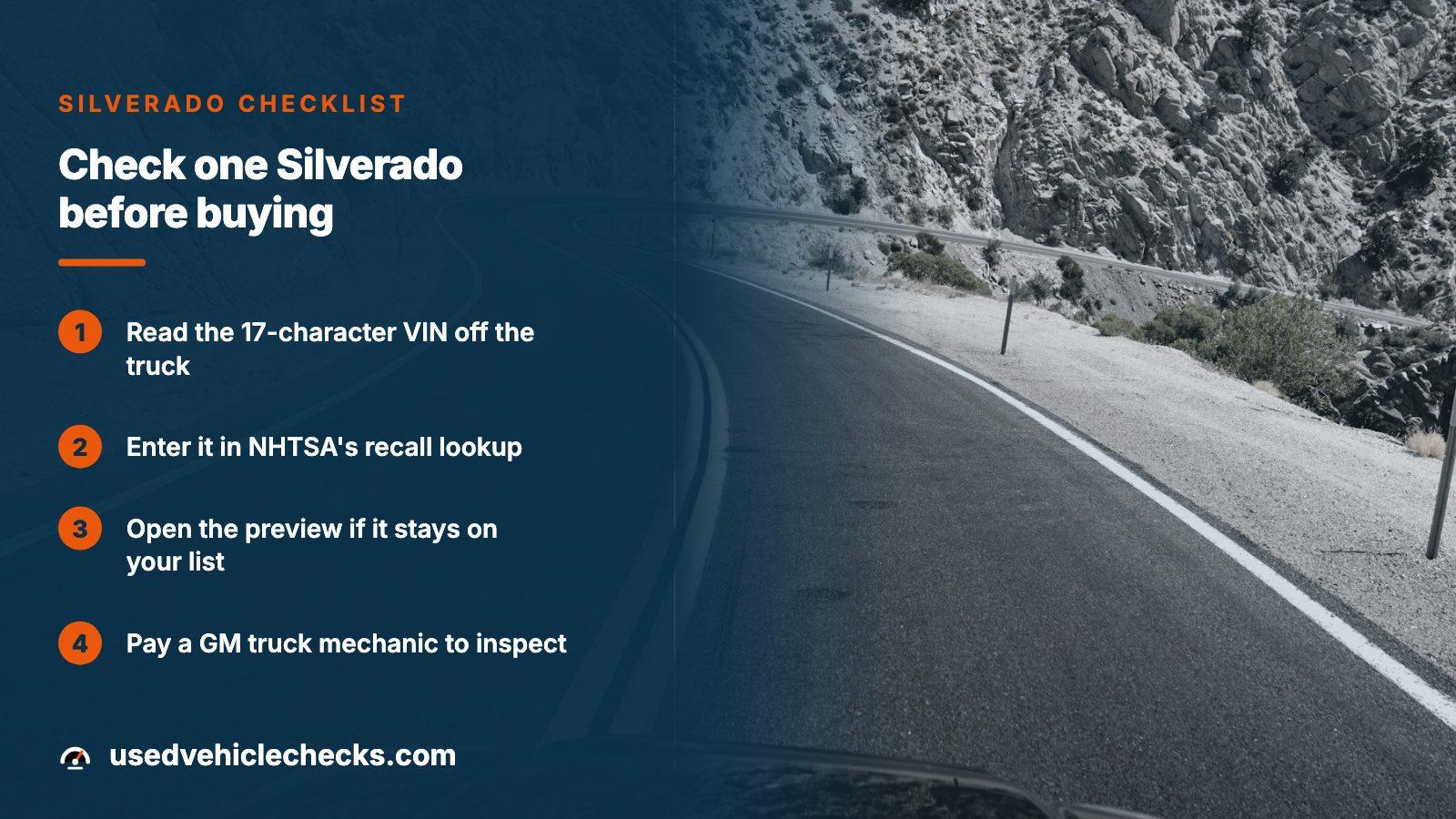
- Read the 17-character VIN off the truck itself, not the ad, and check that the title carries the same number.
- Enter it in NHTSA's recall lookup. A campaign applies to a slice of production, so the VIN is what tells you whether this truck is inside it. NICB's VINCheck is a separate lookup that costs nothing and flags theft and total losses.
- Open the preview here. When the truck is still on your list afterward, buy the report and start with the odometer readings, oldest event to newest.
- Hold the readings against the title brands, salvage entries and use type, then against what you see on the truck.
- Pay a mechanic who knows GM trucks to look at the engine, the steering and the brakes.
The pricing page lists the one-report option and the packs. Payment is a single charge, never a subscription.
Where this information comes from
- NHTSA: vehicle safety and owner complaints — Where the owner complaint filings behind the model-year counts are collected.
- NHTSA: recalls by VIN — Lets you look up open recall campaigns on one truck at no cost.
- NMVTIS: for consumers — Federal title program page covering odometer readings, brands and the risk of a falsely clean search.
- NICB: VINCheck — A no-cost screen of one VIN for theft and total-loss records.
- NHTSA owner complaint 11766505 — owner experience, paraphrased
- NHTSA owner complaint 11773253 — owner experience, paraphrased
- NHTSA owner complaint 11774772 — owner experience, paraphrased
Sources and photos: Facts checked against the sources above in November 2026. Photos by Zoshua Colah, Will Truettner and Masjid MABA on Unsplash; diagrams by UsedVehicleChecks.
Keep reading
- GMC Sierra 1500 Years to Avoid, and Why Mileage Still DecidesThe same year-by-year read for the Silverado's sister pickup.
- Odometer Rollback Check by VIN: Run the Mileage Test Before You PayHow to put a truck's readings in order and spot a step backward.
- How Many Miles Is Too Many on a Used Car? Age, Pace and ProofDecide what a big number on the dash means before you shortlist a truck.
- Mileage Check by VIN: What the Recorded Odometer Readings ShowWhat a mileage check on one VIN shows and how to read it.
Frequently asked questions
Which Chevrolet Silverado years should I avoid?
Start your caution with 2014, 2015 and 2019, which carry 1,606, 1,405 and 1,151 NHTSA complaints against a median year of 826. Caution means inspecting harder and offering less, not walking away, since sound trucks exist in every year. Each of the three has its own weak spot, so ask the seller about that area first.
Which Silverado years are the most reliable?
Complaint counts measure filings, not reliability, but 2012 has the lightest settled record at 359, with 2013 and 2010 close behind. The newest years look clean simply because few owners have filed yet. An older year with a light file still needs its odometer history read, since age means more miles.
What is the most common Silverado problem?
Engine, at 2,155 complaints across the years on record, followed by the electrical system and the power train. Because engine is also the top-reported area for 2019, a cold start, a question about oil use and a look at the service invoices belong in any inspection, whatever the year.
Is mileage more important than model year on a used Silverado?
Often. The year drops a truck into a complaint group, but the odometer shows how hard that one truck worked. Towing and fleet duty add miles quickly, so a higher number with matching records can beat a low one nobody can document. A reading that jumps backward between events is the warning sign.
How do I check one specific Silverado before buying?
Start from the VIN, not the listing. Run NHTSA's recall lookup, then open the preview here. If the truck stays on your shortlist, the paid report adds its odometer readings, title brands, and accident and salvage entries. After that, pay a mechanic to look underneath.
Now check the car itself
The guide explains what to look for. The report shows what this VIN has on record.