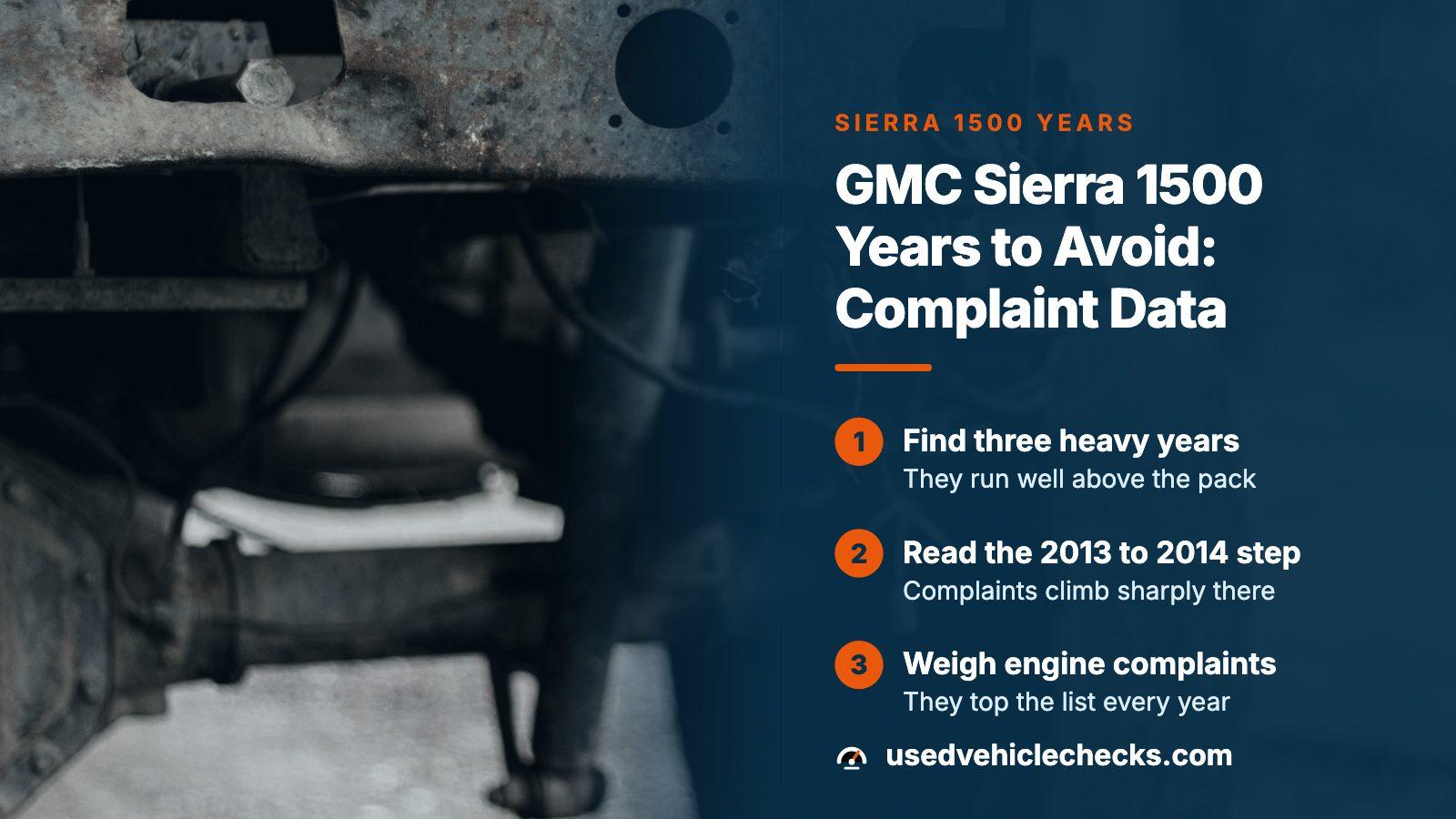
THE SHORT ANSWER
On NHTSA complaint counts, the Sierra 1500 years to approach with care are 2014, 2015 and 2019, which run at 2.01, 1.9 and 1.45 times the truck's median of 426 complaints a year. The lightest settled records are 2016, 2012 and 2013, and engine draws more complaints than any other area. A year says little about one truck, so check that VIN's odometer readings, recalls and title record before you pay.
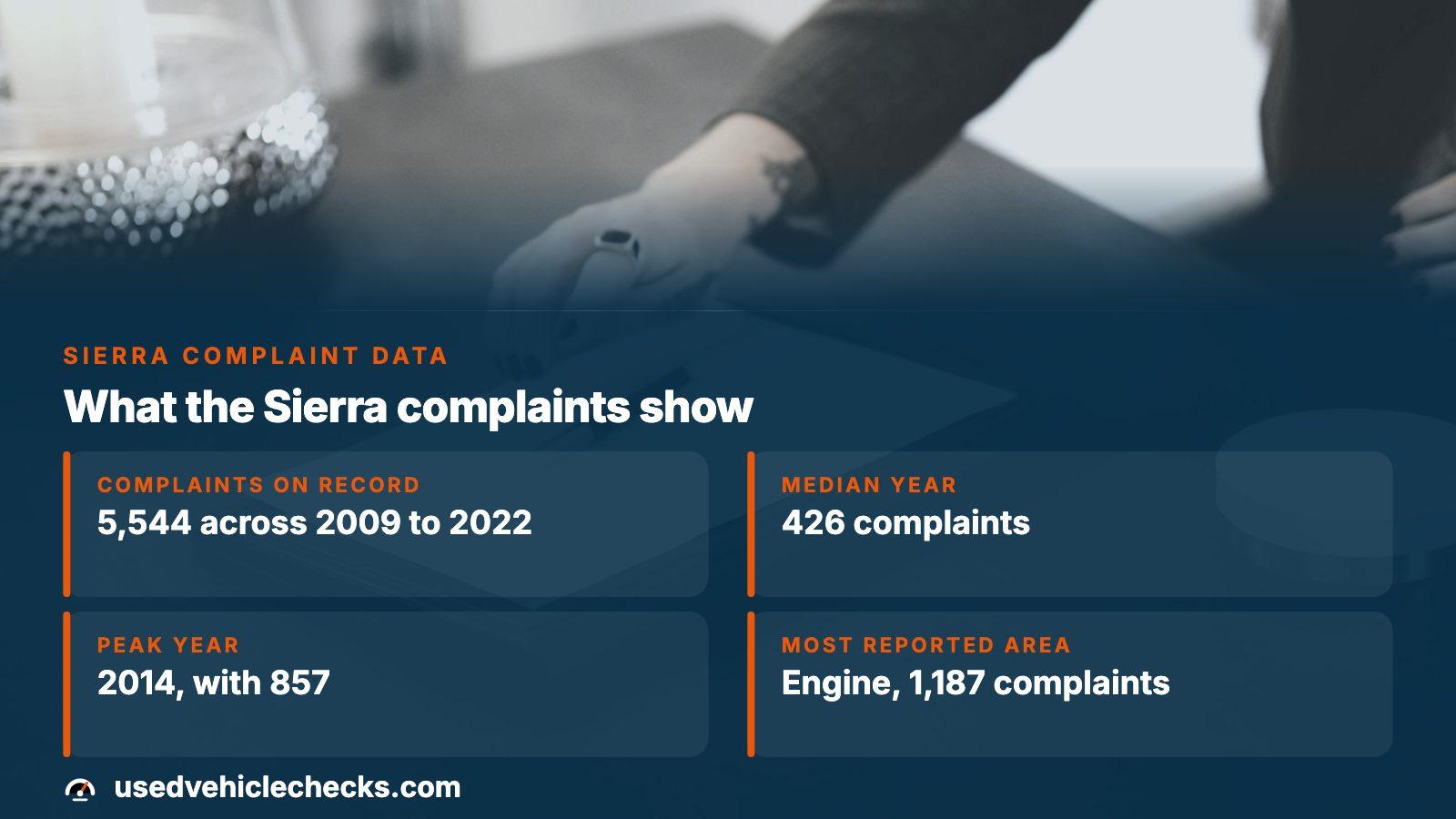
- Complaints on record
- 5,544 across 2009 to 2022
- Median year
- 426 complaints
- Peak year
- 2014, with 857
- Most reported area
- Engine, 1,187 complaints
The three years that run well above the pack
NHTSA holds 5,544 owner complaints for the Sierra 1500 across model years 2009 to 2022, and they pile up unevenly. The middle year of the 13 in the data sits at 426, so each year is read against that figure, not against other makes. Three years clear it by a wide margin.
| Model year | Times the median | Most reported area | Complaints |
|---|---|---|---|
| 2014 | 2.01× | Exterior lighting | 857 |
| 2015 | 1.9× | Service brakes | 811 |
| 2019 | 1.45× | Engine | 619 |
In 2014, the peak year, steering complaints stand out too. None of this condemns a given truck. It tells you where to inspect harder and where a seller should expect a lower offer.
From an NHTSA owner complaint
An owner of a 2014 Sierra 1500 told NHTSA the headlights were dangerously dim and that driving at night had become uncomfortable. The owner saw "no solution for fixing them" and said a service bulletin had been issued that did little to help.
Exterior lighting is the top 2014 complaint area, so drive any 2014 after dark and ask the seller what has been replaced.
The lightest records, and the catch behind them
Three settled years sit far under the median: 2016 with 47 complaints, 2012 with 152 and 2013 with 167. Read 2016 with some care. It has the thinnest complaint file and also 7 recalls, against 3 each for 2012 and 2013. That mix can mean owners got problems fixed before anyone wrote to NHTSA, but it also means more campaigns to look up on the truck's VIN.
The newest years are left out of any cleanest list, since owners have had little time to report problems. The data also has no row for the year between 2009 and 2011, so nothing here speaks for it.
The step from 2013 to 2014
Complaints go from 167 for the 2013 model year to 857 for 2014. A leap of that size tends to trace back to a redesign or deeper mechanical rework rather than a slow drift in quality. A smaller step shows later, from 296 for 2018 to 619 for 2019.
For a buyer, the side of the change a truck sits on matters more than the year printed in the listing. When a seller calls something basically a 2014, get the VIN and settle it from the record.
From an NHTSA owner complaint
Another 2014 Sierra owner wrote that the steering rack failed. A remanufactured rack from GM was fitted and programmed by the dealer, yet the assist still cut out at low speed, once for 3 seconds at 15 mph while slowing for a turn. The owner adds that the recall had been done, but on the original part.
A recall marked done on a VIN does not prove the symptom is gone. Ask for the repair invoice and try tight turns at parking-lot speed.
Why the odometer outranks the model year on a pickup
Two Sierras of the same year can be different trucks. One spent its life on a farm road with a trailer behind it, the other commuted. The complaint table cannot tell them apart. Mileage, and how consistent the record of it is, can. A truck with miles shaved off hides the wear a buyer is trying to avoid.
- Dated readings in order, each higher than the last, at a pace that fits the truck's use.
- A run of identical readings across several events, which can mean a stopped odometer.
- The use type on the record: fleet or commercial service puts miles on fast.
- Wear that matches the number: pedal rubber, the driver's seat bolster, the steering wheel, the bed floor.
A record that runs ahead of the dash
If an earlier reading is higher than the display shows now, treat it as evidence of tampering or an undisclosed instrument cluster swap. Ask for an explanation in writing and walk away unless an invoice shows the mileage at the swap.
What owners complain about, in every year
Across the full run, complaints gather in a few systems. Engine leads by some distance, and mileage bears directly on engine and driveline wear.
| Complaints | Problem area |
|---|---|
| 1,187 | Engine |
| 876 | Power train |
| 740 | Service brakes |
| 719 | Electrical system |
| 367 | Air bags |
From an NHTSA owner complaint
An owner of a 2019 Sierra 1500 with the 6.2-liter engine reported it locking up on the road at about 103,000 miles. A low-oil light had come on in the mid-90,000s, and a dealer visit over oil loss ended with word that GM's earlier oil update was already done. A mechanic later tied the failure to a lower camshaft bearing problem.
That is one owner's unverified account, but the mileage detail is the point: read a truck's odometer history and its oil-related invoices together. On any Sierra 1500, whatever the year, the table doubles as an inspection order: engine and driveline first, then brakes, then electrical. A mechanic's cold start and a test drive will tell you more than a chart.
Reading the counts without being misled
- Volume: popular years pile up more filings than scarce ones, even when the trucks are equally sound.
- Age: an older year has had more time to collect reports, so a young year looks tidy by default.
- Source: each complaint reflects what one owner believed happened, with nothing checked.
- Recalls: the maker has acknowledged the defect and fixes it without charge, but federal law ends that duty 15 years after first sale, so the oldest trucks may no longer qualify.
The same logic applies between nameplates: the Chevrolet Silverado 1500 shows 12,743 complaints for 2008 to 2022, against the Sierra's 5,544, so compare each year with its own truck's median.
Putting the year and the mileage together
- A flagged year at a price that already reflects it, with service invoices and a clean mileage sequence, can still be a fair buy.
- A light-record year whose readings step backward is a pass, whatever the table says.
- A truck with an open recall on its VIN should be repaired before the sale, or priced for the trouble.
- A truck from either side of the 2013 to 2014 jump deserves a question about what changed.
Before you pay for a specific Sierra 1500
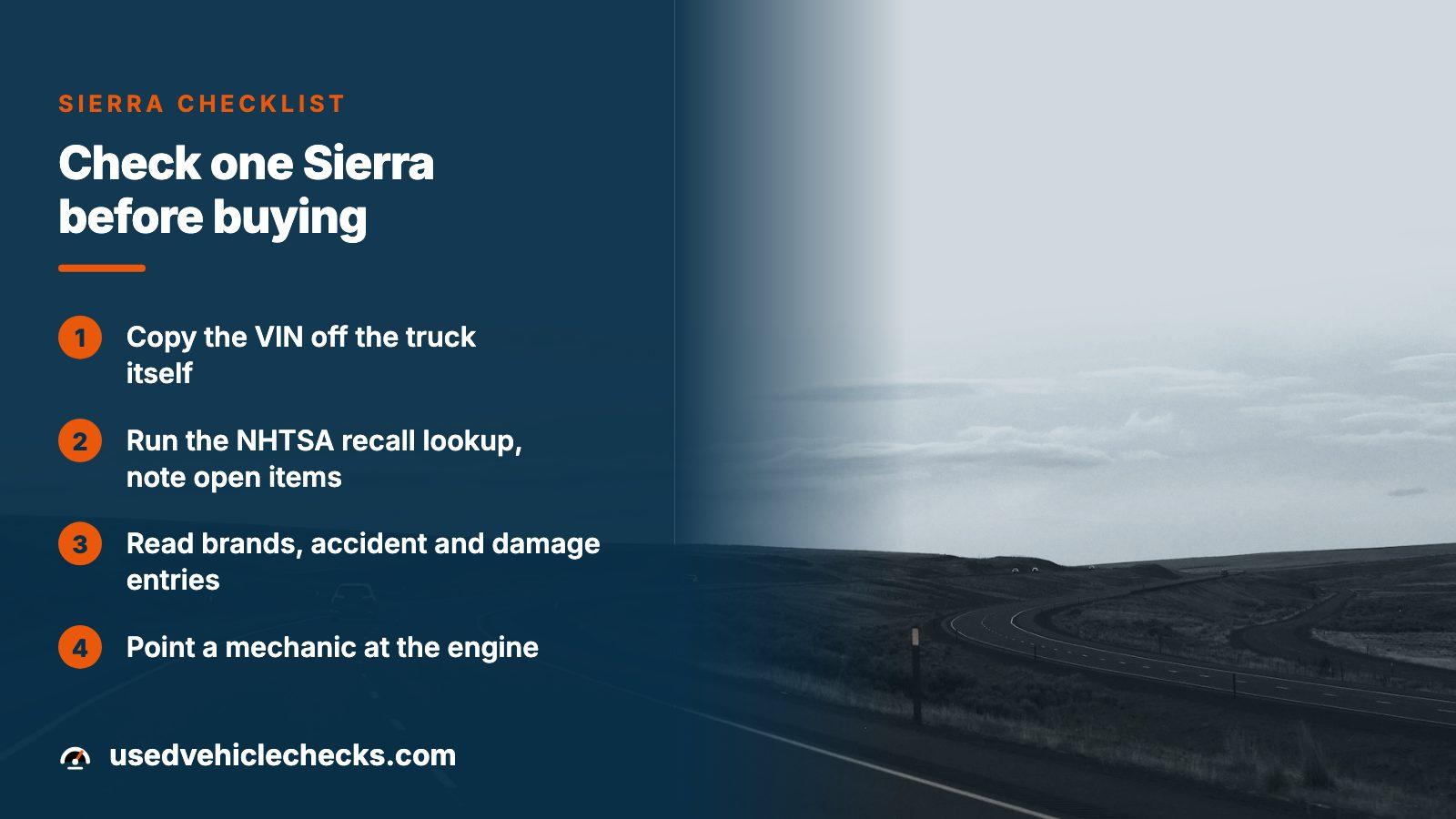
- Copy the VIN off the truck itself. It is stamped on a plate you can read through the windshield at the driver's corner, and printed on a label inside the driver's door opening.
- Run it through the free NHTSA recall lookup and note any open campaigns. A campaign covers certain builds, not every truck of a given year.
- Open the free preview here. If the truck stays on your list, buy the report and read the odometer readings first, oldest to newest.
- Then read the report's title brands, accident and damage entries, salvage and auction records and use type against those readings.
- Hand the findings to a mechanic and point them at the engine, driveline and brakes.
Payment is one time, with nothing recurring. The pricing page lists the single report and the multi-report packs.
Where this information comes from
- NHTSA: vehicle safety and owner complaints — Where the owner complaint filings behind the model-year counts are collected.
- NHTSA: recalls by VIN — Lets you look up open recall campaigns on a specific truck at no cost.
- NMVTIS: national title record — Federal title history program that covers one vehicle, which a year-by-year table cannot.
- NICB: VINCheck — A no-cost screen of one VIN for theft and total-loss records.
- NHTSA owner complaint 11583283 — owner experience, paraphrased
- NHTSA owner complaint 11613411 — owner experience, paraphrased
- NHTSA owner complaint 11766351 — owner experience, paraphrased
Sources and photos: Facts checked against the sources above in November 2026. Photos by Zoshua Colah, John Kakuk and Annika Wischnewsky on Unsplash; diagrams by UsedVehicleChecks.
Keep reading
- Chevrolet Silverado Years to Avoid, and What the Odometer AddsThe same year-by-year read for the other big full-size pickup in this class.
- Odometer Rollback Check by VIN: Run the Mileage Test Before You PayHow to put a truck's mileage readings in order and spot a step backward.
- How Many Miles Is Too Many on a Used Car? Age, Pace and ProofDecide what a high number on the dash means before you shortlist a truck.
- How to Buy a Used Car: Start With the Mileage, Then the RecordsThe wider checklist that sits around a model-year choice.
Frequently asked questions
Which Sierra 1500 model years are worth skipping?
Start your caution with 2014, 2015 and 2019. They carry 857, 811 and 619 NHTSA complaints, against a median year of 426. Caution means a closer look and a smaller offer, not a ban, because good trucks exist in every year.
Which Sierra 1500 years are the most reliable?
Complaint counts measure filings, not reliability, but 2016, 2012 and 2013 have the lightest settled records at 47, 152 and 167. The 2016 truck also has 7 recalls on file, so look up open campaigns on its VIN. A low count does not replace a mileage check and a lift inspection.
Where do Sierra 1500 owners report the most trouble?
The engine, which tops every other NHTSA category with 1,187 complaints over the years on record. Power train comes next, then service brakes and the electrical system. Whatever the year, have a mechanic check the cold start, driveline and brakes before you talk price.
Is mileage more important than model year on a used Sierra 1500?
Often, yes. The year drops a truck into a complaint bucket, but the odometer shows how hard that particular truck worked. Towing, hauling and fleet use stack up miles quickly, so a higher number with solid records can beat a low one nobody can document.
How do I check one specific Sierra 1500 before buying?
Use the VIN. Run the free NHTSA recall lookup, then open the preview here and, if the truck stays on your list, buy the report to see its odometer readings, title brands, and accident and salvage records. A model year describes a population of trucks; the VIN describes one.
Now check the car itself
The guide explains what to look for. The report shows what this VIN has on record.