THE SHORT ANSWER
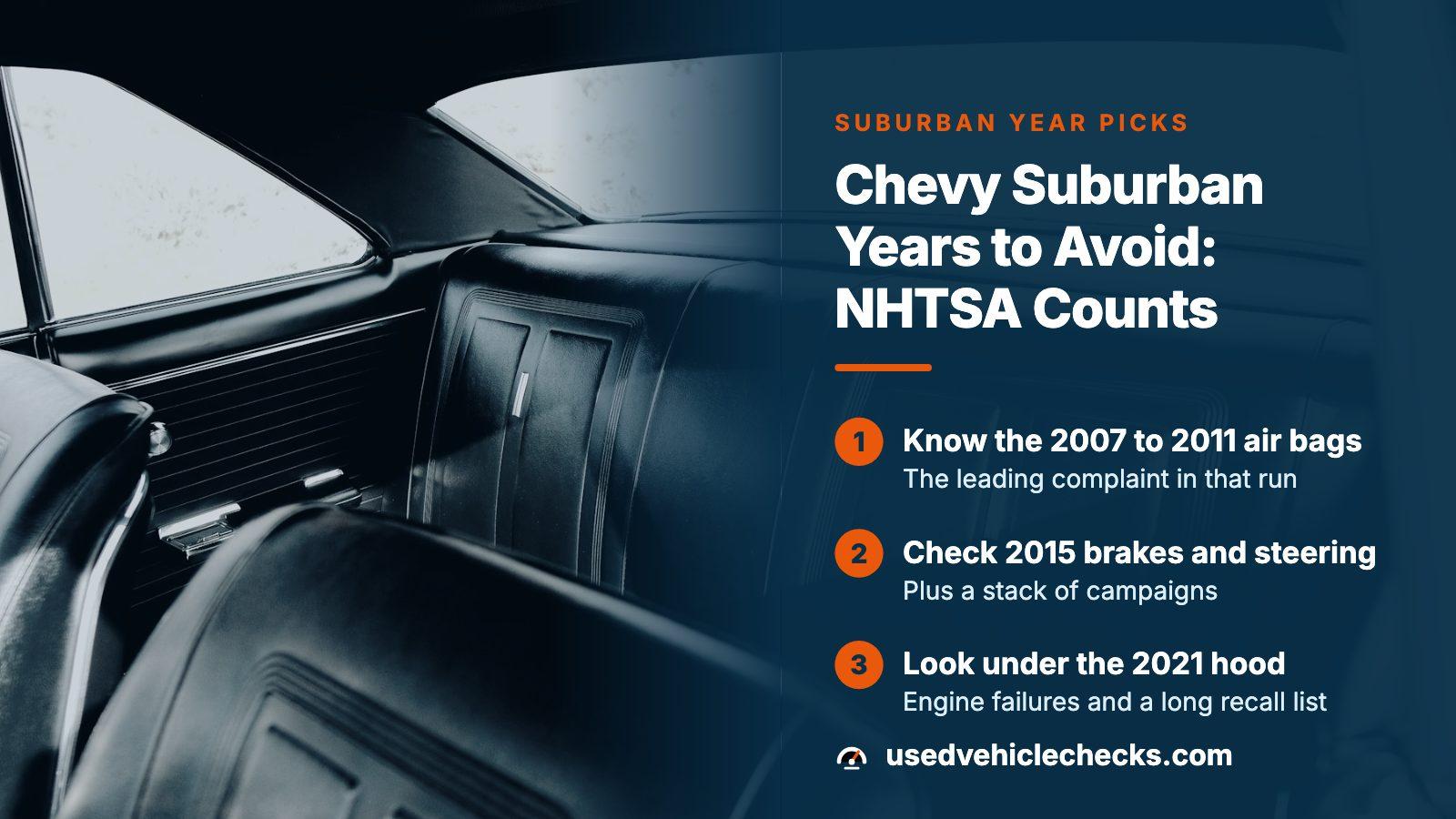
Pulling NHTSA's own data for 18 model years, 2007 leads with 482 complaints, then 2015 with 432 and 2008 with 314. The 2007 to 2011 trucks lean on air bag complaints, the 2015 on brakes, and the 2021 on engine failures. The calmest years are 2020, 2024 and 2014. Whatever year you shop, check that exact VIN for open recalls and for honest mileage before paying.
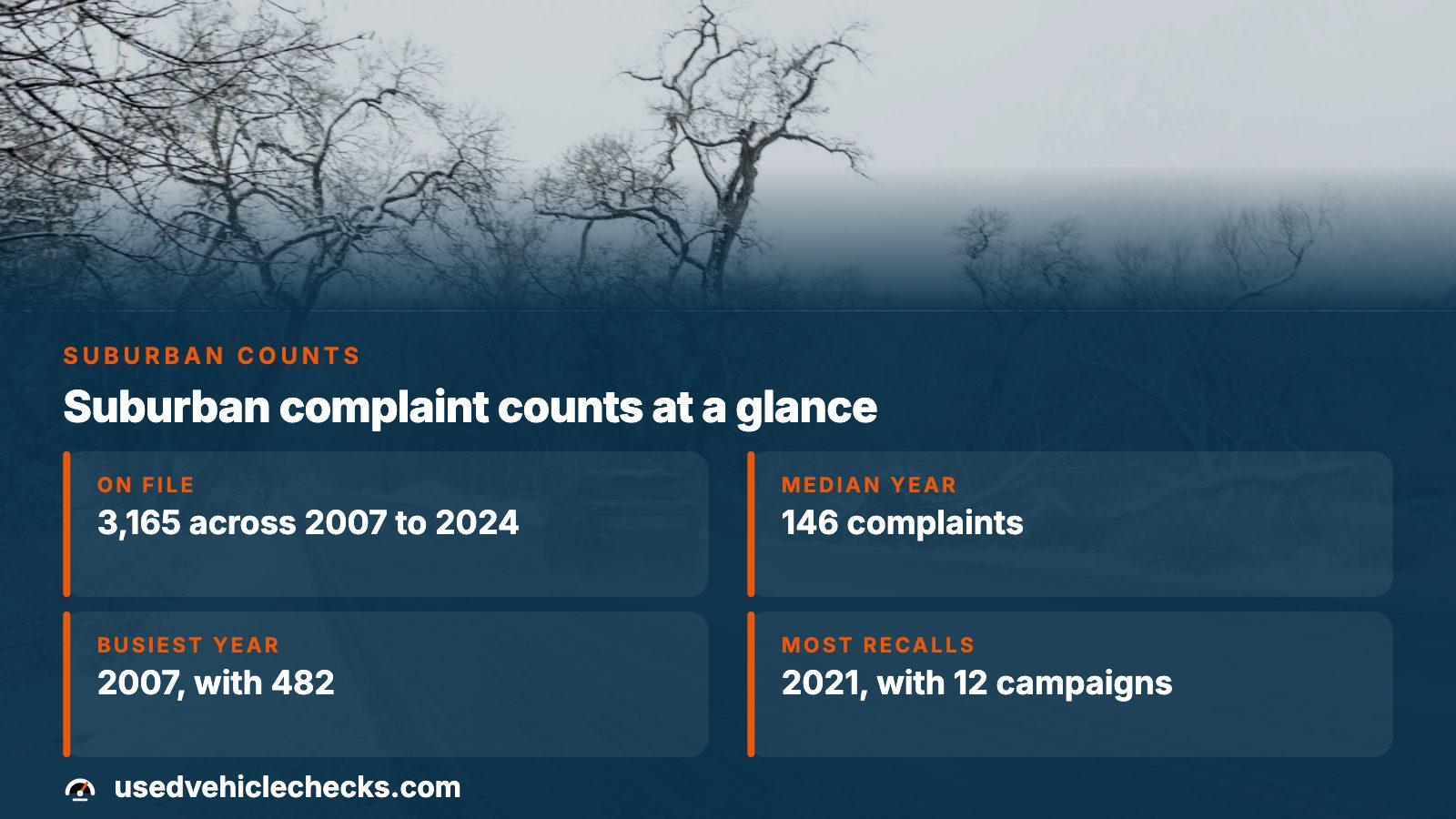
- Complaints on file
- 3,165 across 2007 to 2024
- Median year
- 146 complaints
- Busiest year
- 2007, with 482
- Most recalls
- 2021, with 12 campaigns
The four model years that stand out
NHTSA's complaint database holds 3,165 filings for the Suburban from 2007 through 2024. The middle year of those 18 sits at 146 complaints, so each year below is judged against that figure. Four years rise well above it, and each has a different weak spot.
| Model year | Complaints | Times the median | Top complaint area | Recall campaigns |
|---|---|---|---|---|
| 2007 | 482 | 3.3 | Air bags, 209 | 4 |
| 2015 | 432 | 2.96 | Service brakes, 153 | 11 |
| 2008 | 314 | 2.15 | Air bags, 136 | 4 |
| 2021 | 208 | 1.42 | Engine, 92 | 12 |
Read the last column with care. A high recall count means the faults were acknowledged and a free repair exists, which is better than a quiet defect nobody fixed. It only helps if the repair was actually done on the truck you are looking at.
What these counts can and cannot tell you
Complaints are filed by owners, so older trucks have had more years to collect them, and a popular year collects more than a rare one. That is why 2024, at 46, looks spotless: it is simply young. The counts rank how much trouble people reported, not how likely your particular truck is to fail.
A quirk of the records is worth knowing. NHTSA files Suburban complaints under the plain model name for 2007 to 2009 and 2021 to 2024, and under a longer name with the 1500 added for 2010 to 2020. Both were combined here. A recall also names several GM trucks at once, so many campaigns on a Suburban year are shared with the Tahoe and Yukon.
2007 to 2011: the air bag years
Air bags top the complaint list for every Suburban year from 2007 through 2011, and the 2007 count is the largest in the whole set. Of its 482 complaints, 209 concern air bags and 71 concern structure. Twelve of the filings mention a fire and the injuries reported across them add up to 72.
Two 2021 recalls cover the front passenger inflator on these trucks, one for sales and registrations in southern and coastal states and a second for a different list of states. The remedy is a replacement inflator at no charge. The danger GM described is an inflator rupture that throws metal fragments at the occupants, so a truck from this era with an unfinished inflator job is not one to drive home.
2015: brakes, steering and a pile of campaigns
The 2015 Suburban shows 432 complaints, 153 of them about service brakes and 61 about steering, with 21 flagged as crashes. It also carries 11 recall campaigns, including a power steering motor replacement, two brake-related software updates and a transfer case recall filed in May 2026 that tells owners of affected four-wheel and all-wheel drive trucks not to drive them until the repair is done.
From an NHTSA owner complaint
An owner of a 2015 Suburban LTZ reported that the brakes gave out at low speed in a parking lot, both going forward and backing up, so the pedal needed extreme force to stop the truck. When the owner took it to a Chevrolet dealer, the answer was that no recall was attached to that VIN. The filing is dated November 2025.
The lesson is that a recall names a range, and each VIN inside or outside it is a separate answer. Ask the seller for proof the brake and steering campaigns were completed, and test the pedal feel at parking speed, not only on the highway.
2021: the newest trouble spot is under the hood
The 2021 Suburban holds only 208 complaints, but 92 of them name the engine, and it holds the most recall campaigns of any year at 12. Seat belts, seat attachments, a fuel pump module, a rear driveshaft and a 6.2L V8 engine campaign all appear. That engine campaign spans 2021 to 2024 trucks: a dealer looks the engine over and repairs or swaps it where needed.
From an NHTSA owner complaint
A 2021 Suburban owner described warning messages for traction control and stability control at 60 mph, then a flashing engine light. The dealer found pitted lifters and a worn camshaft, and quoted about 17,000 dollars for a new engine. The owner believes the truck was built just before the recall's start, and so fell outside it.
Engine complaints continue in 2022 and 2023 as well, at 65 and 79. If you shop these years, get the campaign status in writing and a dealer inspection record, not a verbal assurance.
The quieter years: 2014 and 2018 to 2020
The lightest complaint records belong to 2020 with 44, 2014 with 59, 2019 with 79 and 2018 with 84. Their complaints lean toward the power train and engine, spread thin, and none of them rises near the median multiples of the four problem years. Three recall campaigns apply to the 2014 and 2019 trucks.
Quiet is not clean. The brake vacuum and transfer case recalls reach across several of these years, so each VIN still needs a recall lookup. A low count also reflects what owners bothered to file, so treat these years as a better starting point, never as a pass.
Why the odometer matters more than the year
A Suburban is a truck that gets used hard: long family trips, trailers, rental and livery duty, school and church runs. The number on the dash decides how worn the engine, transmission, brakes and suspension are likely to be, and how much to offer. A model year says nothing about that.
A mileage check on the VIN pulls the odometer readings recorded over the years, from titles, inspections and service events, so you can see whether the readings climb steadily. A drop, a long gap or a reading that sits flat is the cue to ask questions, or walk away. The federal title system exists partly so fraud and dangerous vehicles do not slip past buyers, and a mileage check, started from a free preview, applies that idea to one truck.
A short routine before you pay
- Confirm the true model year from the VIN, because listings are sometimes sloppy about it.
- Look up open recalls for that VIN on NHTSA's recall page, and ask for repair orders for the campaigns that applied.
- Run a mileage and title check and read the odometer readings in date order.
- Ask for the dealer inspection record on any 2021 to 2024 truck with the 6.2L V8.
- Drive it at parking speed and on the highway, and watch brake pedal feel and warning lights.
If the odometer history, title brands and recall status all line up with what the seller told you, even a year on the cautious list can make sense if the price reflects it. If any of them disagrees, the price should move or you should.

Where this information comes from
- NHTSA recalls API: 2015 Chevrolet Suburban — recall campaigns by model year, counted for every year in the table
- NHTSA complaints API: 2015 Chevrolet Suburban — owner complaint counts and components
- NHTSA owner complaint 11700962 — owner experience, paraphrased
- NHTSA owner complaint 11773294 — owner experience, paraphrased
- VehicleHistory.gov: NMVTIS — federal title information system and its consumer purpose
Sources and photos: Facts checked against the sources above in November 2026. Photos by Wesley Tingey, Michal Biernat and Zoshua Colah on Unsplash; diagrams by UsedVehicleChecks.
Keep reading
- GMC Yukon Years to Avoid: Worst Years by NHTSA CountsThe Yukon shares its frame, engines and many recalls with the Suburban.
- Chevrolet Silverado Years to Avoid, and What the Odometer AddsThe same truck platform, with its own complaint pattern by year.
- Mileage Check by VIN: What the Recorded Odometer Readings ShowHow to read a VIN's recorded odometer readings.
- How Many Miles Is Too Many on a Used Car? Age, Pace and ProofPutting a Suburban's mileage in context before you bid.
Frequently asked questions
What is the worst year for the Chevy Suburban?
By NHTSA complaint count, 2007 is the worst, with 482 filings, nearly all concerning air bags and structure. The 2015 follows with 432, mostly brakes and steering. Counts favor older trucks that had more time to collect filings, so look at the type of complaint and the recall record of the specific VIN.
Which Suburban years are the most reliable?
On complaints alone, 2020, 2014, 2019 and 2018 are the quietest, with 44, 59, 79 and 84 filings. That is a starting point, not a guarantee. Reliability depends on maintenance, towing history and mileage, which a VIN-based record can show far better than a model year.
Does a recall make a Suburban year a bad buy?
Not by itself. A recall means a free fix exists, and 2021 has 12 campaigns while 2024 has 2. The risk is a truck whose repair was never performed, or one whose VIN falls just outside a campaign yet shows the same symptom. Check the VIN, then ask for repair records.
How do I check a Suburban's recalls?
Type the full VIN into NHTSA's recall search. It costs nothing and lists any open campaign on that vehicle. Do it yourself instead of trusting the listing, and repeat the lookup close to the purchase date, since new campaigns are filed all the time, including some in 2026 for trucks built years earlier.
Why check the mileage on a high-mileage Suburban?
Large SUVs often carry high odometer readings legitimately, so the number alone proves little. The sequence matters. A mileage check lists recorded readings over time, and a reading that drops or stalls suggests tampering or a replaced cluster. That affects wear, price and what you can safely expect.
Now check the car itself
The guide explains what to look for. The report shows what this VIN has on record.