THE SHORT ANSWER
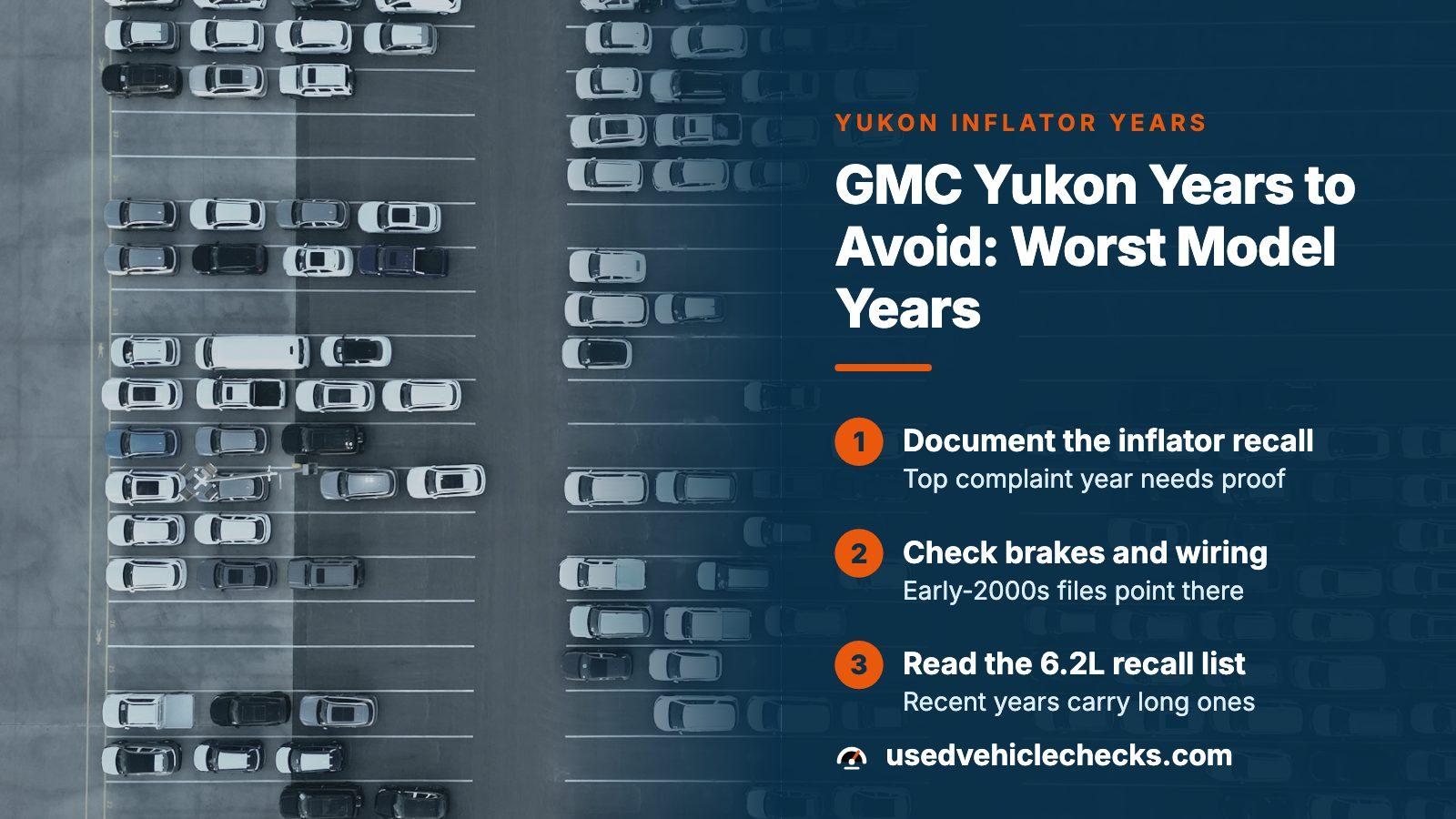
Skip 2007 unless the air bag inflator recall is documented, because that year tops every other with 777 complaints. Be wary of 2001 to 2004 for brake and electrical complaints, and of 2021 to 2024 for engine failures tied to recall 25V274000. The quietest files are 2012 to 2014 and 2018 to 2020, with 164 complaints across the last three.
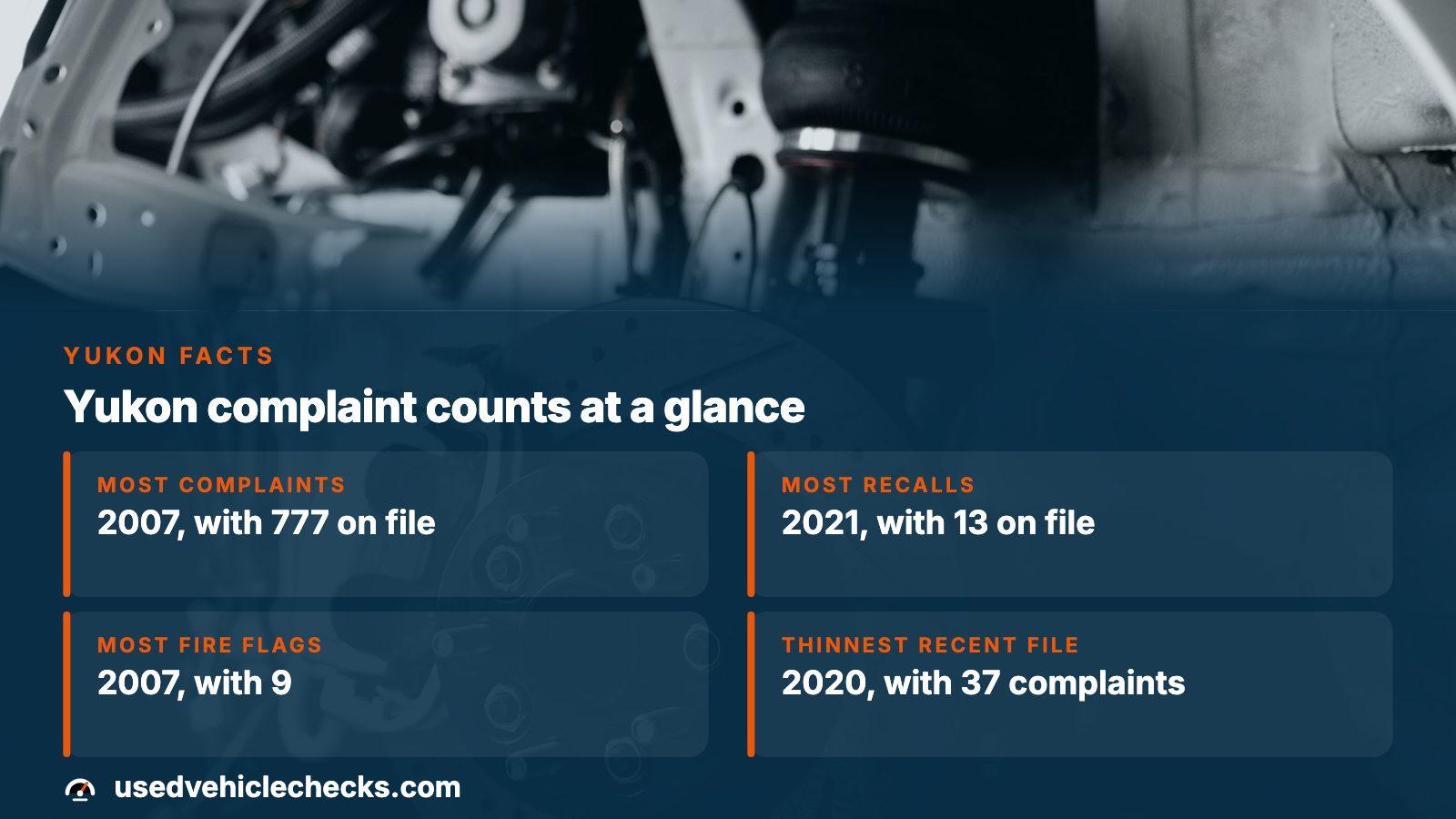
- Most complaints
- 2007, with 777 on file
- Most recalls
- 2021, with 13 on file
- Most fire flags
- 2007, with 9
- Thinnest recent file
- 2020, with 37 complaints
Yukon model years ranked by NHTSA complaints and recalls
I pulled NHTSA's public complaint and recall records for every Yukon model year from 1992 through 2026. The Yukon lookup also returns some Yukon XL reports, so treat the counts as the whole Yukon family. The table keeps the years that decide the verdict.
| Model year | Complaints | Recalls on file | Verdict |
|---|---|---|---|
| 2007 | 777 | 4 | Avoid unless inflator recall is done |
| 2015 | 548 | 10 | Check steering, brake and lighting history |
| 2003 | 517 | 6 | Avoid unless brakes and wiring are proven |
| 2004 | 446 | 4 | Avoid unless brakes and wiring are proven |
| 2001 | 431 | 8 | Brake trouble is the pattern |
| 2008 | 412 | 4 | Check air bag recalls |
| 2011 | 399 | 5 | Check air bag recalls |
| 2021 | 346 | 13 | Verify engine and recall work |
| 2023 | 246 | 4 | Verify engine recall work |
| 2013 | 186 | 4 | Reasonable with clean records |
| 2012 | 138 | 3 | Reasonable with clean records |
| 2014 | 61 | 3 | Thin file, check wear instead |
| 2020 | 37 | 4 | Thinnest recent file |
Older trucks have had longer to collect complaints, so raw counts lean against them. Even so, 2007 beats every year before and after it by a wide margin.
2007 to 2011: the air bag inflator problem
Model year 2007 logs 777 complaints, with 83 injuries and 9 fire flags, and no other year matches it on any of the three. Air bags are the top component, with 352 flagged, and a keyword count of the summaries finds 212 that mention an air bag. The 2007 to 2011 span adds up to 2029 complaints, and 2008 through 2011 keep air bags near the top of each list.
The cause shows up in recall 21V050000, filed in February 2021. It covers 2007 to 2011 trucks, Yukon and Yukon XL among them, whose front passenger inflators use a propellant that can degrade in long exposure to heat and humidity. NHTSA says an inflator may explode and throw metal fragments at the occupants. Dealers replace the inflator free of charge. Trucks originally sold, or ever registered, in hot humid states such as Florida, Texas or Louisiana are named first.
From an NHTSA owner complaint
The owner of a 2007 Yukon XL reported that the air bag light came on at startup, with a chime and a Service Air Bag message. According to the filing, a dealer blamed the driver-side front crash sensor, and the truck went unrepaired. The filing listed 171,264 miles.
A used 2007 to 2011 truck that spent years in the Gulf states deserves an open-recall lookup on its VIN before anything else, and a receipt if the inflator was swapped.
2000 to 2004: brake lines, ABS lights and wiring
Together these five years total 2027 complaints across 2000 to 2004. Service brakes top the list in 2000 with 101 flags, in 2001 with 177 and in 2002 with 159. Then 2003 and 2004 flip to the electrical system, with 165 and 181. Model year 2004 also logs 8 fire flags.
The recall lists look longer than they are. Several entries for 2000 and 2001 cover aftermarket parts such as replacement fuel filters, wheel hubs and tires. The GM campaigns that matter include 00V345000, a front brake pipe that can rub, and 04V045000, a hydro-boost relief valve that dealers replace to meet a brake standard.
From an NHTSA owner complaint
A family that had owned three Yukons from 2001 to 2003 wrote that each had serious brake problems: a lit ABS lamp, a parking brake that failed, and fluid leaking until it ate at nearby hoses. The writer needed three rows of seats and could not afford a newer vehicle.
Treat that as one owner's account, not a measured failure rate. Its use is in what to ask: when were the lines, hoses and ABS sensors last replaced, and can the seller show it?
2021 to 2024: the 6.2L engine and a long recall list
The current-generation trucks collected 959 complaints across 2021 through 2024, and engine is the leading component every year: 190 for 2021, 113 for 2022, 160 for 2023 and 130 for 2024. Model year 2021 also has 13 recalls on file, the most of any year, covering a fuel tank, a fuel pump module, rear driveshafts, third-row belts and brake calibration.
The heaviest of them is recall 25V274000, filed 24 April 2025. GM reported that certain 6.2L V8 engines may have flawed rods or crankshafts, which can end in a dead engine. The fix starts with a dealer inspection, then a repair or a replacement when the engine fails it. Engines that pass receive heavier oil, a new cap and a fresh filter. A keyword count shows 47 of the 346 summaries for 2021 mention a lifter.
From an NHTSA owner complaint
An owner of a 2021 Yukon described abnormal engine noise while driving, then a tow to the dealer. The dealer confirmed lifter failure and still had to decide between replacing lifters and replacing the engine. The owner put the failure at roughly 69,000 miles.
Whether a given truck is a 6.2L is a trim and VIN question, so confirm it, then confirm the recall is closed.
The years with the lightest files
The calmest stretches are 2012 through 2014, at 138, 186 and 61 complaints, and 2018 through 2020, at 70, 57 and 37 for a combined 164. The 2018 to 2020 trucks have few recalls too, with 3, 2 and 4 on file.
A thin file is a cue, not a guarantee. Plenty of owners never file a report, and a Yukon from a quiet year may still carry a hidden crash repair or a wound-back dash. The 2025 and 2026 years show 58 and 47 complaints only because they are new.
Why the odometer matters more than the badge year
Yukons tow trailers, carry families and often spent time in fleet, government or rental use. Two trucks from one model year can sit a hundred thousand miles apart, and that gap moves price and wear more than the year does. Complaint counts say what tends to fail. The odometer record shows how hard this one has worked.
A reading that drops between dated entries, a cluster replacement with no mileage note, or a commercial use entry all change how you read the truck. The federal NMVTIS system holds the latest reported odometer reading plus brand history such as salvage or flood, fed by state title offices, insurance companies and scrap or salvage lots. Its own page warns that a clean search can still miss unreported events.
Before you pay for one specific Yukon
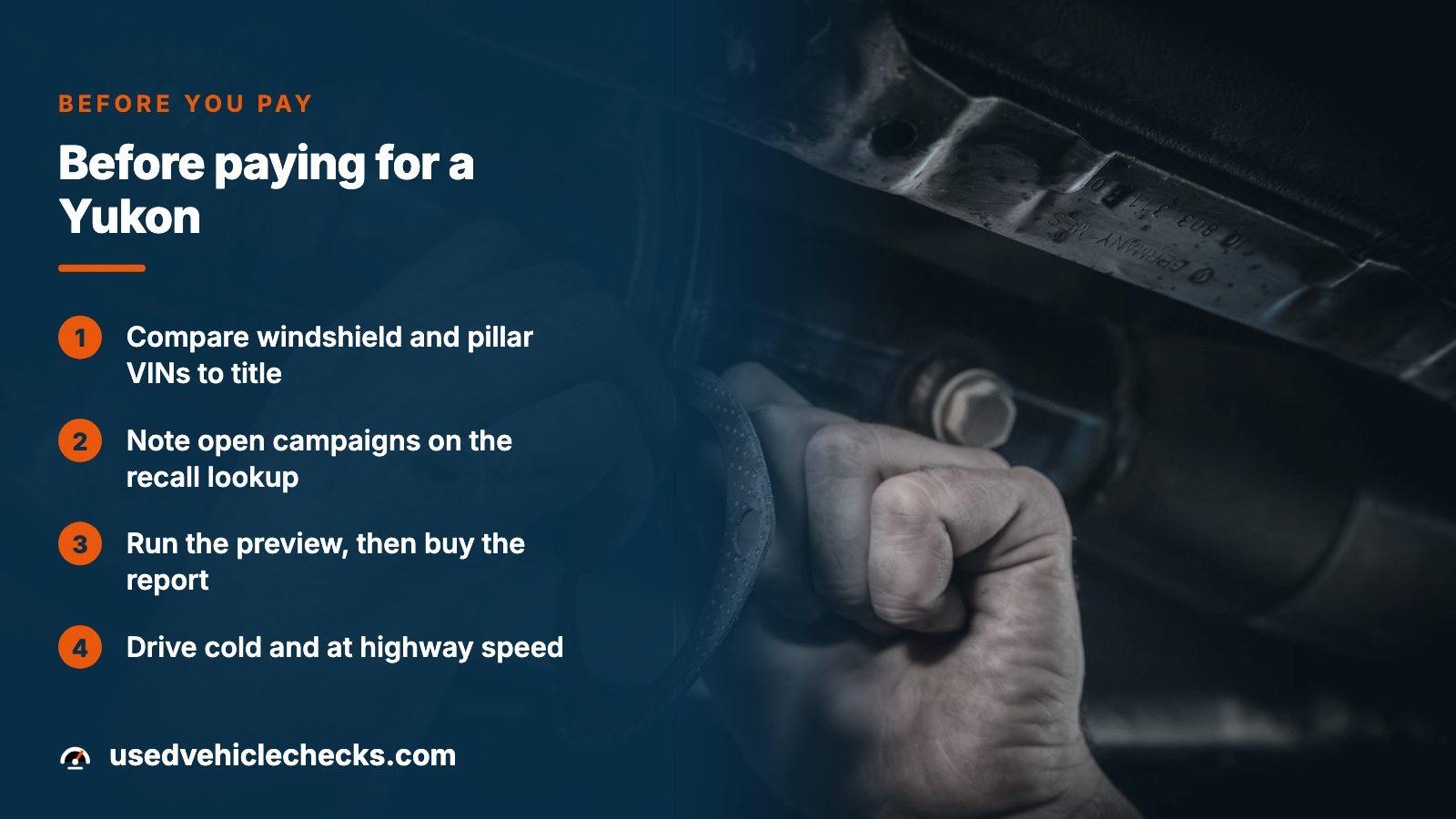
- Copy the VIN off the windshield corner and the door pillar label, then compare both against the title.
- Enter that VIN in NHTSA's recall lookup and note each campaign still open.
- Start with the free preview here, and buy the report only if the truck survives your shortlist. Go through the dated odometer entries first, then brands, damage and salvage entries, then use type.
- Drive it cold, then at highway speed, for longer than the seller suggests.
- Pay a shop to look at the brakes on 2000 to 2004 trucks, the inflator status on 2007 to 2011 and the engine on 2021 to 2024.
One payment buys the report, there is no subscription, and the pricing page shows the single report and the packs.
Where this information comes from
- NHTSA complaints API: GMC Yukon — Source of the yearly complaint, crash, fire, injury and component counts.
- NHTSA recalls API: GMC Yukon — Campaign numbers, dates and remedies named on the page.
- VehicleHistory.gov: NMVTIS for consumers — What the federal title system holds on odometer and brands, and its limits.
- NHTSA owner complaint 11751857 — owner experience, paraphrased
- NHTSA owner complaint 11649890 — owner experience, paraphrased
- NHTSA owner complaint 11770195 — owner experience, paraphrased
Sources and photos: Facts checked against the sources above in November 2026. Photos by Iain, Martin Fennema and Erik Mclean on Unsplash; diagrams by UsedVehicleChecks.
Keep reading
- Mileage Check by VIN: What the Recorded Odometer Readings ShowRead a truck's dated odometer entries before it makes your shortlist.
- Odometer Rollback Check by VIN: Run the Mileage Test Before You PayHow to spot a reading that steps backward on a high-mileage SUV.
- How Many Miles Is Too Many on a Used Car? Age, Pace and ProofDecide what a big number on the dash means for a truck this size.
- GMC Sierra 1500 Years to Avoid, and Why Mileage Still DecidesThe same year-by-year read for the Yukon's pickup sibling.
Frequently asked questions
Which GMC Yukon years should I avoid?
Start with 2007, which has the most NHTSA complaints and the inflator recall, then 2001 through 2004 for brake and electrical reports. For newer trucks, 2021 to 2024 need proof that the engine recall was handled. Any year can be fine when the paperwork backs it up.
What is the most reliable GMC Yukon year?
NHTSA does not grade reliability. The lightest recent files belong to 2020 with 37 complaints, 2019 with 57 and 2014 with 61. Age and mileage still matter, so a short file does not replace an inspection or a look at the truck's own records.
Is the GMC Yukon engine recall serious?
NHTSA lists recall 25V274000 as a possible engine failure that raises crash risk. The recall reaches some 2021 to 2024 trucks fitted with the 6.2L engine. Ask the seller or a dealer to confirm the repair on the VIN, since a recall notice alone does not prove the work was done.
Does a low complaint count mean a safe year?
Not alone. New model years have had little time to pile up reports, and plenty of owners never file. Counts point you at what to inspect; the truck's own odometer entries, title brands and open recalls say what it went through.
Can a VIN check show if a Yukon has been in an accident?
Often, if the event was reported. A VIN report can carry accident and damage entries, salvage or auction records and odometer readings, but it cannot see repairs nobody recorded. Add an inspection, a road test and a recall lookup.
Now check the car itself
The guide explains what to look for. The report shows what this VIN has on record.