THE SHORT ANSWER
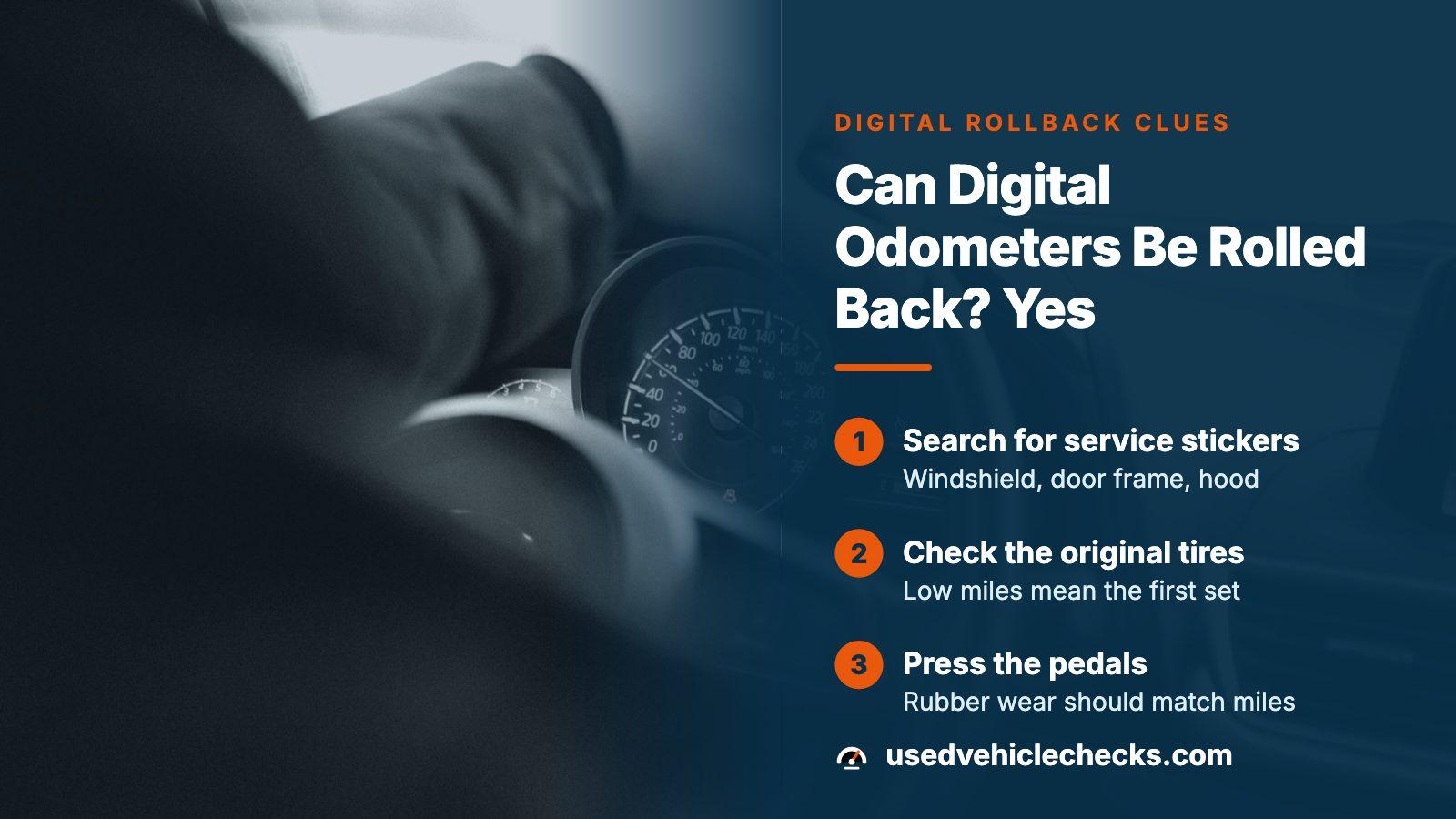
Digital odometers can be changed, and the change leaves no scratched numerals or loose digits to see. NHTSA says the car's condition and a detailed history report are a buyer's best clues. So compare the displayed miles with the title, service stickers, tires and pedal wear, then check the dated odometer readings recorded under the VIN before paying.
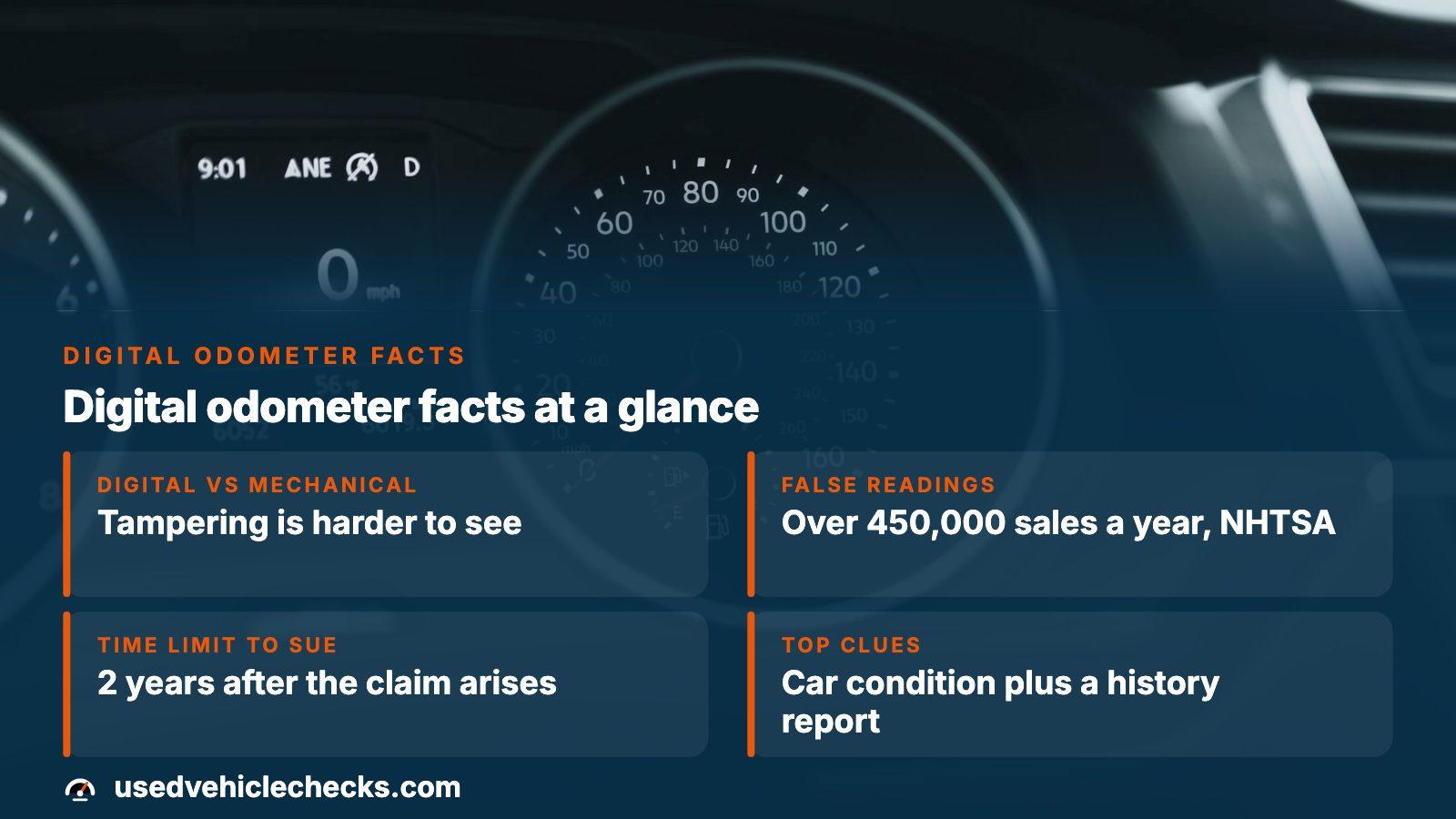
- Digital vs mechanical
- Tampering is harder to see because nothing moves
- False readings
- NHTSA estimates more than 450,000 sales a year
- Civil damages
- 3 times actual loss or $10,000, whichever is more
- Time limit to sue
- 2 years after the claim arises
Why a screen does not make the number safer
Many buyers assume a number on a screen is harder to fake than a spinning wheel of digits. The reasoning runs the wrong way for the person buying. An old mechanical unit that has been wound back can show crooked numerals, a drum that sits slightly off, or a cluster with scratches where someone opened it. A digital readout shows none of that. The figure looks crisp whether it is true or not.
NHTSA's odometer fraud page makes the same point. Since nothing visibly moves inside a digital unit, the agency says an altered one is tougher to catch than an altered mechanical one, and it names two things worth trusting: how the car looks and wears, and a detailed history report. That is a polite way of saying the display itself proves nothing, and the proof sits somewhere else.
What federal law says about changing the mileage
The federal odometer statute does not care whether the instrument is a drum or a chip. It prohibits unhooking, zeroing or editing the unit with the aim of changing what it records, and it prohibits advertising, selling or fitting any gadget that makes the reading differ from the distance actually driven. Conspiring to do either is covered as well.
| Consequence | What the statute provides |
|---|---|
| Government civil penalty | Government can seek $10,000 for each violation; related violations top out at $1,000,000 |
| Criminal penalty | Fine, prison time of as much as 3 years, or both, when the violation is knowing and willful |
| Buyer's civil claim | triple the actual damages or $10,000, whichever figure is larger, plus costs and attorney fees |
| Deadline for a buyer's suit | Two years from when the claim arises |
Congress wrote the reason into the law itself: buyers lean on the reading as a guide to a vehicle's condition and value, and they are entitled to rely on it. Keep the two-year clock in mind. A buyer who finds a discrepancy months after the sale should move quickly.
A replaced cluster is not automatically a rollback
Instrument clusters fail, and a swap is legal. The statute allows an odometer to be serviced, repaired or replaced as long as the mileage shown stays the same. When it cannot, the new unit starts at zero, and whoever owns the car (or acts for the owner) must post a written notice on the driver-side jamb, left side of the car, stating the old mileage and when the work happened.
Look at the driver's door frame
A jamb notice is the legal paper trail for a cluster that restarted at zero. If the dash shows low miles and no notice exists, ask why. Tearing off or changing that notice to deceive someone is a separate violation.
So a low number alone does not prove fraud, and a replaced cluster does not prove innocence. What matters is whether the story the seller tells matches the dated records.
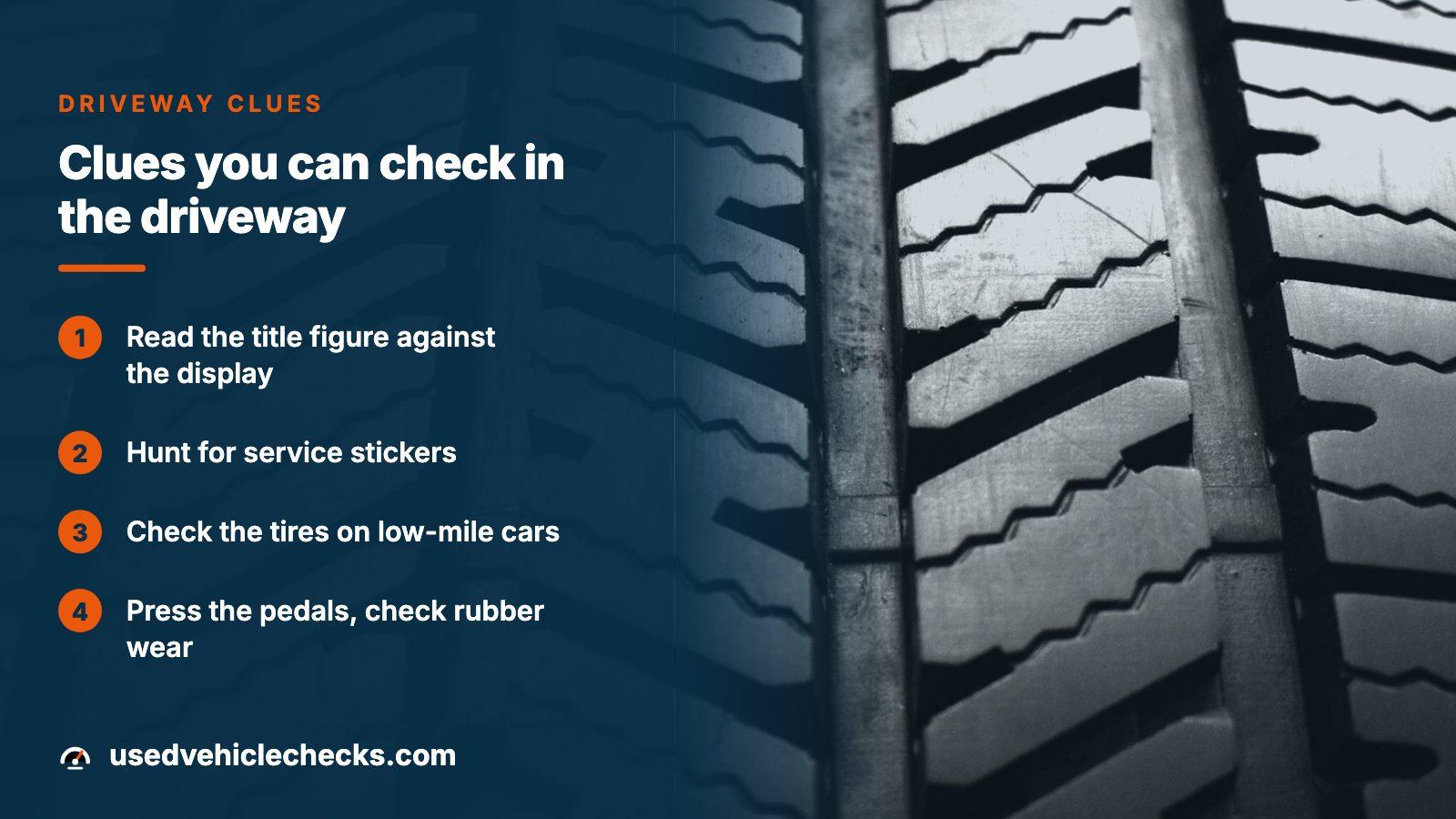
Clues you can check in the driveway
Because the dash cannot be trusted alone, test the car against things that wear out at a steady pace. NHTSA lists several of these checks for used-car buyers.
- Read the figure printed on the title against the display, and look harder if the notation is smudged or hard to make out.
- Hunt for oil change and service stickers on the windshield, the door frame, in the glove box and under the hood.
- Look at the tires. A car showing 20,000 miles or less should still be on its original set.
- Press the gas, brake and clutch pedals and check that the rubber wear fits the miles shown.
- Ask for maintenance and inspection records and match their dates and readings with the display.
None of these is a verdict. Together they either support the number or give you a specific question to put to the seller.
Where the VIN records come in
A rolled-back display cannot reach back and edit the readings that were written down earlier at title transfers, inspections or insurance events. That is why the strongest test is a timeline: line the recorded readings up by date and make sure the figures only go up. A later display that sits below an earlier recorded reading is the red flag.
The federal NMVTIS consumer service lists the latest reported odometer reading along with title brands and salvage or total-loss determinations. The program is blunt about its limits, though. It calls its report intentionally concise and cautions that an apparently clean search may miss things: more than half of states report data, and the system covers 87 percent of vehicles. One source is a start, not the finish.
Run the VIN before you commit
Run the VIN preview first; it carries no charge. After that, the full report is bought once, and the pricing page shows the amount. Odometer readings by date sit beside title brands and salvage history, so a mileage story that fails can be tested against everything else on the car.
What a rollback looks like to the person who bought it
From an NHTSA owner complaint
A buyer of a 2014 Ford Focus told NHTSA that after taking the car home they noticed mismatches between the title and the odometer reading. A history report, a call to the state DMV and a mechanic's inspection all pointed toward title jumping and a doctored odometer, along with signs of undisclosed flood damage. The owner stopped trying to sell the car and filed the complaint.
Notice the order of events in that complaint. The buyer titled the car before the discrepancies were confirmed, and the checks that exposed the problem came afterward. Reversing that order costs nothing: run the history and have the car inspected first, then sign. The same account shows how odometer trouble often arrives with other problems, here a skipped title step and hidden water damage.
If the numbers do not add up
If the gap stays unexplained, walk away, or negotiate only if you accept the risk. A seller who knows the display is wrong must say so in writing on the title; the one who stays quiet is whom the federal law targets.
- Photograph the display, the title and any stickers or records that contradict it.
- Keep the history report and every message from the seller.
- Report an individual case to your state enforcement agency; NHTSA takes large-scale schemes at its Vehicle Safety Hotline, 888-327-4236.
- Talk to a private attorney, since NHTSA does not pursue claims for individual consumers.
NHTSA reports that its investigators helped bring over 250 criminal convictions across more than 30 states, with sentences ranging from one month to 10 years. The cases exist, but they depend on the paper trail you preserve.
When no mileage statement is required
The written disclosure on the title is not required for every vehicle. NHTSA says cars 20 years old or older are exempt, as are model year 2010 vehicles and older. On those cars, a missing statement is not a clue by itself.
That does not make older digital odometers more honest. Without the disclosure, the readings recorded at inspections, service visits and past sales carry more weight, and so do the wear checks in the driveway.
Where this information comes from
- NHTSA: Odometer fraud — digital odometer warning, buyer tips, reporting and exemptions
- GovInfo: 49 U.S.C. chapter 327, odometers — tampering ban, replacement rules, penalties and civil damages
- NMVTIS: Information for consumers — what a federal title search reports and where it falls short
- NHTSA owner complaint 11716083 — owner experience, paraphrased
Sources and photos: Facts checked against the sources above in November 2026. Photos by Miles Loewen, fr0ggy5 and Nathan Dumlao on Unsplash; diagrams by UsedVehicleChecks.
Keep reading
- Odometer Rollback Check by VIN: Run the Mileage Test Before You PayThe step-by-step test for spotting a rollback on a specific car.
- Odometer Discrepancy Check: Find a Mileage Mismatch Before You PayWhat to do once two mileage figures disagree.
- Mileage Check by VIN: What the Recorded Odometer Readings ShowHow to pull the recorded readings tied to a VIN.
- Instrument Cluster Replacement and Mileage: What the Odometer Should ShowHow a legal cluster swap affects the number on the dash.
Frequently asked questions
Can a digital odometer be reset to zero?
A new or replaced cluster can legally start at zero, but then the law calls for a posted notice on the left jamb stating the prior reading and the service date. A cluster that reads zero or low with no notice and no explanation deserves hard questions and a records check.
Is it illegal to change the mileage on a digital odometer?
Yes, when the aim is to change the mileage shown. Federal law forbids resetting or altering an odometer, and forbids selling or fitting a device that makes one misreport. A knowing, willful offender risks a fine, a prison term capped at 3 years, or both.
Does a clean vehicle history report prove the mileage is real?
No. A report only contains readings that someone recorded, and NMVTIS itself cautions that a clean result can hide gaps. Weigh it alongside the title, the service records and your own look at the wear.
Can I sue if I bought a car with a rolled-back odometer?
The statute gives a buyer a civil claim when the violation was done with intent to defraud: triple the actual damages or $10,000, whichever figure is larger, plus costs and attorney fees. A court filing has a 2-year window, so speak to an attorney promptly.
Do cars over 20 years old need a mileage statement?
No. NHTSA says vehicles 20 years old or older, and model year 2010 and older, are exempt from the written disclosure on the title. Rollback is still illegal on those cars, but the missing statement is expected rather than suspicious.
Now check the car itself
The guide explains what to look for. The report shows what this VIN has on record.