THE SHORT ANSWER
Cluster failures are common, and fixing one is legal. The odometer must keep its reading through the swap. If it cannot, it restarts at zero and a posted notice records the earlier miles and the repair date. A quiet reset is tampering. Buyers should hunt for the notice, ask for the repair invoice, and compare against dated odometer records.
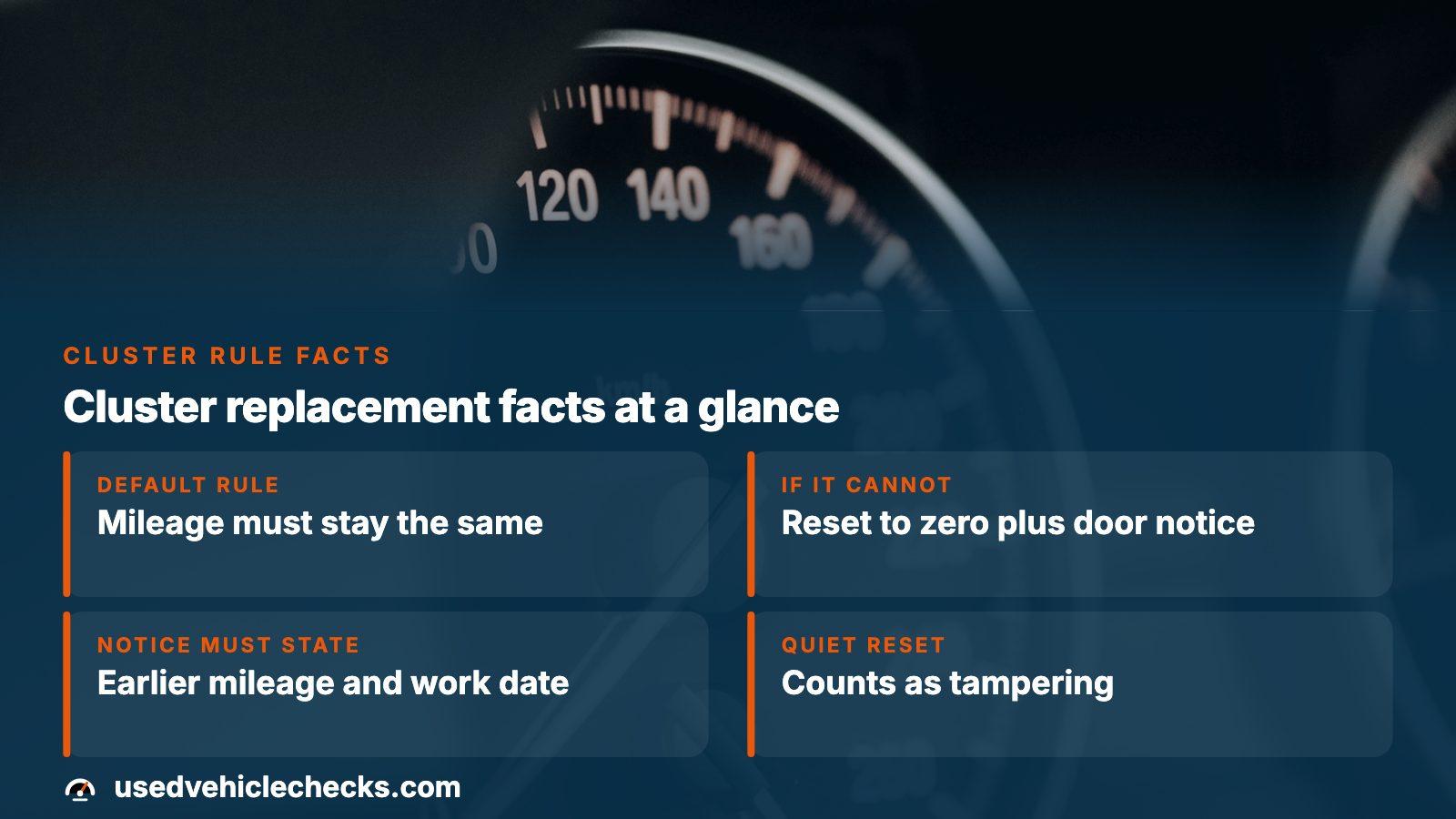
- Default rule
- Mileage must stay the same after a replacement
- If it cannot
- Reset to zero plus a left door frame notice
- Notice must state
- Earlier mileage and the date of the work
- Civil damages
- 3 times actual loss or $10,000, whichever is more
Why a dashboard unit ends up on the repair bench
On most modern cars the odometer is not a separate part. It lives inside the instrument cluster, next to the speedometer, tachometer and warning lights, so when the cluster fails the odometer goes with it. That is why mileage questions follow cluster work around.
Owners describe the failures plainly to NHTSA: gauges that fall to zero, warning lights stuck on, a display that goes dark for a few seconds. Most are honest repairs, though a buyer cannot assume that, or the opposite. What a buyer can do is learn what a lawful swap leaves behind and treat anything missing as something to explain.
What federal law says about replacing the unit
The federal odometer chapter has a section devoted to service, repair and replacement. Anyone may do the work if the reading afterward equals the reading before. When that cannot happen, the odometer goes to zero and a paper notice has to be fixed to the door frame on the left side by the owner or someone acting for the owner.
| Situation | What the law expects |
|---|---|
| Cluster replaced, old reading carried over | Nothing further; the number simply continues |
| Reading cannot be carried over | Zero start plus a left door frame notice |
| Notice posted | Gives the prior miles and the repair date |
| Notice removed or altered to mislead a buyer | A separate violation when fraud is intended |
| Odometer reset or altered to change the reading | Prohibited under the tampering section |
The tampering section also bans selling or installing a device that makes the odometer show something other than the miles driven. A swap is lawful only when it preserves the car's mileage history, in the display or on the door frame.
Finding and reading the door frame notice
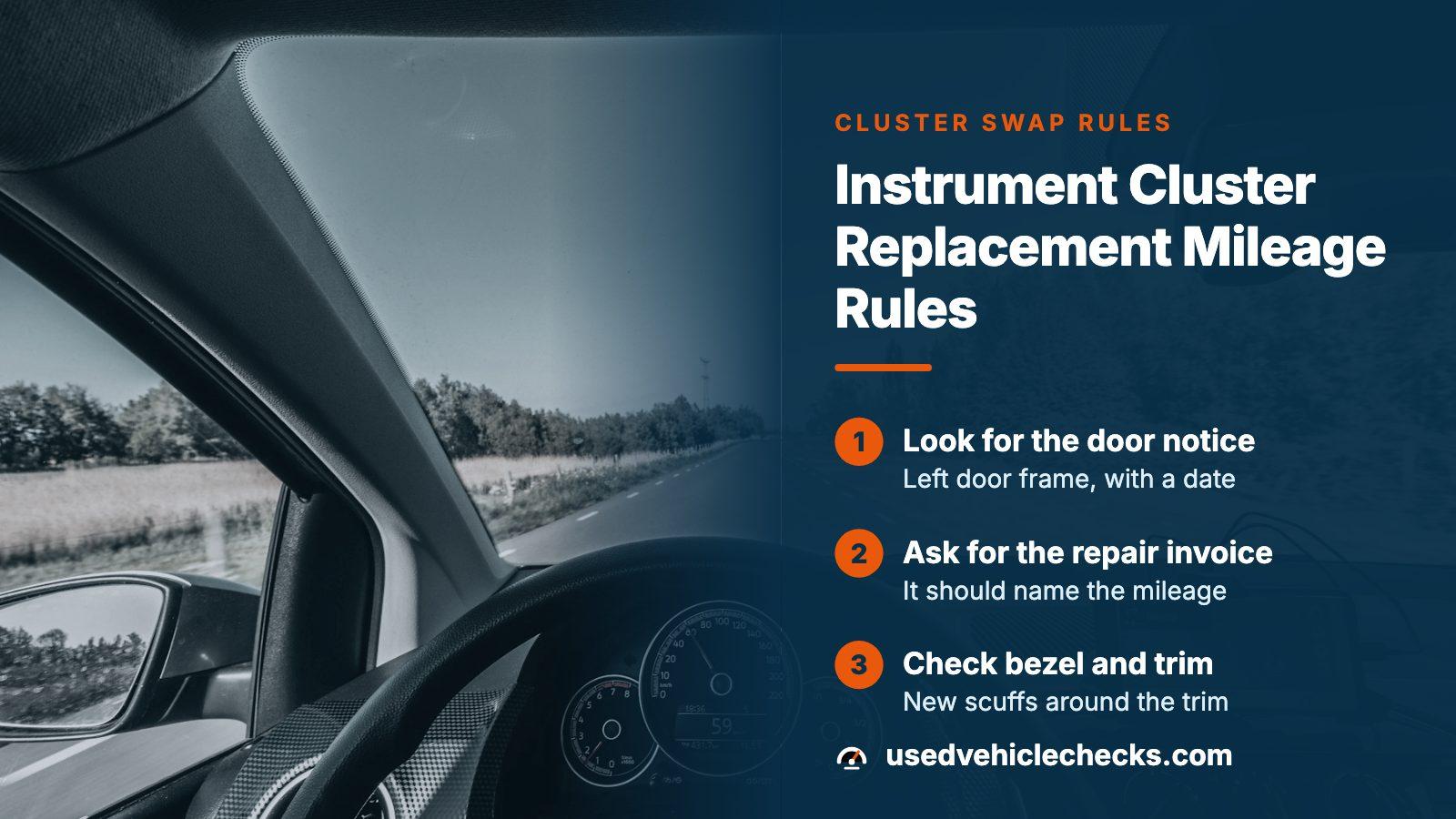
Open the driver's door and run a hand along the frame near the latch. A legitimate notice is usually a small label naming the earlier reading and when the work happened. Photograph it, because it is the only on-vehicle proof the old miles existed.
- Does the notice have a date, and does that date fit the car's other paperwork?
- Is the old mileage plausible for the age of the car at that time?
- Does the dash now show roughly the old mileage plus what the car could have driven since?
- Is the sticker clean and stuck down, or does it look scraped, re-pasted or handwritten over?
No notice does not prove fraud, since the mileage may have been carried over, which is allowed. It does mean the shop or seller should hold an invoice saying so.
What owners actually report after cluster work
From an NHTSA owner complaint
A 2010 Ford Fusion owner wrote to NHTSA that the trip odometer kept ticking upward by itself while the car sat parked, and that a warranty cluster replacement had not cured it. The dealer explained that the trip meter rounds to a tenth, tied to the main odometer. The owner asked whether the main reading could drift the same way, heard no, and still voiced a fraud worry.
A cluster can misbehave in small ways without tampering, and this owner went looking for an explanation rather than assuming the worst. Ask the same questions, and ask for the work order showing the mileage.
From an NHTSA owner complaint
A 2007 Toyota Camry owner reported intermittent cluster trouble in which the odometer did not count miles traveled, while the speedometer and tachometer dropped to zero and the ABS and parking brake lights stayed on. A car in that state can accumulate real miles that never reach the display.
A cluster that stops counting makes the dash too low though nobody meant it to. The dash cannot settle the question in either direction.
Signs a replacement is covering something
Most replacements are boring. The worrying ones share traits, and two or three together mean slow down.
- A very low reading on a car whose seats, pedals, steering wheel and carpet are heavily worn.
- A cluster whose bezel looks fresher than the surrounding dash, or has new scuffs around its trim.
- No door frame notice, and a seller who cannot say when or why the unit was replaced.
- A seller who is vague about the work, or whose story changes between conversations.
- Service stickers, tire dates or inspection records that show higher miles than the dash.
- Title mileage that is higher than the display.
Intent matters under the law, and a dashboard cannot show intent. A buyer can check whether the evidence agrees, and when it does not, that disagreement is the finding.
Checking the real mileage when the dash cannot be trusted
Since the dash is the thing in doubt, the useful evidence is whatever was written down before the swap. Readings are logged at titling, transfers, inspections and some service visits, and a federal title information system gathers the latest ones its sources report. Line the dates up and the climb should be steady. A drop, or a long flat stretch, shows where to dig.
Test the story with the VIN
Start with the VIN preview, which carries no charge. Going further means one purchase of the full report, with the amount on the pricing page. It lays out dated odometer readings alongside title brands and salvage records, so a replaced cluster can be tested against what was logged before the swap.
Records have gaps. The federal consumer page for that title system says a search can come back clean when a source never reported, so treat a clean result as one piece of evidence.
Matching the paperwork to the dash
At a sale the seller records mileage on the title, and a seller who knows the reading is off must state that the real mileage is unknown. A zeroed cluster should show up in what the seller signs. If the dash shows one number and the title a much higher one, ask which is right.
Older cars are a special case. Under the federal rule, a model year 2010 or earlier car needs no mileage statement once its tenth birthday has passed, counted from January 1 of the model year, and for newer cars the wait is 20 years. Titles on such cars may be silent, so service records carry more weight.
If the numbers will not agree
- Ask the seller for the repair invoice that names the cluster and the mileage at the time.
- Call the shop that did the work and confirm the invoice is theirs.
- Take pictures of the dash, the left door opening and the title before any money moves.
- Pay an independent mechanic to inspect wear against the claimed miles. A history report does not replace a hands-on inspection.
- Walk away if the seller dodges. Another car is cheaper than a disputed one.
A buyer already cheated can sue under federal law if intent to defraud is shown. The law lets a winner collect treble the actual loss or $10,000, whichever is bigger, along with costs and a lawyer's fee, and the claim has a 2 year limit. Knowing and willful violations can also bring up to 3 years in prison.

Where this information comes from
- GovInfo: 49 U.S.C. 32704, service, repair, and replacement — same-mileage rule, zero reset and left door frame notice
- GovInfo: 49 U.S.C. 32703, preventing tampering — what counts as resetting or altering an odometer
- GovInfo: 49 U.S.C. 32710, civil actions by private persons — buyer damages and the time limit to sue
- NMVTIS: Information for consumers — latest reported odometer readings and the false-negative warning
- NHTSA owner complaint 10439325 — owner experience, paraphrased
- NHTSA owner complaint 11004332 — owner experience, paraphrased
Sources and photos: Facts checked against the sources above in November 2026. Photos by Sander Jeurissen, Mustafa Sheikhmouss and CHUTTERSNAP on Unsplash; diagrams by UsedVehicleChecks.
Keep reading
- Can Digital Odometers Be Rolled Back? Yes, and How to Catch ItHow digital readouts get altered and the clues that expose it.
- Odometer Rollback Check by VIN: Run the Mileage Test Before You PayA step-by-step test for spotting a rollback on one car.
- Odometer Discrepancy Check: Find a Mileage Mismatch Before You PayWhat to do once two mileage figures disagree.
- Mileage Check by VIN: What the Recorded Odometer Readings ShowPulling dated mileage records for a specific VIN.
Frequently asked questions
Does replacing an instrument cluster reset the mileage?
It should not. The work is lawful only when the new unit shows the old reading. If that cannot be done, the odometer starts at zero and a notice goes on the left door frame with the previous miles and the service date. A silent reset is tampering.
Where is the odometer notice placed?
The statute puts it on the left door frame, usually the driver's side. The owner or the owner's agent writes it. Look for a small label near the latch, and compare its date and miles with the title and service records.
Can a dealer legally sell a car after the odometer was replaced?
The replacement itself is allowed under the repair section, and nothing there stops a later sale. What matters is that the mileage stays honest: carried over, or zeroed with the notice. The seller's written mileage statement on the title should not misstate the actual miles.
What if the cluster stopped counting miles on its own?
A failing cluster can stop adding miles without anyone tampering, as owner complaints to NHTSA show. The dash then understates the true figure. Treat it as unreliable, get the repair invoice, and lean on dated readings from title, inspection and service records instead.
Will a VIN check show a cluster replacement?
It will not label one, because the replacement is not a record in itself. What it can show is the sequence of reported odometer readings by date. A drop, a stall or a restart near zero after a higher reading is the pattern that suggests a swap worth asking about.
Now check the car itself
The guide explains what to look for. The report shows what this VIN has on record.