THE SHORT ANSWER
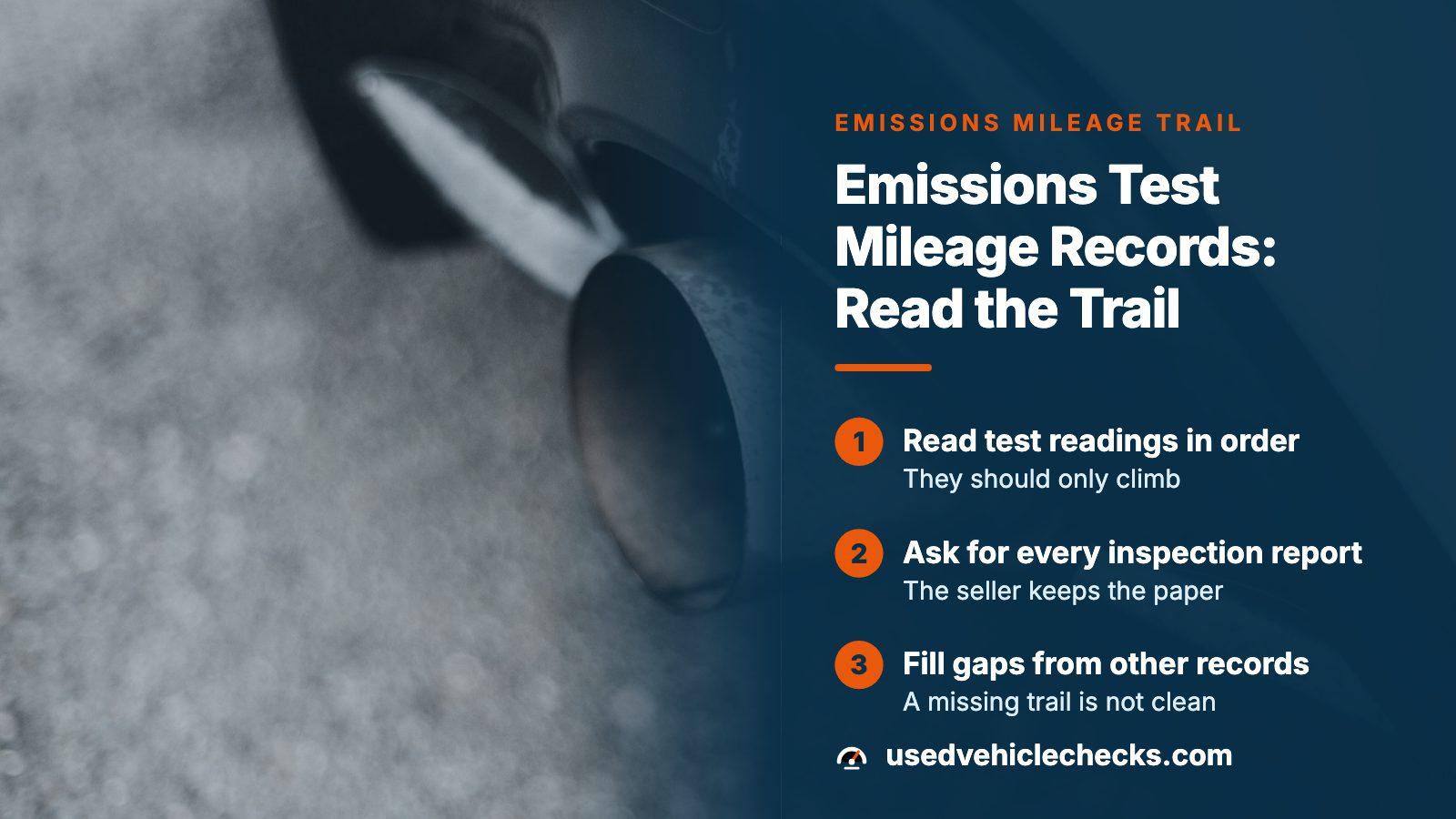
Federal rules for state inspection programs make the odometer reading one of the items recorded on every emissions test. A car tested in a program area therefore carries dated mileage entries made by the station. Read them in order: they should only climb. Only some states and cars have them, so treat a missing trail as a gap to fill from other records, not as a clean result.
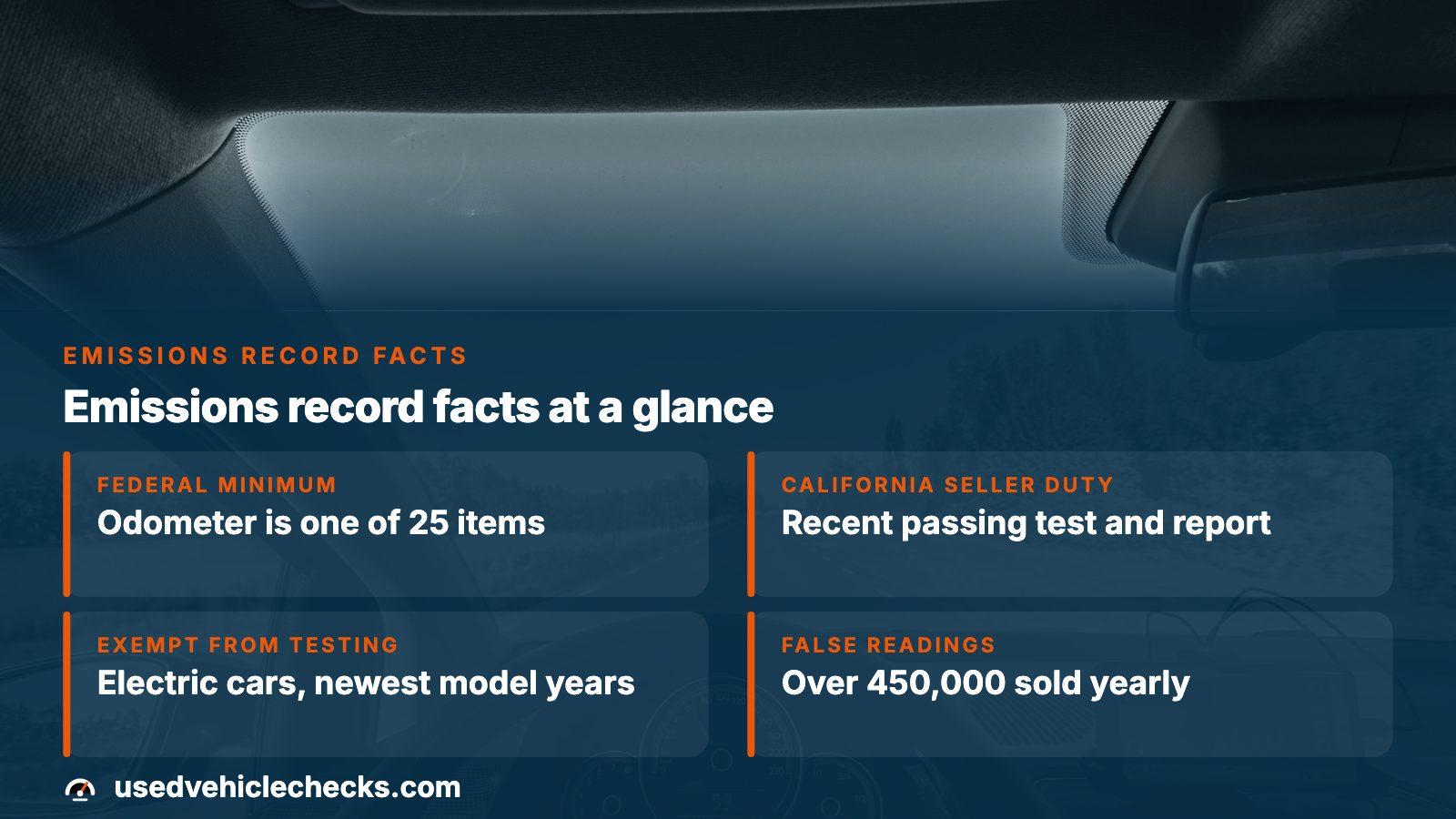
- Federal minimum
- Odometer is one of 25 items logged per test
- Seller's duty in California
- A recent passing test and a copy of the report
- Exempt from testing
- Electric cars and the newest model years in California
- False readings
- NHTSA estimates over 450,000 sold yearly
A mileage reading the seller did not write
Mileage claims on a used car mostly trace back to people who profit from the sale: the seller's say-so, a dashboard that a scan tool can rewrite, a title signed by whoever is cashing out. An emissions inspection works differently. A licensed station keys in the odometer as part of a test that gets reported to the state, and the station has no stake in the figure being low.
For a buyer who puts mileage first, that makes the trail worth hunting down. It is a string of dated points laid down by a neutral party across the car's life. One point means little. Four or five, held against the title and the service file, show whether the story fits together.
What a test record has to carry
The federal rule on data collection for inspection and maintenance programs sets a floor of 25 items for every test. The odometer reading sits on that list next to details that pin the test to one car and one moment.
| Logged field | Use to you |
|---|---|
| Odometer | A dated mileage point from a third party |
| VIN and plate | Confirms the test belongs to this car, not a lookalike |
| Test date | Gives you the timeline for comparing readings |
| Test category | Shows whether a pass came after an earlier failure |
| Station and inspector IDs | Name the party behind the result |
| Diagnostic result and codes | Faults the computer held that day |
The rule spells out its aim: linking each result to one vehicle, one site and one inspector, and flagging stations that behave oddly. Mileage comes along as a side effect, and that is what makes it handy.
How to read the readings in order
List the readings by date and work out the distance between each pair. A car in normal use piles up miles at a pace that fits its owner, and the line never sags.
- A reading below the one before it points to a rolled-back or swapped display.
- A long stretch with hardly any added miles, then a normal pace again, can mean a car in storage or one that was altered. Ask which.
- Annual distance that shrinks just ahead of a sale calls for service papers covering that period.
- A test figure well above today's dash can mean the cluster was replaced after the test.
- Test, title and service figures that agree are the result you hope for.
No single item proves fraud. Each hands you a dated question for the seller, which works better than asking if the mileage is real.
Why some cars have no emissions mileage at all
Programs attach to places, not to cars. Federal rules call for them in ozone and carbon monoxide trouble spots, picked by classification and population, so a vehicle that lived somewhere else was never inspected. Plenty of states have no program.
Exemptions thin the trail further. In California, newer gasoline and hybrid cars skip the test at renewal until they reach eight model years, and skip it at a sale until they reach four. Electric cars and motorcycles are not tested at all. Older cars therefore have more entries than recent ones.
An empty result is not a clean result
No emissions entries usually says something about geography or age. It says nothing about whether the dash is honest, so the mileage has to be checked through other records.
Getting the record before you pay
In a state that publishes test history, start there. California's Bureau of Automotive Repair runs a lookup that takes a VIN or a plate. The agency recommends the VIN, because a plate can change, and says the data refreshes daily at midnight.
California puts the burden on the seller here. A private sale needs a pass dated within 90 days, a dealer sale one dated within two years, and the buyer may ask for the inspection report. Ask, then read the odometer line on the paper. The agency pages I opened never say which fields the online lookup shows, so do not count on mileage appearing there.
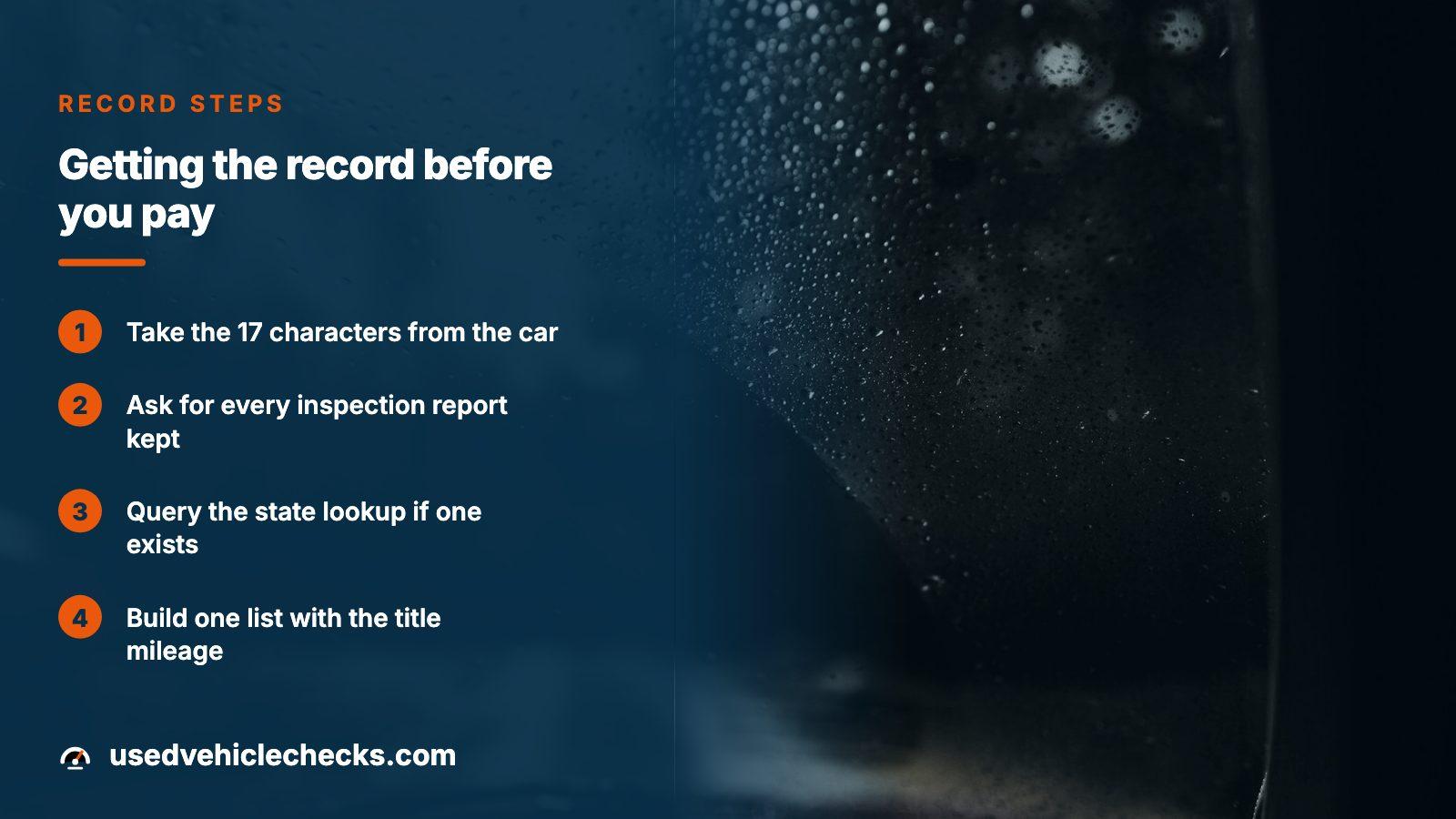
- Take the 17 characters from the car's own label and match them to the ad.
- Ask whoever is selling for every inspection report they kept.
- Query the state lookup if one exists, noting each mileage and date.
- Build one list of readings and put the title mileage beside it.
What a test reading cannot promise
A station reads the display it is shown. If a cluster was swapped or rewritten before the first inspection, every later entry inherits the false base, and the sequence looks smooth. Programs are built to catch bad testing, and a reading can still be mistyped. A smooth line lowers the odds of a problem without removing them.
NHTSA cautions that a tampered digital odometer is tougher to spot than a mechanical one, and names a detailed history report among the best clues a buyer has. So emissions entries make one input among several, not the verdict.
Cross-checks that firm up the number
NHTSA's buyer advice pairs well with the emissions trail: set the dash against the title and against maintenance or inspection records, and hunt for oil change and service stickers on the windows, door frame, glove box or engine bay.
- Tires: a dash under 20,000 miles should come with the factory set.
- Pedals and driver's seat: the wear should suit the displayed distance.
- Title: the signed mileage should land near the test readings.
- Disclosure: the written mileage statement is waived once a vehicle reaches two decades of age, and for model year 2010 and earlier, so those cars lean harder on test and service records.
When a VIN check is the right next step
Where the car has no emissions trail, or the trail has a hole, a VIN check covers the gap. Our odometer check gathers the mileage readings recorded under that VIN from other sources and sets them next to title brands and damage records, so a backward step either has company or stands alone.
Typing in the VIN brings up a no-charge preview. Beyond it sits one purchase rather than a plan that renews, and the amounts are listed on the pricing page. Do this before a deposit, then keep your emissions readings handy to hold against the result.
Where this information comes from
- eCFR data via GovInfo: 40 CFR 51.365 — The list of items a state program must log on each test, including the odometer.
- GovInfo: 40 CFR 51.350 — Why testing follows areas and population, so many cars have no trail.
- California BAR: vehicle inspection history — The lookup by VIN or plate, the advice to prefer the VIN and the daily refresh.
- California BAR: Smog Check requirements — Seller duties, the recency windows and the exempt vehicles.
- NHTSA: odometer fraud — Buyer tips, the 450,000 estimate, the disclosure exemptions and the digital odometer warning.
Sources and photos: Facts checked against the sources above in November 2026. Photos by Erik Mclean, Justin Cron and Sander Jeurissen on Unsplash; diagrams by UsedVehicleChecks.
Keep reading
- Mileage Check by VIN: What the Recorded Odometer Readings ShowThe readings recorded for a VIN from other sources, in date order.
- Check Mileage With Service Records: Build a Timeline That Tests the DashAnother dated trail to set beside the test readings.
- Odometer Rollback Check by VIN: Run the Mileage Test Before You PayHow to test a run of readings for a step backward.
- Odometer Discrepancy Check: Find a Mileage Mismatch Before You PayWhat to do when the dash and the records disagree.
Frequently asked questions
Does an emissions test record the odometer?
Under the federal rule for state inspection and maintenance programs, yes: the odometer reading is among the items every test must log. A car that was tested in a program area has dated mileage entries as a result, though each state decides what its public lookup shows.
Can I look up a car's emissions test mileage online?
In California, the Bureau of Automotive Repair runs a history lookup that takes a VIN or plate. Other states differ, and some publish nothing. If the lookup leaves out mileage, ask the seller for the paper inspection report, which carries the full test details.
What does it mean if a later test shows fewer miles?
Two official-looking figures disagree, and one is wrong. Causes include a rolled-back display, a swapped cluster or a typing slip at the station. Collect repair and service records for that period before buying, and walk away if nobody can explain the drop.
Why does my car have no emissions history?
Testing programs apply to certain areas, and newer models are often exempt. If the car lived in an untested area, or is electric, no test was ever run. Absence says nothing about the odometer, so rely on titles, service files and a VIN-based mileage check instead.
Is emissions mileage enough to prove the odometer is honest?
No. A station records whatever the display shows, so a car altered before its first test can still show a tidy line afterward. Use test readings as one source, then compare them with the title, maintenance records, physical wear and the readings tied to the VIN.
Now check the car itself
The guide explains what to look for. The report shows what this VIN has on record.