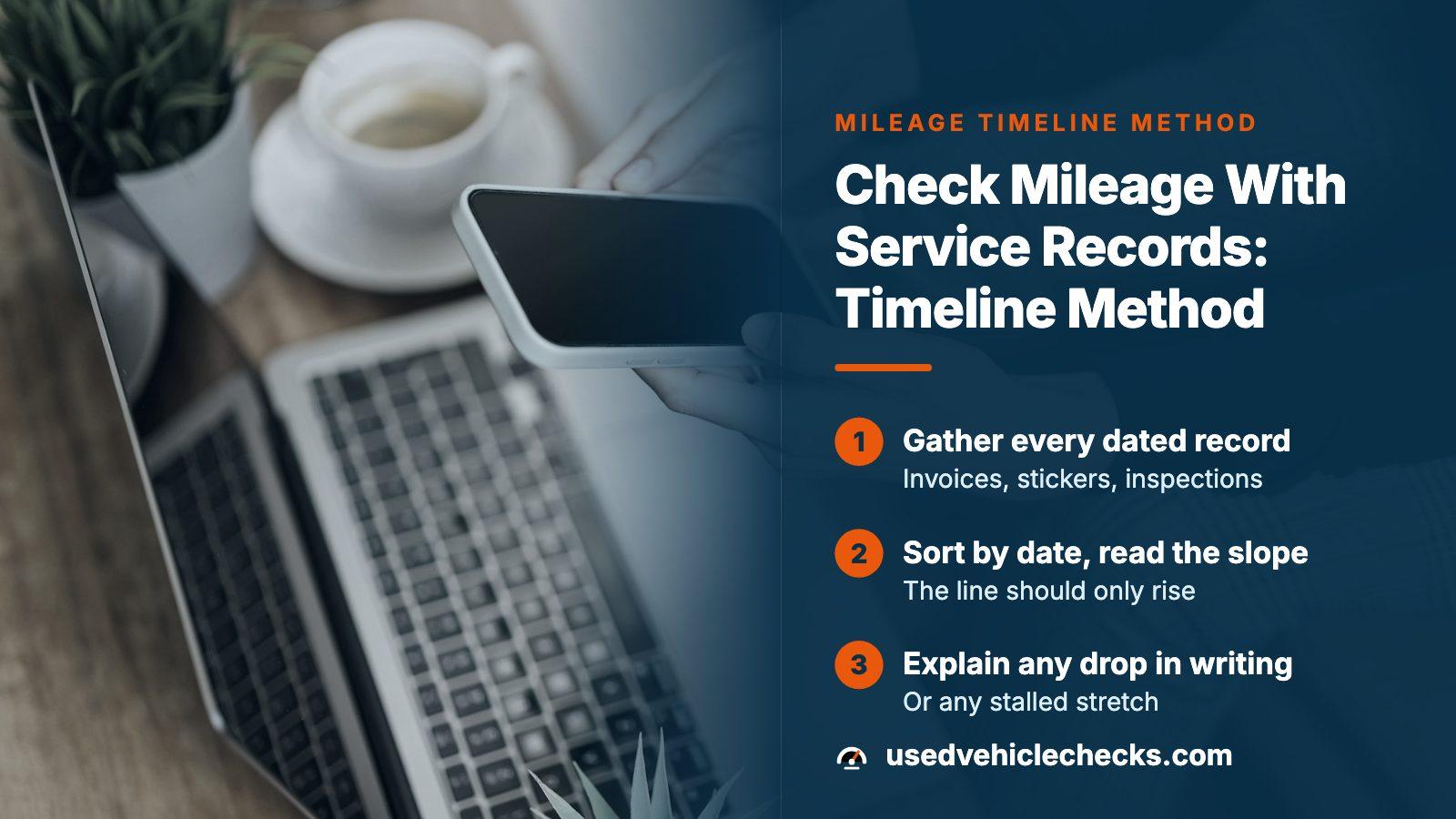
THE SHORT ANSWER
Collect invoices, oil change stickers and inspection papers, write down each date and mileage, and put them in order. The line should only rise, at a pace that fits how the car is used, and finish close to the odometer. Then compare it with the readings tied to the VIN. Any drop, any stretch where the reading barely moves, or any abrupt jump should be explained in writing before money changes hands.
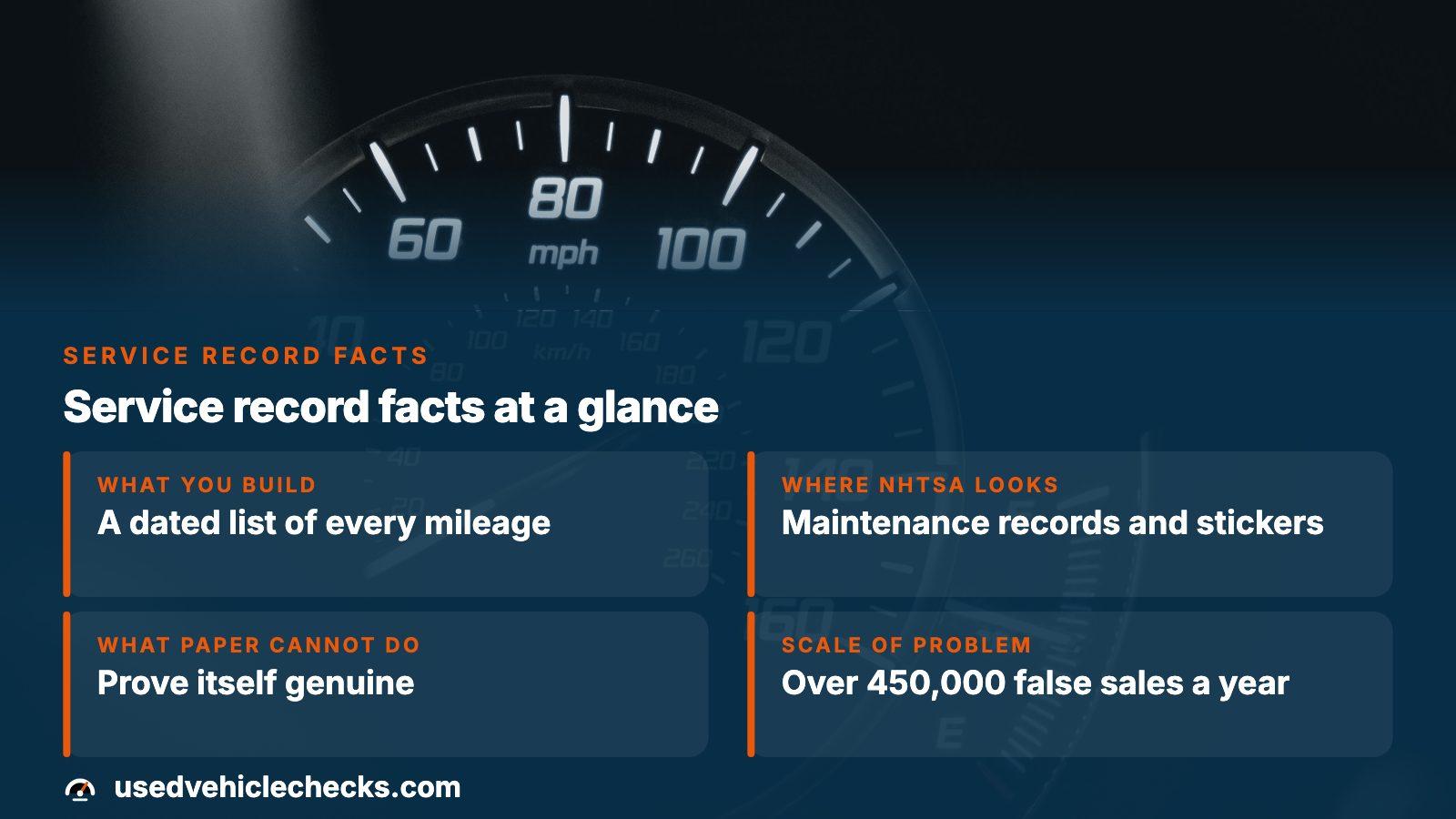
- What you build
- A dated list of every mileage written down for the car
- Where NHTSA looks
- Maintenance records, plus stickers on windows, door frames, glove box and under the hood
- What paper cannot do
- Prove itself genuine, so a second source is needed
- Scale of the problem
- NHTSA says over 450,000 vehicles a year are sold with false readings
Why a folder of receipts can test an odometer
An odometer only reports where it stands today. A service receipt reports where it stood on a particular afternoon, written by someone with no stake in the sale. Line up enough of those afternoons and you get a curve, which is a much harder thing to fake than a single number on a dash.
Among NHTSA's tips for used-car buyers is this very step: hold the dash figure up against the miles noted on the car's own maintenance or inspection paperwork. The agency also warns that altered odometers are hard, though not impossible, to catch, so the comparison is worth the hour it takes.
Where to find the entries
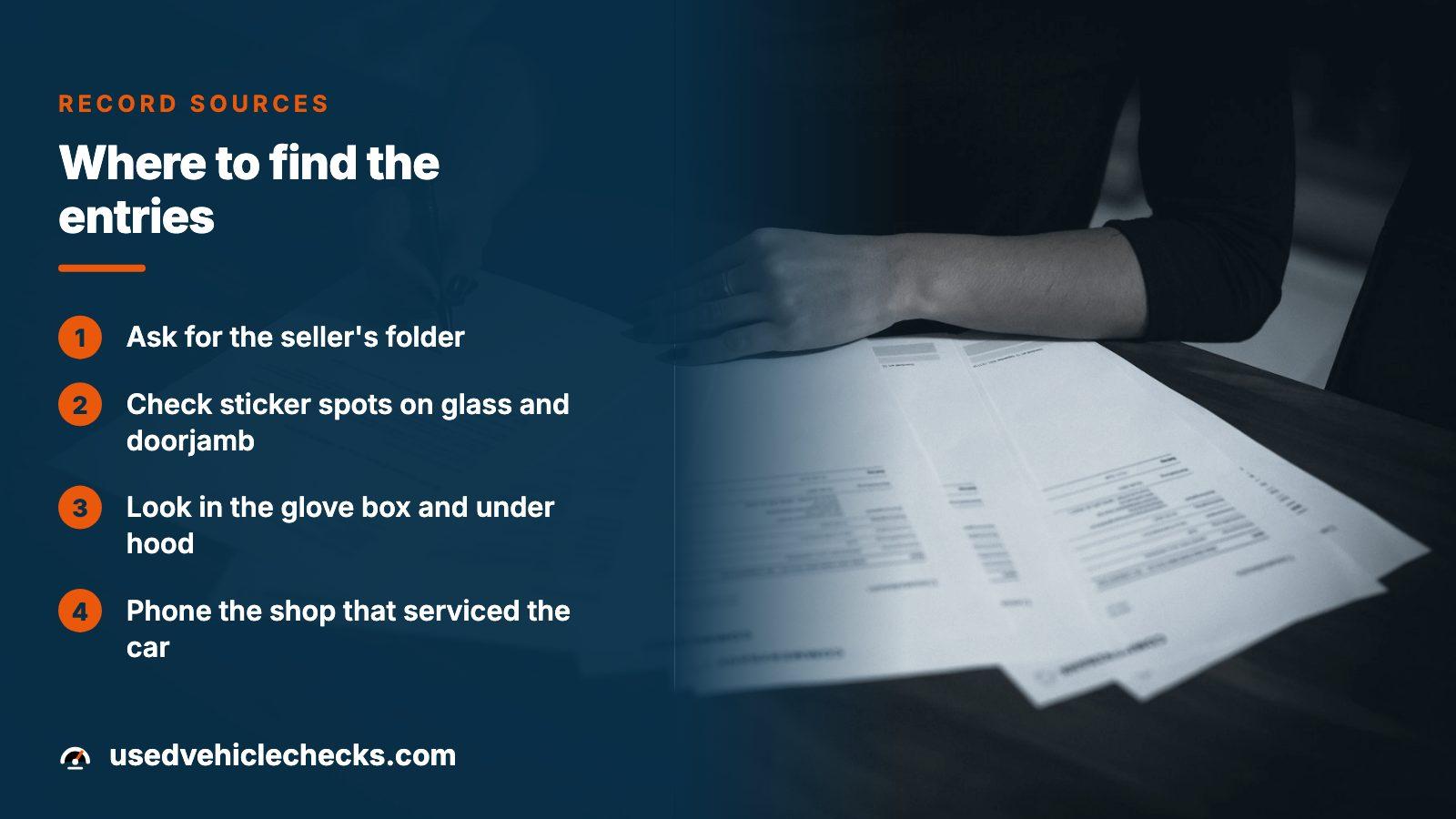
Start with the seller, but do not stop there. A private owner may keep a thin folder while the shop down the road holds years of work orders. NMVTIS, the federal title database, suggests asking whoever owns it, any dealer, or a garage, and adds that when the owner holds no copies, the place that did the bulk of the work may be willing to share what it has on file.
- The seller's folder: invoices, warranty paperwork, state inspection slips
- Quick-lube stickers, usually stuck at a corner of the glass or along the driver's doorjamb
- The glove box and the space under the hood, where NHTSA says to look for maintenance stickers
- The shop or dealership that serviced the car most, reached through the seller's permission
- The previous owner, which NMVTIS recommends when the current seller knows little about the car's past
Setting out the timeline
Use one line per entry and sort by date, not by the order the papers came out of the folder. Note who wrote each figure, because a shop's work order and a seller's handwritten note carry different weight.
| Date | Source | Miles | Check |
|---|---|---|---|
| Oldest paper | Dealer work order | Written down | Matches the first title reading? |
| Middle entries | Shop invoices, stickers | Written down | Rising at a sensible rate? |
| Newest paper | Last service slip | Written down | Close to the dash today? |
| Today | Dash and title | Photograph both | Do they agree with each other? |
Photograph the dash during your visit so the final line of your own timeline is not left to memory.
What a believable line looks like, and what is not
Mileage can only go up. Any entry lower than the one before it is a problem, whatever the explanation offered at the kitchen table. Beyond that, look at the shape.
- A lower figure on a later date: a backward step the seller should explain in writing
- Months with no movement: the car may have sat idle, or the display may have stuck, so ask
- A sudden jump far beyond the earlier pace: plausible for a commuter or delivery van, but ask how it was used
- A last paper entry far above today's dash figure: the most worrying pattern of all
- A tidy set of entries with identical handwriting and ink: ask the shop to confirm one of them by phone
No single pattern shows fraud by itself. Treat each as a question; an honest seller can normally answer with one more document.
A real case where paper and the dash disagreed
From an NHTSA owner complaint
A 2018 Chevrolet Equinox owner filed an NHTSA complaint stating that 60,248 miles were displayed when buying from a dealer. When the owner applied for extended warranty service, the company said the last reported reading was 155,000. A history report then showed 144,738 recorded in September 2024, and the dealer was told about the gap.
The lesson for a buyer is about timing. The owner learned of the gap after paying, while the mismatch sat in recorded readings the whole time. Building your timeline and pulling the VIN's readings before the deal would have put that conflict on the table when walking away was still free.
What service records cannot settle
Paper is only as honest as the person who handed it over. A receipt can be copied, a sticker can be bought, and a shop's figure is whatever someone typed at the counter. NMVTIS also makes clear that repair and maintenance data is not part of its report, since private providers cover that area. No federal source I opened says routine service visits are gathered into a national mileage record, so do not expect one.
That is why the timeline is a first screen, not a verdict. It earns its value when a second, independent source agrees with it, or when the disagreement points you to the right question.
Setting the VIN's recorded readings beside your list
Readings tied to the VIN come from title transfers and the agencies and companies that report on the car. NMVTIS says its odometer entry helps buyers spot discrepancies in a vehicle's history, and NHTSA calls a detailed history report one of the best clues, especially on digital odometers that leave no visible sign of tampering.
The UsedVehicleChecks preview costs nothing and starts from the VIN. If the car holds up against your timeline, the report adds dated odometer readings, title brands and damage or salvage entries, so you can slot each reading into the same table. A reading that falls between two of your paper entries should fit between their figures.
Checks that need no paperwork at all
The car itself keeps a record that no one edits. NHTSA points out that a car under 20,000 miles on the dash should still be on the tires it left the factory with, and that the gas, brake and clutch pedals should show wear in proportion to the miles claimed. A shiny new pedal pad on a car with a long paper history deserves a question.
NMVTIS also gives the standard advice of having a mechanic examine the car and test-driving it uphill, at highway speed and in stop-and-go traffic. A tired suspension on a car claiming a short life is another quiet disagreement with the paperwork.
If the entries and the dash will not reconcile
- Put the mismatch to the seller and request the explanation in writing
- Look at the title, where federal law requires a written mileage disclosure, and read it closely if the notation is hard to make out
- Phone the shop named on the suspicious invoice and ask it to confirm the figure
- Walk away or renegotiate if the explanation is thin, since you can always find another car
- If you suspect fraud, take it to your state's enforcement agency; NHTSA takes large-scale schemes at 888-327-4236 and cannot pursue claims for individuals
Federal rules have dealers hold a copy of every mileage statement they give or accept for five years, so a dealer sale leaves paper you can ask to see.
Where this information comes from
- NHTSA: Odometer fraud — Buyer tips on maintenance records, stickers, tires and pedals, plus reporting routes.
- NMVTIS: Used car buying tips — Asking owners and shops for maintenance files and talking to a previous owner.
- NMVTIS: Understanding a vehicle history report — What the federal report holds and where repair data sits outside it.
- 49 CFR part 580: Odometer disclosure requirements — Dealer retention of odometer statements.
- NHTSA owner complaint 11730173 — owner experience, paraphrased
Sources and photos: Facts checked against the sources above in November 2026. Photos by Jakub Żerdzicki, Dimitri Karastelev and NATHAN MULLET on Unsplash; diagrams by UsedVehicleChecks.
Keep reading
- Mileage Check by VIN: What the Recorded Odometer Readings ShowHow the dated readings for a VIN are listed and read.
- Odometer Discrepancy Check: Find a Mileage Mismatch Before You PayWhat to do once the paper and the dash disagree.
- Odometer Rollback Check by VIN: Run the Mileage Test Before You PayTests for a backward step in the readings.
- Check Mileage Without an Odometer: What to Do When the Dash Is DeadRebuilding mileage when the dash itself has failed.
Frequently asked questions
Can service records prove the real mileage?
They can support it but not prove it alone. A shop figure is typed by a person, and paper can be copied. Treat the records as one witness, then compare them with the readings recorded for the VIN and with the wear on tires and pedals before you decide.
What if the seller has no service records?
Approach whichever shop or dealership handled the bulk of the work, since NMVTIS says they may share their files. Also talk to the previous owner. With no paper at all, lean harder on the VIN's recorded readings, a mechanic's inspection and wear that fits the displayed miles.
Is a mileage sticker on the windshield reliable?
It is a clue, not proof. NHTSA tells buyers to look for such stickers on windows, door frames, the glove box and under the hood, then compare them with the dash. A sticker showing more miles than today's odometer is a red flag.
Do oil change shops report mileage to a national database?
I found no federal page saying so. NMVTIS states that repair and maintenance data was not meant to be in its report. Do not count on a single national record of service visits; ask for the shop's own file.
What mileage drop should worry me?
Any drop at all. Mileage should only rise from one dated entry to the next. A lower figure later in time needs a written explanation, and a dash reading below the newest paper entry is the pattern to take most seriously.
Now check the car itself
The guide explains what to look for. The report shows what this VIN has on record.