THE SHORT ANSWER
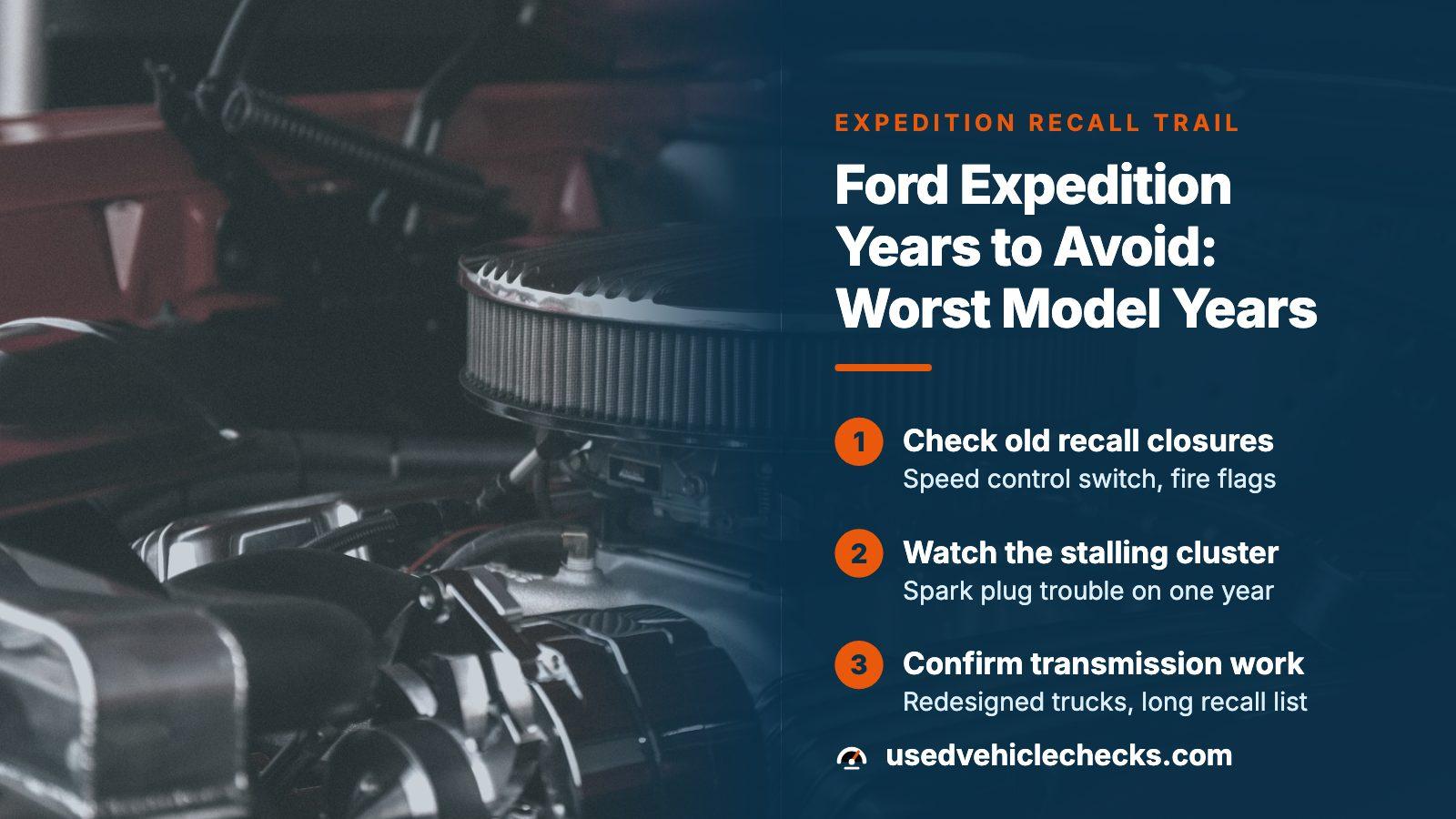
Avoid the 1997 to 2001 Expeditions unless the speed control switch and other recalls are documented as done; 2000 carries 208 fire flags. Treat 2003 with caution for engine stalls and spark plug trouble. Among 2018 to 2020 trucks, 2019 has 528 complaints and 2020 has 18 recalls, so confirm transmission and recall work. The 2009 to 2014 years are quietest.
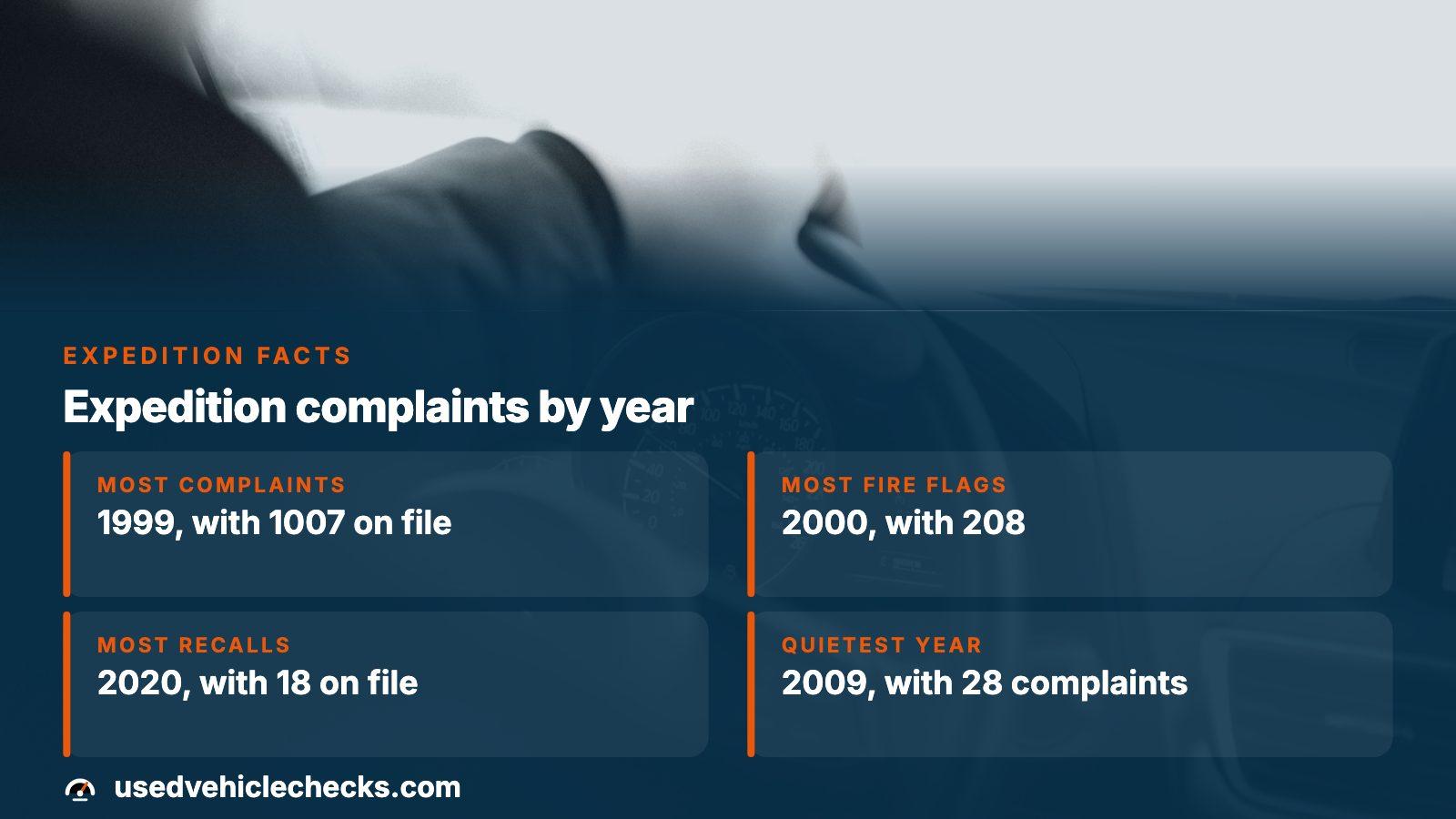
- Most complaints
- 1999, with 1007 on file
- Most fire flags
- 2000, with 208
- Most recalls
- 2020, with 18 on file
- Quietest year
- 2009, with 28 complaints
Expedition model years ranked by NHTSA complaints and recalls
I pulled the owner complaint and recall records for every Expedition model year from NHTSA's public API, 1997 onward. The table keeps the years that decide the verdict: the biggest complaint piles, the newer years with the heaviest recall lists, and the quiet stretch between.
| Model year | Complaints | Recalls on file | Verdict |
|---|---|---|---|
| 1999 | 1007 | 9 | Avoid unless fixes are documented |
| 2000 | 964 | 11 | Avoid: 208 fire flags |
| 1997 | 906 | 9 | Avoid unless fixes are documented |
| 1998 | 901 | 7 | Avoid unless fixes are documented |
| 2003 | 655 | 6 | Inspect the engine closely |
| 2019 | 528 | 11 | Verify the transmission and recalls |
| 2020 | 430 | 18 | Verify the transmission and recalls |
| 2018 | 383 | 14 | Verify the fuel pump and brake recalls |
| 2009 | 28 | 1 | Thinnest file, check wear instead |
| 2010 | 58 | 0 | Reasonable with a clean record |
| 2014 | 72 | 0 | Reasonable with a clean record |
| 2023 | 65 | 8 | Few complaints, confirm recall work |
Raw counts favor young trucks, since a 1999 has had far longer to collect complaints than a 2023. The pattern still holds: 1997 through 2001 add up to 4391, while 2009 through 2014 never pass 118 in a year.
1997 to 2001: fires, stalling parts and old recalls
The first generation is where the Expedition record looks worst. Model year 2000 carries 208 fire flags among 964 complaints, the highest fire count of any year, and 1997 logs 11 deaths, also the most. Electrical trouble tops the 2000 file with 226 complaints, with tires next at 181.
The fire link is documented. Recall 05V388000 describes a cruise control cutoff switch that can run hot, smoke or burn, and owners were sent to dealers to have it disconnected until parts arrived. A 2003 steering recall, 03V196000, covers a yoke that can slip off the steering gear shaft and cut the link to the wheels. Two 1998 campaigns cover a brake pushrod clip and fuel lines that could leak.
From an NHTSA owner complaint
An owner of a 2000 Expedition described the truck burning at about 2 a.m. while parked outside an apartment building. Flames were visible from a second-floor window, residents were evacuated, and the truck was a total loss. A fire inspector placed the start under the hood near the driver's side. The owner added that the truck was not named in any recall, though that point was never confirmed by a dealer.
Paper recalls prove little: ask for the repair receipts, and check recall status on the exact VIN.
2003: the spark plug and stalling cluster
Model year 2003 is the odd one out for engines. Its 655 complaints put engine and engine cooling at the top with 132, followed by electrical at 117 and service brakes at 88. About 110 of the summaries mention a spark plug, by my own keyword count, and 1999 shows 136 of 1007.
The 2003 recall list looks busy at 6 entries but misleads. Five are aftermarket lamp recalls from outside parts makers, and the sixth covers wiring on a running-board conversion. None is a Ford-built part defect, so the recall count says little and the complaints say a lot.
From an NHTSA owner complaint
A 2003 Expedition owner reported a check engine light and a shaking front end, then a stall on the road after a loud boom. A mechanic found a spark plug had come out of its cylinder. The cylinder was rethreaded and the plug refitted, but the same failure returned.
Shopping a 2003 to 2006 truck? Ask the inspector to check the plug threads, and question any record of a repaired cylinder head.
2018 to 2020: the redesigned truck and its transmission
The current-generation Expedition arrived for 2018, and its first three years draw the most owner complaints. Together 2018, 2019 and 2020 hold 1341, with power train on top each year. By my keyword count, transmission or 10-speed shows up in 123 of the 383 summaries for 2018, 168 of 528 for 2019 and 224 of 430 for 2020.
Recalls pile up too. Model year 2020 has 18 on file, the most of any year, and 2018 has 14. They range from seat tracks and belt sensors to a fuel pump with welds that can crack, and a brake master cylinder that can leak into the booster. Recall 25V628000 warns of a battery junction box short that can start an engine fire, and tells owners to park outside until it is fixed. Recall 26V402000, from June 2026, covers 2018 to 2021 trucks whose transmission park pawl may engage while moving.
From an NHTSA owner complaint
A 2020 Expedition owner wrote that while merging, the truck acted as if it dropped into neutral, the engine speed jumped to between 6000 and 7000 rpm, and the gearbox then banged back into gear. It happened several times over most of a year, three times in a single day, with a cement truck closing in on the last one. The dealer was visited three or four times and said it could not reproduce the fault.
Notice the pattern: an intermittent fault the shop cannot duplicate. Ask for a long test drive with a hard merge, not a loop around the block.
The years with the thinnest complaint files
The calm stretch runs from 2009 to 2014. Complaints are 28 for 2009, 58 for 2010, 71 for 2011, 118 for 2012, 92 for 2013 and 72 for 2014, and 2010, 2011, 2013 and 2014 have no recalls on file at all. Where complaints do appear in 2012 and 2013, power train leads with 64 and 43, so a transmission check still belongs on the list.
Newer years look light too, at 117 for 2022, 65 for 2023 and 79 for 2024, but they carry 12, 8 and 7 recalls and have had little time to collect complaints. A low count is a cue to inspect the individual truck.
Why mileage history matters more than the badge year
Every Expedition year in the table is a big SUV that tows, hauls families and sometimes ran in fleet or rental service. Two trucks of one year can differ by a hundred thousand miles, and that gap moves value more than the year does. Complaint counts say what tends to fail. The odometer record says how hard this one has worked.
A reading that steps backward between dated entries, a cluster swap with no mileage note, or a commercial use-type entry all change how you read the truck. The title record adds brands such as salvage or flood, carried by the federal NMVTIS system from state titling agencies, insurers and salvage yards. Those never appear in an NHTSA complaint table.
Before you pay for one specific Expedition
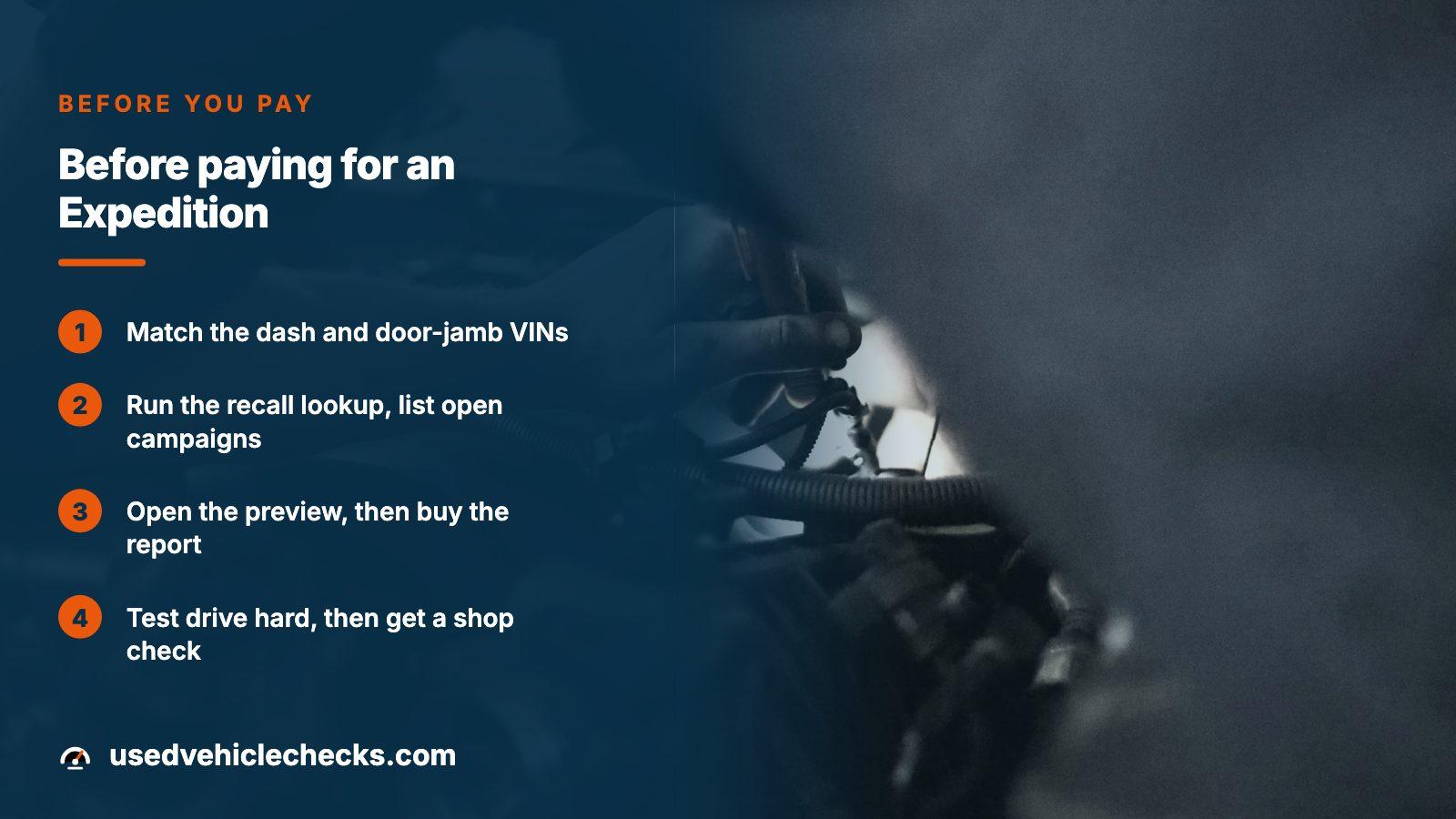
- Copy the VIN from the dash corner and the door-jamb label, and make sure the two match each other and the paperwork.
- Run the recall lookup on that VIN and write down every open campaign.
- Open the free preview on this site, then buy the report if the truck stays on your list. Read the dated odometer entries first, then title brands, accident and salvage entries, and use type.
- Take a long test drive with a hard merge, a cold start, and a highway pass.
- Have a shop check the transmission behavior and, on 2003 to 2006 trucks, the spark plug threads.
The report is a single payment with no subscription, and the pricing page shows the single report and the packs.
Where this information comes from
- NHTSA complaints API: Ford Expedition — Source of the yearly complaint, crash, fire and component counts.
- NHTSA recalls API: Ford Expedition — Campaign numbers, dates and remedies named in the page.
- VehicleHistory.gov: NMVTIS for consumers — What the federal title system holds on odometer, brands and theft.
- NHTSA owner complaint 11774471 — owner experience, paraphrased
- NHTSA owner complaint 11748008 — owner experience, paraphrased
- NHTSA owner complaint 11642012 — owner experience, paraphrased
Sources and photos: Facts checked against the sources above in November 2026. Photos by Victor Hughes, Mustafa Sheikhmouss and Miles Loewen on Unsplash; diagrams by UsedVehicleChecks.
Keep reading
- Mileage Check by VIN: What the Recorded Odometer Readings ShowRead a truck's dated odometer entries before it makes your shortlist.
- Odometer Rollback Check by VIN: Run the Mileage Test Before You PayHow to spot a reading that steps backward on a high-mileage SUV.
- How Many Miles Is Too Many on a Used Car? Age, Pace and ProofDecide what a big number on the dash means for a truck this size.
- Ford Explorer Years to Avoid: What the Complaints and the Odometer SayThe same year-by-year read for Ford's smaller SUV.
Frequently asked questions
Which Ford Expedition years should I avoid?
Start with 1999, 2000, 1997 and 1998, the four years with the biggest NHTSA complaint piles, then 2003. Among newer trucks, check 2019 and 2020 hardest. Any of them can be fine if recall work and maintenance are documented for that VIN.
What is the most reliable Ford Expedition year?
NHTSA does not rate reliability, but the lightest complaint files are 2009 with 28, 2010 with 58 and 2014 with 72. Those years also show few or no recalls. Age and mileage still matter, so a thin file does not replace an inspection.
Are older Expeditions a fire risk?
The record says some are. The 2000 model year has 208 fire flags, and recall 05V388000 covers a cruise control switch that can overheat and burn. Check whether the switch work was done, since a recall notice alone does not prove the repair.
Does a low complaint count mean a safe year?
Not by itself. Recent years have had less time to collect reports, and many owners never file one. A count tells you where to look. The truck's own odometer record, title brands and open recalls tell you what happened to it.
Can a VIN check show if an Expedition has been in an accident?
A VIN-based report can list accident and damage entries, salvage or auction records and odometer readings, if they were reported. It cannot see unreported repairs. Pair the report with an inspection, a test drive and a recall lookup.
Now check the car itself
The guide explains what to look for. The report shows what this VIN has on record.